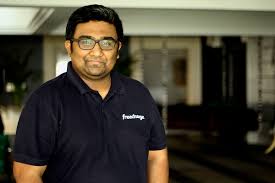
All right, hi everyone. So you know, over the last, Kunal and I were sitting in this for the last, so first thing we want to clarify: this is a panel of startups, not upstart, just to be very clear. Those of you who haven't been here before, you know what I mean. Okay, great to see everybody. First of all, congratulations to the CBC team. 25 years is a very long time. You know, if you look at the leading web portal in 1997, Sanjeev Bikhchandani, Naukri in 1997. India had 14,000 internet accounts. 14,000. And Sanjeev said most of those accounts were probably accessed through internet cafes. Basically, it went up to about a lakh, lakh of accounts in 1999. Five years ago, CBC India started. India's GDP per capita was $400. Today, South Sudan is at $450. It's the lowest GDP per capita in the world of any country, 180 plus countries, right? Third thing: Infosys founded in 1981, went public in 1993, raised 13 crores at 280 crore market cap. Now let's fast forward to 2024. 800 million internet users. On average, an Indian user spends more than six hours on the internet every single day. GDP per capita is well north of $2,000. And that consumer power, by the way, leads to a company like Mama Earth that can go from launch to IPO in seven years. That's the India that we are in today. And as all of you know, Infosys now has a market cap of over $70 billion. Lots of things have changed, including the startup ecosystem. The first unicorn, I know Rishad, my friend, my dear friend Rishad Premji, doesn't like unicorn, but that's okay. They are billion dollar privately valued companies. First unicorn in 2011. Over 100 unicorns today. 10 years ago, India was not in the top 100 countries when it comes to digital payments. Today, we have over 50% of real-time digital payments in the world. And finally, in 2015, 2019, which is only five years ago, the total public market cap of venture funded startups that had gone public in India was less than $10 billion. Today, the public market cap of venture funded companies that are public is over $100 billion. So clearly, everything has changed. And what we're going to try to do in the next 20 to 25 minutes is get our panelists here, who will introduce in a minute, to share their perspectives on what they are seeing today, but more importantly, what's going to happen over the next 5, 10, 15 years. Kunal, we are going to start with you. Kunal, as all of you know, is the founder and CEO of CRED. Kunal, you sold your last company, FreeCharge, in 2017. It's been what, three plus, four, seven years. What's changed in the last seven years? I gave some sense of what's changed in the last 20 years, but what's changed in the last seven years? And also, maybe in the course of that, just talk a little bit about what exactly is CRED, what do you guys do actually? I am curious, how many of you use CRED over here? Okay, not so bad, decent market share.
First of all, Rajan, I've been a veteran. I realize that some of the youngest founders who are in the ecosystem are reaching their parents' age now, so it's quite a query like how the ecosystem is evolving. I started the company actually in 2015 and not 2017, and it's almost like 10 years since that. I have been lucky to invest in many, many companies. I have also seen the transformation of the same internet ecosystem and how consumption is completely changing. But I think the biggest change is the confidence that investors and entrepreneurs have. Earlier, it was easy to assume that these guys are going to amount to nothing. And it was almost a topic of ridicule. It still is being ridiculous, as you notice. But the point is that these things are just changing so quickly. And we should all understand one thing: that no matter who we are, we always assume the next generation is absolutely messed up, and thankfully they turn out to be much more efficient, much smarter, and go on to do great things. So it's just a matter of time that we are going through this evolution. Coming to CRED, we were fortunate. I would say 80-85% of all internet businesses kind of rely on this 20 million customers in some ways. And we just focus on those customers. And we found that if you can serve them with a very distinct focus, it's not like an internet company that you're focused only on 25-30 million customers. It's internet, supposed to be this hundreds of millions of customers that you're supposed to be focusing on. We focus on this customer base. We make it easy for them to have good financial behavior. And because we attract a certain quality of customers, we make it easy for banks, brands, merchants to come and cross-sell things on our platform. It's a simple business model. For those who use it, and those who are not using it yet, this is a good time to download the app. Right.
Great, thank you. Thank you, Kunal. Amrit is the co-founder and CEO of Zetwerk. Amrit, we should talk a little bit about what Zetwerk does, but in a country until very recently where manpower-led, we had Make in India, manufacturing really wasn't a thing. I think it's great to see India now having some very, very interesting, rapidly scaling manufacturing startups. So, Amrit, you tell the audience what Zetwerk is, but then also talk a little bit about how come we are seeing manufacturing startups today? What's happening in India today that's leading to sort of companies like yours emerging?
Yeah, so we started in 2018. We are essentially a platform business. We connect small factories with large industrial demand. Our customers essentially want to bring new products to market. Typically, the way they would do it is they would give the order to a large factory, and then those large factories would produce those goods. We created a platform that breaks down the manufacturing process into smaller fragments, allowing us to offer better terms of on-time delivery, quality, etc. But by bringing a lot of new capacity online and introducing it to the marketplace, we are able to offer more choice to our customers and lead to better outcomes. And this is largely for industrial goods and consumer products. Going back to your question, I think yeah, it's an interesting time to be a manufacturing-focused business. Look, we started six years back. I think Kunal mentioned this concept of ridicule. We were very ridiculous. Like, you would look smart, why are you spending your time on something so unsexy? I think what has fundamentally changed is that the public markets have paved the way in some shape or form. There is a lot of appetite for new stories which are solving not just Make in India problems, but really showcasing our abilities in the global markets. We have definitely seen evidence of that within our company as well. Like, a third of our revenue comes from the US. These are companies which used to buy from China before and are now buying products in India. So getting that flywheel starting with the public market, seeing maybe some examples in the private markets with us, probably is inspiring a new generation of entrepreneurs to tackle problems which traditionally seem very hard. I think the VC assumption has always been that hardware is hard. Maybe you have more to say about that, but I think there are more examples today that yes, it is hard, but solvable.
Great, thank you, Amrit. A copy. Let's move to you. You know, the first SaaS unicorn in India was Freshworks in 2018. Today we have close to 30 SaaS unicorns, right? Building software from India for the world. But Unicom went public. I think this idea that you can build software products, sell it to Indian customers, and build a large company was not a thing. So like manufacturing wasn't a thing, it wasn't a thing. So Kapil, I think you and your team, huge kudos to you guys. You built Unicommerce, you took it public. So maybe for the group, just tell them a little bit about what does Unicommerce do, but then more importantly, what's happening with Indian enterprises? In fact, last night I was with an e-commerce company, and I told them that I'm on this panel, I'm going to have you. They were quite excited, like, hey, we use Unicommerce. So talk a bit about that.
Thanks, Rajan. It's a pleasure to be here. And I think I hope every one of you here shops online. And when you are shopping online, the backend of that is powered by Unicommerce. So Unicommerce is India's largest e-commerce post-purchase enablement SaaS platform. We are processing near 25% of India's e-commerce volumes. So near a billion transactions get processed annually through our platform. When you are ordering online, you see the website on which you are placing your order, and you see the delivery boy that's coming to your doorstep. Whatever happens in between is getting powered through the software that we provide, which caters to various capabilities like order management, inventory management, warehouse management. All non-sexy things, but that's what you see when you are shopping online. And we are able to work across sectors and scale. We took the company public, as Rajan mentioned earlier this year, and we were the second most subscribed IPO of 2024. But it was a great validation that you can build a SaaS company in India for the Indian ecosystem and actually grow this to a large scale. We, in fact, our vision is to become a one-stop shop for e-commerce enablement. And in line with that, we've also recently acquired, just this week, a company called Shipee, which also gives us capabilities across the entire e-commerce value chain. So beyond just order and inventory management, warehouse management, we can now do carrier aggregation, marketing automation. So it becomes a one-stop shop solution for all e-commerce brands and sellers.
Great, thank you, Kapil. And for those of you that don't follow e-commerce, India's e-commerce GMV, gross merchandise value, is about $70 billion. Over the next 20 years, we should get to about $2 trillion, right? Because China's e-commerce market is around $2 trillion. So you know, I think a lot of folks wonder why is it that Unicommerce trades at the multiple that you do, which is basically you know, you power pretty much every single e-commerce company in India. E-commerce goes from $70 billion to you know, call it a trillion, and there you go. Right? That's what you get. All right. Let's now move to sort of scale of each of your companies, because I think a lot of folks, as Kunal said, you know, you used to ridicule startups. I think now it's kind of hard when you have a company like Zomato that trades at $27 billion market cap. You know, I want to talk a little bit about scale and how quickly companies are scaling. And Amrit, I'll start with you. Maybe to the extent you can, talk a little bit about the scale of Zetwerk and when was Zetwerk founded? 2018? Yeah, 2018. So Zetwerk is basically six years into this company journey. Talk a little bit about the scale that you are at, and also what you are seeing, not just in India, but globally, on global appetite for Indian manufacturing.
Yeah, so I mean, last year we did close to 11,000 crore of revenue, of which 3,000 crore was exports. So we made in India and we exported. And yeah, those are numbers that we feel proud of. And I think the more interesting thing is we don't have a global comp. So now we, something we learn from investors: are you the Uber of India? Are you the Amazon of India? And we often have good answers to those. And the reason we have answers is because we are solving very unique problems to India that we are solving. And when we started the business six years back, that was not very well understood by capital markets. I think some along with our journey and a few other companies, that is a big change we are seeing today. We are seeing a bunch of 'X of' and some variants of that. And the key message here is, I think solving a unique problem which is unique to you is more important than solving a similar problem being in a different market. The true value can sometimes come in a short span of time, you know.
Thank you, Amrit. So I want you to notice this: a company was launched 6 years ago, 11,000 crore of revenue, 3,000 crore of exports. And it's a company that we mean by that, it's unique. It started right now. Other companies are trying to replicate it. In fact, I was going for years and every single daddy would ask me, what's the Uber of India? The Uber of India? But the CRED of India is CRED, CRED, CRED. And so that's what you're seeing in the Indian ecosystem. Right. Kunal, let's go to you next. To the extent you can share the scale, not just in terms of users, but any other financial metrics that you can as well. And I want you to share one insight about the Indian consumer that you have inside data. Kunal, what's happening with the Indian consumer?
So CRED, just like Zetwerk, we will complete six years in two weeks from now. And it feels like forever because most of our building was during the COVID time. And we currently command a large market share of, let's say, the affluent customers of India, and kind of the credit-worthy customers of India. In terms of scale, today, yearly, 35 to 40% of all credit cards in India are managed on the platform. And what we do on top of that, we cross-sell a bunch of things. We are north of $300 million of revenue. A lot of the stuff is public and growing quite rapidly. But the more interesting thing, Rajan, you will remember, we had no monetization two and a half years ago. So all the monetization happened in the last two and a half years, building the platform and distribution before. So and thankfully, we are operating in a category where the gross margins are quite high. We kind of focus on the business and operate a pure internet business. On the insight, Indian consumers are unique. I will talk about something different than Indian consumers. While we see all the startups listing, the one unique thing that is different than what it was before: for the first time, we see wealth sharing happening at a scale that we last saw this was in Infosys, where employees made a lot of money. But now we are entering a time where a large percentage of employees of these companies that are getting listed are getting wealthy. And for the first time, we are moving away from just 'pay me salary and be happy' to moving into the stock. And that's going to create a new wave in my view, because I have never seen a lot of people from startups joining those big companies. But I am seeing a wave of all the executives now moving to this side because now everybody has tasted the blood of stocks. Absolutely, you know.
Thank you, Kunal, for sharing that. So I want you to keep in mind: CRED was started six years ago. Two and a half years ago, CRED had zero revenue. And today it's over 2,400 crores with the last published number. I know it's much higher than that, much higher than that today, right? So the pace at which Indian companies are generating real revenue is quite incredible. By the way, and you'd be surprised how profitable both those companies will be very soon. All right. Let's move to Unicommerce. Kapil, you know, talk a little bit about it. You used to be that Indian enterprises, with the exception of maybe even the top 100 large companies in India, right, really didn't want to pay a lot for software. But that is changing. But like, tell us a little bit about what's changing in enterprise behavior, buying behavior.