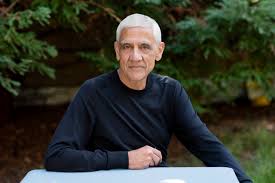
Mr. Vinod Khosla and Mr. Sam Altman, where should we start? Hopefully somebody will keep us honest on time. Sam, maybe first, I'm always excited to see so many young people. So maybe you can talk about your observations here.
Yeah. This has been a wonderful trip to India for me and I have a lot more exciting stuff today, but this is the thing I've been most looking forward to of the entire trip. Watching what's happening with young people around the world, especially in India though, building with incredible energy with AI. The new startups that are going to happen are already happening. The new products and services that are going to get created, the just total embrace of AI and the excitement and the desire to bring all of this agency and energy and, you know, speed to the future is awesome. I don't know about you, but I think this is the biggest shift that has happened in the landscape of what a young person can accomplish in my entire life.
Yeah. It's totally amazing to see and watching what people are doing is just incredible.
Let's ask some practical questions. Do you think GDP rates from whatever is projected by economists today and every country has its 15 and 25 year forecasts? Do you think they more than double what happens?
I think GDP is going to turn out to be a terrible metric because AI is so deflationary. What we want to measure and I think what GDP is meant to approximate is sort of quality of life.
And quality of life, technically it's a definition of goods and services but it's measured in dollars, which is money will be a whole different thing.
Yeah. So I think a proper metric of what GDP is trying to approximate will growth rate will more than double for sure. GDP measured in nominal dollars, that probably gets kind of squirrely actually. To ask you a weird question, interest rates in five more years, -2% or 20%?
I think by 2035 for sure we will have a hugely deflationary economy that the world isn't thinking about. It's interesting because Google just issued 100-year bonds and I said by 2035 you should own all those bonds because the world will be so deflationary that it's hard to imagine anybody pretending. And this is sort of this notion of, you know, the world doesn't yet know how large the change is and they're going on as business as usual.
I think one of your engineers wrote a great manifesto. Can you talk about that a little bit?
People do a few of these. Forgetting the name. I just mentioned it earlier in the conversation. Essentially that the world is clueless about what's going on and how the magnitude of the change.
It'll come to me in just a second. I think even people who work in AI, we feel a little bit clueless about the magnitude of the change. Codex is an example. By the way, Codex is growing in India faster than anywhere in the world. And mostly with young people, but Codex is an example of where everyone's intuitions, even though we knew this intellectually, emotionally we were all hit by it. We have like lots of Codex access inside of OpenAI and what it means to be an engineer, what it means to be a researcher changed so much so quickly that that is just going to happen again and again throughout the economy. And if you believe, which I do, that the top level driver of the economy and of life getting better and better every year is scientific discovery. And then the second most important thing is the economic engine around that that brings these new capabilities out into the world. And both of those are going to get automated at the same time. We're going to automate scientific progress. We're going to automate the whole economy. And you think about what that really would mean if these things can happen 10 times faster, 100 times faster than we've been able to do it on our own. We did not evolve to have intuitions about that kind of a growth rate and that kind of compounding. So I don't know. But if you were back here as a student, what would you do tomorrow?
No, I've thought about it a lot. The way I frame the minimum level of change to imagine 15 years from now. So imagine 2040. I have to say I imagine life the delta being the same between now and 2040 as it is between today and 1970. So look back at technology in 1970. That's my assumption about Delta and I think that's too conservative a notion because...
I think that's too conservative.
Yeah. So that's the magnitude of change and people ask me so what should we do. I say learn how to learn really, really fast. Like your area of expertise doesn't matter whether you're electrical engineer or a mechanical engineer is largely going to be irrelevant. In fact I scared the director a little bit saying nothing you learn will be relevant even in 2030 when the first year students gradually, you won't have learned anything that the AI doesn't know better. I know Sam if you agree with me or not, you won't know any technical field better. You may understand better what people want. You may understand much better how to interact with people, motivate people, how to come up with creative ideas, how to sort of adapt quickly and create value. But yeah, any technical skill that you learn better at, it's still worth learning, you know, like someone asked me recently, do I regret learning to program? Because, you know, clearly the AI is a better programmer than me. And the answer is not at all. I also don't regret learning math. I never use math as an adult. Learning how to think, learning how to learn quickly. This was all a valuable skill, but it was all of the meta-skills that matter. I mean the one thing that I think we could say with confidence of a specific skill to learn is when I was in school, learning to program was the obvious thing. Now learning to use these tools is the obvious thing. And the fluency that people pick up with each new generation, if you sort of are pushing as much as possible on the edge, that seems very valuable. If you're a college student, what do you think matters the most? What will matter when the technical knowledge they have doesn't matter? And an electrical engineer can do a structural engineer's job quite easily. And by the way, we're building both structural engineers, chip designers, and electrical engineers today. That'll be used pervasive everywhere. So, what do you think matters?
Well, I know I just said this, but I can't emphasize enough how important I think it is to stay on the forefront of the tools. I expect that to be a compounding accelerant. So, building projects all the time, just figure out what's going to be possible and it's going to rapidly increase every couple of months from now on, that really matters. The class that I wish my college had offered, the motto of Y Combinator is make something people want and it is I think for 20 years now been like the best motto of any investor. And I wish my school had offered a class on that because I think that is a learnable skill figuring that out. And that's going to be ever more important in a world where you can sort of make anything happen. Figuring out how to get good ideas, which like anything else, deliberate practice seems to improve. That seems to matter a lot.
Yeah. So from my personal view, what's most important to learn is curiosity and agency. Can you tell me if you agree, disagree, elaborate on that?
I totally agree. I think agency is also a learnable skill. The world kind of beats it out of you. So you have to resist and continue to believe that you can sort of figure anything and make anything happen. And the more times you do it, the more self-belief you develop. Many people learn this late in their careers. It is super valuable to learn early. Like other things, you just have to start and you have to keep doing it and you'll develop confidence in it. But the returns on agency clearly have never been higher. You know, we've talked for a long time about what one person is going to be able to do with AI. We're finally seeing it now. A single person with drive and an idea and willpower can make incredible things happen. And in some sense, the most important learning of my entire career has been that if you are right on the idea, no matter how unpopular it is, in fact, it's often better to be unpopular because you have no one else you're competing with doing it, and you stick with unwavering conviction over a long time, and you just knock down obstacle after obstacle with no loss of enthusiasm between each setback, you can accomplish amazing things. This was certainly the story of OpenAI. Now it obviously looks like a great thing, but when we started it seemed totally crazy and it was just like a bunch of us were in a room with force of will and sort of an attitude that we were going to do it no matter what. And then even the first like four or five years of OpenAI, it was sort of it seemed like a very bad idea. Thank you for believing in it by the way. And the agency that we had all developed earlier in our careers, which I wish we had developed even earlier, was critical to making it happen.
Sam, you wrote this article in Times of India earlier this week and the headline kind of captured your message very nicely where it said that AI will define India's future and India will define AI's future as well. And I know at the AI summit you've seen a lot of what's happening around development in AI. Would you like to talk a little bit about your impressions there?
India is already our second largest market. There's a 100 million ChatGPT users. A third of them are students. Fastest growing Codex market in the world. India should be our largest market over time. More than just usage of products like ChatGPT. The building energy in India seems like it is growing faster than anywhere else. The desire to really create new kinds of products and services, brand new companies that are all about AI. This is, yeah, it's just amazing. And so it's been great to be here.
Wonderful. So we're going to go to the students next and we'll open it up live. I think we have Mukund who's going to ask the first question and Mukund is from IIT Delhi. Let's get started with Mukund then.