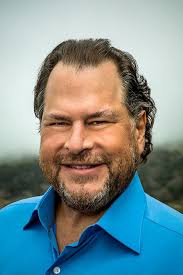
All right, everybody. Welcome back to the number one podcast in the world, the All-In Podcast. Episode 273. It's a huge week. Sax is out, so we got to get Marc Benioff, CEO of Salesforce.
I'm the only one left here. You're the only one left. That's why, that's how I made it on.
No software CEOs, right, to China.
There's no software CEOs in China.
Interesting. But did you get the invite? What's your status with this administration because you were obviously very famous for, you know, being a Democrat on the left?
I'm not a Democrat on the left. I never have been.
What are you talking about? You donated to all these folks and now you're kind of in Trump's camp. What is it?
Listen, the number one thing is, hey, I'm here to support the country. That's what I do.
So, you're right in the middle. You have an allegiance to America.
I'm not a Democrat or Republican.
Okay. I like it. Benioff got the invite to the two hottest tickets. He got the invite to Windsor Castle in Wales and then he got the invite when Prince Charles came here too. I saw he was in Wales then too.
And also we were at that Saudi dinner too. Weren't you there?
I did not go to that one. All right. Well, we have a big docket here. The Trump-Xi summit has begun. That is the number one story right now after a two-month delay because of the war in Iran. This is the first visit to China since 2017. Seventh face-to-face meeting for Trump and President Xi. There are 12 hours, 15 hours ahead of us. Today, Thursday was officially day one. Here's what happened. China agreed that the Strait of Hormuz should remain open with no military commitment and that Iran should not have a nuclear weapon. So, we're in sync on that. On Taiwan, this is a little spicy. Xi warned that quote if handled poorly the two countries will collide or even clash putting the entire US-China relationship in an extremely dangerous situation. Polymarket says Taiwan is safe for 2026, only 6% chance China invades this year on 23 million in volume, which is a lot of volume. 17% chance, roughly triple that, something happens by the end of 2027. There's been a lot of debate. Some people say it will happen after Trump is out of office. Some people think it's going to happen while he's in office. On trade, Xi committed to buy more soybeans, US oil, LNG, and 200 Boeing jets. He said the talks laid out a vision for constructive, strategic, and stable ties. Trump was effusive in his praise for his friendship, giving the disclaimer that people don't like it when he praises Xi. Let's stop here and have a bit of a discussion. Friedberg, you have been a bit obsessed with this relationship and the bipolar nature of it. What are your thoughts here? And what is the goal for Trump? What is winning for Trump coming out of this? What is winning for Xi?
I mean, Xi made comments in his opening remarks that it would be ideal if the United States and China could avoid the Thucydides trap, which as you'll recall, we talked about with Graham Allison and we've talked about several times over the last few years that as a rising power meets a kind of declining power, there's always some moment where you end up in this kind of state of conflict. And the question is, can the US and China avoid conflict and find a path to cooperation, which has happened a few times in history when we found ourselves in this moment, but doesn't often happen. And I think the way to kind of think about the opportunity is if you're in a resource expansive world where you are increasing productivity and increasing production globally at an accelerating pace, perhaps there's less of a reason to have conflict. Perhaps there's a way that both societies, both countries can increase the quality of life for their people without taking it away from the other side. And in a world where you're more resource constrained or resource static, that becomes less possible. You have to fight and grab land and grab territory and grab resources from the other side. And it seems like in this moment when we are seeing these extraordinary technology shifts unlocked by AI and automation and biotech and all of these kind of moments of which could be true abundance ahead of us. It seems like the perfect moment to say hey maybe the world can be more multipolar. It doesn't need to be unipolar. It doesn't need to be bipolar but everyone can participate in the expansion of the pie. And I think that that's kind of the idealistic way to look at the opportunity in front of the administration and Chinese leadership right now. Is there a way to kind of look at the next 30 years and ask the question, how do we all share proportionally in growing the pie and not find ourselves in a moment of conflict where we assume the pie is static? That's I think hopefully the message that comes out of this from an administration political perspective. It just seems like this is going to be a major coup for the president if he can walk away with a series of trade deals with China that increase job security, increase prosperity, increase income levels, increase investment in America and American jobs. It would be a huge win. And I think that's the tactical stuff that people will be truly looking for. And I think the big strategic question which I care most about which is avoiding conflict. Is there a way we can chart an economic and cooperative path that doesn't involve eating each other and involves sharing in a bigger pie?
Chamath, why is Trump bringing all of these CEOs with him and what does success look like coming out of this meeting?
I think that you find a resolution and a path forward with China through economic cooperation. It's the largest consumer economy in the world. It's still largely closed off. And so I think what this is was about bringing some amount of financial firepower with them so that they could start to penetrate that market. Planes, cars, chips, you know, very much hard equipment type stuff. I've said this before, but I think the Chinese are very much a top-down Confucian societal philosophy, whereas Americans are much more bottoms up kind of an individualist construction. The fact that we're so different actually gives us a lot of room to find cooperation and not find conflict. And I think at the center of that is economic cooperation. I had a friend call me this morning, very prominent Democrat. And you know, he was the one that called out the media, which I was surprised by, and he said, you know, the media gets it all wrong because they're talking about why is he bringing these CEOs? And instead the reality is that the simplest and shortest path to a no-conflict détente with China is economic entanglement and it has to be bidirectional because really for so many years it's been one way where they're sending us the cheap goods that they've wanted. So I think strategically it's good and I think you know I'll just take a slightly different take on what Friedberg said. I think behind closed doors they're probably just figuring out how to divide the pie.
Unpack that for a second. Divide which pie? The globe, the economy, the western hemisphere versus...
Look, China still needs a lot of energy, they also need a lot of critical technologies that America provides and so I think that there's a trade there and the quid pro quo is there are certain regions of the world where we want them to de-escalate their participation in, Central South America being probably the most important and then the second is probably in the Middle East and then maybe the third is just to find some reasonable view of the Asia-Pacific region together and I think there's a trade there to be done and in that you kind of start to carve up the world into a pretty easily identifiable bipolar construction.
They also, Mark, need customers to buy their goods and we've had a bit of mixed signals there. Tariffs obviously last year sticking it to China in a pretty hard way. The decoupling after COVID. Hey, we need to be independent energy, PPE, drugs, chips from China. Now, we're kind of saying, hey, let's come to the table and build connective tissue. So, sort that out for us on a business level. Should the two countries be deeply entwined? And then how do we manage having too much dependency on China?
Well, you heard it today from President Xi when he said he wants a wider door. And that means that he wants the door of business to open even wider between the two countries. We have our absolute best salespeople there. Not just our president, who has to be one of the best salespeople I've ever met, but also we've got Elon, we've got Jensen selling chips, Kelly selling planes. He's already sold 200. He wants to sell financial services. Brian is selling soybeans. Brian Sykes, the CEO of Cargill. You know, Cargill is the world's largest private company based in Minneapolis and he is going to come away selling a lot of soybeans. So, we have a you go through the list of the CEOs. Each one is our best salesperson in this category and they're going to come back with orders and it's going to be amazing. And by the way, I think you said it very well. You know, this idea of business is this kind of greatest platform for change. They are working together like never before. Don't forget, this isn't Trump's and Xi's first meeting. These guys really like each other. They are very connected together. You can see they're smiling with each other. They're very they have a sales orientation. So, I expect a lot of order books to come back.
I have a question for you. Are you allowed to sell software in China?
Well, with the right, the Chinese have a lot of data residency laws. So you know we we do it is we don't have any offices or employees in China. We never have. The only time we end up with any residue in China is when we buy a company and they have a presence over there and then we have to divest from it. We have an exclusive partnership with Alibaba. Everything just goes through them and we we don't do anything in China.
Is it significant growing? Is it what percentage of your revenue is it?
Yeah, it's it's great. You know, we have it's a great partnership. Key customers of Salesforce like Louis Vuitton, you know, or Loro Piana, I know Chamath loves Loro Piana. And you know, Loro Piana sells a lot of sweaters in China and then, you know, in all other stores all over the world, they use Salesforce, but in China, it's Salesforce on Alibaba.
It's still your code, but then it resides in their servers for data residency stuff.
Their data residency, their their partnership. It's a totally unique relationship. It's the only place in the world that we do such a thing.
Yeah. And it has to be all the data has to be kept in China. All the data has to be accessible by the CCP.
That's why it's so extraordinary. By the way, what Elon has, you know, Elon has Tesla in China, no partnership. He's the only one. He has a phenomenal relationship with Xi. When you look at Xi and Elon together, notice how differential and respectful they are of each other. And here is these AI cars with all these cameras, American-made, you know, Chinese factories driving around China. That is pretty incredible.
How do you think he pulled that off? Is that just a one-off exception?
I think Elon's the greatest salesman in the world. That's how.
I mean the cynical take on it Chamath would be they wanted him there and they wanted to study the company and the innovation and they have now become the biggest competitor with their EVs and so it is a pretty coopetition I guess it would be the cynical way to do it.
I want one of those new BYD, you know, what do you call those with the doors that flip up? Gullwing. I want one of those Gullwing BYDs. They have some cool cars, have you seen those?
They're cool, but they're not safe.
They're talking in this they they said they're talking about bringing some of those cars to the US. That would be incredible.
It would hollow out the entire automotive industry here if we had $20,000, $30,000 cars from China. It would be the end of the US automotive industry overnight. And Tim Cook's there. He has to store all his data there. That's been a pretty controversial issue for him because Friedberg, if anybody has private information or is a dissident, Tim Cook has to give that data over to the Chinese Communist Party. How do you think this plays in America vis-a-vis the midterms? Friedberg, Americans feel ignored, inflation over 3% and they look at the Iran war as a betrayal by President Trump and they look at China as not material to their well-being. So when you look at Trump being on a six-month timeline for the midterms and he's only got two more years in office after that, you got Xi who's working off of a hundred-year playbook. How does that dynamic play out with Trump and the midterms and his core constituency, MAGA, which is now evolving into America first, America only? And this kind of is rubbing that group of people the wrong way.
I think the second and third order effects of anything that comes out of China is what's going to be most consequential to the average voter, which is job security and income security and income growth. And then cost of living impact. The cost of living impact would be if there can be some deflationary effect from a trade deal that makes access to goods lower price for Americans. And then anything that America is exporting, there's increased demand. Like there's a follow-on effect to the soybean export market. There's a follow-on effect obviously to the oil export market. There's a follow-on effect to for example technology and software being exported. So that increases economic productivity in the US and increases job security income. And then the other side of the trade deal is can we get stuff that Americans really care about and make it cheaper. Can people now buy stuff at the store that drops in price by 30, 40% where we've kind of tariffed and reduced trade that increases the price of things. So if those deals kind of get worked out, people will see things get cheaper at the store and they'll feel good about kind of their income security. And I think that could be positive. I think that's what's ultimately going to make people make the blue-red decision when they go to the polls in November.
That's the schizophrenic nature of this Chamath. We have Americans who very much want cheap goods from China and then we have last year all these tariffs being put on and we have this great decoupling. So, how do you handicap the midterms, Trump's timeline and Xi's timeline and what their goals are and then I guess we'll get to Taiwan after that.
I don't know. No, it's I think it's a little bit above my pay grade. But what I will say is that the midterms I think are probably going to swing more based on these recent gerrymandering rulings from the Supreme Court and what happened in the Virginia Supreme Court and what's going to happen in the state legislatures of these red states and some of these blue states more than what's going to come out of this summit with President Xi. So let me just put that over here. And I think that money is getting organized. There was an article in the New York Times this week which really surprised me, but the largest donor in this election cycle is Andreessen Horowitz.
Yeah. What is that about? Yeah.
I think it's because they're they're trying to establish themselves as part of the financial firmament of America, which I think strategically as a business makes a lot of sense. Like they're in the AUM business, right? So they can't stop at 100 billion of AUM. They're marching towards a trillion. They're going to be the next Blackstone, which I think is an incredible feat and they're building a juggernaut of a business. But I think they also realize that politics is now a permanent part of that if they're going to be investing in higher quantum more geopolitically influenced parts of the capital cycle and parts of the economy. So I think the midterms are largely that the money that's going to be raised plus the gerrymandering that will get done and undone over the next few months. Again I think I think the the Chinese and the Americans have a very strong incentive to kind of divide up the world. Like I think the future at this point you have these critical resource inputs. China has a stranglehold. You have energy and intelligence AI where America has a stranglehold on one and an effective stranglehold on the other which is energy and I think there's a trade there to be done and as long as you can negotiate what a reasonable give and take is I think they're just going to find common ground like does China really need to be in Chile and Venezuela and Panama? Probably not. Does America have to have an incredibly strong point of view about the Strait of Malacca? Probably not. And so there's probably a trade to be done so that we can get their rare earths, they can get some more oil, everybody can be happy, and we can all find abundance.
Yeah. The the key issue here is China is and most people are, you know, chinophobic, but China has serious systematic issues with population, with their real estate, with their GDP. All of this is in decline. And I think Xi most of all is concerned about another Tiananmen Square if he doesn't get more people working. They've had the largest growth of any middle class you know in history. They have the largest middle class in the world. I think you were sort of referencing that Mark with luxury goods and luxury goods providers are going there but it's tenuous.
And that's the number one by the way that is the number one point of focus of President Xi. President Xi's focus has been getting 500 million people from poverty into the middle class. It's not exactly how we think about the world in the United States. That's the main focus of the political leader and and he's achieved that. That that has been an incredible accomplishment.
And and but it's at risk right now because their GDP is falling. They need their factories to operate. They're being undercut by other regions. And then of course Taiwan is what they want most of all and supremacy in you know their part of the world.
I'm not convinced of that actually. I think what they want Oh, I mean I think we just kind of said it and to summarize they they want to have you know economic success. They want to continue to grow their middle class. They want to continue to have a healthy economy. They want more trade. I thought it was interesting that they're talking about Trump is talking about not only having the board of peace now he wants a board of trade. That was a discussion we've never heard before today. Then we have Xi saying I want the wider door. Then we have all these folks there are selling their products. Two people we didn't mention, the CEO of Visa and the CEO of Mastercard are on the trip. Now why is that? Because if you look at you know commerce in China it is dominated by companies like Alibaba and these organizations who use these super apps. It's not really all the way open for a Visa and a Mastercard. That would be incredible for those executives. So in the same way that we want to sell airplanes, we want to sell chips, Nvidia, the Qualcomm Cristiano is also there, we want to sell soybeans, we want to sell payment services, we want to sell everything. The more economic collaboration and cooperation you can get between the two countries, the more peace you're going to have. I think 100% I agree.
Three, three hard questions, Mark. Should we be selling them the latest chips? Yes or no? In your mind.
I think it's irrelevant at this point. I think that the Chinese models are as competitive as these US models and they've learned to make these models without having the highest end chips. I think the highest end chips is kind of more of a ego gratification for us. We have Blackwell, we have this, we have that. But when you look at their models, their models are excellent. They fast follow us. You know, the best models we had a year ago, they have now.
Should we just sell it to them since they're figuring it out anyway, Mark?
We probably should just sell whatever we can at this point.
And I think that as I said, I think the more economic cooperation and collaboration is better. And if you want peace, I think that this I think Taiwan, it's kind of a circle back to that.
Friedberg, your take on chips. Should we sell them latest chips? And then Chamath, I want to get the answer to that question from each of you.
I think it's inevitable that they get there. I, by the way, I do think this is one of the key aspects of this deal. I've said this before, but maybe Taiwan becomes less relevant to the US and to China as both China and the US mainland FAB. So, as we build out our own manufacturing capacity here in the US, and I know we've struggled and there are fits and starts and issues with it and whatnot, but the TSMC facility in Arizona is running, they're printing, and if it works and they figure out how to scale it. There'll be other facilities in the US and then China's mainlanding with Huawei standing up a lot of facilities. They've got a multi-decade government investment in ensuring competitiveness not just with fabs but also with semiconductor manufacturing equipment so that they don't get cut off on the supply chain with companies like ASML blocking sales into mainland. So as they build out their own semiconductor capital equipment systems and their own fabs, does Taiwan really matter? Is there really that much of a security risk to the United States and to China in that sense? And perhaps what everyone's focused on, which is this pivot point around Taiwan. Maybe it's not that the US is selling Taiwan down the river, but it's just that no one gives a shit anymore. So, you know, there may be this kind of cultural moment for China where they want to at some point say, 'Hey, by 2040,' which I think is what I've heard, they want to be able to kind of, you know, bring Taiwan fully into the sphere. Maybe the US shouldn't care that much at that point from an economic and security perspective. So I think that's one of the things that's happening.
So you're in the camp of sell the chips to them and it will demotivate the TSMC or the capture of those fabs.
Put it this way. I think the more the global productivity index can climb, the better off all humans will be. So the question is, do you really want the west to see their productivity index climb and then you're effectively forcing conflict and forcing issues with the east? Or if we all grow our productivity index, we all make more stuff, everyone benefits, everyone has better jobs, everyone makes more money, everyone has access to more stuff, the cost of goods comes down for everyone, doesn't that make the world a safer and more secure place? Sure. So I think this idea that like technology should be held to one side of the world and not given to the other side of the world is inevitably going to lead to conflict or increase the probability of conflict. Whereas if you let technology diffuse and proliferate, everyone benefits and conflict indices go down.
It's commoditized, you know, and everybody has access to it. So then it becomes you give everyone a higher standard of living and you give everyone's economy a boost and you give everyone less reason to fight with each other. Since you went there with Taiwan, should we take our arms sales off of the table, Friedberg? And should we ask China to not sell arms to Iran?
Yes, we should ask China to not sell arms to Iran.
Yeah. Okay. I don't know what there is. What is there to talk about there? Because I think what Xi wants is for us to not sell arms to Taiwan. So, would you make that trade, I guess, is what I'm saying.
Oh, yeah. I mean, that's a good question. And I think in that context that's that's a nuanced one. I don't know.
That's why I bring it up because that seems to be generally you're right. Yeah. I mean generally that's probably a trade that you know that should be kind of trade, do the deal.
So you say make the trade.
Chamath. I mean I kind of know we're 18 months from Taiwan not being an important moment of conversation the way it is today. Why 18 months? Because we are at a point where we're probably 1 to 2 nanometers away from being able to do what we need Taiwan to strategically do for us. And so as we scale up our chip fabs, as we get more capacity and interestingly there are these orthogonal technologies being developed. I don't know if you guys saw but Neuralink was showcasing now a machine that is literally operating at the almost nanometer scale to do the brain operations for the implantation all automatically. So when when you when you have the dexterity and the capability mechanically to make these things, the real reason then is a very different one than what it is today. Today it's economic and if you take that off the table, I think we'll have a very different attitude to Taiwan. That's number one. Number two, sell the chips. And the reason we should sell the chips is we want Nvidia to win. We do not want to give enough oxygen for Huawei to then all of a sudden emerge and have a version of a chip that works. And what Mark said is totally right. These models are catching up. They're almost at the same pace. So the more important thing, Jason, is probably we should all agree is just like let's have a reasonable KYC for how the models get used so that you know somebody in a basement doesn't cook up some bioweapon. Meanwhile, sell the chips. Proliferate. Let Jensen win. I'd rather he win than Huawei win.
Mark, I'm going to give you the last word, but I'm going to force you to answer a hard question. China sets up a blockade around Taiwan and they decide they're taking it. Should the US defend it? Yes or no?
I I've said this for years. I I don't agree with Niall Ferguson on that point. I think that this is a nonsense issue. I think China and Taiwan will reconcile. I think that Well, first of all, I do want to schedule though Chamath for that Neuralink. Next Tuesday 5:00 we can drill your brain. Chamath, can I get you in?
What are you trying to do? Put some empathy into Chamath. I talked to Elon. He said it doesn't. You just drill right in. There's a and boom. And then well, you can get hooked up. It is the craziest thing.
I know. I got you scheduled at 5:00 on Tuesday tomorrow. Hold your hand if you're too nervous.
And by the way, finally had a hard question for Mark for an even better show.
Abs. It would be incredible. Yes. And I would laugh and I would giggle. We could get into show tunes here. Friedberg, I know you're not big on the show tunes.
A heart. A brain. And what's the third one?
If I only had a Neuralink.
You got to give you courage. Friedberg. Okay, move on.
All right, let's move on here.
Your shit. By the way, I took kids. Tim stayed home. I took his kids to the Wizard of Oz at the Sphere. It was incredible. If you haven't seen it, do something enriching with my kids or hit the crafts table.
No, I I'll be honest with you. I get a little freaked out in large like groups of people.
Yeah, I get I get a No, just just like when there's a lot of people, I get very nervous.
Really? Is this because of your newfound celebrity? Is this is that the issue or just always like No, I don't even want to go there. I just have these bad thoughts of like, oh my god, what if something happens? How do we get out and like terrorist attack? Panic disorder. I don't know. Yeah, exactly. You have panic disorder. Panic disorder. I don't I don't like these large spaces with lots of people. I get a little wound up.
Anyway, your kids had a great time. Great show. Tony Robbins lives very near you, Chamath. Don't you think we can get that to happen?
Yeah. Let's get Tony Robbins in there to clear that blockage. You're a Tony Robbins guy, Mark. Why are you so into Tony Robbins?
I love Tony Robbins. I had him at my conference this week. It was incredible. Actually, he did an incredible presentation.
Did he unlock for you your success? He claims to that he has you on the roster of $50,000 a year CEOs?
I am the number one fan of Tony Robbins. So I mean what percentage of your success is attributed to Tony's mentorship? Hey, if it wasn't for Tony Robbins, I don't think there would be a Salesforce. So there you go.
Can you actually no jokes aside, can you tell us like what like what like what were those big kind of blockages and how did you how did he help you or how did you work through it?
Just focusing on hey the questions you know the quality of your questions is the quality of your life. It's that insight and just are you asking yourself the right questions. What do you want? What's important to you? How are you getting it? What is preventing you from having it? How will you know that you have it? Just no one had ever said that to me. And then it was just like clear to me, wait, I need to write that down. Like what do I really want right now? What is my point of focus? And that is what gave me motivation as soon as I got that clarity. I mean, a lot of us do it automatically, but that's not where I was when I was a kid. That's for sure.
Did you run across the coals? Did you do any of that kind of stuff?
Okay, there it is, folks.
Absolutely. We had Tony on the show. I tried to get in there and understand his psychology, but he just had us do breathing exercises. All right. The All-In Summit is happening again. Fifth year in a row. Wow. We've been doing this for a while. allin.com/events September 13th, 14th, and 15th. We'll have you back, Mark, in year six. But when you score so highly on a keynote, we give you two years off so that we can build up the anticipation. So coming in 2027, our guy Marc Benioff. But for this year, allin.com/events. Okay. Topic two, AI's impact.
By the way, real quick, can can I just do a quick PSA?
A public service announcement coming.
Public service announcement. Yes. Nick, just pull up this link. This dog named Scooter needs a home. Promise my wife I do this. Don't get mad at me. This dog named Scooter needs a home. He's in Baldwin Park. Dog's about to die. Lives in Baldwin Park at the Animal Care and Control. They're overwhelmed in LA. There are so many homeless street dogs that are being collected. They're all being put to sleep. Wow. Someone give this dog a home. Gorgeous dog. Scooter. Good dog. Link. Link will be on the YouTube channel. Thank you very much.
Are you getting a little emotional, Friedberg, about this dog being put down? I just don't like these, you know, all these street dogs. Like they they didn't choose that situation they were in and then they all end up kind of getting pulled in by animal care and control and then they all get put to sleep. Kind of sucks. You're a dog guy. Come on. You got to have a heart.
No, I have a big heart. Chamath, it's $10,000 to keep these dogs alive for another week. Can we count on you for that donation?
Any purebred white golden retrievers in that bunch?
No, they're just mutts. Just mutts.
We have a cat that we got at the shelter actually. Kind of a story. Walked into the shelter looking for a cat. All of a sudden, we're in the shelter. This cat's like coming at, you know, my kids and all of a sudden they're, 'Okay, we'll take this cat.' What is this cat's name? This cat's name is Cloud. Cloud. That's our cat.
Wow. Absolutely. Yeah. We have Cloud the cat.
All right. I like it. That's awesome. All right. AI's impact on software rippling through the market. Mark, you're on the front lines here.