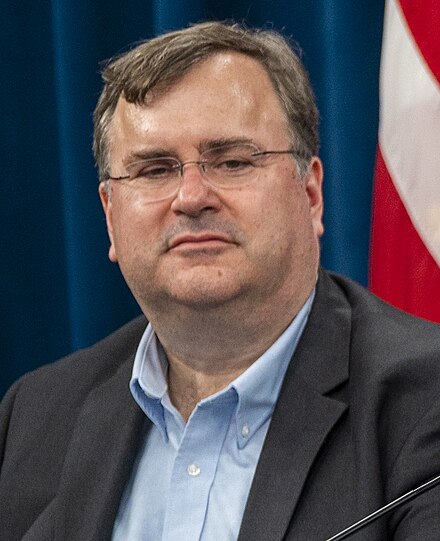
Please join me in welcoming Reid Hoffman.
Hello there. Nice to see you.
I don't know where you sit and I sit. Let's just, I don't care either. Let's do it. So nice to see you again.
Thank you for being here. So you came to Wired Health last year, Reid, to talk about how you were trying to cure cancer, no small feat, through AI-driven drug discovery with your new startup Manifold AI, which you announced in January 2025. So you're known as the co-founder of LinkedIn, PayPal, your role in companies like OpenAI and Meta, so on and so forth. I could keep going. Why did you choose this specifically as your next big project, as your next big endeavor?
And I know we have tight time, so I'll be quick in the description. But one of the things, so Silicon Valley has a lot of strengths, it also has blind spots. And the blind spot tends to be like, 'Oh, we're going to really focus on coding acceleration,' which is great, useful in a bunch of things, you know, enterprise software, a bunch of other things. And I said, 'Okay, we're going to have a bunch of great things. What are the areas that are perfect for AI and for this new generative model that will be in the Silicon Valley blind spot?' And you know, partially because, you know, we think, 'Oh, pharma's too difficult, FDA certification, clinical trials, blah blah blah,' which all of like, you know, we kind of go, 'Ooh, look, the...'
Right. Roadblocks. Yeah. Yeah.
So we tend to go to only software. And yet, when you think about what makes the most massive difference for humanity, curing these diseases, curing the uncurable, really, really matters. And so what it came out is, you know, so I'd known Siddhartha Mukherjee for a number of years. We had dinner. I was like, 'Look, I have this idea.' And he's like, 'Oh no, your idea is better than you think.' Because like he helped create CAR-T therapy and so forth. So it's like, 'Here, let's run through everything, and then you be AI, and I'll be, you know, pharma, medical system, clinical trials, etc. And let's figure this out.'
You went for it. And it's so interesting. I mean this is one of my maybe sort of great fears about AI is exactly what you were commenting on earlier. There are sort of these areas. I mean education is one, health care and medicine is another one that I worry Silicon Valley just sort of like blows right past because there are these other sort of shinier, sexier, easier in some ways. I mean none of this is easy but but easier targets. And the idea that you would sort of disregard the idea of applying this technology to modern medicine and drug discovery. So obviously very very glad and grateful to hear about the work that you're doing. Now last year you said that using AI you hope you could accelerate this very slow process of drug discovery to a point where you could make new announcements every year rather than every 10 years.
Well Reid, it's been a year. So give us a sense of the progress that you have made since the last time you were here. How have the last 12 months been?
I love the question. So what we're at, at a very quick snapshot, what we're doing is building an AI engine. This is the AI thing for targets and for small molecules. So that you have a much higher throughput in terms of here is things that might be solves for a triple negative breast cancer, for etc. And we built the kind of called the alpha version. Even though we have the alpha version, we're not really making announcements but we filed some INDs.
Okay. And tell IND, I mean maybe more people in the audience know this than I do.
Oh so like the kind of the provisional paperwork for FDA and patent on we have a new drug that we're looking at, etc. It's the very earliest. It's a 'I think I've got something' is roughly what it is.
But you think you've got something, sounds like. And there's a lot of brutal work that follows that.
And so we have made a bunch of design decisions that we're not public about because we think it's our secret sauce about how it is we can solve the kinds of problems around there's much actually much less data. Part of the reason you have to build specific models is because when you do an LLM, there's trillions of words on the internet, so you can use that. That kind of data doesn't exist in any addressable format other than like some protein folding, but like proteins are only one particular part of this whole targets and different kinds of molecules that can make a difference. You have to deal with ADMET and all these other things in order to solve this. And so there's much more limited data set, so you have to have a unique kind of strategy for with that limited data, how is it you're actually going to have really good generative, you know, kind of solutions?
That's what we're building. We're pretty happy with what we built so far. And happy enough that when you ask me the same question next year, I will have better answers.
Interesting. Okay. I'm excited. I'm excited to ask you that question next year, and you know I will. You know I will. Now, we heard earlier from Isomorphic Labs, co-founded by DeepMind's Demis Hassabis, of course. They're using AI models, AlphaFold in this case, to design new medicines. They're not the only ones. There's In Silico, there's Exscientia. How does your approach to drug discovery differ from those other approaches? What are the similarities and maybe what are the distinctions?
So, look, one of the good things about drug discovery is there can be multiple great efforts, and that's awesome. So, I want them to...
Do you feel that sense of sort of startup competitive hunger around this, or is it much more... Or is it sort of a distinct experience for you because you're talking about drug discovery, right? We're talking about curing cancer.
So, classically, when you're doing something like a social network, this is like what I wrote about in Blitzscaling, it tends to be what I call Glengarry Glen Ross markets, which is first prize Cadillac, second prize steak knives, third prize you're fired.
So, it really matters. Actually, one of the things that and it took me a bit of reflection to get to this to not be the 'we must be the Cadillac.' Because really the competitive drive is I want to also be a great company. If the other ones are great, that's great, too. It's just better for humanity.
Because if this one is solving these issues around liver, we're solving these issues around cancer, this one solving these issues around inflammation and blood markers...
Human bodies have many issues as we know.
Yes. Great. The more, the merrier. I do have that competitive instinct and it's like one of the good things about business and capitalism. I really, I don't want to be embarrassed like, 'Oh, they all achieved great things and we didn't.' That would be embarrassing.
Yes, they would. It happens, but you don't want that.
And so that kind of the competitive landscape's different than it classically is in a lot of these kind of software markets. It's like, you know, there tend to be one dominant CRM company, one dominant, you know, kind of human resources, you know, SaaS company, etc., etc., etc. This I think there is room for multiple.
Now, as far as I can tell, we are adopting different approaches to two different variables. One variable is how do you build your AI model and what's the generative thing. And so, for example, some of them are like, 'Hey, we're reading all these medical papers and we're doing our almost like an abduction theory approach from reading all the medical papers.'
That is a valid different approach. We will actually use that to cross-check our own work, but that's not how we're coming to generation. Some, you know, for example, are like, 'Well, we launched we solved our data problem by using the only place where there's a lot of rich data, which is protein folding.'
And so, we're doing a lot of things on proteins. That happens to help with some medicines and some conditions. But you also need to tie that to good targets, to an understanding of the medical process, etc. So, one of the things we kind of tell an internal joke at Manifold is that to some degree, it's we have a unique approach to building AI, we think. You know, discover, but it doesn't matter even if there's multiple. And we have what we call Sidarth ML, right? Which is Siddhartha Mukherjee.
You know, as like, what is the right discovery of targets? What's the right discovery of a whole range of molecules, not just protein molecules, but things that are small molecules that could be medically therapeutic, or preventative. And so, what you want to create something amazing is you want to have best of world-class AI talent and world-class medical talent, and you need both. Some of them do only AI, we think they're going to run into a whole bunch of problems when they really get to what it is that is targets and therapeutics and all the things that go into it, not just the questions around clinical trials and all that. That matters, too, but all that. And then, others are like, 'Oh, we're adding some AI dust into our normal drug discovery problem.' And that will be a nice acceleration, but it will be a small acceleration, because you actually we think you have to refactor what your drug discovery process is to having a much higher volume of targets and proposal molecules, which some of these other approaches are doing, too, and those are the ones we pay much most attention to.