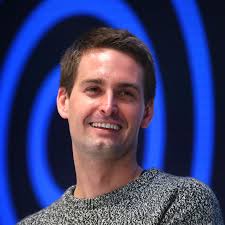
Hi everybody. I'm Nicolola Tangen, the CEO of the Norwegian Sovereign Wealth Fund. And today I'm really thrilled. I'm here with Evan Spiegel, the co-founder and CEO of Snap, the company behind the very popular Snapchat. Now it's used by nearly a billion people every day. He was 22 years old, turned down a $3 billion offer from Mark Zuckerberg, and has continued to build a company, which by the way, in Norway of all places was one of your first really, really big markets. So fantastic to have you here.
Thanks so much, Nicole. It's great to be on the show and yeah, we now reach more than 3 million Norwegians. So very proud to serve the Norwegian people.
Now, it started as an idea that most people thought was almost totally ridiculous, a photo that disappears just after you look at it. So where the heck did that idea come from?
Well, Bobby and I had grown up with social media. And on social media, everything was saved forever. It was public. It was like a big competition to see how many friends you had or likes you could get on your photos. And so it meant that people were only posting pretty and perfect moments, not the full set of emotions or full set of experiences they have that are really important to relationships. So I think the most important thing Snapchat did was created a new way of communicating with visual messaging. That was really the foundation of the service. Now today it's diversified across a map that lets you see what your friends are up to or augmented reality lenses, of course content with stories and spotlight, but the core of the service is really visual messaging between friends and family.
So, where do you go? You're like 22 years old, no money, no app, no nothing. I mean, how do you start?
Well, I was in school at the time and Bobby and I actually lived across the hall from each other and so we started working on some projects together. One of which was called Future Freshman, which was a service designed to help people get into college. That was a total failure. Only my mom signed up for our service despite both of our siblings applying for college at the time. So, we got some strong customer feedback in the early days. We ended up shutting down Future Freshman, trying a few other things, and ultimately creating Peekaboo, as Snapchat was called at the time, which I presented to my class in junior year.
When did you understand that you were on to something big?
Oh gosh. I mean, it probably wasn't until about a year after we launched the service, when there were enough folks using it and continuing to use it, in a way that we thought maybe we could build a business. But I think the most important thing for us is that we loved using it together with our friends. And so that really gave us the conviction to stick with it, continue evolving Snapchat, because we were having so much fun using Snapchat to message with our friends.
Now, in the beginning, people kind of thought it was a bit secretive, right? Stuff is disappearing. There is no record of anything. So, how did you think about the kind of reputation side of it?
You're right. Back then, people didn't really think about or prioritize privacy the way they do now. I mean, if you remember at the time, everyone was talking about the world being open and connected and everyone was going to share everything permanently. And I don't think people had yet realized the downside of saving everything forever or allowing companies to access and store such large amounts of data. And so it was unusual for Snapchat, I guess now 15 years ago, to say privacy is really important to us. And we think that privacy is actually the foundation of self-expression, right? Unless you feel like you can express yourself with your friends and family without fear of that being recorded and broadcast publicly, it's very hard to feel comfortable expressing yourself. So I think we were early to explain the connection between privacy and self-expression, which I think now is obviously very well understood and widely accepted.
You had a pretty healthy offer to sell the company early on. Now in Europe we typically take the money and run. You thought differently. How come?
Well we really loved what we were doing. We saw a huge long-term opportunity. I mean now the service reaches nearly a billion people around the world. Back then it was still very small and so we believed that we had a vision that was unique and different than traditional social media that was much more focused on close friends and family on messaging and self-expression and so we decided to pursue our own vision. And I think the thing that really helped us make the decision was just how much we love what we do.
Now, you've been at the forefront of a lot of innovations, right? Disappearing messages, stories, augmented reality filters, and so on. How do you build a company that comes up with these kind of ideas?
Well, I think what's so important is to continue to create a culture where great ideas can come from anywhere, where people put good ideas in before hierarchy. One of the challenges with companies as they grow is they become much larger organizations. People become more fixated on promotions or making more money rather than taking risks. And so one of the things that we've done is kept a very, very small design team. It's about nine people. It's a totally flat structure. So there's no fancy titles or anything like that. And the entire idea is to iterate really quickly to try new things. We look at hundreds of ideas on a weekly basis. And every now and then we have a good idea. But I think the most important thing is to create a culture that rewards creativity and risk-taking rather than a culture that rewards promotion, for example.
What's the craziest idea you looked at lately?
Oh my goodness. The craziest idea I've looked at lately, we had all sorts of wild ideas for April Fool's jokes on Snapchat. Most of which, actually all of which, I think we discarded except for we briefly renamed Spotlight Reels R-E-A-Ls because we're so focused on the authenticity of videos made on Snapchat.
So when you sit around the table, how does it work? Do you have a screen? You put things on a screen? You have a whiteboard? Just what do you do?
Yeah, we've got a screen. Sometimes we draw stuff. Sometimes we use a whiteboard. Most of the time, we're just debating stuff and laughing. I mean, I think one of the things that's so important is creating a culture where everyone can speak up and share their point of view. And part of what makes that enjoyable is to make sure that it's fun, right? I think fundamentally, unless you can have fun with design, it's very hard to be creative. So I think the levity of those design meetings is something that I always really enjoy and something that brings out the best in people and creates a space where everyone can share their perspective.
How did you guys come up with stories?
Well, that was actually an outgrowth of people asking for a send to all button. And so in the early days of Snapchat, people said, 'Oh gosh, it's such a pain to go select each one of my friends when I want to send them a snap. I'd rather just have a send to all button so I can blast snaps to everyone who's my friend on Snapchat.' And we were really concerned that that would end up with people spamming each other all day long rather than intentionally communicating. But we did understand that people wanted to share Snaps with all of their friends. So, we asked them a lot about how they were using social media at the time. And they complained that the feed was engrossed in reverse chronological order. They complained about likes and comments and feeling the pressure when they were posting. And they were frustrated that their profile when they went back and looked at it felt like it didn't reflect who they were currently because it had all these old images and photos of them. And so for us, we took a lot of those learnings and what we heard and we created a product that disappears after 24 hours. You can start fresh the next day that doesn't have public likes and comments that's in chronological order so people can follow you through your day instead of experiencing your day in reverse. And we released stories and the early uptake was minimal. I mean, people were just discovering the feature and there wasn't a lot of growth early on, but as people figured it out and started using stories to share with their friends, it became a very large success for us.
How many stories do you put out?
Do I personally put out? Oh, I put a couple snaps on my story a week, I would say, for my friends and family.
Now, people just copy what you do, right? So, Instagram copied stories, TikTok took the short-term kind of short form video, WhatsApp disappearing messages. I mean, is it depressing that people take your ideas or do you think it's kind of flattering or how do you look at it?
Well, it's a heck of a lot better than coming up with ideas that nobody wants to take, right? So I think certainly prefer it to the alternative but it means we have to be really thoughtful about how we build our business for the long term how we continue to build a moat and make Snapchat very resilient. And it's what's helped us think a lot about our future-looking investments like in augmented reality where we have, I think, the largest augmented reality platform today, advanced developer tools and really this ecosystem we've developed because we found that as you build an ecosystem that's much harder to copy than an app feature for example.
Now, the biggest bet now for you seems to be the augmented reality glasses. And I believe you're on generation 5. Do you think the world is ready for this now?
I think the world is so ready. I think that technology has been trying to catch up to where the world is. I think folks are exhausted by what their computers and their phones demand of them. I mean, people are spending seven or eight hours a day hunched over a screen. They feel like it distracts them from the real world, takes them away from their friends and family, but yet this technology is so useful and so powerful, right? That we don't want to just put our laptops away. We need to fundamentally change what a computer is. And that's really what Spectacles do. They take computing and they actually integrate it in the world around you. They make it something you can share together with your friends. So you and your friends can participate in the same computing experience in the same place at the same time. That's really, really powerful and it represents a whole new direction for computing that I think the world has wanted for a long time but the technology hasn't been ready.
Some pretty big players have tried already and they failed. So why should you succeed here?
Well, I do think we have unique customer insight that we've been able to translate into very innovative products in the past. And I think staying close to our customers, what they really want and building products that really delight them is core to who we are. And I think that's been combined with the ability to really invest consistently over the long term. I think a lot of companies that have tried and experimented in this space have turned their initiatives on and off abruptly, which is really damaging for long-term research and development. They've sort of chased different market opportunities, pivoting back and forth between consumer and enterprise. And so these pivots and these sort of starts and stops are really, really harmful to long-term research and development. And I think that's where we're very different because now I think for more than 12 years, we've invested very consistently and very deliberately against this vision. Starting with just normal camera glasses, adding a second camera, adding a display, building out our own proprietary operating system and the developer ecosystem, and now launching a bit later this year full-fledged consumer grade Spectacles that fit all of that capability into a normal pair of glasses. So, I think it's really that focus and long-term consistency that's going to differentiate us in this space.
How far into the future do you think you can see? So what I mean is that I have a question where do you see Snap in 10 years time and then I thought 10 years time, I mean that's like a hundred years for this guy. So but I mean can you see like two to three or just what is your time frame when you plan and when you look at your visions?
Well the hardware time horizon is obviously far longer than the software time horizon. So, in the hardware space, we plan through, I would say now we plan through 2030, right? So, we have a general idea of the tech tracks and product capability and what we need to land over that time frame and what the consumer value proposition needs to be and the price point. So, I think one of the great things about hardware actually is that we get to benefit from our long-term vision because by the time we've released a product, we're already years ahead in terms of the next generation of the product and our investment cycle. So it makes it harder for our competitors to catch up because they're only seeing what we worked on several years ago when we launch a new hardware product. On the software side, I'd say the cycles are a lot faster and we can pivot and make changes much more quickly. And of course the software on Spectacles for example even after we launch the hardware continues to develop at a really rapid clip. So it depends, hardware versus software. But I think taking a step back big picture looking out over the next three to five years Snapchat will reach more than a billion people. It'll have a diversified set of revenue streams across subscriptions and direct revenue as well as our advertising business. And then we'll be layering in the development of this Spectacles ecosystem and the Spectacles hardware product starting first with early adopters and enthusiasts but by the end of the decade I think really having a mass market glasses product out there.
In terms of augmented reality, is it the hardware which is the slowest now or is it software or just if you look at what could make it move faster?
Well, hardware is always harder than software. That's why it's one of the most compelling places to invest, I think it's so important if you want to create long-term value to do really difficult things and to solve really difficult problems. And certainly the hardware space for glasses is difficult because you have to combine so much capability into a very, very lightweight and wearable product. So I think looking at the history of our augmented reality development we already have an AR platform that's used by hundreds of millions of people inside Snapchat and the question will be how that evolves as the glasses hardware ultimately is released later this year. And we've seen a lot of promising signs from the 2024 edition of Spectacles which was developer focused people have built hundreds of lenses for that device and I'm really excited to see what the developer community builds on this next generation.
Moving on to culture, what are the non-negotiable parts of your corporate culture?
We've got three values, very simple, kind, smart, and creative. All non-negotiable. And the most important thing I think actually is the relationship between kindness and creativity. And what we really learned over the years is that unless you have a culture where people feel supported, feel like they can bring their full selves to work and experiment with crazy ideas, it's very, very hard to develop a consistently creative culture. So the relationship between kindness and creativity is very important to us.
I try to be as kind as I can. Certainly I'm more kind after a cup of coffee.