CEOInterviews.AI
Start App
Try: AI strategy tariffs earnings guidance layoffs interest rates growth

Chase Koch

President, Koch Disruptive Technologies

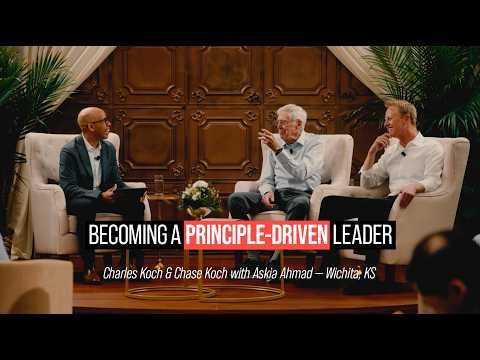
Search every verified Chase Koch interview, podcast appearance, and on-the-record quote — each transcript cross-checked by AI and human review to confirm speaker identity. Chase Koch, executive vice president of origination and partnerships at Koch Inc. and founder of Koch Disruptive Technologies, has been promoting his book "Becoming a Principal-Driven Leader: 41 Principles to Build an Enduring Business," co-written with his father Charles Koch. In podcast appearances during August through October 2026, he discussed the company's principle-based management system, which he described as a culture where people know what to do without being told, and emphasized bottom-up empowerment over top-down control. He stated that Koch hires on values first, skills second, and credentials last, and described the company as more of a technology company than an industrial one, citing $50 billion in technology investments over roughly eight years, including the acquisition of software firm Infor. Koch also addressed succession and business longevity, saying that family businesses should operate as meritocracies rather than assuming family members are best suited for leadership. He encouraged leaders to write down their values and principles and to learn from failures, stating that if a business does not disrupt itself from within, the market will disrupt it. On broader societal trends, he expressed concern about growing government regulation and what he described as a belief among younger generations that they cannot solve their own problems without government intervention.

Recent appearances

Notable quotes

“The first thing is have the mindset of it's actually not a family business. And a lot of people scratch their heads when I say that, but what I mean by that is it's a meritocracy and it doesn't matter if your last name's on the building or not. And so so many third gen, fourth generation businesses start on the decline or fail because the next in line is like well he or she is going to be CEO right. Well back to our ”

“The way we look at it is based on a principle of marginal contribution and that looks at every individual and say how are they contributing over to the overall the whole. Now it's much more difficult to apply that as opposed to let's say in a sales role I made x I brought in x million dollars of business so I therefore get y incentive at the end of the year. We look a lot of different factors. So what do we want peop”

“We hire on values first, skills second, and credentials last. I would say that's one of our biggest differentiators as a company. Most companies I think are the opposite. Credentials first. Where'd you go to school? What companies did you work at before? What was your GPA? And we feel like all that's nonsense. We want someone that is contribution motivated. They want to come in. They don't think they know everything.”

“We're more of a technology company than an industrial company. I think that's a better framing for what reality is today. We've invested 50 billion over the last 8-ish years in technology. And two examples would be two of our 12 different business platforms that we have are just pure technology companies. One would be Infor, that's ERP software. When we acquired Infor, that brought us north of 30,000 software enginee”

“The government keeps getting bigger and bigger and bigger, more regulations, more telling people how to live their lives and more sadly more people especially the next generation that believes when we've done the research on this that that is the answer. We can't solve our own problems anymore. We need someone else to come in and solve them for us. That's a very scary place to be and it's a very scary trend.”

“We've really transformed ourselves from being an industrial company to a technology company. Um, yes, we're in energy, we're in fertilizers, um, so agriculture, but we're in wood products as well. all and consumer products like toilet to toilet paper and paper towels, um glass manufacturing, but also software um ERP software and um um uh technology with like Molex for example with connectors and cabling that's making”

The summary and quote tags on this profile are produced with AI assistance from verified, first-person interview transcripts, then checked by our team to confirm the speaker's identity and the accuracy of every quote. See how we verify →