CEOInterviews.AI
Start App
Try: AI strategy tariffs earnings guidance layoffs interest rates growth

Navrina Singh

Cofounder, Credo AI

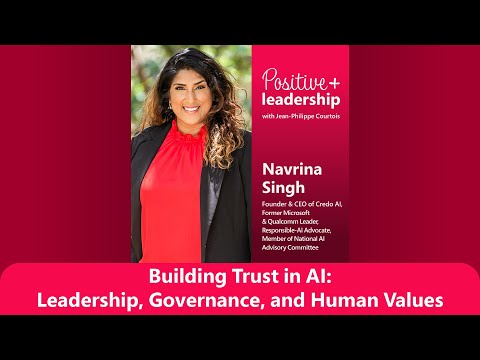
Search every verified Navrina Singh interview, podcast appearance, and on-the-record quote — each transcript cross-checked by AI and human review to confirm speaker identity. Navrina Singh, founder and CEO of Credo AI, has recently discussed the state of enterprise AI adoption and governance in several interviews. Speaking with Axios in October 2026, she said that while businesses have begun thinking about AI trust and governance, they have not yet meaningfully invested in it, and she described the current stage of enterprise AI adoption as "very early innings." She also discussed shifts toward open-source models and the need for oversight of autonomous AI agents, including defining what data they can access and what actions they can take. In a podcast interview, she described Credo AI's founding thesis as focused on what goes right when AI is deployed responsibly, and she said she does not currently worry about a "Skynet scenario," though she argued for continued investment in AI governance and safety. At a CNBC AI Forum, Singh advised that AI policy should focus on use context rather than just model capability, emphasized human agency in controlling agentic systems, and called for greater AI literacy. She also discussed the concept of a "kill switch," saying she dislikes the term but that the key idea is being able to block, advise, escalate, or redirect agent actions. In a September 2026 interview at theCUBE + NYSE Wired, she described Credo AI's role in codifying organizational intentions into controls and monitoring AI systems for drift from those objectives. She noted that the company had experienced three consecutive record-breaking quarters and that enterprises were increasingly demanding evidence and verification of AI ROI.

Recent appearances

Notable quotes

“I think one of the most dangerous views we can get into is that we need something new and let's just work on that something new. Actually, we have a lot of consequential problems right now that we need to be solving. And again, I'll keep going back to the thing that it is going to take all of it, and it is going to take all of us, whether you are working on the frontier foundation models, or whether you're working in”

“So, Maddy, maybe a little bit more context around Credo AI's work should give you a little bit sense of where we sit in the ecosystem. So, Credo AI is a leading provider of AI governance software. What that means is we help enterprises who are buying a lot of frontier capabilities, who are building around open source, and are building their own applications, they want to have control and trust within their applicatio”

“I think we are in very early innings of figuring out what governance for AGI might look like. But this is exactly the reason why we should be thinking about all the different scenarios. That's why we should be investing more in AI governance. Why we should be investing more in AI safety and trust ecosystem as well as startups. Because I think we just don't know so much especially on the you know we're already on this”

“I think the biggest thing that I see falls in two categories. One is they are seeing AI governance as a enabler versus a hindrance. So if you talk to a board or the executive leadership of a company that just has this mindset that I don't want to build a foundation of risk and compliance because it's going to slow my AI innovation down you should already count them out because what we are finding is when you actually”

“So JMA, you know, I started on this journey almost 6 and a half years ago. We created the AI governance category and when I started Credo AI it was a Z TAM but there was a lot of 100% conviction behind the idea that as AI capabilities advance we need to really draw down on our governance debt which is going to arise from a couple of different reasons. One because we won't have systems that always have human in the lo”

“So one, you know, on Jensen's comment, I think there's a spectrum of trust that everyone's sort of missing and it's really important to nail that down. I don't think the answer is just testing and evaluation that an organization does or having a regulatory framework. There's an entire set of things that you need to be doing to make sure that these highly capable systems actually reap the benefits and the ROI that we ”

The summary and quote tags on this profile are produced with AI assistance from verified, first-person interview transcripts, then checked by our team to confirm the speaker's identity and the accuracy of every quote. See how we verify →