President and CEO, Federal Reserve Bank Of Dallas
Search every verified Lorie Logan interview, podcast appearance, and on-the-record quote β each transcript cross-checked by AI and human review to confirm speaker identity. Lorie Logan, President and CEO of the Federal Reserve Bank of Dallas, participated in two public conversations in May and July 2026. In her remarks, Logan stated that she currently believes "modestly higher interest rates would better balance the outlook and risks for the FOMC's dual mandate goals." She characterized inflation as "too high" and "trending in the wrong direction," adding that her best judgment is that inflation appears to be "heading toward the mid-2s, not all the way back to 2%." Logan noted that PCE inflation still ran close to 4% over the past 12 months and said she is "increasingly concerned that higher interest rates could be necessary later this year to fully restore price stability." Logan described the labor market as "stable" and "balanced," with an unemployment rate of 4.3%. She assessed that monetary policy is "not restraining the economy" and appears "neutral or perhaps even a bit loose," adding that "better modest restriction now than severe restriction later." In her discussions, Logan also addressed regional economic topics, including increased export activity of oil and gas, rising electricity demand from data centers and generative AI, and labor demand in construction and manufacturing related to data center development in the Dallas Fed's district.
“So today, I'd like to tell you why I currently believe modestly higher interest rates would better balance the outlook and risks for the FOMC's dual mandate goals.”
“So, putting together all these ways at looking at the data and the economy, my best judgment is that inflation appears to be heading toward the mid-2s, not all the way back to 2%.”
“So today, I'd like to tell you why I currently believe modestly higher interest rates would better balance the outlook and risks for the FOMC's dual mandate goals.”
“History shows that when central banks try to hold down unemployment by accepting persistent inflation, they often end up with more inflation and more unemployment. If higher inflation becomes entrenched, we'd need sharper rate increases to bring it back to target with a larger cost for the labor market. Better modest r...”
“Looking first at inflation, it's just taking too long to return to the FOMC's 2% target. The FOMC measures inflation with the price index for personal consumption expenditures or PCE. PCE inflation surged past 7% in the aftermath of the pandemic. It's come down meaningfully since then, yet it still ran close to 4% over...”
“These conditions indicate to me that monetary policy is not restraining the economy. I'm increasingly concerned that higher interest rates could be necessary later this year to fully restore price stability and appropriately balance both sides of the Fed's dual mandate.”
“Look, as I said in my remarks, when I look at inflation on the inflation side, it's too high. It's trending in the wrong direction and I see further upside risks. On the labor side, I see that as stable. And on the growth side, growth is very solid.”
“I'm just not sure that policy is very restrictive. It's to me it looks neutral or perhaps even a bit loose. And you know, in order to return inflation all the way to our 2% target, as I said, you know, if I look at a variety of measures, I think underlying inflation looks closer to two and a half, mid-2s to me than it...”
“Even before the conflict in the Middle East, I wasn't convinced that we were headed on a path all the way to our 2% target. The first readings of inflation earlier in the year surprised forecasters to the upside and I was particularly concerned with the inflation we were seeing in core services excluding housing, which...”
“The FOMC at its last meeting voted to keep interest rates steady. I supported that decision because I thought it was the appropriate path for policy to best balance our dual mandate objectives of maximum employment and price stability.”
“We've been running with inflation above our target for five years now. It is incredibly important to restore price stability and get inflation back to 2% because stable inflation is the bedrock for a strong economy.”
“My first takeaway from our analysis is that shifting the demand curve inward by reducing banks' need for reserves is a better approach than returning to scarce reserves. US dollar reserves are the safest, most liquid asset in the world and it costs the Fed little to meet banks' reserve demand.”
“First and foremost, I'm committed to sustainably achieving both of these dual mandate goals: maximum employment and stable prices.”
“The economy is strong and stable, but certainties remain in the outlook. Downside risks to the labour market have increased.”
“If the economy evolves as I currently expect, a strategy of gradually lowering the policy rate toward a more normal or neutral level can help manage the risks and achieve our goals.”
... how fast policy should move and where rates should ultimately settle," Federal Reserve Bank of Dallas President Lorie LoganΒ ...
Lorie Logan of Federal Reserve Bank of Dallas gives her keynote speech a the ECB Money Markets Conference, 2023.
Federal Reserve Bank of Dallas President Lorie Logan says inflation appears to be trending more toward 3% than 2% during aΒ ...
"If term premiums rise, they could do some of the work of cooling the economy for us, leaving less need for additional monetaryΒ ...
Federal Reserve Bank of Dallas President Lorie Logan outlines what she's monitoring in the economy to show the Fed has madeΒ ...
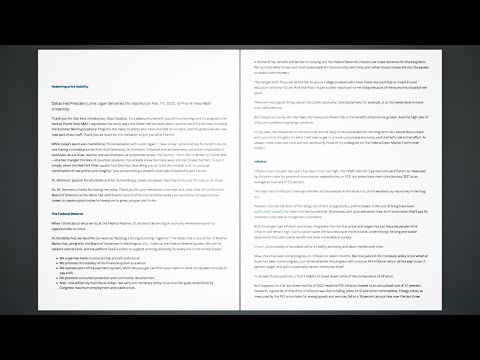
Thank you for that kind introduction, Dean Quddus. It's a pleasure to be with you all this morning, and it's so good to be here atΒ ...
Sign in to search the full transcript archive, filter by topic, and access every quote from Lorie Logan.
The summary and quote tags on this profile are produced with AI assistance from verified, first-person interview transcripts, then checked by our team to confirm the speaker's identity and the accuracy of every quote. See how we verify →