
Why 90% of Data Science Fails — And How to Fix It — With Eric Colson
Eric Colson—former Chief Algorithms Officer at Stitch Fix and VP of Data Science and Machine Learning at Netflix—explains why ...
Chief Executive Officer & Director, ARTISAN PARTNERS ASSET MGMT
Search every verified Eric Colson interview, podcast appearance, and on-the-record quote — each transcript cross-checked by AI and human review to confirm speaker identity. Eric Colson, CEO of Artisan Partners and a former data science executive at Netflix and Stitch Fix, has discussed the challenges companies face in leveraging data science effectively. In a February 2025 podcast, Colson argued that many firms treat data scientists as a support function, limiting their impact by only executing ideas from business teams. He advocated for giving data scientists autonomy and accountability for measurable outcomes, and for using trial-and-error experimentation with cheap failures to find winshol. Colson also emphasized the importance of decoupling algorithms from applications and enabling data scientists to frame problems rather than simply optimize within inherited constraints. In earlier appearances, Colson addressed the asset management industry, stating that "a lot of true active management got diluted" as firms prioritized growth over differentiation. He described Artisan's model as centered on investments, people, and trust, and noted the firm's introduction of "investment degrees of freedom" to allow teams to deviate from benchmarks. Colson also discussed value investing, saying Artisan seeks stocks that are out of favor and positions itself differently from the herd, and highlighted the firm's expansion into global and alternative strategies, including a China post-venture strategy.
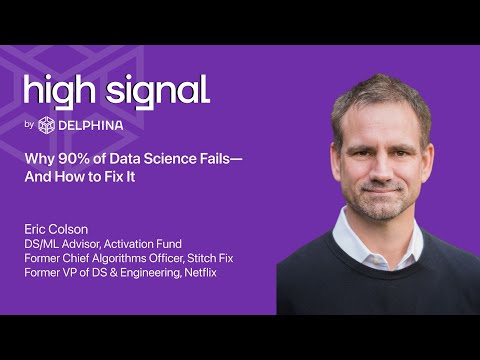
Eric Colson—former Chief Algorithms Officer at Stitch Fix and VP of Data Science and Machine Learning at Netflix—explains why ...

Citywire South Africa Editor, Patrick Cairns, speaks to the CEO of Artisan Partners, Eric Colson. He reflects on the lessons that the ...

Most companies data science caps out I'd say a director level but by providing these executive level rules you can enable a full ...

Subscribe to O'Reilly on YouTube: http://goo.gl/n3QSYi Follow O'Reilly on: Twitter: http://twitter.com/oreillymedia Facebook: ...

Machine learning and artificial intelligence have made tremendous advances in the last several years. Machines are now better than humans at many tasks - facial recognition, medical diagnosis, parole decisions, driving cars - and the list is rapidly growing. As these tasks are ceded to machines, it creates new opportunities for humans to think less like machines and more like … humans. Skills like the ability to empathize, the ability to leverage ambient information, and the ability to grasp broad context are tremendously valuable and in the purview of humans. As machine algorithms become ubiq…

ai.bythebay.io Nov 2025, Oakland, full-stack AI conference Scale By the Bay 2019 is held on November 13-15 in sunny Oakland, ...
Sign in to search the full transcript archive, filter by topic, and access every quote from Eric Colson.
The summary and quote tags on this profile are produced with AI assistance from verified, first-person interview transcripts, then checked by our team to confirm the speaker's identity and the accuracy of every quote. See how we verify →
Pro unlocks every transcript in full, plus unlimited search across every executive and company we cover.
50% off appliedPulling data at scale? The Data API gives you 30,000 transcripts a month over REST, MCP and JSON.
Compare all plans