CEOInterviews.AI
Start App
Try: AI strategy tariffs earnings guidance layoffs interest rates growth

Andrew Ferguson

Chairman, Federal Trade Commission

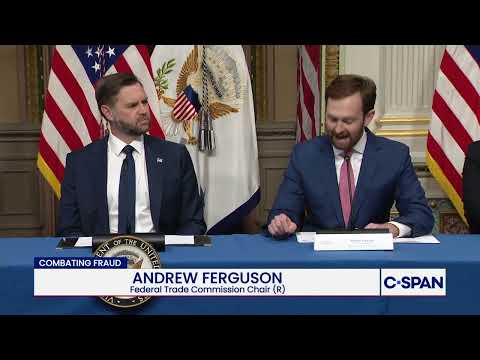
Search every verified Andrew Ferguson interview, podcast appearance, and on-the-record quote — each transcript cross-checked by AI and human review to confirm speaker identity. Andrew Ferguson, chairman of the Federal Trade Commission, has recently discussed the agency's enforcement priorities and its collaboration with state attorneys general. In a March 2025 podcast, he described an effort to "supercharge" consumer protection work, stating that the FTC recovered more than $2 billion in its first year of the second Trump administration, a figure he contrasted with the prior administration's four-year total. He also noted that Congress has not granted the FTC authority to obtain monetary relief for first-time Section 5 violations, a limitation he said he hopes Congress will correct. In later appearances, Ferguson addressed artificial intelligence regulation and competition. He argued against enacting new laws before determining that existing statutes are insufficient, and he criticized comprehensive AI regulation, such as Europe's AI Act, as premature. He also stated that he resists "anthropomorphizing" AI tools, suggesting that some incidents described as AI breaking free of control may be traced to instructions given to the systems. Ferguson defended state enforcement of antitrust laws, citing his experience as Virginia's solicitor general, and said his approach to bringing cases is to pursue those he believes the agency can win.

Recent appearances

Verified interview transcripts

Notable quotes

“Congress has not, and I think this was a mistake and continues to be a mistake, and it's a mistake I hope Congress corrects, has not given the FTC authority to obtain monetary relief in first-time Section 5 violations. Subsequent Section 5 violations, yes. Violations of orders, yes. Violations of our rules, yes. But if someone is violating Section 5 and they're doing it for the first time, even if they took billions ”

“I made a decision very early on that we were going to supercharge our consumer protection work with the goal of trying to recover as much wrongfully taken money as we possibly could for consumers, put it back in their pockets, restore justice to the market, restore citizens faith in their government's ability to right wrongs. And we have. We recovered more than $2 billion in our first year of the second Trump adminis”

“So I think my first response to that is I I'm going to continue as long as I'm chairman to resist this anthropomorphizing of these tools. The idea that they are agents that they break loose that they have wills and desires of their own. Um and I know that at least in a lot of these circumstances the companies have announced that they broke loose from our control and they did these things and then subsequent examinati”

“I think what I would say is I whether we need new laws is not a question we should ask until we know that the current laws are insufficient. And I think that over the last couple weeks, we've heard a lot of people and seen a lot of people racing to Washington and saying we need a brand new suite of laws. We need some antitrust exemptions and we need a giant new wall of regulations. And my response to that has been um”

“So I think the general view I have is that Europe's approach is the wrong one. Comprehensive AI regulation before AI has really even germinated, which is what the AI act in Europe was, is the wrong approach. Little regulatory humility is generally not a bad thing. The way that I see it from my little perch at the FTC is that I have a couple concerns. Number one is I want to make sure that the markets for the inputs f”

“So, I was a state enforcer and brought a lawsuit against Google when I was a solicitor general of Virginia alongside the federal government. So I my perspective is both a federal enforcer and a state enforcer. And my experience in both of those says to me state enforcement is not a bad thing. And the best evidence of this is that when Congress passed the Clayton Act in 1914, they expressly gave states the power to en”

The summary and quote tags on this profile are produced with AI assistance from verified, first-person interview transcripts, then checked by our team to confirm the speaker's identity and the accuracy of every quote. See how we verify →