CEOInterviews.AI
Start App
Try: AI strategy tariffs earnings guidance layoffs interest rates growth

George Church

Professor of Genetics, Harvard University

Search every verified George Church interview, podcast appearance, and on-the-record quote — each transcript cross-checked by AI and human review to confirm speaker identity. George Church, professor of genetics at Harvard Medical School and a founding core faculty member of the Wyss Institute, has continued to discuss advances in genomics, synthetic biology, and aging research. In recent appearances, he described progress in xenotransplantation, noting that patients have received pig kidneys engineered in his lab and have been off dialysis for extended periods. He also discussed the falling cost of genome sequencing, which he said has dropped from over $3 billion for a haploid genome to hundreds of dollars for a high-quality diploid genome, and expressed disappointment that more people have not yet been sequenced. Church stated that he does not see a barrier to controlling aging, describing it as programmed by evolution and potentially reprogrammable, while emphasizing that he focuses on aging reversal rather than longevity because the latter would require impractical long clinical trials. Church has also addressed the intersection of artificial intelligence and biology, saying that AI's ability to design proteins is "not overhyped" and has had a profound influence on biotech research and development. He has discussed the possibility of making cells resistant to all known and unknown viruses by recoding the genetic code, and has commented on the potential for gene editing to create societal divides, saying he does not see such a split happening because technologies tend to become affordable quickly. He has also spoken about the importance of considering unintended consequences of new technologies and involving the public in discussions about their use.

Recent appearances

  • George Church • Bio-Infrastructure: Refactoring Legacy Biological Code

    Synthetic Biology: Harvard Wyss Institute • George Church George Church, one of the most influential figures in modern biology, joins us to explore the breathtaking frontiers of synthetic biology. From his foundational role in the Human Genome Project to his groundbreaking work on gene editing, de-extinction, and engineered immunity, Church has helped transform biology from a descriptive science into a design discipline. In this episode, we trace the arc of synthetic biology—from sequencing DNA to programming life itself. We discuss how the field is converging with artificial intelligence an…

    Read the verified transcript → Watch on YouTube ↗

  • Harvard Geneticist: The Man Making Humans Immune to ALL Viruses

    This is a clip from our full conversation with George Church. Watch the full episode 👉    • Harvard Geneticist: "Immortality May Have ...   ------------------------- What if humans could be engineered to resist every virus we know? In this clip, Harvard geneticist George Church explains how advances in genome editing could make broad viral immunity possible by rewriting parts of our genetic code that viruses rely on to infect cells. The conversation explores how technologies like multiplex gene editing might one day protect humans from entire classes of viruses, fundamentally changing how we…

    Read the verified transcript → Watch on YouTube ↗

  • Harvard Geneticist: "Immortality May Have Already Happened!"

    This is a clip from our full conversation with George Church. Watch the full episode 👉    • Harvard Geneticist: "Immortality May Have ...   ------------------------- What if immortality didn’t arrive as a single breakthrough but quietly, step by step? In this clip, George Church explains the idea of “longevity escape velocity”: the point where medical progress extends life faster than we age. If each generation of therapies buys us more time to develop the next, the path to dramatically longer lives or even practical immortality may already have begun. ------------------------- 👉Subscribe t…

    Watch on YouTube ↗

  • George Church – GATC25 – AI & Genetic Agency

    Watch Dr. George Church, a pioneering figure in synthetic biology and genomics, explore the profound intersection of artificial intelligence and genetic agency at the inaugural Genetic Agency Technology Conference (GATC) 2025. Known for his foundational contributions to genome sequencing and synthesis, Dr. Church discusses how we can responsibly harness exponential technological progress to solve some of humanity's most complex challenges. From the potential of multiplex gene editing and the latest advancements in AI-driven protein design, to addressing the impending global fertility crisis w…

    Read the verified transcript → Watch on YouTube ↗

  • DISRUPTIVE: SYNTHETIC BIOLOGY Pamela Silver & George Church

    I’m excited to offer the first episode of DISRUPTIVE, my new monthly podcast series produced with Harvard’s Wyss Institute for Biologically Inspired Engineering. The mission of the Wyss Institute is to: Transform healthcare, industry, and the environment by emulating the way nature builds, with a focus on technology development and its translation into products and therapies that will have an impact on the world in which we live. Their work is disruptive not only in terms of science but also in how they stretch the usual boundaries of academia. In this inaugural episode, Wyss core faculty mem…

    Read the verified transcript → Watch on YouTube ↗

  • George Church on Widespread Genomic Sequencing, Xenotransplantation, and Shepherding Change

    In recognition of GenomeWeb'’s 25th anniversary, we are conducting a series of interviews with leaders in the field to reflect on the last 25 years of genomics, as well as what the future may hold. The full series is available here: https://www.genomeweb.com/topic/genom... In this interview, we speak to George Church, a professor at the Wyss Institute, Harvard Medical School, and the Harvard-MIT Program in Health Sciences and Technology. A thinker, inventor, and collaborator extraordinaire, Church's technologies and personality catalyzed the Human Genome Project, the Personal Genome Proje…

    Read the verified transcript → Watch on YouTube ↗

  • From Launching the Human Genome Project to the Redesigning the Life Itself with Prof. George Church

    In this episode, we are joined by Professor George Church (Harvard Medical School, Wyss Institute, Colossal Biosciences) – a pioneering scientist who helped launch the fields of genomics, synthetic biology, and genome engineering. We explore his revolutionary work on the Human Genome Project, CRISPR technology, and the future of de-extinction, aging reversal, co-founding companies and engineering life. From sequencing the first human genome to designing new species, George Church shares his bold vision for the future of biology, and humanity itself. What you’ll learn: • How George Church’s p…

    Read the verified transcript → Watch on YouTube ↗

  • George Church: Embracing Outliers in Science and in Life

    Dr. George Church, is a genetics professor at Harvard Medical School and the Wyss Institute. George is a pioneer in synthetic biology and personalized genomics. In 2017, Time magazine named him as one of the 100 most influential people in the world. In addition to being a scientist, George is also a prolific serial entrepreneur. He has co-founded over 50 biotech startups through his lab at Harvard. George also serves as a Faculty Advisor for the Harvard Biotech Club. In this episode, George shares his career path to become a professor at Harvard Medical School and the Wyss Institute, where…

    Read the verified transcript → Watch on YouTube ↗

  • A billion years of evolution in a single afternoon — George Church

    George Church is the godfather of modern synthetic biology and has been involved with basically every major biotech breakthrough in the last few decades. Professor Church thinks that these improvements (e.g., orders of magnitude decrease in sequencing & synthesis costs, precise gene editing tools like CRISPR, AlphaFold-type AIs, & the ability to conduct massively parallel multiplex experiments) have put us on the verge of some massive payoffs: de-aging, de-extinction, biobots that combine the best of human and natural engineering, and (unfortunately) weaponized mirror life. Read the transcri…

    Read the verified transcript → Watch on YouTube ↗

  • 20ish Questions with George Church

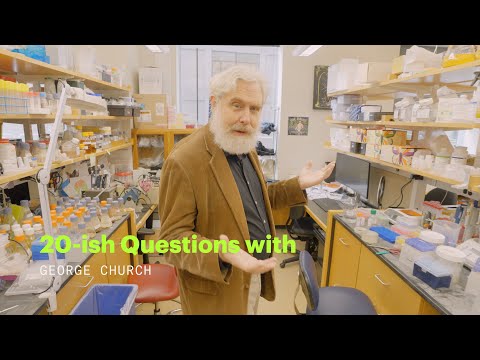
    20-ish Questions shows a different side of Wyss Institute faculty, touching on aspects of their personal life, hobbies, interests, as well as their research. This round follows George Church, a founding core faculty member of the Wyss Institute and lead of the Synthetic Biology focus area. For more information, please visit: https://wyss.harvard.edu/team/core-fa... Credit: Wyss Institute at Harvard University

    Watch on YouTube ↗

  • Combating Climate Change with George Church

    In this episode, Anthony talks to Dr. George Church. Dr. Church is a Robert Winthrop Professor of Genetics at Harvard Medical School, Professor of Health Sciences and Technology at Harvard University and Massachusetts Institute of Technology (MIT), and founding Core Faculty member of the Wyss Institute for Biologically Inspired Engineering at Harvard University. He received his PhD in biochemistry and molecular biology at Harvard University in 1984. His research has spanned many disciplines, from genomic sequencing to synthetic biology. He has also co-founded multiple companies, such as Coloss…

    Read the verified transcript → Watch on YouTube ↗

  • George Church (Harvard, MIT) on Internal Wearables

    Recorded at the ApplySci Deep Tech + Neurotech conference at MIT on September 30, 2022.

    Watch on YouTube ↗

Notable quotes

“I don't see any barrier to controlling aging. I mean, we've got a few examples. Some of them are cellular where we can go from 80-year-old human cells to basically embryonic, you know, day five type embryo-like cells. We have a few that work at the whole organism level. I think it's programmed by evolution and it can be reprogrammed. I don't think it's easy. I think that there's been a lot of wishful thinking that it”

“I don't see the split happening. I mean it's important to consider all the alternatives but once you consider them all I think you know choice is important. I mean you know having a split due to choice is a far better than having a split that's involuntary or enforced by the government or enforced by economic divides. I think that when I look at at least the scientific and medical revolutions that I've been embedded ”

“It is remarkable that we brought down the price of sequencing from over three billion for a haploid genome, which is half of really what your inheritance is, down to hundreds of dollars from three billion for haploid to hundreds of dollars for a diploid high quality clinically relevant genome. But still it's not used that much. There are very few nations that have said we're going to sequence our entire population. A”

“The ultimate genetic agency is an adult individual well-educated making decisions for themselves. But every now and then there are reasons that we want to make a proxy decision for our future children. And when you think about gene therapies or for that matter any orphan drug or late onset disease, there is a high price often for a false positive. If you have a false positive for say a cancer predisposition and you p”

“I was involved in the science paper that reflected that meeting. There has been a recurring concern about manipulation of the human germline, meaning something would leave a permanent impact on a family or on the entire human race. That goes back to the early days of test tube babies in the early 1970s, their common DNA debate. Now synthetic biology and crisper in particular being so easy possibly applicable to human”

“I in certain ways I think I saw too much. That is to say I'm a tiny bit disappointed that in 25 years we haven't sequenced more people's genomes. I think we could have sequenced 8 billion genomes by now. We could use current technology, wouldn't have to scale it up that much, and it would pay for itself. So you wouldn't even have to raise any money for serious Mendelian diseases which affect about 3 to 5% of us, it c”

Other executives at Harvard University

The summary and quote tags on this profile are produced with AI assistance from verified, first-person interview transcripts, then checked by our team to confirm the speaker's identity and the accuracy of every quote. See how we verify →