CEOInterviews.AI
Start App
Try: AI strategy tariffs earnings guidance layoffs interest rates growth

Harj Taggar

Managing Partner, Y Combinator

Search every verified Harj Taggar interview, podcast appearance, and on-the-record quote — each transcript cross-checked by AI and human review to confirm speaker identity. Harj Taggar, managing partner at Y Combinator, appeared on the September 4, 2026 episode of the Lightcone podcast, which featured Jeffrey Morgan, co-founder and CEO of Ollama, a Y Combinator-backed company. During the conversation, Taggar discussed the shift toward open AI models, noting that cost is a primary driver for businesses adopting them. He said that while cost is a short-term solution, businesses ultimately seek greater control and customization of AI models for their specific needs. Taggar also addressed the evolving landscape of fine-tuning custom models, observing that interest in this practice declined after early 2024 but appears to be returning. He highlighted the role of curation in the open model ecosystem, suggesting that services which integrate fragmented models, inference technology, and cloud offerings provide significant value to developers. He cited examples such as OpenRouter and OpenCode as tools that simplify access to a wide range of models and providers.

Recent appearances

  • Open Models Change The Economics of AI

    Ollama (YC W21) is used by 9 million developers and 85% of the Fortune 500, giving co-founder and CEO Jeffrey Morgan a unique view into which AI models people are actually using and how that’s changing. Right now, the biggest shift he sees is toward open models, driven by coding agents, falling costs, and capabilities that are rapidly catching up to the frontier labs. On Ollama Cloud, that shift has driven a 150x increase in token usage since the start of the year. In this episode of the Lightcone, Jeff joins us to talk about the future of open models and the story behind Ollama, from two ye…

    Read the verified transcript → Watch on YouTube ↗

  • The Case For Data Centers In Space

    Philip Johnston is the co-founder and CEO of Starcloud, the company building data centers in space. In November 2025, Starcloud launched an Nvidia H100 GPU into orbit and trained the first large language model in space. They've since raised $200 million, hit a billion-dollar valuation just 17 months after YC demo day and filed with the FCC to deploy 88,000 more satellites. In this episode, Philip walks us through their wild origin story, the engineering challenges behind the Starcloud-1, why they booked a SpaceX launch before they even knew what they were building and how data centers in space…

    Read the verified transcript → Watch on YouTube ↗

  • The Age Of The 40-Year-Old Solo Founder Is Here

    Bryant Chou co-founded Webflow, which today powers around 1% of all websites on the internet. Now he's back in the current YC batch with Ploy, an AI-powered website and marketing platform that doesn't just build your site — it connects to your analytics, CRM, and search console to optimize your marketing while you sleep. In this episode of the Lightcone he explains how he built Ploy to be “anti slop,” how building today compares to his first startup, and why founders with domain expertise are making a comeback. Chapters: 00:00 — What Experience Gives You in the Age of AI 00:38 — Meet Bryant C…

    Read the verified transcript → Watch on YouTube ↗

  • YC Demo Day Lightning Round, New Snap AR Glasses, SpaceX Rips, Threads hits 500M Users

    00:04:38 SpaceX Rips 00:11:33 Andrew Lee, co-founder of Firebase (acquired by Google in 2014), discusses his latest venture, Tasklet, an AI agent platform that integrates with various work tools to automate workflows. He highlights Tasklet's rapid growth, achieving a $7 million run rate, and its ability to dynamically generate integrations using AI, enabling connections to both public and internal APIs. Lee also mentions a recent $20 million funding round and emphasizes Tasklet's competitive positioning against major AI labs. 00:21:47 Stamatis Floratos is the co-founder and CEO of Eden Robotic…

    Read the verified transcript → Watch on YouTube ↗

  • Inside YC's AI Playbook

    Building superintelligence inside a company isn't about adding AI as a feature. It's about making it the operating system the whole organization runs on. In this episode of the Lightcone, we sat down with YC's Pete Koomen to talk for the first time about how he led the effort to build YC's internal agent infrastructure from the ground up. We cover how giving agents unrestricted access to one database changed everything, the self-improving skill loops that get smarter overnight and why he thinks we've arrived at the personal computer moment for AI. Chapters: 00:00 — Intro 00:39 — YC's AI Stack…

    Read the verified transcript → Watch on YouTube ↗

  • Tokenmaxxing: How Top Builders Use AI To Do The Work Of 400 Engineers

    We're entering a new era of software where a single person, working with AI agents, can build products that previously required entire teams. In this episode of Lightcone, the hosts break down the rise of AI coding agents, "tokenmaxxing", and the emerging workflows behind tools like Claude Code and OpenClaw. They discuss why AI systems today feel less like productivity tools and more like collaborators, why the future of AI should be personal and user-controlled, and how founders are starting to build software in completely new ways. 00:00 — Will you control your AI? 00:47 — Coding again aft…

    Read the verified transcript → Watch on YouTube ↗

  • François Chollet: Why Scaling Alone Isn’t Enough for AGI

    François Chollet has spent years asking a different question than most of the AI world. Instead of scaling what already works, he’s trying to understand what intelligence actually is—and how to build it from first principles. In this episode of Lightcone, he traces that path from his early work on deep learning to the creation of the ARC prize, and the launch of ARC V3, a new benchmark designed to measure something deeper than performance: the ability to learn, adapt, and reason efficiently in entirely new environments. He explains why today’s systems may be hitting limits, what recent breakth…

    Read the verified transcript → Watch on YouTube ↗

  • AI Is Unlocking Millions Of New Builders

    In this episode of The Lightcone, we talk with Mukund and Madhav Jha, the founders of Emergent - an AI platform that lets anyone build and ship production-ready software. In just eight months, users have created more than 7 million apps on Emergent, with the number doubling in just the last 45 days. We discuss how they built one of the most powerful AI coding agents, why they focused on non-technical users and what it's like building for a global audience from India. Apply to Y Combinator: https://www.ycombinator.com/apply Work at a startup: https://www.ycombinator.com/jobs Chapters: 00:00…

    Read the verified transcript → Watch on YouTube ↗

  • The Powerful Alternative To Fine-Tuning

    Poetiq is a new startup founded by former DeepMind researchers that recently achieved a major jump on the ARC-AGI benchmark by layering a recursive self-improvement system on top of existing models. In this episode of Lightcone, Poetiq's Founder & CEO Ian Fischer joined us to discuss how small teams can build “reasoning harnesses” that outperform base models, what that means for startups and why automating prompt engineering may be one of the most powerful levers in AI today. Chapters: 00:00 – Intro 00:40 – What Is Poetiq? 01:07 – Recursive Self-Improvement Explained 02:07 – The Fine-Tuning T…

    Read the verified transcript → Watch on YouTube ↗

  • Rebuilding Customer Support for the AI Era

    In this episode of Founder Firesides, YC Managing Partner Harj Taggar talks to the founders of Pylon (W23), Marty, Advith, and Robert, who recently raised a $51M Series B. Pylon is an AI-native customer support platform built for B2B companies, replacing legacy tools like Zendesk with a modern system designed for Slack, Teams, and other shared channels. It helps support, success, and account teams manage customer conversations, structure data, and automate workflows — without losing the high-touch relationships B2B requires. https://usepylon.com/ Apply to Y Combinator: https://www.ycombinato…

    Read the verified transcript → Watch on YouTube ↗

  • The AI Agent Economy Is Here

    With the takeoff of OpenClaw and MoltBook, a new agent-driven economy is taking shape. In this episode of the Lightcone, the hosts take a look at the explosive growth of AI dev tools and whether the time has come for builders to make something agents want. Chapters: 00:00 - Intro 02:12 - No human involvement is changing the experience 04:55 - Does YC need to change its motto? 07:48 - Email tools and agent infrastructure 09:36 - Agent driven documentation 13:00 - Swarm intelligence 15:36 - Content generation and dead Internet theory 18:12 - Growth, rules and founder insights 20:48 - Outro Ap…

    Read the verified transcript → Watch on YouTube ↗

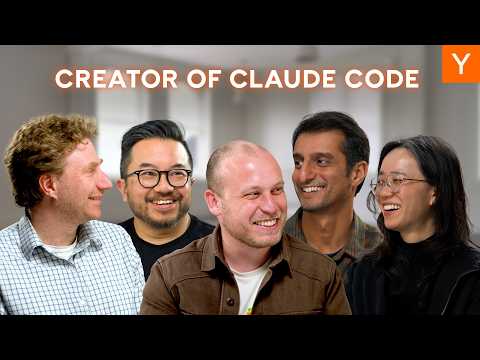
  • Inside Claude Code With Its Creator Boris Cherny

    A very special guest on this episode of the Lightcone! Boris Cherny, the creator of Claude Code, sits down to share the incredible journey of developing one of the most transformative coding tools of the AI era. 00:00 Intro 01:45 The most surprising moment in the rise of Claude Code 02:38 How Boris came up with the idea for Claude Code 05:38 The elegant simplicity of terminals 07:09 The first use cases 09:00 What’s in Boris’ CLAUDE.md? 11:29 How do you decide the terminal’s verbosity? 15:44 Beginner’s mindset is key as the models improve 18:56 Hyper specialists vs hyper generalists 21:51 Th…

    Read the verified transcript → Watch on YouTube ↗

Notable quotes

“Cost is by far the largest pain point that open models can jump in and solve. But you know, every business has a vision of getting better control over AI and customizing it for their business. And that's really their north star. You know, cost is something they can solve in the short term, but it then enables them to then go and customize these models for their unique use case.”

“During the batch, the way I thought about StarCloud was that it could only work if you were able to make it cheaper per unit of compute than like ground-based compute. And I think you will, but it's occurred to me since then that like it's not actually clear to me anymore that that is necessary for StarCloud to succeed. I'm curious if you think about it the same way because since the batch, we've learned that AI data”

“I think the thing of getting GPUs to now natively run on DC, you avoid the whole conversion of energy AC to DC because that's what makes solar panels not as efficient is the whole conversion. You lose a lot of power which is... So you could unlock a bunch of companies also just building GPU data centers using solar power period. Whether in space, under the water, or in Earth.”

“I don't think the business models have fully switched over to like sort of paper work yet it's certainly paper usage. But I don't think it's paper work yet. And I think that's just because the agents as yet haven't quite been good enough to actually consistently deliver like the final contract in a way that makes the startups feel good about charging that way. I do think we're right on the cusp of that changing thoug”

“I think this batch is following a similar trend to the winter 26 batch where things that have been happening. A lot of these companies are the first one that are basically riding the wave with agent coding working. It has become the norm where company well the norm has become more common that companies can go to zero to seven figures in revenue within just three months, which when I did the batch that would have been”

“There's a really interesting subtle thing that I wanted to talk about around like what I learned from your essay, which is like AI can either be centralizing or decentralizing. And the Google Gmail like I can't change the prompt thing is like the perfect example of that. We basically have a choice to be made over the next, I don't think it's even that long. I think it's like 18 to 24 months. It might take five years,”

Other executives at Y Combinator

The summary and quote tags on this profile are produced with AI assistance from verified, first-person interview transcripts, then checked by our team to confirm the speaker's identity and the accuracy of every quote. See how we verify →