CEOInterviews.AI
Start App
Try: AI strategy tariffs earnings guidance layoffs interest rates growth

Jared Friedman

Managing Partner, Y Combinator

Search every verified Jared Friedman interview, podcast appearance, and on-the-record quote — each transcript cross-checked by AI and human review to confirm speaker identity. Jared Friedman, managing partner at Y Combinator, appeared on two episodes of the Lightcone podcast in September 2026 to discuss trends in the startup ecosystem and the economics of AI. In the September 17 episode, he and his co-hosts analyzed data from recent YC batches, noting a shift from software-only startups toward "hard tech" and full-stack companies that perform end-to-end tasks, with the median startup's monthly recurring revenue rising from about $8,000 to $20,000 by the end of the batch. Friedman attributed this growth to AI models accelerating research and enabling smaller teams to tackle more ambitious problems, and he highlighted a resurgence of experienced founders in their late 30s, 40s, and 50s, as well as YC's role in supporting solo founders. In the September 4 episode, Friedman discussed open models with Ollama CEO Jeffrey Morgan, focusing on how falling costs and improving capabilities are driving adoption of open-weight AI models. He noted that frontier labs may slow down to address AI safety and alignment issues, while open source models continue to improve, and he framed the competition between frontier labs and open source developers as a "bundling/unbundling" dynamic, where labs seek to keep users in walled gardens while developers push for more open alternatives.

Recent appearances

  • The State of Startups in 2026

    YC works with thousands of founders every year, which gives us an early look at how startups are changing. Right now, the shift is striking: startups are moving from bits to atoms, nearly one in five YC companies has a solo founder, and companies are reaching meaningful revenue faster than ever. In this episode of The Lightcone, Garry, Jared, Diana, and Harj dig into what’s driving these changes and what they mean for founders. They discuss how AI is making it possible for smaller teams to take on more ambitious problems, why experienced founders are having a resurgence, and why knowing wha…

    Read the verified transcript → Watch on YouTube ↗

  • Open Models Change The Economics of AI

    Ollama (YC W21) is used by 9 million developers and 85% of the Fortune 500, giving co-founder and CEO Jeffrey Morgan a unique view into which AI models people are actually using and how that’s changing. Right now, the biggest shift he sees is toward open models, driven by coding agents, falling costs, and capabilities that are rapidly catching up to the frontier labs. On Ollama Cloud, that shift has driven a 150x increase in token usage since the start of the year. In this episode of the Lightcone, Jeff joins us to talk about the future of open models and the story behind Ollama, from two ye…

    Read the verified transcript → Watch on YouTube ↗

  • The Case For Data Centers In Space

    Philip Johnston is the co-founder and CEO of Starcloud, the company building data centers in space. In November 2025, Starcloud launched an Nvidia H100 GPU into orbit and trained the first large language model in space. They've since raised $200 million, hit a billion-dollar valuation just 17 months after YC demo day and filed with the FCC to deploy 88,000 more satellites. In this episode, Philip walks us through their wild origin story, the engineering challenges behind the Starcloud-1, why they booked a SpaceX launch before they even knew what they were building and how data centers in space…

    Read the verified transcript → Watch on YouTube ↗

  • He Built the World's #1 Open-Source Coding Agent

    Jay V is the founder and CEO of Opencode, an open-source alternative to Claude Code that works with any model you want. It's one of the fastest-growing products in AI: 13 million monthly active users, 20X growth this year, and more tokens processed daily than all of OpenRouter. But the overnight success took 16 years, one legal entity, and nine YC applications. In this episode of the Lightcone, Jay explains how Anthropic's attempt to block Opencode accidentally fueled its rise, how 16 years of near-misses prepared him to catch lightning in a bottle, and why most of the world still hasn't exp…

    Read the verified transcript → Watch on YouTube ↗

  • The Age Of The 40-Year-Old Solo Founder Is Here

    Bryant Chou co-founded Webflow, which today powers around 1% of all websites on the internet. Now he's back in the current YC batch with Ploy, an AI-powered website and marketing platform that doesn't just build your site — it connects to your analytics, CRM, and search console to optimize your marketing while you sleep. In this episode of the Lightcone he explains how he built Ploy to be “anti slop,” how building today compares to his first startup, and why founders with domain expertise are making a comeback. Chapters: 00:00 — What Experience Gives You in the Age of AI 00:38 — Meet Bryant C…

    Read the verified transcript → Watch on YouTube ↗

  • The Most AI-Pilled CEO We Know

    Brex co-founder and CEO Pedro Franceschi believes most people still underestimate how much AI will change the way companies are built. AI isn't just another tool, it's a new foundation for building products, teams, and companies. In this episode of Lightcone, Pedro shares why he thinks we're only months into a platform shift as significant as the invention of electricity, how AI has changed the way he works, and why every founder should be "token maxing" to understand the limits of the technology firsthand. He explains why the CEO needs to be the chief AI officer, how Brex is rebuilding itse…

    Read the verified transcript → Watch on YouTube ↗

  • Inside YC's AI Playbook

    Building superintelligence inside a company isn't about adding AI as a feature. It's about making it the operating system the whole organization runs on. In this episode of the Lightcone, we sat down with YC's Pete Koomen to talk for the first time about how he led the effort to build YC's internal agent infrastructure from the ground up. We cover how giving agents unrestricted access to one database changed everything, the self-improving skill loops that get smarter overnight and why he thinks we've arrived at the personal computer moment for AI. Chapters: 00:00 — Intro 00:39 — YC's AI Stack…

    Read the verified transcript → Watch on YouTube ↗

  • Advice for Young Founders from Y Combinator’s Managing Partner | Jared Friedman

    Apply for PAT 2026: https://tinyurl.com/bdez9676 Join the official PST Telegram Group for the latest updates, PAT preparation and doubt resolution 👉 https://bit.ly/43jtHmA -------------------------------------------------------------------------------------------------------------------------------------------------------------- What does Y Combinator actually look for in founders? In this conversation, Jared Friedman — Managing Partner at Y Combinator — shares why YC is bullish on India, how AI is changing software engineering, and what students need to do to become world-class builders. H…

    Read the verified transcript → Watch on YouTube ↗

  • Tokenmaxxing: How Top Builders Use AI To Do The Work Of 400 Engineers

    We're entering a new era of software where a single person, working with AI agents, can build products that previously required entire teams. In this episode of Lightcone, the hosts break down the rise of AI coding agents, "tokenmaxxing", and the emerging workflows behind tools like Claude Code and OpenClaw. They discuss why AI systems today feel less like productivity tools and more like collaborators, why the future of AI should be personal and user-controlled, and how founders are starting to build software in completely new ways. 00:00 — Will you control your AI? 00:47 — Coding again aft…

    Read the verified transcript → Watch on YouTube ↗

  • The GPT Moment for Robotics Is Here

    Physical Intelligence is building a foundation model that can control any robot to do any task — what the team describes as the GPT-1 moment for robotics. The company's cross-embodiment approach trains across many different robot platforms, and recent results show tasks being performed zero-shot that last year required hundreds of hours of data collection. In this episode of The Lightcone, co-founder Quan Vuong sat down with Garry, Jared, Diana, and Harj to talk about why robotics is finally ready for its scaling moment, how PI runs its models in the cloud rather than on-device, and the playb…

    Read the verified transcript → Watch on YouTube ↗

  • This Startup Catches Fraud at Scale

    In this episode of Founder Firesides, YC Managing Partner Jared Friedman talks to Karine Mellata, co-founder of Variance (W23), who is coming out of stealth and announcing their $21 million Series A. Variance builds purpose-built AI agents for risk and compliance — automating fraud detection, content review, and identity verification for Fortune 500 companies and platforms like GoFundMe. They discuss why Variance built in the shadows for three years, detecting state-sponsored fraud rings, and the accident that nearly ended the company. https://www.variance.com/ 00:00 – $21M Raise: Coming Out…

    Read the verified transcript → Watch on YouTube ↗

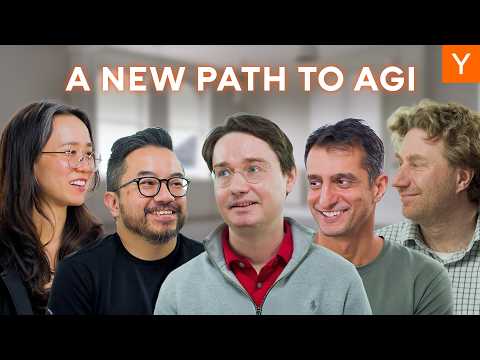
  • François Chollet: Why Scaling Alone Isn’t Enough for AGI

    François Chollet has spent years asking a different question than most of the AI world. Instead of scaling what already works, he’s trying to understand what intelligence actually is—and how to build it from first principles. In this episode of Lightcone, he traces that path from his early work on deep learning to the creation of the ARC prize, and the launch of ARC V3, a new benchmark designed to measure something deeper than performance: the ability to learn, adapt, and reason efficiently in entirely new environments. He explains why today’s systems may be hitting limits, what recent breakth…

    Read the verified transcript → Watch on YouTube ↗

Verified interview transcripts

Notable quotes

“I think when people hear these revenue numbers growing so fast, an easy knock on it is like maybe it's just AI hype and these companies are just like shelling out money for AI products because it's like the cool thing to do. And to be fair, that's probably some of that. But I think like the bull case is actually something that we said in an episode like two years ago when agents were really just beginning to be a thi”

“I mean, that's the true bull case for hard tech. It's not just that people are shying away from funding software businesses, but it's actually that the super smart models that we have now are actually accelerating scientific research and making it possible for startups to have bigger research breakthroughs earlier, and that therefore these deep tech companies will actually work better. I think the other factor is the”

“I mean, we're also entering this moment where AI safety is becoming more and more of an issue at the frontier labs. So the frontier may well slow down to figure out its alignment and containment issues. And then meanwhile, the open source models and open weight models are continuing to grow and get better.”

“Most people in the world still haven't experienced the magic of a coding agent. This is just an unprecedented market. Like the market for intelligence has not existed before. Everybody should be thinking in a positive-sum growth mentality.”

“The other thing you have to do is be willing to spend like $10 to $100,000 a year on tokens. But if you're willing to do it and you invest in the skills and you like actually do everything in an open way with your team that way, like basically what I realized is it allows you to live in 2028, right? Like what you spend $100,000 or a million dollars a year on now, it will be commonplace like in two years, right? It wo”

“We basically have a choice to be made over the next, I don't think it's even that long. I think it's like 18 to 24 months. It might take five years, but there are sort of two scenarios and what comes to mind is literally like the 1984 Macintosh commercial by Apple where it's like is 2034 going to be like 1984? And you know the 1984 case would be we have centralized control. Like there are five kings. There's only, yo”

Other executives at Y Combinator

The summary and quote tags on this profile are produced with AI assistance from verified, first-person interview transcripts, then checked by our team to confirm the speaker's identity and the accuracy of every quote. See how we verify →