CEOInterviews.AI
Start App
Try: AI strategy tariffs earnings guidance layoffs interest rates growth

David Imel

Co-host, Waveform podcast; formerly contributor, The Verge, Waveform

Search every verified David Imel interview, podcast appearance, and on-the-record quote — each transcript cross-checked by AI and human review to confirm speaker identity. David Imel has been serving as a guest host on The Verge's Vergecast podcast while regular host David Pierce is on leave. During this period, he has led discussions on a range of technology topics, including OpenAI's new "Dots" AI agents, Meta's "Muse" assistant, smart glasses from Meta and Snap, Nvidia's DLSS 5, Google's new "Googlebooks" laptops, and the iPhone 18 Pro's camera. He has also interviewed guests such as Linus Tech Tips' Linus Sebastian, Fairphone CEO Raymond van Eck, and The Verge reporters covering data centers, Pokémon trading cards, and smart home tech in college dorms. In his commentary, Imel has expressed skepticism about certain consumer AI products, questioning their privacy implications and practical utility, and has discussed the challenges of smart glasses adoption due to privacy concerns. He has also weighed in on hardware trends, such as the rising cost of RAM and laptop buying strategies, and has shared opinions on topics like the TI-84 calculator's place in tech history. His hosting has been noted by colleagues as a temporary arrangement, with plans for him to continue appearing on the show in some capacity.

Recent appearances

  • Dots get up in Muse's business | The Vergecast

    Is the key to turning around public opinion on AI just to make it cuter? Nilay Patel, Jake Kastrenakes and David Imel talk about the latest adorable agents that want access to all your data, then discuss whether this week's White House AI accord is worth the paper it's written on. Plus: Gadgets, gadgets, gadgets! We speculate on Apple's rumored October 13 announcement, drool over Huawei's camera for your cameraphone, and herald the return of physical buttons in the new Kindle cases. We wrap things up with the usual Brendan Carr is a Dummy and a lightning round full of Cybercabs, data centers,…

    Read the verified transcript → Watch on YouTube ↗

  • We answer your questions about an iPod comeback, an E Ink iPhone Duo, and more

    In this hotline episode, guest host David Imel answers your questions about digital cameras, iPods, E Ink phones, and the TI-84 graphing calculator being iced out of the Version History Hall of Fame. TI graphing calculator Version History episode:    • Why did we need TI graphing calculators?   0:00 Intro 00:29 90 Seconds on The Verge 04:39 Can Smartphone Companies Make Digital Cameras? 08:56 Is it Time to Bring Back the iPod? 16:14 An E Ink iPhone Duo 20:00 AI Hacking and Internet Safety 25:42 Does the TI-84 Belong in the Hall of Fame? 29:17 Wrap Up The Vergecast has been nominated for a…

    Read the verified transcript → Watch on YouTube ↗

  • Dots are OpenAI's cute lil guys | The Vergecast

    Jolly's got new competition: OpenAI just launched its competitor to Muse and Grok Bot. It's called Dots, and the headline feature is that it's also cute, with fuzzy lil triangles and clouds and hearts that you can give access to your personal accounts to do things for you. The Verge's senior AI reporter Hayden Field joins guest host David Imel from San Francisco right after OpenAI's DevDay presentation. 00:00 Intro 00:41 90 Seconds on The Verge 04:49 What Are Dots 07:21 How Agents Differ 10:02 Specialist Enterprise Dots 15:44 Safety and Standards 18:44 Compute Limits and Pricing 20:03 Protest…

    Read the verified transcript → Watch on YouTube ↗

  • Pokémon trading cards are their own economy | The Vergecast

    The Pokémon Trading Card Game isn't just a game, it's an economy. Livestreamers provide vicarious dopamine hits to viewers who tune in to watch them open booster packs, and the rarest cards can resell for hundreds or even thousands of dollars. The game's 30th anniversary collection just launched, putting more copies of the game's rarest cards back into circulation. Guest host David Imel talks about the state of the Pokémon TCG market with The Verge's film, TV and pop culture reporter Charles Pulliam-Moore. Read the full story here: https://bit.ly/4z04eLR The Vergecast has been nominated for…

    Read the verified transcript → Watch on YouTube ↗

  • Meta’s Muse actually does the thing | The Vergecast

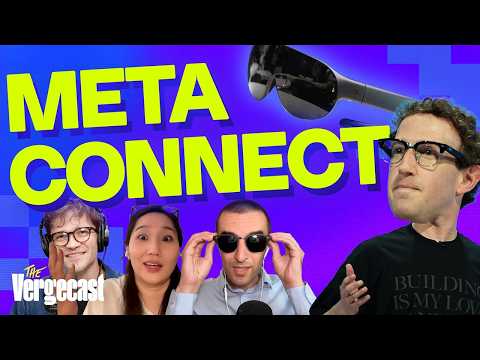
    Meta's Muse AI agent is cute (sometimes caked-up) and it performs well as a productivity tool. And, if you give it access to your social media and e-mail, it can know basically everything about you. This week on The Vergecast, Nilay Patel, Jake Kastrenakes and David Imel give their reactions to Mark Zuckerberg's demos at Wednesday's Meta Connect keynote. They also talk about the new glasses hardware, including the new VR glasses and audio-only, camera-free Ray-Bans. Then, we take a look at the newly-announced, chimeric Chrome/Android hybrid Googlebooks, find out why Brendan Carr is a dummy th…

    Read the verified transcript → Watch on YouTube ↗

  • Meta and Snap battle for your face | The Vergecast

    Meta and Snap both want to get on your face. The Verge's Victoria Song and Jay Peters tried out all the new hardware: Specs, audio-only Ray Bans, and Meta VR. Today, they join guest host David Imel to talk about how these new smart glasses feel, both physically and emotionally. 00:00 Intro 00:26 90 Seconds on The Verge 03:29 Meta Connect 05:02 Muse Agent On Glasses 08:29 Ray Ban Meta Gen 3 10:14 Audio Only Ray Bans 14:19 Meta VR Glasses 19:04 Compute Puck Details 23:50 Snap Specs Hands On 27:36 Will Smart Glasses Catch On 30:06 Final Thoughts And Wrap Subscribe to The Verge: https://bit.ly/3…

    Read the verified transcript → Watch on YouTube ↗

  • DLSS 5 explained, with Linus Tech Tips | The Vergecast

    Nvidia's new DLSS 5 (Deep Learning Super Sampling 5) rendering technology uses AI to (theoretically) improve video game graphics. When it was announced, social media declared that it was "yassifying" video game characters, changing faces in a way game developers didn't intend. Linus Tech Tips' own Linus Sebastian and David Gauthier join guest host David Imel to break down the the hype and controversy. 0:00 Intro 00:38 90 Seconds on The Verge 02:20 From Upscaling to Neural Rendering 07:46 Does DLSS 5 Take Creative Power Away? 10:46 Hardware Costs and Adoption 22:52 Nvidia’s Mixed Messaging 30:…

    Read the verified transcript → Watch on YouTube ↗

  • Googlebooks are coming for your Mac | The Vergecast

    We tried out the new Googlebooks, which are essentially Chromebooks evolved with an Android elemental stone. They're made by Dell, Lenovo, HP, Acer, and Asus (not Google), but all have the new Googlebook OS, heavy Android phone and Gemini integration, and a built-in "Glowbar." Laptop reviewer Antonio G. Di Benedetto went hands-on with the new devices, and reports back to guest host David Imel. 0:00 Welcome and Setup 00:37 90 Seconds on The Verge 03:29 What Is Google Book? 05:55 Phone Integration Features 07:08 Preorders and Launch Timing 11:34 Models Pricing and Specs 14:38 Why No Google Hard…

    Read the verified transcript → Watch on YouTube ↗

  • The real story of the iPhone 18 Pro's camera | The Vergecast

    This week's iPhone 18 Pro discourse made aperture a priority, but today on Vergecast we zoom out to talk about the state of smart phone photography at large. Executive editor Jake Kastrenakes, guest host David Imel and senior reviewer Allison Johnson get into manual controls, "buckets of photons," and Apple and Google's strategies on how to prove a picture you took is real. Then, senior AI reporter Hayden Field returns to The Vergecast, just a few new revelations of misaligned behavior since her last appearance. She breaks down who's calling for a slowdown, who's full steam ahead, and the pris…

    Read the verified transcript → Watch on YouTube ↗

  • We unfolded the iPhone Duo | The Vergecast

    Apple did the one more thing: This week it announced its much-anticipated folding phone. It also announced some surprising and controversial new AI features for Apple Watch, including "Live Rewind," which gives the user a text transcript of the last 15 seconds of real life. On today's Vergecast, Allison Johnson and Vee Song report back from California after having more hands-on time with Apple's new devices. Plus, Nilay Patel and David Imel take another swing at discussing Mac Minis and local LLMs with AI researcher CJ Trowbridge. Finally, Allison and Jake tackle some non-Apple stories in the…

    Read the verified transcript → Watch on YouTube ↗

  • What’s happening with US data centers? | The Vergecast

    Data centers have been a staple of Loudoun County since the early dot-com boom, but recent expansions have left some residents wondering how much more the county can take. In this episode, guest host David Imel talks to Lauren Feiner about her recent article detailing the buildout of “Data Center Alley,” what it means for residents, and what other counties reeling with similar buildouts can learn from it. Read the full story here: https://bit.ly/4cqvudJ 00:00 Intro 00:36 90 Seconds on The Verge 02:15 How Data Center Alley Began 03:09 What Data Centers Do 05:32 Tipping Point for Residents 07:…

    Read the verified transcript → Watch on YouTube ↗

  • What the AI overlords get wrong about being alive | The Vergecast

    Elizabeth Lopatto recently wrote about Mark Zuckerberg's 6,500-word AI manifesto in her piece, "Mark Zuckerberg doesn't understand how to live." Today, she joins guest host David Imel and senior wearables reviewer Victoria Song for a freewheeling discussion about what happens when we let AI make decisions for us. 0:00 Intro 01:10 90 Seconds on The Verge 02:37 Zuck’s Manifesto Context 04:24 New Tools to Express Our Ideas 08:23 Everyone Can Create a Business 10:35 Experiencing Minds in Art 19:19 Is AI Replacing Effort? 25:05 AI Can’t Give Wisdom 29:42 Hobbies Require Friction 33:41 Loneliness a…

    Read the verified transcript → Watch on YouTube ↗

Verified interview transcripts

Notable quotes

“The whole argument for dots is it costs money, right? And so if I'm paying them money, I can be demanding as a consumer and probably they will understand they should not do horrible privacy violating things. Now, does OpenAI violate the privacy of like dozens of British mathematicians every week? The for some reason that's a thing they've decided to start doing and they're like stealing the answers to the tests and t”

“They talked about the fact that, you know, this is going to be really secure, really private, really trustworthy. But I was chatting with Glenn Coats, um, the head of app platform at OpenAI in a one-on-one interview today, and he said that he thinks they're in a different position to Meta in that, um, they since they have 1.2 billion users, um, they want to launch something that doesn't make those types of mistakes. ”

“I think the more that they increase production, the more sales there are going to be. I don't know how much the Pokémon Company would have to be printing in order to fully stamp this problem out. There are a few different solutions that they could take to try to address the issue. Printing more rare cards is the easiest, right? Like you flood the market with these things and then their value tanks. I don't think it's”

“So, like I mentioned earlier, buying things online is very difficult. In large part because the reseller economy has sort of adopted these tools that make it easy for them to accumulate product in bulk in a way that your average person can't. So, when you hear people talking about bots, what they're talking about are automated programs that basically brute force their way through sales where the bot will continuously”

“The entire point of the glasses is to blend into your face. And much like when you're using your phone and it is obvious to other people that you're not paying attention to them because your attention is being directed in a specific vector towards your phone down at your phone. Generally when people are recording on their Ray-Ban glasses, they just click it really quickly and then they kind of go about their day. And”

“The long story short is that I've always been a skeptic of smart glasses despite, you know, being the wearables lady testing all of them. There are times and use cases, specific enterprise or work-based use cases, and I think this is true for all AI wearables where it makes a whole lot of sense. But when you have a company with certain incentives for engagement where they want you to be using it all the time so they ”

The summary and quote tags on this profile are produced with AI assistance from verified, first-person interview transcripts, then checked by our team to confirm the speaker's identity and the accuracy of every quote. See how we verify →