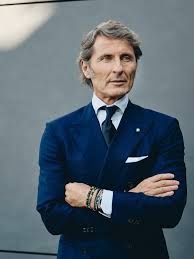
At the end of the day, you have to have an approach which is coherent, which has a strategy, a long view, and for sure you have to create the critical mass to reinvest into the future of the company. To die in beauty is something which is not paying off. But we have a design DNA, but there are two rules in the design of Lamborghini. One is that every car has to be very different to the generation before, and this is one of the key elements which we need to continue to work on. The second rule is that there must be some elements which make the cars recognizable even if they are different in terms of design. You have to be a rebel with a cause today. You can't be a rebel and that's it. No, on the other side, with the politically incorrect, it's very difficult to stay sharp and to be different, and for me this is something which we have to continue to pursue and to really foster and not to be in a cage of the moment of the fashion. We have to be the trendsetters. We have to be able really to be the ones which are aspirational as a brand also in the future. I'm Stephan Winkelmann and this is Cars and Culture with Jason Stein.
What a pleasure to be here in this beautiful setting with you, Stefan. Congratulations on another Pebble Beach and another Quail. You always save the best news for Quail. What is it like for you to be back here enjoying this beautiful time and these beautiful places and of course a big launch too?
I think for me it's the 20th year that I'm coming to Pebble Beach, the Monterey Car Week and the Quail Lodge. So for us, not only because the US is the most important market but also because this week especially is one of the most important ones in the year in terms of customer relation, press contact, and also environment. And therefore at the Quail in the last years we always had world premieres which is something which paid into the brand and so far it was very positive for us. And yesterday when we were at the Quail we had this unveiling and again I think we were the talk of the day.
Phenomenal, right? That's the vehicle. Tell me a little bit about the development of this vehicle. I know you're only going to do 29 units, $3.1 million. Is that right?
3.5. You know, we started with the few-off almost 20 years ago with the Reventon at that time. We had two models, the Gallardo and the Murcielago. And we had a discussion with our engineers and the designers and also with the marketing guys. They told me, 'Yeah, we need to do something special because with two cars, we only can show so much, but we have so many ideas. Let's do something.' And then we said together also with the sales department, at the end of the day, we decided we do it. But I said we only can do it if we sell them before we start with the project. And this worked. So that went on was a huge success. It was the first time we did this and it's really paying into the brand. It's design and technical innovation and this is holding on until now and also with the phenomenal still we have the same approach and we pre-sold all the cars before presenting it.
Amazing. Amazing. What was the reaction yesterday?
I was on stage presenting the car. So I always get a sense, an immediate sense of the feedback and it was very positive. So the applause was there. Everybody was there with their phones filming and then I was really attacked as soon as the press conference was over. Everybody wanted to see the car. So it was really good and I checked constantly. I started yesterday evening and also this morning. And once in a while I look into and speaking also to our press guys how the feedback is and it's very very positive also in social media. So we did the right thing.
It's kind of the ultimate expression, a design manifesto as I guess the way that Lamborghini describes it. Stylistic elements to the extreme. Is that what you wanted to really show here? Unique design, custom aerodynamics, and a V12 which is the most powerful V12 in Lamborghini's history, which says a lot when you talk about Lamborghini history.
Right, no, it's two things. One is the design always to showcase what we can do by doing every time something unexpected and different, and on the other side it's innovation. So these two, the combination of the two things, which is part of the DNA of Lamborghini. If you ask, give me a definition of a Lamborghini car, it's about design, performance, and technical innovation. And I think this has to be inside those cars. And it's also a bit of an anticipation of what might come next, at least to some extent. And therefore, it's a very important use case, but also a business case. And we want to continue to do those things once every 3 or 4 years.
Wonderful. Lamborghini. When we talk about 20 years of you being at Pebble Beach and at Quail, we talk about your own history of 20 years ago with the brand. How much has the brand changed during that time? I mean, you've grown exponentially, but what was the vision for Lamborghini when you first took control of it? And maybe what developed, what changed?
But we were when I first joined in 2005, it was clear that we needed to work on the two most important things which is the brand and the product. And on the product, for sure it was always to get the people to buy something which is exceeding the expectations. Always it has to be something which is better than your dreams and you never buy mobility when you drive a Lamborghini, but you buy a dream car. And this is one thing. So technical innovation, design, the combination, and always the recognizability of a car immediately, even if you don't know what type of model it is, you have to understand that it's a Lamborghini by always changing drastically the design. This is one thing and we worked on this including all the derivatization, so having open cars, faster cars, lighter cars, this was one of the things together with the few-offs now to start to have a history which is consistent in terms of feedback from the customers, in terms of presence in the media. And then for sure on the brand, we said we have to have a very clear and easy message. So the colors, we went away from the yellow, we picked only black and white, and we said for at least one decade Lamborghini is uncompromising, extreme, and Italian, and this should stick. And this was a very clear and sharp positioning. And once you have done this and once this was going into the mind of the people, we were also when we started to work on the third model, the Urus, we wanted to be more open. So we had to change the approach. So the brand is something which is constantly moving now. And today we say when we speak about the brand, it's brave, unexpected, and authentic. And this is what also is the history of our founder. When you want to change things, you have to be courageous. You have to be brave. And then you are unexpected. But being unexpected is not enough. You have to be true to yourself. So the authenticity and these are the things where we are today and this is also reflecting in our models. Now we have three models. They're all successful. We moved from internal combustion engines only into hybridization. So it's really something which is on a constant move. You never stand still. There's always something to do.
I want to talk about hybridization in a moment. But I also want to focus on Urus and what Urus meant. It was a game changer really for the brand. There were some purists who doubted it. But it became a bestseller. How did that decision come about? What was the pathway to develop a vehicle like that? And was it a big risk?
I start with the end. No, it was not a big risk for me personally. I was convinced 100% that this was the way to go. We are a super sports car company. Yes. But if you look into the history of Lamborghini, Lamborghini did GT cars, super cars as we do also today. But we also did cars like the LM002. So back in the 70s, beginning of the 80s, there was this first SUV, first luxury SUV which was a very exclusive car which was done by Lamborghini. So we showcased already at that time that we could do more than just the pure supercars. So this was therefore in terms of the segment, in terms of the idea of putting it into a Lamborghini was for us set. We analyzed all the segment and the opportunity. So we were the first ones to get into it and we created the subsegment. And to the purists at that time, also when we moved from one model to two models when we started with the Gallardo, there was also the discussion that no, there will always be, but at the end of the day you have to have an approach which is coherent, which has a strategy, a long view, and for sure you have to create the critical mass to reinvest into the future of the company. So to die in beauty is something which is not paying off.
Mhm.
The hybridization piece of this, there's been so much talk of electrification in the midst of a major shift that's going on and the pendulum that goes back this way and then the pendulum comes back this way especially in this country now obviously with some of the latest news. I know electrification is no longer a question of if, but when and maybe even how. Where do we sit now that you're fully hybridized across all of your products and were considering maybe still considering electrification?
So the most important decision we took is to hybridize all the lineup. At that time there were people telling us you are very late in doing this, you should go electric or not, but you're late. And we always said we don't need to be the first ones in doing these type of things because this is not about Lamborghini, it's about when are we ready to do a perfect car which is combining sustainability with more performance. Because the promise we made to our customer was easy: when we go hybrid, we will be more performing than the generation before. And this is something which immediately gets into the brain and it's something which is clear and acceptable. So we did this and we have all the lineup which is very successful and hybridization is accepted. We are constantly making analysis on the acceptance of the full electric cars and we're not speaking only about the United States. We're speaking worldwide how this is moving also in terms of regulations and the acceptance curve is flattening generally speaking, and this is even more valid for our type of cars. So we took the first decision that the follow-up of the Urus is going to be again a plug-in hybrid car. We are working on the model number four and here we have not taken a decision so far. So the model four is still there, there are various things under consideration as it relates to that is basically what you're saying. Yes, we decided on the type of cars, on the body style. Because when we look into the super cars or the luxury cars or the sports car brands, then everybody has a Gran Turismo or GT car and this we had in the past and this is missing today. So this is the car we are going to add to the model lineup. So we will have two low flat super sports cars, we will have the SUV, and then we will have the Gran Turismo, the GT which is a two-door two-plus-two seater. The only open topic is the type of engine we are going to use.
Design has always been so central to Lamborghini. Aggressive, unmistakable, emotionally charged, to some extent. How do you define where Lamborghini's design language is today and maybe where it needs to go?
We have a design DNA. But there are two rules in the design of Lamborghini. One is that every car has to be very different to the generation before. And this is one of the key elements which we need to continue to work on. The second rule is that there must be some elements which make the cars recognizable even if they are different in terms of design. One is this tense line which is going from the front of the car until the rear. And the other one is to have a squared greenhouse, not this bubbly greenhouse which other brands have, but a square one. And for us, which is a bit difficult to understand but it's the key element, is that for us function follows form and not the other way around, because we think like Aristotle has said that form is substance itself. So for us, being a made in Italy car, the design is so predominant that it has a really immense role.
There's so much emotional connection among owners and the brand. They feel it. How much of that is engineered and how much of it is intangible?
The fact that you have to instill in our clients the DNA of Lamborghini, which is very often they have more than we have as employees or as people which work in Lamborghini in the brand and the factory, is that we have to exceed everything what the imagination is able to do. So we have to continue to work where the others stop. We have to go the extra mile to fulfill what is necessary. So it's clear that heritage is what is intangible. If you come from the Countach and you see the Aventador, you have an idea that it's clear. It's the kept forward design, the scissor doors, the fact that you have this tense line. All these things they give you an idea of continuity but also a clear cut. And this is what we have to tell them. So it's a lot. I'm not saying storytelling because storytelling without the substance would be very soon spoiled. So you have to walk the talk. This is in my opinion the key element. Better to do less but to do it right than to try to do everything. And the authenticity is something which our customers are appreciating. I don't know if I answered, but it's very difficult to nail it in a couple of words.
For sure. Our listeners probably don't know much about you. I've known you for a long time. You were born in Berlin but primarily raised in Rome. And you did your studies in Munich. How did your upbringing shape your path into the automotive world?
Where did all this come from?
My father was a diplomat. So we moved to Rome when I was a baby. And I was always more into motorcycles as a kid because growing up in Rome there was no helmet law, so there was absolute freedom. It was a good time. And I was very much interested in history and politics. So I studied political sciences and I wanted to become a professional soldier. So I volunteered, went to the paratroopers. And then I discovered after two years this is not my destiny and I left as a lieutenant. And I finished my studies in political sciences in Munich. And for me it was a no-go to go into journalism or politics or diplomacy or staying at the university. So I had to reinvent myself because my dream changed over that year. So by chance I started to work in the automotive business. I had a traineeship at Mercedes and then I went to Fiat Auto. And then they called me to run Lamborghini. And at the beginning I was also a bit not scared but I said I'm happy with what I'm doing now. But then I said to myself this is an opportunity which is once in a lifetime. So I never regret it. So I'm happy that I did it and that I had the opportunity to be part of a team which is acting globally, which is doing the approach 360 degrees from development, purchasing, production, marketing and sales, now also the responsibility for profit of the company. So this is something which for me is where I feel blessed because I had the opportunity to be there or to get in.
You couldn't have imagined where you are today, sitting here and going back to the start, I would imagine.
No. And maybe this is also a message. When I did a commencement speech some weeks ago, I said it's not always the plan which is important. You have to be flexible and you have to make the difference. You have to be active and you have to work hard, but you also have to think positive. And sometimes who has not a predefined dream can easily adapt to new situations than the ones which are maybe not fulfilling the dream and have a difficult time to find a new frontier. For me it was happening with my military stuff, but at the end of the day I'm happy how the things worked out.