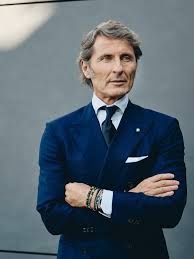
A Fiat Uno I bought with my military savings. Last year we exceeded 3 billion in revenue and we are reassessing the decision on the first electric car that was supposed to arrive in 2030.
In 1963, the son of two farmers built his first car in Sant'Agata Bolognese with a bull on the hood. Today, Lamborghini is a 3-billion-euro brand with legendary cars like the Miura, Countach, and Aventador. We came here to discover the story of CEO Stephan Winkelmann, who grew revenue from 240 million to 3 billion in 20 years. Let's start from the beginning.
It was born in 1963. Founder Ferruccio Lamborghini was already a successful entrepreneur with tractors and a sports car lover. He was unsatisfied with quality and went to complain.
I wasn't there, but it's said it was Enzo Ferrari. He wasn't heard, so he founded this company. The first super sports car was the Miura in 1966, then the Countach in 1971 with its scissor doors and boxy design.
The Diablo came in the early 2000s, then the Murcielago, the Gallardo called Baby Lambo, and the Urus SUV were revolutionary. Revenue decupled from 2005 to 2025 thanks to Stefan. So, what was your childhood dream?
I wanted to be a career soldier. My father was a diplomat working at FAO in Rome. I was born in Berlin, moved to Rome as a baby, and attended German school.
I studied political science at La Sapienza in Rome and then in Munich. I did two years of military service, then worked in financial consulting for a year, which helped me understand what I didn't want to do.
In 1991, Stefan graduated, worked at MLP, spent 9 months at Mercedes, and entered Fiat in 1994. He became Alfa Romeo sales manager in Germany, then led the commercial launch of the Alfa 156 across Europe and South America. His mentor Mario Bernardi taught him to never give up.
Never give up and always show up, even when you think you can't make it. We had many high-pressure meetings presenting imperfect things. That lesson still applies. At 39, I became CEO of Fiat in Germany. Then at 40, I got a call from Volkswagen to lead Lamborghini. I accepted and never regretted it.
It was with Martin Winterkorn, then CEO of Audi and later Volkswagen. He asked about numbers—I said I came from Fiat, where we talk only numbers—and some personal questions. Years later he told me he felt a good match with the brand.
When I arrived in 2005, we had 600 employees building about 1,000 cars a year with 200-300 million in revenue. We worked on quality, stopped the line, changed the Gallardo's horsepower, and defined the brand as extreme, uncompromising, and Italian. We launched a new product every year. The Aventador in 2011 was a turning point, then the Huracan, and the Urus—which required a massive investment for a third model.
From 2005 to 2016, Stefan grew revenue from 240 to 900 million by investing in quality, launching at least one car per year, and introducing the Urus SUV. In 2016 he left Lamborghini.
21 more exchanges in this transcript
Sign in free to read the rest of this interview. No card required.
Winkelmann, S. (2025, November 19). Il CEO di Lamborghini: la Supercar Italiana da €3 MILIARDI 🐂 Stephan Winkelmann [Interview transcript]. Chapeau. CEOInterviews.AI. https://ceointerviews.ai/interview/1017024/
MLA
Stephan Winkelmann. "Il CEO di Lamborghini: la Supercar Italiana da €3 MILIARDI 🐂 Stephan Winkelmann." Chapeau, 19 Nov. 2025. Transcript, CEOInterviews.AI, https://ceointerviews.ai/interview/1017024/.
BibTeX
@misc{winkelmann2025_1017024,
  author       = {Stephan Winkelmann},
  title        = {Il CEO di Lamborghini: la Supercar Italiana da €3 MILIARDI 🐂 Stephan Winkelmann},
  howpublished = {Interview transcript, Chapeau. CEOInterviews.AI},
  year         = {2025},
  month        = {nov},
  url          = {https://ceointerviews.ai/interview/1017024/},
  note         = {Speaker-attributed transcript with timestamps}
}