In 2024 we achieved revenue that for the first time exceeded 3 billion euros, with a profit of 835 million, so important with a ROST of 27%. And we have more than 3,000 employees.
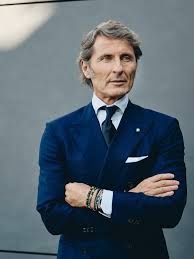
Good morning and welcome back to Money Vibe Stories. Today we have the pleasure and honor of having Stefan Winkelmann, CEO and President of Lamborghini. We are at the Bologna headquarters of Resto del Carlino. Welcome.
So, we could talk about Lamborghini for three or four days without a break because it is part of the imagination, dreams, and also a lot of technology. You are one of the companies that does the most research. A global market. Is there any place where you are not yet with your cars? I don't think so.
I don't think so. Well, today we have 186 dealers, covering 56 countries, where the United States counts as one nation, and we have a very balanced distribution among macro-regions: the Americas, Europe, Middle East, Africa, and Asia Pacific. There are no major open points or great opportunities. The market for sports cars or luxury vehicles accounts for about 0.2% of the global automotive market, with 80 million units.
These are types of cars that need to be cared for, pampered, requested in advance. It's not a car you buy overnight, also because of the type of car. This creates a relationship with the buyer that is also emotional, perhaps a bit more complicated because...
It is much more complicated. Naturally, the most important thing together with the product is the brand, safeguarding the brand, having a balance between the waiting period for the car, which today is between one year and a year and a half, and the residual value, so the used car value. The higher the residual value, the better it is for the customer and also as an investment. What matters today is that we don't sell mobility, we sell dreams. So we have to try to create cars that are beyond the imagination of our customers and fans. Once someone buys a car, they become part of a club, a circle of people who love these types of cars. Naturally, part of our work is exactly that: entertaining our customers, organizing events, track events, off-road drives, and naturally inviting them to the factory, inviting them around the world to extraordinary events. This is now part of what we call 'Money by'.
It's a connection that is increasingly tight. You come from a small town in the province of Bologna, Sant'Agata Bolognese, part of a large group, the Audi Group, German. There is this combination of Italian craftsmanship and a global automotive group. Is it complicated to make these two worlds work together?
Well, first there is a history. Ferruccio Lamborghini founded the company in '63. He himself, or rather the family, stayed in the company for just under 10 years, then it passed from hand to hand, first to Swiss entrepreneurs, then an Indonesian fund, there was also Chrysler in the middle in the 80s, until arriving in 1998 at the Volkswagen Group, of which Audi is also a part. And I must say that this gave stability to the company. Since those years it has grown every year. In 2024 we achieved revenue that for the first time exceeded 3 billion euros, with a profit of 835 million, so important with a ROST of 27%. And we have more than 3,000 employees, and we deliver just over 10,000 cars. We did this both in 2023 and 2024, so a company that is living the best period in Lamborghini's history. What is specific to Lamborghini today is, on one hand, technology, but also the know-how, the beautiful, the well-made, and on the other hand, we have excellence in engine development, carbon fiber, aerodynamics, and naturally increasingly also the combination of hybrid with the thermal engine.
This is a big topic, also because people think that supercars or cars of a certain type are actually incompatible with electricity, with future engines. Where are we today? Does an electric car speed?
No, today we have kept a promise we made in 2021 to have the entire range hybridized, with a very simple promise. Hybridized means plug-in hybrid, so you can recharge the batteries with a plug. With a simple promise: every new car we make will have incredible design, be completely new, be more performant than the previous generation, and have lower CO2 emissions. We started in 2023 with the Revuelto, then the Urus SE, and this year, at the end of last year, with the Temerario. So we kept the promise, and customers are following us. We have a waiting list of a year and a half, so it's a very positive thing. We use hybrid for acceleration. Yes, it also has full electric range, but in the end we don't call it plug-in hybrid, we call them high-performance electric vehicles. So the battery serves, in a company like ours, much more for a boost, for acceleration.
Yes. So, your cars were also the first to experiment, among other things, with the use of carbon fiber. I myself came to you, I saw that you do very harsh things to the cars, you throw things at them, you make them get struck by lightning. How did this come about? Maybe it wasn't even thought possible to build a carbon fiber car. And today, what are your cars like?
Well, carbon fiber has two values. On one hand as a structure, it is light, very rigid. This helps the weight-to-power ratio and torsional rigidity, which is very important in sports cars, especially when you go on the track, when you exit curves. And it also has an aesthetic value, so a car completely in carbon fiber is something that is very appealing. We have the ability to do both, but the most important thing is that the monocoque of the Revuelto is made of carbon fiber. And this makes the cars performant and lighter.
The other great legend about Lamborghini, beyond the beginnings, is that there are engineers who, even from a distance, can tell from the sound what is happening, that almost everything is a matter of acoustics despite the technology. Is that still true?
Yes, today it is very easy to recognize an 8-cylinder, a 10, a 12. Our engineers have this ability, which is no longer necessary, of course, but anyone who loves these types of cars can tell from the sound what kind of car or engine is passing.
So, in the world of Lamborghini, there is also particular attention to design from the beginning, colors that are well recognizable, and a whole series of customizations that have made it. How far can you go? Have they asked you for cars with particular things?
It's part of the history, the colors of Lamborghini. When the Miura was born in the 60s, cars were mostly gray, blue, or black, very dark shades. The Miura was the first to have yellow, orange, green, bright colors. And from this comes the myth of Lamborghini colors, which doesn't have a specific color. We have a lot of black, yellow, since the 60s, but today we have 400 colors to choose from. It is increasingly important for the customer to have something that differentiates them from others. The problem is for us because industrialization and logistics are very complex, so everything we do is well accepted, it's never too much for our customers. We call this program 'Ad Personam' and it is working very well, not only for colors but also for carbon fiber, materials, and stitching.
Listen, you are German, but you speak perfect Italian, you grew up in Italy, you have a history with Italy.
Yes. I was born in Berlin, my parents moved because my father is a diplomat, he worked at the FAO, the Food and Agricultural Organization, which has its headquarters in Rome. So they moved when I was a newborn, and I went to the German school in Rome.
And when you were little, did you want to be the president of Lamborghini?
No, I wanted to be a career military officer.
A career military officer. And how did you get into the automotive world?
Well, after a certain period I realized it wasn't my choice for life. I studied political science, and I entered the automotive world by chance. First I was at Mercedes, I did a traineeship in sales, then they were looking for bilingual people at the Fiat group, at the time it was still called that, and I entered Fiat. I was at Fiat for 11 years. Then I was called by Audi and they asked me to become CEO of Lamborghini. That was in 2005. So I did 11 years at Lamborghini, then I was head of Audi Sport for a period, then I did Bugatti, and I returned at the end of 2020.
And the Lamborghini world, I imagine, even for someone coming from other groups, is immediately noticeable for its particularity. It's a very small, highly specialized company, with cars that require care and long production times, and a world that in some way lives entirely in one factory. Do you spend a lot of time in production? Is it a world apart, as it seems from the outside?
Well, a bit yes, we are a bit of an enclave in a small town called Sant'Agata Bolognese, northwest of Bologna. Clearly, we go to the factory every day, not only to move from one meeting to another but also to see details that are happening in production. We have many meetings not only on vehicle development but also on what is happening in the market. There are challenges to be addressed.
Well, among the challenges that have been successfully overcome, there is also the relationship with employees, which has become historic for some things. There is important welfare, a dual system that was unknown in Italy, borrowed from Germany, and today the Lamborghini system is still talked about. Is it really like that?
Well, it's a hybrid system, not a true dual system as we know it in Germany, but we have an excellent relationship with the unions. This has been the case since I entered, I must say it's not the merit of a single person, but a team effort on both sides. There is strong understanding, but also the fact that promises have always been kept, even in the most difficult times.
Where do you think the automotive market can go today? There is a lot of talk about automotive, a world that brings with it a huge supply chain, and we talk about the future of the car. What is your vision of the future of the automobile?
Well, if we talk about super sports cars, it's a very separate vision from what is happening in the world. So, I see today a world that is taking steps back from globalization. I see a world that is more regionalized. Now, regarding the problem of development and market acceptability, large brands will increasingly have local sites in the macro-regions of the world. This will mean that suppliers will be more local, cars will be created more for local taste, and it is changing. In general, I think that cars are still the main means of transport and will be in the future. There are mega-trends, apart from electrification, autonomous driving, and digitalization. All this will make access to cars easier, create opportunities to better use available spaces and infrastructure. So I strongly believe that it will continue to be a point that corresponds to freedom. The car is changing a lot. The transition to electric is not easy. It's not easy for several reasons, not only for what we are experiencing here in Europe or the European Union, but also because for homologation, emissions, there are many rules that are different from European ones, both in America, South America, and the rest of the world. This needs to be resolved, in my opinion, to facilitate the task of large manufacturers. But we are moving from a globalization that seemed the beacon for any type of market to a return to regional characteristics. This is the current trend. Then after Covid, things have changed a lot. There are cycles that pass. I believe that sooner or later we will return to clarity on what is important. I think that globalization, now I speak for Lamborghini, is a condition here, not for success, because Made in Italy is what we do. We do not export something that we then produce locally, both for size and because the customer requires this. With trade barriers, modulations, different rules, this will become increasingly difficult. However, I think that sooner or later we will return to a globalization as originally envisioned.
But does Made in Italy still really matter? I mean, the fact that this car is made in Italy, I think of the American market but not only, does it have added value or do we tell ourselves that because we like to say it?