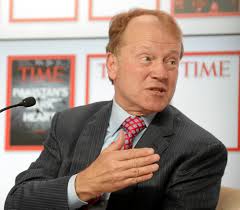
I think there's not going to be a major company either established or new startup entrepreneur that doesn't have AI as a broad-based foundation. They have to have an AI first mentality and it's got to be a platform on which they build everything else around. I don't invest anymore in a company that doesn't have a real good AI strategy and well into its implementation.
Good morning, good afternoon, or good evening depending on where you're listening. Welcome to a special episode of AI and the Future of Work. I'm your host Dan Turchin, CEO of PeopleReign, the AI platform for IT and HR Employee Service. Loyal listeners know we've published more than 300 amazing conversations over the past five years. To those joining for the first time, where have you been? Welcome to a community of more than a million AI enthusiasts. If you want more insights and of course fun facts, dig into the archives and of course sign up for the Weekly Newsletter. Both links are in today's show notes. No AI fun fact or listener mailbag today. We're going with a different format. I have questions for the guest, then as part of today's big announcements from PeopleReign, our guest has a few questions for me. Let's jump right in. We've met unicorn CEOs, Nobel laureates, Pulitzer Prize winners, and AI pioneers. We've never met a guest who has had more impact on how we live and work. Today's guest is a legend in business in tech who has changed more lives than any elected official, pop star, or dare I say monarch. Under his leadership, Cisco Systems built the infrastructure of the internet and grew from $70 million to $49 billion in revenue and from 400 to 75,000 people. Cisco is a perennial leader in customer satisfaction and is consistently ranked a best place to work. Today's guest personally oversaw 180 acquisitions and correctly predicted more market transitions than anyone along the way to creating one of the most successful companies in history. Time named him one of the 100 most influential people. CNN named him one of the 25 most powerful people. I call him an investor and a friend. Without further ado, it's my pleasure to welcome John Chambers, former CEO of Cisco Systems, founder of JC2 Ventures, and chairman of the US-India Strategic Partnership Forum, to AI and the Future of Work. John, let's get started with your backstory. I've read your great book Connecting the Dots, but for those listeners who haven't, share a bit about how you got to where you are today.
Well Dan, first for the kind introduction, extremely nice on your part. Like many leaders, we're also a product of our challenges we face and how we dealt with those. I've seen every movie at least twice and I've made every mistake at least once, but what you do is you learn from them and make yourself stronger. In terms of the backstory, I grew up in West Virginia, son of two doctors. West Virginia at that time was the coal center of the US and also the chemical center with 7,000 engineers in Charleston, West Virginia. Chemical engineers, FMC, DuPont, etc. More millionaires in the state than all the United Kingdom, tremendous economic success. And because we didn't reinvent ourselves, we fell behind. Instead of being at the top of most lists, we were in the bottom 10% of almost all the US states. We're now turning that around. But I learned painfully: if you don't disrupt yourself, you get disrupted, and the implications are hard. Went to IBM when they led mainframes, saw that those who led in a given technology didn't lead in the next technology. Many computers, I was with Wang, there was Data General, a number of players. Then to client-server, then to the internet which we led at Cisco, then to the cloud, and now to AI. So I've watched market transitions occur and they have very much similarity. Connecting the Dots is my way of telling the story. I'm dyslexic by background, so I kind of tell it in a way that has each chapter on how to do acquisitions, how do you do culture, and then at the end of the chapter, Cliff Notes if you will, here are the key takeaways that you might want to see. I love challenges, I love competing almost to a fault, and I enjoy building great organizations. Out of our 22 startups, we now have nine unicorns already. We've had two of the top three exits in the last two and a half years out of the market M&A with OpenGov and Pensando, top defense M&A exit with Drone getting acquired, and one of the really hot startups, Rubrik, Bipples company doing an amazing job. So it's been in what was a very tough couple years for venture capital. We are more of a strategic partner, more of a coach than venture capitalist, but our financial returns have been very fortunate as well.
John, you talked about so many of the platform shifts that you've been a part of, many of which you predicted. Let's talk about the shift to AI first workflows, AI first apps. What's different this time around?
Well, I think if you watch out of all the platform changes, Dan, you articulated and I covered, there have only been two that would change the way you work, live, learn, and play. When I said that early 90s on the internet, that was when Jeff Bezos's biggest issue about explaining what Amazon was doing was selling over the internet. He had to explain to people what the internet was. And yet when we said this would change every aspect of our lives, which now looking back should have been easy to call, but no one did. They said, 'You're moving around zeros and ones over routers, what does that have to do with work and the way we live and the way we learn?' I think we now realize it. So the parallel with the internet to AI is going to be, I think, very similar. If you want to know what's going on in AI, you look purely at what is Nvidia's earnings, how are they doing, how fast they're growing. If you wanted to know how the internet was growing, you would have just looked at Cisco revenue growth and earnings for over a decade. I think we're at the very early innings of it, and I think they're going to parallel. Those will be the two technologies that not only allow business and personal market transitions enabled by the technology. The difference is AI will move at probably five times the speed and three times the impact. In simple terms, a startup that used to take five years, two years to build a product, a year to get five to seven references, get a million run rate, a year, three, two more years up to 5 million, your unicorn. That will occur in 12 to 18 months today. Speed, impact dramatically different. It's breathtaking. So we'll see how it goes, but I'm extremely optimistic on how it's going to change our lives, mainly for the better, even though it does have key challenges.
Yeah, John, building on that, I've heard you talk about how AI first companies get to market faster for less investment, they're more innovative, they're a lot of advantages. So talked about nine unicorns so far in the JC2 portfolio. What do you look for in companies, specifically AI first companies?
So the first thing I look for is a business model change that is occurring, like Amazon selling books over the internet and they will buy a new technology, the internet. So I look for the business models. Now the neat thing about AI first, every industry, and in my predictions for 2025, I said 2025 will move from most of the people on this podcast to AI is not change the way that they work or play or learn yet. That's about to occur. And in PeopleReign, as you know, you're using that very uniquely in terms of the approach. I think by the end of this next calendar year, it will be across all industries and many of the people both in this country and around the world will already be experiencing in their work and their personal lives either through a next generational personal assistant, an Alexa type device with AI capability from companies, or the way their car is driven or their new mobile phone operating system is able to do things they've never envisioned before. So I think that's going to go across all industries. Second thing I look at is a CEO. Does she or he have a great vision? Do they understand where they're going to go? Do they have a culture that I really believe in? And do they want to be coached? That's one of the reasons, Dan, I invested in you is I believe that you all hit all those. I then go to customers. Steve Jobs did an amazing job at building products, but he just somehow knew what the customer wanted. I'm a business-to-business person, so I go straight to the customers and say, 'What do you think about this technology? What do you think about this company?' And usually if a company has as few as five or seven customers, I'm going to know one of them and say, 'What do you really think?' Overall, then I try to catch them near an inflection point where there can be a sudden increase, if you will, to three years ahead of time, i.e., call that market transition. And does the company have short-term and longer term sustainable differentiation if they execute well? And then I end on culture. We often tease, if it weren't for customers and people, this would be an easy business to run. In each of our industries, it's all about customers and people in terms of what you do and the direction you go.
So you're talking to a lot of entrepreneurs who are always chasing elusive product market fit. We talked about the early days the internet and Bezos and disrupting a market, and you also said every market is right for disruption in an AI first world. What's your advice to entrepreneurs who are looking for that Bezos book-selling online kind of disruptive opportunity?
Well, the first thing, I think there's not going to be a major company either established or new startup entrepreneur that doesn't have AI as a broad-based foundation. So today's world, if you don't have that place in your startup, your funding evaluation is going to be half of what it would be in a traditional software as a service type environment or operating system type of environment for the same business case. And I think you've got to have this not as a check-the-box, but what were you going to do that differentiates you? How do you gather your data? How do you really bring that to the market? And so I think about what this is going to mean in terms of entrepreneurs. They have to have an AI first mentality and it's got to be a platform on which they build everything else around. I don't invest anymore in a company that doesn't have a real good AI strategy and well into its implementation. The second thing is speed. You've got to disrupt yourself, Dan. It used to be that if you as a CEO had a new strategy and vision evolution every 18 months, I would say, Dan, my career for 40 years has taught me that if you're changing strategies every 18 months dramatically, you're chasing the new shiny object and markets don't move that fast. Today it's actually reverse. If you're not evolving your strategy dramatically every 18 months with the speed of which AI is doing, you're falling behind. So you've got to have the courage to disrupt yourself and you've got to take risk in that process. Are the majority of startups going to crash and burn? Yeah, they are. Are there going to be spectacular Fortune 500 companies? Back the majority of them won't exit this next decade on that list. That is going to happen. But will there be a new generation of job creation and exciting new companies through this? The answer will be absolutely. And that's really what I'm focused on.
I know firsthand how and why JC2 is unique as an investor, but for those who haven't had the pleasure of getting to know you and the team, talk about when you started JC2 Ventures. What did you set out to do that really is unique in the venture industry?
Well, I started with out of all the things that I did at Cisco, I loved innovation and scaling. We were remarkably good and effective and great teams, and we built a great team. We had 12 out of 18 products number one, three that were number two, three that were number three in it. And we went in with a philosophy of we either do that or we don't compete. And so I love to build organizations and get these market transitions. And then I realized really what I love is helping to identify them, but I like staying with them afterwards. I love to see them grow and scale. And at Cisco, out of the gate, with a new startup such as PeopleReign, as you know, I get very much involved in your strategy and vision. It's your company to run, but to be your advisor and trusted partner and how we go forward, that changes things dramatically in terms of the direction. So we outlined more of a business partner than a typical VC investor. And I don't view VCs as competitors. Other VCs, they usually view us as a partner with them helping to grow and scale the company. And we focus on how do you both build cultures, how do you scale an organization. Unfortunately, really good at crisis management because I've seen them all before, and an ability to separate dreams to a combination of building good process which isn't bureaucracy but move with speed that others have not seen. So you talked to a number of CEOs of my JC2 portfolio before you came on board, but they probably said I'm a business partner first. The Indian companies would say I'm their guru. I help them grow in scale, tough love. I get really close to the team, help them on evolution of culture, help them drive it through, but more of a strategic trusted business partner who also invests. And usually I get a fair amount of options in addition to the investment as we move forward. So not the traditional VC at all.
John, because this is a turn the tables episode, yay! I got to get you off the hot seat so that I can be on the hot seat. But you got to answer one last question for me. All right, roll back the clock to the mid 90s when you took over as CEO of Cisco. What's your advice to that younger version of John Chambers?