I would like to introduce Aman Bhutani and the registry that gave us the agent its name a moment ago is GoDaddy. Under Aman Bhutani, GoDaddy has become far more than domains. It is the identity and the trust layers for tens of millions of businesses and it is now extending that same layer to AI agents. Aman ran product and technology at scale before this. He's betting that the thing that gave every business a name and a presence online is exactly what every agent is going to need. Please welcome Aman Bhutani, CEO of GoDaddy.
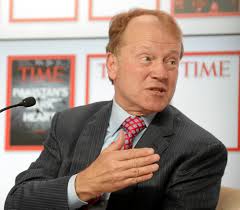
Thanks buddy. And it's a great pleasure and a great privilege and an honor for me to introduce someone I've considered one of the greatest leaders, a mentor, someone that I continuously learn from. For two decades, one company was the plumbing of the internet and one man led it. Under John Chambers, Cisco became the backbone of the connected world and for a moment in 2000, the most valuable company on the planet. What John is really famous for isn't the size, it's the timing. He built a career on spotting what he calls market transitions before anyone else could see them. And every January, he publishes 10 predictions. Unlike most people who make predictions, he keeps scores. And we're going to find out. Today he backs the next generation of founders through JC2 Ventures. Please welcome John Chambers.
Thank you. Thank you, sir. Thank you.
So, we have a lot of questions. So, I think we should get started. That's good. I think it's still...
By the way, if you agree with everything I say, we failed. And I'm going to make you uncomfortable. I want to get you to sweat because you should be. At the same time, I have no fear for the future. We're going to get through this, but we have to plan it out and execute well. So, I'm going to challenge you today on wherever you take me.
All right. So, let's start with the uncomfortable. Carl talked about predictions. Most people like predictions to be forgotten, John. But for years, every year you have had a prediction. So as you look back to the previous set of predictions, you know, what can you tell us about how bold you were? Where were you not bold enough? And more specifically, you had a prediction around, you know, AI happening five times faster and three times, and where do you think we've really landed? Have we hit those marks that you put out there?
We have as a whole. Now, I have an unfair advantage. I get the data for pattern recognition from customers and so I listen constantly in terms of what's occurring. So it was easy for me in 1991 to say the internet was going to change the way you work, live, learn and play and people said you're a tech company moving around zeros and ones and it won't. Or call digitization of countries and companies in 2010 or the internet of everything. More recently, I use these projections not as a branding opportunity, but more as a way I help the 24 CEOs that I provide guidance to in my portfolio manage their business. So, I start with predictions of where the industry is going, what are the relevant aspects, and then each CEO, if they agree, we say, 'What are you going to do to run your business to align with this next year?' I used to do three to five year planning. Most of my planning is now one year within it. Key ones that you'll be aware of: 10 years ago I bet big on AI and I said cyber security will tie to AI in a unique way. So I really resonated with the comments earlier and the risk factors we went through. Projections that would be kind of interesting that now sound kind of like, oh, you should have seen it. But when we said it in November of the year before, two years ago as an example, we said 2025 would be the era where AI goes mainstream across all industries and all companies, and that was when many people thought the CEOs couldn't even get projects to work. And then this last November, we said by the end of the calendar year, the majority of employees in most companies in the US will already be using AI. Even the major AI tool said, 'My odds on that being right were 10%.' And I think all of us would agree we're going to see it.
And then the productivity, we said 10% is what every well-run company will drive to. People said GDP has never grown faster than 2.2%. No chance on that. I was with 45 CIOs yesterday and at the session, how many of you in the room are driving your productivity above 10%? It was the whole room with one exception. And then people tend to look, well, that's just job displacement. You're going to use that productivity to realign your resources with tremendous speed. And you'll be doing this not once a year, you'll be doing it monthly. Huge challenge for the head of HR and culture as you begin to make these changes. And so as you do this, most of my startups are not adding headcount near as fast as they would. Some of them are growing over 150% a year, order of magnitude in three years, and have added almost no headcount. But they realign the resources quickly. They don't lay off people. They recruit to where the direction's going. So I run those projections through and make people uncomfortable with them. And I was too early on cyber security. I thought it should have been going two or three years ago because I knew what AI could do to the infrastructure. But you're going to see now and you've seen in the cyber security stocks. They're up on an average probably 50 to 70% this year. So it indicates when you see money start to flow, that's usually a transaction technology and business-wise that's about to happen.
Yeah. John, and cyber is a great example. You said, you know, AI is not a bubble. You said that there will be train wrecks. In fact, I think you said spectacular train wrecks. Those things will happen, you know, and I think you said it'll happen in '26. You know, Carl talked about a couple of things. What can you tell us about those, especially those train wrecks that you think are going to happen that maybe need to happen? You know, how do you feel like, what's your view on that?
Well, most of the train wrecks don't need to happen. It will be an execution issue and a stretch issue and lacking culture or playing out the game issue. Your playbooks, many people are making their moves one at a time and I love to compete. I apologize for that. I'm going to be better in my next life. But I love it when I compete against a competitor that makes their moves one at a time and then says what I do next. I've already played the chess game to the end. Work backwards and forwards. The driving trend here is that bell-shaped curve that Stanford and other universities taught us at school that if you were in the middle, that's where the majority of companies would end up in terms of their execution. The far right 15% did well. The far left would go out of business, 15%. That thing is going to flatten big time. Being average is not going to be okay anymore. Being average, you're going to be eliminated. And that will occur with the Magnificent Seven or the Magnificent 12. There'll be a number of them who won't be on that list even close within three to five years. So you start with that assumption and then you say what causes these to miss? What causes them to miss? They didn't get the market transition right. They did not build an execution plan that allows them to execute off of that speed. They took so much money at times, and this is true of even small startups, that they had to stretch too hard to get their shareholders comfortable with their growth numbers. And one of the most basic things that people forget, and I think the valley has learned the hard way, is culture within these companies is as important as vision and strategy. So in many ways it's back to the basics.
The challenge though is we've been too slow to change on trust within AI. For those of you who remember the internet and you were kind on the Cisco introductions and it's always nice you pointed out the successes. I made lots of mistakes. I learned more from my mistakes than the successes. But across America, 91% of Americans in the mid-1990s felt the internet was going to be good for them and good for the country. John Doerr from Kleiner Perkins, myself, Jim Barksdale established TechNet. We spent a huge amount of time in Washington educating the Democrats and Republicans. Both sides got it and understood the implications. We saw the problems coming like job destruction and we developed technologies and classes like Cisco Networking Academy, etc. And I know there's several Cisco people in the room. We trained seven million students worldwide rather than jobs getting eliminated. Here's where you do it and you combine it with your regular education. And then we spent time on the legitimate concerns government had or citizens had and you share and you implement it. The industry, especially the new players, have done a terrible job. There's no reason data centers aren't so important and strategic to our future that if done right and wrapped in a way that protects the energy, your prices don't go up, it's environmentally friendly, etc. You can put those data centers in your backyard and Bloom Energy is an example of a company that's riding that. So, those are the challenges in front of us. Have I got you uncomfortable yet? Doing okay.
Okay, I'm trying. I think it's fantastic. You mentioned the productivity gain. You mentioned the flattening of the curve. You mentioned education into government. You know, there's so many facets. You mentioned jobs. You know, you were there when the internet came along, like you said, and you were able to with others do all of these things. What are the key things that we have to do now with AI coming? Do we have to do some things differently? You know, are there things that are top of mind for you? Very specific things that you feel, hey, I'm in the room here or all these folks are in the room here. Go do X because I know from my experience we did it for the internet. We have to do it for the AI internet.
Well, I think the internet was actually a fun, slow-moving playbook and the emphasis slow-moving. Remember at the time we said it was three times faster than traditional business. It is really slow moving compared to what we are now. So when you were kind enough to comment, I said AI going back five years ago was going to move at five times the speed of the internet with three times the results. I was wrong. It's going to be five times plus for the results in terms of implementation. So you have to see these problems coming. Let me be tough on some of my new peers. If your product's not stable, if it has security problems in it, you shouldn't ask government to put guardrails in place and say, 'Don't ship it. You don't ship it. Just don't ship it.' And at Cisco and my peers and I had some good competitors, really good competitors, but as an industry, we focused together on the benefits and we came together as a group and worked across all the party lines, state lines within it as a whole. And we agreed we had to solve the problems with security or the whole industry trust would disappear. So now fast forward, we are really behind.
Yeah. It's moving five times the speed and the results are 5x. And what is America's trust in AI and the leaders in AI? 61% on the survey that came out yesterday don't trust. So what do we have to do? We have to get after it today. If you're in companies that are really driving productivity within your company, you have to think about how do you retrain the people? If you're involved in education, the education system has to change. Not just in K through 12, but the universities. We do a poor job of preparing our university students for where the jobs will be. And this isn't rocket science. You can take a good university, not at the scale of Stanford or the Ivy Leagues, West Virginia University. We began eight years ago redoing the whole curriculum in business school, the healthcare. We began to attract major billion-dollar investments into our state. The graduation rate that had jobs from the business school went from 48% the minute they walked across stage. It would get like the other universities up to the 80 or 90% within six months. That number is now 78%. And they're doing AI classes across the whole university with minors within not just business and engineering but in legal and others. So each of us have to think what role do we have and when you think about your company then you begin to think about how do you drive it through. Now you know at my heart I'm a salesperson. So I'm going to mention a couple of my companies that you all ought to think about. Watch a company called Unifor. I've been very lucky with Bloom Energy, with Datadog many times over, with Rubrik. Bippul's done an amazing job. KR's done an amazing job. Unifor is probably the best kept secret in terms of enterprise company standardizing architecturally on one player across its whole infrastructure. And they not only are growing at 150% from 200 million a year to 500 million a year this year, you have companies standardizing on them. And now you see companies that didn't even know their name a year ago doing 10 to 25 million dollar orders. That's synonymous with the internet. And KPMG, I think there are two of you in the room. You talk about how you all reinvented one of the top global systems integrator and consultancy companies. Watch how fast they moved as a company to not only adjust new startups, standardizing that startup internally, but taking to your customers. But then they took on the hard issue, the cultural issue. How do you reorganize the company not in silos, geographies and industries, but across AI as a whole and how do you move leaders around? Some are going to make it, some will not. And then how do you really get the company managing itself with an evolving culture? Some of the strengths before, but cultural changes in terms of speed and you share the challenges if they don't move. That's what we all need to do. So, we know the challenges coming at us. You know, if you're producing productivity faster in a company, then you're growing in terms of sales, you're either going to lay off people or you're going to have to move into new revenue streams. See it coming. Take care of the people. So, I'm going to challenge us a little bit. I don't think we've done a good job. The scary part is it's moving so fast it's hard to keep up. How many people would agree with that? How many would disagree? I always worry when somebody doesn't disagree because then I'm worried that we missed something. But that I will always ask you and give me candid feedback afterwards about things you might agree with or things you think I need to think differently.
I think it's very interesting. Two things you said jump out at me and I'm going to club them together. One, you stood at the frontier of the internet. You see market transitions before other people. You were able to separate hype from market transition. And a lot of us, I'm sure, would want to know how we can do that, right? Wouldn't everybody love to know like how you see it? So, if you could touch on that, but I want to link it to another idea. You talked about it's moving too fast. It's 5x faster. Of course, Dario wrote the paper on pacing the frontier. Tell us a little bit about being able to see a market transition and separating the hype, but also how much of what Dario says about the pace of AI and when he says pacing the frontier, what he's really talking about is let's move, not necessarily slower in terms of not doing the technical work, let's do the technical work but let's pace ourselves and build the guardrails in, right? The question for you is how do you see these market transitions? Can you really pace the frontier? Is it possible or does when change come, it just comes and you can't slow it down for the guardrails to be put in at the time when the change is happening?