There was a 5-year waiting list and we got a rotary telephone, but it dramatically changed our lives. People would come to our house to make calls to their loved ones. I would have to go all the way to the hospital to get blood test records, and it would take 2 hours to go and they would say, 'Sorry, it's not ready, come back the next day.' 2 hours to come back, and that became a 5-minute thing. So as a kid, this light bulb went off in my head about the power of technology to change people's lives. We had no running water; it was a massive drought, so they would get water in these trucks, maybe eight buckets per household. Me and my brother, sometimes my mom, we would wait in line, get that, and bring it back home. Many years later, we had running water and a water heater, and you could get hot water to take a shower. For me, everything was discrete like that. I've always had this firsthand feeling of how technology can dramatically change your life and the opportunity it brings.
I think if p(doom) is actually high, at some point all of humanity is aligned in making sure that's not the case, and so we'll actually make more progress against it. I think the irony is there is a self-modulating aspect there. If humanity collectively puts their mind to solving a problem, whatever it is, I think we can get there. Because of that, I'm optimistic on the p(doom) scenarios. But that doesn't mean I think the underlying risk is actually pretty high. I have a lot of faith in humanity rising up to meet that moment.
Take me through that experience when there's all these articles saying you're the wrong guy to lead Google through this, Google is lost, it's done, it's over.
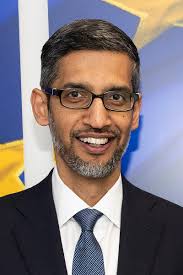
The following is a conversation with Sundar Pichai, the CEO of Google and Alphabet, on the Lex Fridman podcast. Your life story is inspiring to a lot of people, it's inspiring to me. You grew up in India, your whole family living in a humble two-room apartment, very little almost no access to technology, and from those humble beginnings you rose to lead a $2 trillion technology company. So if you could travel back in time and tell that 12-year-old Sundar that you're now leading one of the largest companies in human history, what do you think that young kid would say?
I would have probably laughed it off. Probably too far-fetched to imagine or believe at that time. You would have to explain the internet first, for sure. Computers to me at that time... I was 12 in 1984, so probably by then I started reading about them, I had seen one.
What was that place like? Take me to your childhood.
I grew up in Chennai, in the south of India. It's a beautiful, bustling city, lots of people, lots of energy. Simple life. Definitely fond memories of playing cricket outside the home. We just used to play on the streets, all the neighborhood kids would come out and we would play till it got dark and we couldn't play anymore, barefoot. Traffic would come, we would just stop the game, everything would drive through, and you would just continue playing. To give you a visual, pre-computers there was a lot of free time. Now you have to go and seek that quiet solitude. Newspapers, books is how I gained access to information at the time. My grandfather was a big influence. He worked in the post office, he was so good with language, his English, his handwriting till today is the most beautiful handwriting I've ever seen. He would write so clearly, he was so articulate. He got me introduced to books. He loved politics, so we could talk about anything. That was there in my family throughout. Lots of books, trashy books, good books, everything from Ayn Rand to books on philosophy to stupid crime novels. Books was a big part of my life. It's not surprising I ended up at Google because Google's mission always resonated deeply with me, this access to knowledge. I was hungry for it. I have fond memories of my childhood. Access to knowledge was the wealth we had.
Every aspect of technology I had to wait for a while. I've spoken before about how long it took for us to get a phone, about 5 years. But it's not the only thing. A telephone, there was a 5-year waiting list, and we got a rotary telephone. But it dramatically changed our lives. People would come to our house to make calls to their loved ones. I would have to go all the way to the hospital to get blood test records, and it would take 2 hours to go and they would say, 'Sorry, it's not ready, come back the next day.' 2 hours to come back, and that became a 5-minute thing. So as a kid, this light bulb went off in my head about the power of technology to change people's lives. We had no running water; it was a massive drought, so they would get water in these trucks, maybe eight buckets per household. Me and my brother, sometimes my mom, we would wait in line, get that, and bring it back home. Many years later, we had running water and a water heater, and you could get hot water to take a shower. For me, everything was discrete like that. I've always had this firsthand feeling of how technology can dramatically change your life and the opportunity it brings. That was a subliminal takeaway for me throughout growing up. I observed it and felt it. We had to convince my dad for a long time to get a VCR. Do you know what a VCR is? Because before that, you only had one TV channel. By the time I was in 12th grade, we got a VCR, a Panasonic, which we had to go to some shop that had smuggled it in, I guess. But then being able to record a World Cup football game, or get video tapes and watch movies... I had these discrete memories growing up, always leaving me with the feeling of how getting access to technology drives that step change in your life. I don't think you'll ever be able to equal the first time you get hot water, to have that convenience of opening a tap and having hot water come out.
It's interesting, we take for granted the progress we've made. If you look at human history, those plots that look at GDP across 2,000 years, you see that exponential growth where most of the progress happened since the industrial revolution. We just take it for granted, we forget how far we've gone. Our ability to understand how great we have it and also how quickly technology can improve is quite poor.
It's extraordinary. I go back to India now, the power of mobile, it's mind-blowing to see the progress through the arc of time. It's phenomenal.
What advice would you give to young folks listening to this all over the world who look up to you and find your story inspiring, who want to be the next Pichai, who want to start companies, build something that has a lot of impact in the world?
Look, you have a lot of luck along the way, but you obviously have to make smart choices. You're thinking about what you want to do, your brain is telling you something, but when you do things, I think it's important to listen to your heart and see whether you actually enjoy doing it. That feeling of if you love what you do, it's so much easier and you're going to see the best version of yourself. It's easier said than done, it's tough to find things you love doing. But listening to your heart a bit more than your mind in terms of figuring out what you want to do, I think is one of the best things I would tell people. The second thing is trying to work with people who you feel are better than you. At various points in my life, I worked with people who I felt were better than me. You want that feeling a few times. Trying to get yourself in a position where you're working with people who are stretching your abilities is what helps you grow. Putting yourself in uncomfortable situations, and often you'll surprise yourself. Being open-minded enough to put yourself in those positions is maybe another thing I would say.
What lessons can we learn from an outsider perspective? For me, looking at your story and getting to know you a bit, you're humble, you're kind. Usually when I think of somebody who has had a journey like yours and climbs to the very top of leadership in a cutthroat world, they're usually going to be a bit of an... So what wisdom are we supposed to draw from the fact that your general approach is of balance, of humility, of kindness, listening to everybody? What's your secret?
I do get angry, I do get frustrated. I have the same emotions all of us do in the context of work and everything. But a few things... Over time, I figured out the best way to get the most out of people. You find mission-oriented people who are on the same journey, who have this inner drive to excellence, to do the best. You motivate people, and you can achieve a lot that way. It often tends to work out that way. But have there been times where I lose it? Yeah, but maybe less often than others, and over the years less and less so because I find it's not needed to achieve what you need to do. Losing your temper has not been productive. People may do stuff to react to that, but you actually want them to do the right thing. Maybe there's a bit of sports management. In football, people talk about man management. There is an element of that in our lives. How do you get the best out of the people you work with? At times, you're working with people who are so committed to achieving that if they've done something wrong, they feel it more than you do, so you treat them differently. Occasionally, there are people who you need to clearly let them know that wasn't okay. But I've often found that not to be the case. Sometimes the right words at the right time spoken firmly can reverberate through time. Also, sometimes the unspoken words... people can see that you're unhappy without you saying it. Sometimes the silence can deliver that message even more. Sometimes less is more.
Who's the greatest soccer player of all time? Messi or Ronaldo? Or Pelé or Maradona? Is this going to be a political answer?
No, I will tell the truthful answer. It's been interesting because my son is a big Cristiano Ronaldo fan, so we've had to watch El Clásicos together with that dynamic. I so admire CR7. I've never seen an athlete more committed to that kind of excellence, so he's one of the all-time greats. But for me, Messi is it. When I see Lionel Messi, you are in awe that humans are able to achieve that level of greatness and genius and artistry. When we talk about AI and robotics, that level of genius I'm not sure you can possibly match by AI in a long time. It's just an example of greatness. In sport, you get to visually see it unlike anything else. The timing, the movement, this is genius. I had the chance to see him a couple weeks ago. He played in San Jose against the Quakes, so I went to see the game. I was a fan, had good seats, knew where he would play in the second half hopefully. Even at his age, just watching him when he gets the ball, that movement... you're right, that special quality is tough to describe, but you feel it when you see it. He still got it.
If we rank all the technological innovations throughout human history, let's go back maybe 12,000 years to the history of human civilizations, and you rank them by how much of a productivity multiplier they've been. We can go to electricity, the labor mechanization of the industrial revolution, or the first agricultural revolution. In that long list of inventions, do you think AI, when history is written a thousand years from now, has a chance to be the number one productivity multiplier?
It's a great question. Many years ago, I think it might have been 2017 or 2018, I said at the time that AI is the most profound technology humanity will ever work on, it'll be more profound than fire or electricity. So I have to back myself. I still think that's the case. When you asked this question, I was thinking, do we have a recency bias? In sports, it's very tempting to call the current person you're seeing the greatest player. Is there a recency bias? From first principles, I would argue AI will be bigger than all of those. I didn't live through those moments. Two years ago, I had to go through a surgery, and then I processed that there was a point in time people didn't have anesthesia when they went through these procedures. At that moment, I was like, that has got to be the greatest invention humanity has ever done. So we don't know what it is to have lived through those times. Many of what you're talking about were general things which pretty much affected everything, like electricity or the internet. But I don't think we have ever dealt with a technology both which is progressing so fast, becoming so capable, it's not clear what the ceiling is, and the main unique thing is it's recursively self-improving. It's capable of that. The fact that it is the first technology that will dramatically accelerate creation itself—creating things, building new things can improve and achieve things on its own—puts it in a different league. I think the impact it'll end up having will far surpass everything we've seen before. Obviously, with that comes a lot of important things to think and wrestle with, but I definitely think that'll end up being the case, especially if it gets to the point where we can achieve superhuman performance on the AI research itself. It's an open question, but it may be able to achieve a level where the technology itself can create itself better than it could yesterday. It's like the Move 37 of AlphaGo. When it can do novel, self-directed research... obviously, for a long time, we'll hopefully always have humans in the loop, and these are complex questions. But yes, I think the underlying technology... if you watched AlphaGo start from scratch, be clueless, and become better through the course of a day, it really hits you when you see that happen. Even our Veo models, if you sample the models when they were 30% done and 60% done and looked at what they were generating, you see how it all comes together. It's kind of inspiring and a little bit unsettling as a human. All of that is true.
The interesting thing about the industrial revolution, electricity, the agricultural revolution... there's what's called the Neolithic package of the first agricultural revolution. It wasn't just that the nomads settled down and started planting food, but all these other kinds of technology were born from that. It's included in this package. It wasn't one piece of technology, there are ripple effects, second and third order effects. Everything from something like pottery that can store liquids and food, to social hierarchies and political hierarchy. Early government was formed because if humans stop moving and have some surplus food, they start coming up with interesting systems. Then trade emerges, which turns out to be a really profound thing. The second and third order effects from that package are incredible and probably extremely difficult to predict. If you asked one of the people in the nomadic tribes to predict that, it would be impossible. All that said, what do you think are some of the early things we might see in the 'AI package'?
Most of it probably we don't know today. But one thing we can tangibly start seeing now is, with the coding progress, you get a sense of it. It's going to be so easy to imagine thoughts in your head translating into things that exist. That'll be part of the package. It's going to empower almost all of humanity to express themselves. In the past, you could have expressed with words, but now you can kind of build things into existence. Not fully today, we are at the early stages of Veo coding. I've been amazed at what people have put out online with Veo 3, but it takes a bit of work, you have to stitch together a set of prompts. But all this is going to get better. The thing I always think about is, this is the worst it'll ever be at any given moment in time.
It's interesting you went there as a first thought. The exponential increase of access to creativity, software creation... are you creating a program, a piece of content to be shared with others, games down the line? All of that just becomes infinitely more possible.
The big thing is that it makes it accessible. It unlocks the cognitive capabilities of the entire 8 billion. Think about 40 years ago, maybe in the US there were five people who could do what you're doing, go do an interview. But today, with YouTube and other products, how many more people are doing it? This is what technology does. When the internet created blogs, you heard from so many more people. But with AI, that number won't be in the few hundreds of thousands, it'll be tens of millions of people, maybe even a billion people, putting things out into the world in a deeper way. I think it'll change the landscape of creativity. It makes a lot of people nervous. For example, Fox, MSNBC, CNN are really nervous about this. This dude in a basement could just do this and use YouTube, and thousands, tens of thousands, millions of other creators can do the same kind of thing. That makes them nervous. Now you get a podcast from NotebookLM that's about 5 to 10 times better than any podcast I've ever done. True, I'm joking at this time, but maybe not. That changes things. You have to evolve. On the podcasting front, I'm a fan of podcasts much more than I am a fan of being a host. If there are great podcasts that are both AIs, I'll just stop doing this podcast and listen to that podcast. But you have to evolve and change, and that makes people really nervous. But it's also really exciting.
The only thing I may say is, in a world in which there are two AIs, I think people value and choose... just like in chess, you and I would never watch Stockfish 10 and AlphaGo play against each other, it would be boring for us to watch. But Magnus Carlsen and Hikaru Nakamura, that game would be much more fascinating to watch. So it's tough to say. One way to say it is you'll have a lot more content, so you will be listening to AI-generated content because sometimes it's efficient. But the premium experiences you value might be a version of the human essence wherever it comes through. Going back to watching Messi dribble the ball, I'm sure one day a machine will dribble much better than Messi, but I don't know whether it would evoke that same emotion in us. That'll be fascinating to see. The element of podcasting or audiobooks that is about information gathering, that part might be removed or more efficiently done by AI. But then it'll be nice to hear humans struggle with the information, contend with it, try to internalize it, combine it with the complexity of our own emotions and consciousness. If you actually want to find out about a piece of history, you go to Gemini. If you want to see Lex struggle with that history, then you look at humans. The point is, it's going to change the nature of how we discover information, how we consume it, how we create it. The same way that YouTube changed everything, completely changed news. That's something our society is struggling with.
YouTube enabled so many creators. There is no doubt in me that we will enable more filmmakers than there have ever been. You're going to empower a lot more people. There's an expansionary aspect of this which is underestimated. I think it'll unleash human creativity in a way that hasn't been seen before. It's tough to internalize. The only way is if you brought someone from the 50s or 40s and put them in front of YouTube, I think it would blow their mind away. Similarly, I think we would get blown away by what's possible in a 10 to 20 year time frame.
Do you think there's a future, how many years out is it, that let's say 50% of good content is generated by Veo 4, 5, 6?
I think it depends on what it is. If you look at movies today with CGI, there are great filmmakers who use it and those who don't. You value that. There are people who use it incredibly, like James Cameron, what he would do with these tools. But I think there'll be a lot more content created. Just like writers today use Google Docs and don't think about the fact that they're using a tool, people will be using the future versions of these things like it won't be a big deal at all to them.
I've gotten a chance to get to know Darren Aronofsky well. He's been really leaning in and trying to figure it out. It's fun to watch a genius who came up before any of this was even remotely possible. He created Pi, one of my favorite movies, and from there continued to create a really interesting variety of movies. Now he's trying to see how AI can be used to create compelling films. You have people like that, and edgier folks that are AI-first, like the Door Brothers. Both Aronofsky and the Door Brothers create at the edge of the Overton window of society. They push whether it's sexuality or violence, it's edgy like artists are, but it's still classy, it doesn't cross that line. Hunter S. Thompson said the only way to find out where the line is is by crossing it. For artists, that's true, that's their purpose sometimes. Comedians and artists just cross that line. I wonder if you can comment on the weird place that puts Google, because Google's line is probably different than some of these artists. How do you think about Veo and allowing artists to get crazy, but also the responsibility for it not to be too crazy?
It's a great question. Darren is a clear visionary. Part of the reason we started working with him early on Veo is he's one of those people who was able to see that future, get inspired by it, and show the way for how creative people can express themselves with it. When it comes to allowing artistic free expression, it's one of the most important values in a society. Artists have always been the ones to push boundaries, expand the frontiers of thought. I think that's going to be an important value we have. We will provide tools and put them in the hands of artists for them to use and put out their work. Those APIs, I almost think of that as infrastructure. Just like when you provide electricity to people, you want them to use it, and you're not thinking about the use cases on top of it. It's a paintbrush. Obviously, there have to be some things, and society needs to decide at a fundamental level what's okay and what's not. We'll be responsible with it. But when it comes to artistic free expression, I think that's one of those values we should work hard to defend.
I wonder if you can comment on earlier versions of Gemini that were a little bit careful on the kind of things you would be willing to answer. I was really surprised and pleasantly surprised and enjoyed the fact that Gemini 2.5 Pro is a lot less careful, in a good sense. I've been doing a lot of research on Genghis Khan and the Aztecs, so there's a lot of violence in that history. I've also been doing a lot of research on World War I and World War II. Earlier versions of Gemini were very much 'are you sure you want to learn about this?' Now it's actually very factual, objective, talks about very difficult parts of human history and does so with nuance and depth. It's been really nice. But there's a line there that Google has to walk. It's also an engineering challenge how to do that at scale across all the weird queries that people ask. Can you speak to that challenge? How do you allow Gemini to say crazy but not too crazy?
One of the good insights here has been that as the models are getting more capable, the models are really good at this stuff. Maybe a year ago, the models weren't fully there, so they would do stupid things more often. You're trying to handle those edge cases, but then you make a mistake in how you handle those edge cases and it compounds. With 2.5, what we particularly found is once the models cross a certain level of intelligence and sophistication, they are able to reason through these nuanced issues pretty well. Users really want that. You want as much access to the raw model as possible. It's a great area to think about. Over time, we should allow more and more closer access to it, maybe let people custom prompt if they wanted to and experiment with it. I think that's an important direction. From first principles, from a scientific standpoint, making sure the models reason about the world, be nuanced, from the ground up is the right way to build these things. Not like some subset of humans is hard coding things on top of it. That's the direction we've been taking, and you'll see us continue to push in that direction.
I gave these notes, I took extensive notes, and I gave them to Gemini and said, 'Can you ask a novel question that's not in these notes?' And it wrote... Gemini continues to really surprise me. It's been really beautiful, it's an incredible model. The question it generated was, 'You, Sundar, told the world Gemini is turning out 480 trillion tokens a month. What's the most life-changing five-word sentence hiding in that hash stack?' That's a Gemini question. It gave me a sense, I don't think you can answer that, but it made me wake up to all of these tokens providing little aha moments for people across the globe. That's learning. Those tokens are people being curious, asking a question, and finding something out. It truly could be life-changing.
It is. I had the same feeling about search many, many years ago. Tokens per month has grown 50 times in the last 12 months. Is that accurate by the way? It is accurate. I'm glad it got it right. That number was 9.7 trillion tokens per month 12 months ago. It's gone up to 480. It's a 50x increase. There's no limit to human curiosity. It's one of those moments. Maybe one day there's a five-word phrase which says what the actual universe is or something very meaningful, but I don't think we are quite there yet.
Do you think the scaling laws are holding strong? There's a lot of ways to describe the scaling laws for AI, but on the pre-training and post-training fronts. Do you anticipate AI progress will hit a wall? Is there a wall?
It's a cherished micro-kitchen conversation once in a while. When Demis is visiting, or Dennis, Koray, Jeff, Sergey, a bunch of our people, we sit and talk about this. We see a lot of headroom ahead. We've been able to optimize and improve on all fronts: pre-training, post-training, test-time compute, tool use. Over time, making these more agentic, getting these models to be more general world models. Veo 3's physics understanding is dramatically better than Veo 1. You see on all those dimensions, progress is very obvious. I feel there is significant headroom. More importantly, I'm fortunate to work with some of the best researchers on the planet. They think there is more headroom to be had. We have an exciting trajectory ahead. It's tougher to say each year. I sit and say, 'Okay, we're going to throw 10x more compute over the course of next year at it, and will we see progress?' Sitting here today, I feel like the year ahead will have a lot of progress.
Do you feel any limitations? Compute limited, data limited, idea limited? Or is it full steam ahead on all fronts?
I think it's compute limited in this sense. Part of the reason you've seen us do Flash, Nano, Flash, and Pro models but not an Ultra model is that for each generation, we've been able to get the Pro model at 80-90% of Ultra capability, but Ultra would be a lot more slow and expensive to serve. What we've been able to do is go to the next generation and make the next generation's Pro as good as the previous generation's Ultra, but be able to serve it in a way that it's fast and you can use it. I do think scaling laws are working, but it's tough to get, at any given time, the models we all use the most are maybe a few months behind the maximum capability we can deliver, because that won't be the fastest or easiest to use. Also, in terms of intelligence, it becomes harder and harder to measure performance. You could argue Gemini Flash is much more impactful than Pro just because of the latency. It's super intelligent already. Sometimes latency is more important than intelligence, especially when the intelligence is just a little bit less in Flash. It's still an incredibly smart model. You have to start measuring impact, and benchmarks feel less and less capable of capturing the intelligence, effectiveness, and real-world usefulness of models.
Another kitchen question. Lots of folks are talking about timelines for AGI or ASI. AGI loosely defined is basically human expert level at a lot of the main fields of pursuit for humans. ASI is what AGI becomes, presumably quickly, by being able to self-improve, becoming far superior in intelligence across all these disciplines than humans. When do you think we'll have AGI? Is 2030 a possibility?
There's one other term we should throw in there. I don't know who used it first, maybe Karpathy did: AJI, artificial jagged intelligence. Sometimes it feels that way. You see progress and what they can do, and then you can trivially find they make numerical errors or counting R's in strawberry seems to trip up most models. We are in the AJI phase where dramatic progress happens, some things don't work well, but overall you're seeing lots of progress. If your question is will it happen by 2030, we constantly move the line of what it means to be AGI. There are moments today where I see glimpses of it. Sitting in a Waymo in San Francisco with all the crowds and people, it works its way through. Sometimes it's impatient. Using Astra in Gemini Live, asking questions about the world, 'What's this skinny building doing in my neighborhood?' 'It's a streetlight, not a building.' You see glimpses. That's why I use the word AJI, because then you see stuff which obviously we are far from AGI too. You have both experiences simultaneously. I'll answer your question, but I'll also throw out that I almost feel the term doesn't matter. What I know is by 2030, there'll be such dramatic progress, we'll be dealing with the consequences of that progress, both the positive externalities and the negative externalities, in a big way by 2030. That I strongly feel. Whatever we may be arguing about the term, or maybe Gemini can answer what that moment is in time in 2030, but I think the progress will be dramatic. Will the AI think it has reached AGI by 2030? I would say we will just fall short of that timeline. I think it'll take a bit longer. It's amazing, in the early days of Google DeepMind in 2010, they talked about a 20-year timeframe to achieve AGI. Seeing what Google Brain did in 2012, and when we acquired DeepMind in 2014, right close to where we're sitting... in 2012, Jeff Dean showed the image of when the neural networks could recognize a picture of a cat and identify it. That was the early versions of Brain. We all talked about a couple of decades. I don't think we'll quite get there by 2030. My sense is it's slightly after that. But I would stress it doesn't matter what that definition is, because you will have mind-blowing progress on many dimensions. Maybe AI can create videos. We have to figure out as a society how we need some system by which we all agree that this is AI generated and we have to disclose it in a certain way, because how do you distinguish reality otherwise?
There's so many interesting things you said. Looking back at this recent, now feels like distant history, with Google Brain. That was before TensorFlow was made public and open sourced. The tooling matters too, combined with GitHub's ability to share code. Then you have the ideas of attention, transformers, and diffusion. Now there might be a new idea that seems simple in retrospect but will change everything. That could be the post-training, the inference time innovations. I think Sridhar tweeted that Google is just one great UI from completely winning the AI race. UI is a huge part of it, how that intelligence manifests. Logan Kilpatrick likes to talk about this. Right now it's an LLM, but when is it going to become a system where you're talking about shipping systems versus shipping the particular model? That matters too, how the system manifests itself and presents itself to the world. That really, really matters.
Oh, hugely. There are simple UI innovations which have changed the world. We will see a lot more progress in the next couple of years. AI itself is on a self-improving track for UI itself. Today, we are constraining the models. The models can't quite express themselves in terms of the UI to people. But if you think about it, we've kind of boxed them in that way. Given these models can code, they should be able to write the best interfaces to express their ideas over time. That is an incredible idea. The APIs are already open, so you create a really nice agentic system that continuously improves the way you can be talking to an AI. A lot of that is the interface. Then of course the incredible multimodal aspect of the interface that Google's been pushing. These models are natively multimodal. They can easily take content from any format, put it in any format. They can write a good user interface. They probably understand your preferences better over time. All this is the evolution ahead. That goes back to where we started the conversation. I think there'll be dramatic evolutions in the years ahead.
Maybe one more kitchen question. This even further ridiculous concept of p(doom). The philosophically minded folks in the AI community think about the probability that AGI and then ASI might destroy all of human civilization. I would say my p(doom) is about 10%. Do you ever think about this kind of long-term threat of ASI, and what would your p(doom) be?
For sure. I've both been very excited about AI, but I've always felt this is a technology we have to actively think about the risks and work very, very hard to harness it in a way that it all works out well. On the p(doom) question, it won't surprise you to say that's probably another micro-kitchen conversation that pops up once in a while. Given how powerful the technology is, maybe stepping back... when you're running a large organization, if you can align the incentives of the organization, you can achieve pretty much anything. If you can get people all marching towards a goal in a very focused, mission-driven way, you can pretty much achieve anything. But it's very tough to organize all of humanity that way. I think if p(doom) is actually high, at some point all of humanity is aligned in making sure that's not the case, and so we'll actually make more progress against it. The irony is there is a self-modulating aspect there. If humanity collectively puts their mind to solving a problem, whatever it is, I think we can get there. Because of that, I have an optimistic take on the p(doom) scenarios. But that doesn't mean I think the underlying risk is actually pretty high. I have a lot of faith in humanity rising up to meet that moment.
That's really well put. As the threat becomes more concrete and real, humans do really come together and get their act together. The other thing people don't often talk about is the probability of doom without AI. There are all these other ways that humans can destroy themselves. It's very possible, at least I believe so, that AI will help us become smarter, kinder to each other, more efficient. It'll help more parts of the world flourish where it would be less resource constrained, which is often the source of military conflict and tensions. We also have to load into that what's the p(doom) without AI versus with AI. It's very possible that AI will be the thing that saves human civilization from all the other threats.
I agree with you. I think it's insightful. I felt like to make progress on some of the toughest problems, it would be good to have AI helping you. That resonates with me for sure.
Quick pause, bathroom break? Let's do that. If NotebookLM was as compelling as what I saw today with Beam... it blew my mind. It was incredible. I didn't think it was possible. Can you imagine the US president and the Chinese president being able to do something like Beam with live translation working well, so they're both sitting and talking, making progress?
For people listening, we took a quick bathroom break and now we're talking about the demo I did. We'll probably post it somewhere. I got a chance to experience Beam, and it's hard to describe in words how real it felt with just six cameras. It's incredible. It's one of the toughest products. You can't quite describe it to people even when we show it in slides. You have to experience it. On the world leaders front, on politics and geopolitics, there's something really special. Studying World War II, how much could have been saved if Chamberlain met Stalin in person? I sometimes struggle explaining to people why I believe meeting in person for world leaders is powerful. It seems naive to say that, but there is something there in person. With Beam, I felt that same thing. I'm unable to explain it. All I kept doing was like a child, 'You look real.' I don't know if that makes meetings more productive, but it certainly makes them more... the same reason you want to show up to work versus remote sometimes. That human connection, I don't know what it is. It's hard to put into words. There's something beautiful about great teams collaborating on a thing that's not captured by the productivity of that team. Some of the most beautiful moments you experience in life are at work, pursuing a difficult thing together for many months. There's nothing like it. You're in the trenches, and you form bonds that way. To be able to do that somewhat remotely with that same personal touch, that's a deeply fulfilling thing. I personally hate meetings because a significant percent of meetings, when done poorly, don't serve a clear purpose. But that's a meeting problem, not a communication problem. If you can improve the communication for the meetings that are useful, that's incredible. I was blown away by the great engineering behind it. We get to see what impact that has. It's really interesting, just incredible engineering.
It is. We'll work hard over the years to make it more and more accessible. Even on a personal front, outside of work meetings, a grandmother who is far away from her grandchild being able to have that kind of interaction... all that will end up being very meaningful. Nothing substitutes being in person, but it's not always possible. You could be a soldier deployed, trying to talk to your loved ones. That's what inspires us.
When you and I hung out last year and took a walk, I remember, I don't think we talked about this, but I remember outside of that seeing dozens of articles written by analysts and experts that Sundar Pichai should step down because the perception was that Google was definitively losing the AI race, had lost its magic touch in the rapidly evolving technological landscape. Now a year later, it's crazy. You showed this plot of all the things that were shipped over the past year. It's incredible. Gemini Pro is winning across many benchmarks and products as we sit here today. Take me through that experience when there's all these articles saying you're the wrong guy to lead Google through this, Google's lost, it's done, it's over, to today where Google is winning again. What were some low points during that time?
Lots to unpack. The main bet I made as a CEO was to make sure the company was approaching everything in an AI-first way, setting ourselves up to develop AGI responsibly and put out products that are very useful for people. Even through moments like that last year, I had a good sense of what we were building internally. I'd already made many important decisions: bringing together teams of the caliber of Brain and DeepMind and setting up Google DeepMind. We made the decision to invest in TPUs 10 years ago, so we knew we were scaling up and building big models. In a situation like that, a few aspects... I'm good at tuning out noise, separating signal from noise. Do you scuba dive? It's amazing. I'm not good at it, but I've done it a few times. Sometimes you jump in the ocean, it's so choppy, but you go down one foot under and it's the calmest thing in the universe. There's a version of that. Running Google, you may as well be coaching Barcelona or Real Madrid. You have a bad season. I'm good at tuning out the noise. I do watch out for signals. It's important to separate the signal from the noise. There are good people sometimes making good points outside, so you want to listen to that feedback. But internally, you're making a set of consequential decisions. As leaders, you make a lot of decisions. Many of them are inconsequential, but over time you learn that most of the decisions you're making on a day-to-day basis don't matter. You have to make them just to keep things moving. But you have to make a few consequential decisions. We had set up the right teams, right leaders. We had world-class researchers. We were training Gemini internally. There were factors outside people may not have appreciated. TPUs are amazing, but we had to ramp up TPUs, that took time. To scale, having enough TPUs to get the compute needed. But I could see internally the trajectory we were on. I was so excited internally about the possibility. This moment felt like one of the biggest opportunities ahead for us as a company. The opportunity space over the next decade, next 20 years, is bigger than what has happened in the past. I thought we were set up better than most companies in the world to realize that vision.
You had to make some consequential bold decisions, like the merger of DeepMind and Brain. Maybe it's my perspective just knowing humans, I'm sure there's a lot of egos involved. It's very difficult to merge teams. I'm sure there were some hard decisions to be made. Can you take me through your process of how you think through that? How do you pull the trigger and make that decision? What were some painful points? How do you navigate those turbulent waters?
We were fortunate to have two world-class teams. But you're right, it's like somebody coming and telling you to take Stanford and MIT and put them together to create a great department. Easier said than done. We were fortunate. Phenomenal teams, both had their strengths. They were run very differently. Brain was a lot of diverse projects, bottoms up, and out of it came a lot of important research breakthroughs. DeepMind at the time had a strong vision of how you want to build AGI, so they were pursuing their direction. Through those moments, luckily tapping into... Jeff had expressed a desire to go back to more of a scientific individual contributor roots. He felt management was taking up too much of his time. Demis naturally was running DeepMind and was a natural choice. It took us a while to bring the teams together. Credit to Demis, Jeff, Kai, all the great people there. They worked super hard to combine the best of both worlds. When you set up that team, a few sleepless nights here and there as we put that thing together. We were patient in how we did it so that it works well for the long term. With things moving fast, you definitely felt the pressure. But I think we pulled off that transition well. They've obviously done incredible work, and there's a lot more incredible things ahead coming from them.
You have a very calm, even-tempered, respectful demeanor during that time, whether it's the merger or just dealing with the noise. Were there times where frustration boiled over? Did you have to go a bit more intense on everybody than you usually would?
Probably. In the sense that it was a moment where we were all driving hard. When you're in the trenches working with passion, you're going to have days where you disagree, you argue. That's just part of the course of working intensely. At the end of the day, all of us are doing what we're doing because of the impact it can have. We're motivated by it. For many of us, this has been a long-term journey. It's been super exciting. The positive moments far outweigh the stressful moments. Just early this year, I had a chance to celebrate back-to-back over two days: a Nobel Prize for Jeff Hinton, and the next day a Nobel Prize for Demis and John Jumper. Working with people like that is super inspiring.
Is there something with Veo where you had to put your foot down with less versus more, like 'I'm the CEO and we're doing this'?
To my earlier point about consequential decisions, there are decisions you make where people can disagree pretty vehemently. But at some point, you make a clear decision and you ask people to commit. You can disagree, but it's time to disagree and commit so that we can get moving. Whether it's putting the foot down or not, it's a natural part of what all of us have to do. You can do that calmly and be very firm in the direction you're making the decision. If you're clear, people over time respect that. If you can make decisions with clarity, I find it very effective. In meetings where you're making such decisions, it's important to hear everyone out. Sometimes what you're hearing actually influences how you think about it. Sometimes you have a clear conviction and you state it: 'This is how I feel, this is my conviction,' and you place the bet and move on.
Other big decisions like that? I'm kind of intuitively assuming the merger was the big one.
I think that was a very important decision for the company to meet the moment. We had to make sure we were doing that and doing it well. There were many other things. We set up an AI infrastructure team to go meet the moment, to scale up the compute we needed. We brought teams from disparate parts of the company and created it to move forward. Getting people to work together physically, both in London with DeepMind and what we call Gradient Canopy, which is where the Mountain View Google DeepMind teams are. One of my favorite moments is I routinely walk, multiple times per week, to the Gradient Canopy building where our top researchers are working on the models. Sergey is often there amongst them, looking at loss curves. That cultural part of getting the teams together with that energy ended up playing a big role.
What about the decision to recently add AI Mode? Google Search is the front page of the internet. It's a legendary minimalist thing with 10 blue links. That's what people think of when they think of the internet. Now you're starting to mess with that. AI Mode is a separate tab, and integrating AI in the results. I'm sure there were some battles in meetings on that one.
In some ways, when mobile came, people wanted answers to more questions, so we're constantly evolving it. But you're right, this moment, that evolution, because the underlying technology is becoming much more capable. You can have AI give a lot of context. One of our important design goals is when you come to Google Search, you're going to get a lot of context, but you're going to go and find a lot of things out on the web. That will be true in AI Mode, in AI Overviews. We are still giving you access to links. Think of the AI as a layer which is giving you context, summary. Maybe in AI Mode, you can have a dialogue with it back and forth on your journey. Through it all, you're learning what's out there in the world. Those core principles don't change. AI Mode allows us to push... we have our best models there, models which are using search as a deep tool for every query you're asking, fanning out, doing multiple searches, assembling that knowledge in a way so you can consume what you want to. That's how we think about it.