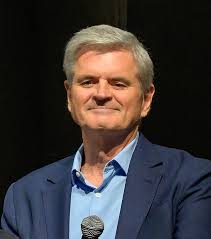
Steve, welcome to Giant Ideas. Great to have you here.
Okay, we're gonna take a walk down memory lane and really talk about what your founding of AOL in the '90s can teach us about the current moment. So, you started AOL in 1985 when there were a tiny fraction of people online. You know, today everyone agrees that AI is the great platform shift. When you look around today, what feels similar and what feels entirely different?
Well, it's an as you'd expect the mix. When we started '85, as you mentioned, only 3% of people were online. Those 3% were online an hour a week. Most people didn't think the internet would ever take off. Most people didn't think it'd ever be mainstream. It was more like a niche hobbyist hacker, you know, kind of market. And it really took a decade from the time we got started to the point where it started building momentum, you know, mid '90s when things started taking off for a bunch of reasons why in retrospect why it took so long. But it was certainly frustrating at the time. I think with AI it's sort of at one level it seemed like an overnight sensation, you know, with ChatGPT launching three or so years ago getting to 100 million users in 90 days. But in fact it took 75 years baking in the oven because AI has been worked on by some in labs for literally decades, even longer than the internet. So it's sort of a and the difference is it was very very slow for the buildup of the internet, faster in terms of the adoption of both consumer and enterprise adoption of AI because all these platforms are built, all the connectivity existed. So when you had something interesting a lot of people can adopt it really quickly.
The other dynamic which is sort of startling for me is when we launched AOL, our first round to get going, the first round of venture capital was $1 million. Over seven years we raised a collective total grand total over seven years several rounds of $10 million. We went public in 1992, the first internet company to go public. In our IPO we raised another $10 million. And now of course companies are getting seeded with a billion dollars and going public at a trillion dollars. So that is certainly different.
And the last point I'd say is on more on the policy politics side of it. When the internet was coming out and it started to build in the 80s and particularly the 90s, there was a debate about what the right public policy should be in terms of, you know, what the rules of the road should be, what sort of guardrails should be. But because it was growing so slowly, the general sense was sort of a light touch regulation made sense until we saw more cards. AI obviously is growing quite rapidly. The adoption is really astronomical which is forcing folks whether it be here in Washington DC or Brussels or other places to say, okay, what should we do here? And obviously there's a tension between, you know, just letting it rip and trying to maximize innovation but take some risk or going too far the other direction and constraining things prematurely. And so the policy debate is now happening faster with AI than it did with the internet.
I think the size of those rounds that you raised and you were the pioneering company of the internet era compared today is definitely illuminated. Another stat I heard was you guys took nine years to get to a million users which was a huge number at the time. I think ChatGPT got to 100 million users in a year or so. So do you think that that...
No, even say it was like three or four months. So no, it was crazy. And again, venture capital back then in the 80s there was a small number of firms writing relatively small checks and the only companies that really could get funded were companies that were viewed as pretty capital efficient. Now there's so much more money, you can take some bigger bets and obviously that's what you're trying to do at Giant. So that's positive. You know, more innovation can happen.
The part that I'm not as wild about is these companies whether it be SpaceX now at two trillion or Anthropic, OpenAI, you know, probably going public around 1 trillion. That's great for those companies. It's great for those investors but it's not great for retail investors. One of the things I loved about AOL was when we went public the market value that day was $70 million. Seven years later when we were merging with Time Warner it was $160 billion, something like 11,000% increase that went in the pockets of retail investors. And so the fact that companies are going public much much much later at much much much higher valuations, there's some upside but a lot of downside for the public investors. And that part of it doesn't I don't allow but obviously I celebrate innovation. I celebrate entrepreneurship and I certainly celebrate these recent successes that are now going public.
That reality and phenomenon will reverse and there will be more opportunity for retail investors to... I mean you could see I guess with Robinhood and the likes that there is a bit of a tide moving against that where people are getting access to some of these companies in the private markets.
Well, I think yeah, certainly the late-stage private markets have been so robust that it did give access to, you know, capital that was unprecedented and so there was less of a need to go public. And in my era, you really raised, you know, and we weren't alone. I mean, we were a little bit lower at 70 million, but Microsoft, Amazon, Nvidia all went public around 500 million. And so these rises to the, you know, trillion dollar plus level again happen in the public markets. I do think the IPO market, the window, if you will, is opening. There are clearly dozens of companies, some of which we're involved in that, you know, confidentially filed to go public. And so, I think you'll see a pretty robust IPO market over the next, you know, 6-12 months, assuming these big big IPOs hold.
So, going to the early days of AOL, you were really ahead of the wave. How did you in those early days distinguish from, you know, when it wasn't necessarily so easy from being too early or whether you kind of, you know, you were right on the money?
Well, we were definitely early at the time, but was, as I said, a small market. There weren't, you know, too many competitors. Most people didn't see it as being that big a market. I remember having a big debate with the personal computer manufacturers at the time, the IBMs, the Apples of the world because when we started in order to get online, you needed to have a modem in your computer and modems shipped as a peripheral device. You know, for the first decade, you had to buy a computer and then decide, I want a modem and go buy a modem and plug it in and figure out how to make it work. Otherwise, that was not a connected computer and you couldn't access obviously the internet.
And you had some quite creative ways of trying to get people connected, right, from a marketing standpoint.
Well, the first step was trying to get those modems built in. So we'd be debating this with the PC manufacturers. Build the modem in. Why would we build the modem in? Like only like 20% of the people buy computers end up buying modems. So why would we, you know, raise the cost to everybody when only a few want? Well, we actually think that's a killer app of the personal computer. And eventually they did it. And eventually that's when things started accelerating. We also as you know were very aggressive in trying to get our free trial disc. At the time we launched most of our competitors were charging for the software, charging an upfront fee to join the service. We said we're going to make the software free and give people a free month because we believed if they actually took the time to try our service they'd fall in love with it and become ongoing subscribers. And that worked well. We distributed a gazillion free trial discs and really kind of slammed foot on the accelerator trying to drive adoption.
And you were 26 at the time right going up against the...
When we started that was 26. Yeah.
Yeah. What gave you the confidence to do that? You've said I think many times that confidence is a key criteria of successful entrepreneurship. Take us back to 26-year-old Steve Case saying I'm going to take on these titans.
Well, I think some of it was probably youthful naivete, which I think is sometimes healthy. I think I thought it'd be easier than it turned out to be, but I did really believe in the idea of the internet, which again, of course, seemed obvious now, but at the time seemed kind of crazy, quixotic. And so I just I didn't know exactly how it was going to play. I didn't know exactly how our company would work, whether we would even survive. But I believed in the idea of people getting connected. I believed in the idea of communicating in new ways with texting and message boards and chat rooms. I believed that content would eventually be distributed in different ways. I believed e-commerce would eventually happen. So I just fundamentally believed which I think gave me and the team we had that sort of the grit, the stick-to-itiveness to stick with it because it seemed like that idea eventually was going to happen. Sometimes it felt like the light was at the end of the tunnel, it was flickering, and sometimes people were adding more tunnel because it just seemed like it was hard to really break out. But fundamentally believed eventually it would happen. And so I think it was a combination of that kind of just being 26, being willing to take the risk, coupled with really fundamentally believing that the idea was a sound idea and somehow, some way we would get the world online.
That core insight and that belief in the internet that allowed you I guess to outmaneuver the incumbents who I guess perhaps were a bit slower to see the value of it or yeah I'm just trying to figure out how you just maybe a bit more tactical how you outgun these guys with so much less capital was it just...
Well, I think the main thing was there was a few other venture-backed startups but not that many. Most of the big players were as you say the incumbents, a big force like AT&T, the largest phone company, or CompuServe and The Source for two of the early pioneers. One of them was owned by H&R Block. GE, General Electric was launching a service called GEnie. Microsoft was planning to enter the market with their own service. So they were kind of big companies trying to figure out what to do about this emerging opportunity but they didn't see it as that big an opportunity. They didn't necessarily put a team on it. They didn't necessarily devote the time to it, which is always a challenge with large companies, they have a lot of priorities. And for us there was one priority which is staying alive and trying to figure out some path to thrive. For others, there's a bunch of things on their agenda. So they should have prevailed, they had great brand names, they had obviously unlimited capital compared to what we had, but they just didn't have the same passion, they didn't have the same focus.
It also helped though because in retrospect I think it helped because it was growing so slowly. It wasn't like everybody was trying to get into it. You know, people thought it was sort of this niche thing. I'd go to personal computer conferences, some of the PC Forum and Agenda and things like that in the 80s, even the early 90s. There'd be hundreds of people there, all of them focused on hardware and software and chips. I was the guy focused on the internet for many of those years. So it was kind of lonely at one level but also it was not as hyper-competitive as it became 10 years later when suddenly there was a gold rush mentality around the internet. So if you're early I think the lesson is sometimes revolutions happen in more evolutionary ways and you really have to be patient and be a little bit of a contrarian but that also means that you might have the opportunity to build some capabilities before everybody else piles in.
Well history doesn't repeat but it rhymes. But we're back to chips these days now. That's the focus. But I think one thing that has changed is, you know, you were up against maybe sleepy or slower incumbents, but the incumbents today, the Googles, the Metas, the Nvidia, the Amazons, they are so on the ball, right, for every kind of technological transformation, they're at the forefront again of this AI one. So in some ways, I think there's stiffer competition than 40 years ago from the incumbent leaders. So what do you think applies today from some of the lessons from AOL and what do you think people maybe misunderstand about AI where there might be an opening?
Well, I'd say it's hard to take on the big boys in sort of the core platform AI, sort of the LLM side of things because that's really kind of like a hundred billion dollar plus ante to play. So that one is basically whether it be the Googles or the Microsoft or others have really been the leaders there. Thankfully there have some new companies obviously Anthropic and OpenAI in particular, and OpenAI largely I think because of the partnership and the money from Microsoft that really fueled their growth. So on that side of things I think the big tech incumbents have had a big structural advantage and does result in essentially big tech getting bigger.
Where it's now shifting quite rapidly is what I think is more like vertical AI as opposed to more platform AI and that's where the technology meets the real world and that's where it's not just about what you're building, it's how you then integrate it into these industries, healthcare and transportation and agriculture, big big sectors, big important aspects of our lives. And the incumbents there are a little bit different. It's not just the tech giants in places like Silicon Valley. It's also the leaders in healthcare like a UnitedHealth in Minnesota. And so how do you work with those incumbents as an entrepreneur? I think partnerships are going to become much more important in this next phase which I've called the internet's third wave. And you're seeing that kind of take hold where the incumbents recognize things are happening, recognize they need to move, don't necessarily have the team in place and the agility to move, so see the value of partnerships and the younger companies see the value of those partnerships as well as accelerating their growth and their ability to enter markets more quickly with more credibility.
Now partnerships are hard so it's tricky to form those but I think you're seeing more and more of that. Some of the companies we back like CLEAR, the biometric technology, now a public company that allows you to move through airports more quickly, kind of a fast pass. That biometric technology is interesting but it was the partnerships they formed with the airports, the airlines, with the transportation authorities that really resulted in the value creation. Similar back to a company also public now called Tempus using AI focused on oncology and other things. Again, the core technology they built was terrific but the partnerships they formed with the leading cancer hospitals so that the data they're able to ingest is what really makes that company work. And that dynamic of partnerships I think becomes much more important. So as entrepreneurs I think part of this is saying okay who are you competing with and is there an opportunity for some co-opetition? Is there rather than assume they're going to be a competitor, is there some way to align with them? And that was a philosophy I had in the early days of AOL. I said everybody's a potential competitor till they start shooting at us and we'll say, okay, they're a potential partner until they start shooting at us and then we'll have to redefine them as a competitor. But leaning into this and trying to kind of co-opt big players and have them on your side, I think is very important.
Okay. So, going back again in history to a moment which in many ways marked the top of the kind of first, I guess, internet bubble. Your merger with Time Warner, it has been described as the worst business deal or merger of all time. Which I think is perhaps not fair, but looking back on it, what do you think people misunderstood? Do you regret it? Any lessons for entrepreneurs listening to this today?