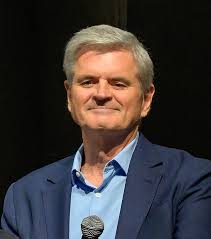
Good afternoon, how is everyone all right? I have my legal pad, so these guys are in some trouble. It's great to be here and to talk about what I imagine is something on the mind of both of you and on the minds of a lot of Americans, and that is all the problems we have in democracy, with poverty, with climate change, with polarization. Some people think the government should solve those problems, some people think the government should stay out of those problems and that the private sector is the best tool to deal with those problems. I think we're all of the mind that we should work together, right? It's an oft-used phrase that's a little bit old-fashioned, this idea of private-public partnerships, but that's the reality of our world. So my first question, in thinking about some of these problems, we'll get to some of the specific problems in a moment, is: to make life better for people, what are the conditions that are required for the government and for business to work together? Mutual respect, I would imagine, is one, mutual trust, people acting in good faith, the rule of law. What do you think, either one of you?
So, it's a real pleasure to be with y'all, and thank y'all for this. I think the answer to that is yes, right? It requires all of it. You know, I remember when I first decided I was going to run for office. I had never run for office before in my life. I was an army officer, I led soldiers in combat, I came back, I joined the world of business, both in finance, and then I ran a small business, we had a successful exit in 2017, then I ran something called Robin Hood, which is one of the country's largest poverty-fighting organizations. And I remember having a conversation with one of our board members when I told him that I was thinking about running for governor, and I told him I want to focus on issues like child poverty and economic growth and inclusive economic growth. And he was saying, 'Well, why would you want to leave this to go to government to do that?' And my honest answer is that you cannot underestimate the role the government had in creating the problems in the first place. That was an interesting reaction, but it's real. Government can't act like they're the ones who can uniquely solve the problem unless they're also willing to acknowledge that they're the ones who also have uniquely helped to create them. The policies that have been in place, the rules and regulations that have been in place, the fact that government has been, maybe in history, the best at picking winners and losers, government has had a role in doing that, right?
But just in fairness, there are people who make that point. Ronald Reagan famously made the point that some of the most frightening words in the English language are 'I'm from the government, I'm here to help.'
Yep. So do you... Was he on track? No, no, because I think it's important to recognize the role the government had in creating them, so I think it's also important to understand the role that government has in helping to unearth them as well. Government can not just have a side spectator role of saying, 'Now that everything is jacked up, now everyone else come and fix it,' particularly when you're thinking about the budgets that we have within state government. Perfect example: I remember when I was running Robin Hood, we'd say, 'Listen, I could make an announcement and say we're going to put $25 million into supporting public education,' and people in the team would cheer, and I might even get a little write-up in the newspaper about the commitment that Robin just made, until you realize that the budget for the Department of Education in New York City alone is $27 billion. So to act like government does not have a role in helping to fix these challenges is also naive. That's where I think the partnership does matter. And I think it's even the way you look at what we've done in the state of Maryland, where I understand that there are certain entities, private sector, philanthropy, etc., that can really serve as our leading indicators. They're the best practice mechanisms, they're the ones who can be essentially the seed capital, often times in innovations at work. What they need to then have is a partner in government who, once they understand what works, once we understand that this actually has an outside societal ROI on it, now we're then prepared to take it public, to say, 'Show me what works and I will fund that. Show me what is not working and I will stop funding that.' It's not more complicated, but that becomes the appropriate role that government can help to take on to help to address a lot of our societal challenges.
Steve, you have a thought? Yeah, I'd add to that. I've been in the innovation economy my whole life as an entrepreneur, as an investor, as a philanthropist, as someone trying to influence some policy things. And I've seen where government can get it right and where government gets it wrong. There's always frustration. I'm sure some of the applause in the audience reflects us about government stifling innovation, regulatory capture, locking in incumbents, a bunch of things like that. But I've also seen, including my own situation, where we started America Online, AOL, almost 40 years ago. That company would not have started if government hadn't taken some action, including breaking up Ma Bell to create innovation in the telecom space, Congress passing a Telecom Act that actually commercialized access to the internet. When we first got started in 1985, only 3% of people were online, they were online about one hour a week, and the reason is it was too expensive. So you had to get the cost down, and it took a few years before even the internet was available to consumers and businesses. It was set up originally by the government, funded by DARPA, as a network for a whole host of strategic reasons and limited to educational institutions and government institutions. So consumers or businesses couldn't do it. Government had to fix that, and the FTC also had to mandate that phone companies had to open up their networks, open access they called it. And that unleashed the internet revolution that put America at front and center as the leader of that revolution. So as we think of technologies now, obviously AI being more front and center, how do we learn from some of those lessons? Make sure, for example, we do have an open access approach, an open source approach in this case to AI. We don't just let big tech get bigger, we make sure the playing field is level so new companies can emerge. That's where government has to strike the right balance from regulations to stop bad things from happening, which is important, while also making sure they are unleashing the next innovation and America continues to lead the way. The last point I'll make is part of the reason America has led the way in so many of these new industries is our policies more generally around tax policy, immigration policy, innovation policy have been better than Europe, have been better than China. And the core in this US-China battle right now is essentially a battle between a top-down approach to innovation led by the government, where they make the key decisions about which companies will win or lose, versus the American approach, which is much more of a bottoms-up, pioneering innovation culture. But we need to make sure that's not just alive and well here in San Francisco, but alive and well all across the country, because that ties into some of the political divide we have now where a lot of people in a lot of parts of the country are feeling kind of left out and left behind. The one data point there that's worth noting: when Donald Trump beat Hillary Clinton eight years ago, 30 states, if you added up all the venture capital in all 30 states, it was 15%. The 20 states she had, 85%. That's important because everybody in this audience knows venture capital generally drives the innovation of the companies that scale, create a lot of jobs, drive a lot of economic growth. So if we're only investing in entrepreneurs in a few places, guess what? A lot of people see the disruption that that causes, don't see the offsetting benefit of new companies, new jobs being created, and that leads to a divide. And we're living it again today.
You mention politics, because we sometimes talk about these things as if smart and intelligent people who are engaging in this debate in good faith, as both of you have been, and we almost talk about it as if all reasonable people would agree and there's not a political or ideological dimension to it. Do we need to do something about our political rhetoric and dialogue so that we don't have undue demonizing of government, and on the other side, undue demonizing of people who are successful through entrepreneurship in this country?
Two points. One is I'm very proud of the role that our company played in getting America Online, getting the world online. I'm very proud of the impact the internet's played in so many different respects in terms of creating opportunity and free exchange of ideas and so forth. One area where I'm really quite disappointed is what's happened with social media. We were the first company that launched instant messaging and buddy lists and chat rooms, and in some ways was the first company prior to Facebook and many others that was in that space. And I always thought, 'Isn't this great?' Because when I was growing up, all I could see was what the three television networks were broadcasting, or three plus PBS, which didn't get general ratings. All I could read was a newspaper owned by the tycoon or the legacy family in that town. Wouldn't it be great if we could level the field and more voices could be heard, and the internet would enable that to happen? And it did enable that to happen. There are many blogs and all kinds of things, podcasts like Masters of Scale, that have come out of that. But what was the unintended consequence, which was surprising to me and very disappointing, is instead of using that as a way to learn about other issues, connect with other people, it led to these tribal tendencies, these filter bubble tendencies, where most people, including most people in this room, are following people and watching things that are consistent with their views and not taking the time to learn the other point of view. So that's been a big disappointment. The one area where I'd say is positive is there's an initiative, a nonprofit initiative launched a few years ago by Tim Shriver, the chairman of Special Olympics, called Unite. And they launched something called the Dignity Index, and it goes to your question. Some politicians now, including a number of senators and governors, are using that to make sure their communications are scored in a way that is more trying to build that common ground, trying to build that consensus, not this hot rhetoric that maybe plays well on cable television or on X but doesn't really result in ways that people can come together. So I invite people to look at that Dignity Index and score some of your own communications. It's a little bit of a wake-up call, not just what they're doing, but what each of us is doing to try to be part of the solution, not part of the problem.
Have there been ratings of our current presidential candidates?
They have. They've done some analysis, including the debate.