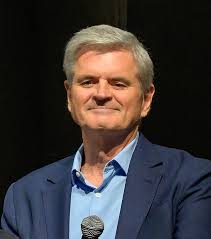
Let me bring up the gentleman I just spoke to, who was part of those early days of the internet, Steve Case, chairman and CEO of Revolution, and of course the co-founder and former CEO of AOL, America Online. So, Steve Case, welcome to my stage.
Hello. Hello. They've been trying to get this music right. So, look, one of my favorite things of all time that I did was riding around in this bus with you in the Rise of the Rest tour. Did anybody know what Rise of the Rest is? Yeah, some of you do. I mean, I love you guys. Your hands go up on everything. So I don't know whether they trust that or not, but what Steve was doing, and it kind of gave me insight to think about entrepreneurs in all different shapes, flavors, sizes, obsessions, because they all are obsessed with something. And I met the coolest people out in the middle of America, flyover country, in little towns, because you believe that San Francisco, the Bay Area, and Boston, New York have become too narcissistic and we're leaving a lot of talent on the table.
That's not what I believe. But your previous speaker was from Albuquerque. So, my belief is that there are great ideas everywhere. There's great talent everywhere, but there's not great opportunity everywhere. So, how do you — which is nothing negative about San Francisco or New York or Boston, obviously very positive, but it's crazy. The majority of venture capital in the country goes to those few places. And how do we get more venture capital backing more entrepreneurs, starting more companies across more sectors in more places, which creates more shots on goal for America so we're likely to win the future, but also in the process creates more jobs and hope and opportunity for those communities who otherwise often feel left out, left behind by what's happening in the technology world. So, it's more about leveling the playing field while still celebrating Silicon Valley and other places.
Well, he is very nice to all cities, and I am less so. But anyway, I just think that what you've done, and I want our audience to know, is you've been probably more responsible than anyone else I know about looking at the importance of creating a pro-entrepreneurship ecosystem and all of the different measures, and you've been a direct investor in that. I have tremendous admiration and respect. But we're now in a new era, and I kind of started this morning saying, 'Hey, the topography of opportunity has changed, the topography of business has changed,' and you've written about these shocks, these waves, the third wave coming in, and I sort of feel like we're living through one of the inflection points in your book, that now we're in a tsunami. I mean, we may not even realize it, of technological change and revolution, and I'd love to get your sense of that map and what we should be paying most attention to.
Yeah, I obviously agree with that. I'm very optimistic about AI and other technologies that are being developed, although I recognize there's some risks and we need to get the balance right. But it's kind of interesting that AI has really been developing for 80 years. People first started working on artificial intelligence, which was even before the internet was developed. AI was developed, it just took a while for it to become more of a societal and consumer phenomenon. And obviously ChatGPT gets the most credit for that. They basically got to 100 million users in 90 days, and that sort of set off the AI gold rush, if you will. And suddenly people saw what was possible because they could see it on their own phones or on their own devices. And that's now accelerated investment. We and a lot of others have been investing in AI for a long time, more than a decade. Our focus has been more on vertical AI, not the platform LLM, OpenAI, Anthropic side of things, but companies like Tempus in Chicago using AI for oncology to better diagnose disease, or Carbon Robotics in Seattle using it for farming, or a lot of other examples of people using AI for specific industries. But there's no question that there's a lot of excitement now, a lot of potential now. It's going to be transformative for society, kind of disruptive and transformative for a lot of different industries, which then creates the dynamic where it went from not too long ago nobody knew about it or cared about it to suddenly it's the next big thing and you want to be part of it, which then leads to a lot of investment, often overinvestment, then at some point a correction. And we're in that phase now where there's still a lot of investment, but at some point — hard to predict, next year, two, three — there likely will be some correction. Meanwhile, which is part of the focus of your day here, is how, because it's moving so quickly, a lot faster than the internet moved, and because it's got such broad societal impact, much more than frankly the early days of the internet did, what is the appropriate policy related to AI? And just saying 'let it rip,' which I know is the view of some, I don't think is responsible because we've already seen some of the risks. At the same time, to be so focused on what might go wrong you don't enable innovation to happen, to unleash what might go right, is equally wrong. And Europe has done some of that — overregulation stifles innovation. So you can't do nothing, you can't do too much. You need sort of this Goldilocks, just-about-right solution. And that's thankfully where the conversation now seems to be, including today at the White House and in other forums. How do you keep the innovation engine going? Make sure America does lead. The risk of China is real, but also the risks of the technology are real. And you've got to make sure you have the right kind of balanced guardrails.
We seem to be going between a kind of 'world is over, world is saved' poles in the AI debate. And I don't know if you were here for Bruce Andrews. Bruce is the chief external affairs guy now for Nvidia. And he was talking about their release yesterday of — it has a name, but it's basically a sentry system, right? That system would have, according to Hugging Face and other players in there, prevented that case from happening, which we wouldn't then have known of the company Hugging Face. But we would have probably less fear and kind of a cold chill through the AI industry had that happened. It's just remarkable how quickly, if it's effective and efficacious, that sentry system has been brought out. So it feels like the terrain is changing so dramatically every day.
For sure, and that seemed like a step in the right direction. Let's see how it plays out. But I think a little bit of context, maybe a little bit of history, is helpful here. Too many people, I think, in the tech sector, particularly the AI sector, just reflexively are anti-regulation. You just believe it's always going to be bad. It's always going to stifle innovation. So arguments around regulatory capture play up, arguments around, you know, otherwise if we do anything China's going to beat us. And I understand the arguments. But at the same time, 50 years ago, when I was in high school, a bunch of new technologies were coming onto the scene. Nuclear power was one. Recombinant DNA was another. Some of the things around agriculture and genetically modified seeds and other things was another. And not getting the policy right ended up hurting, in some cases crushing, these industries. The nuclear power advocates 50 years ago were correctly talking about the fact that it was a cleaner energy solution, and there was a lot of momentum, a lot of investment behind nuclear power. But in the late '70s, we got scared. There was a movie with Jane Fonda and Michael Douglas, The China Syndrome. Three Mile Island happened, and basically that squashed it. The No Nukes festival in New York, which I was at, went to Central Park, and No Nukes.
I was there. I was there. I was partly there because there were still people out there with a — but I bought into it. Again, I was like a teenager. I thought, you know, nukes are bad. Nukes are risky, and there were some safety issues that were real, but there also were some benefits. And because the industry did not build trust and have some policy framework, essentially it got crushed. And other places kind of got the benefit of that. Recombinant DNA was different. There were fears about that, and the industry actually said, 'Let's figure out how to build people's confidence about it.' And the reason America's led the way in biotechnology over the last half century was because they spent the time to think about it. Genetically modified food kind of became Frankenfood for a lot of people, and there was a huge backlash, even though it was helping a lot of farmers grow more food to feed more people, which is a good thing. So these technologies, you have to be optimistic about them, you have to understand what's possible with them, you have to be excited about that, but at the same time you have to understand that as these come on the scene, there are risks. You can't just pretend there aren't. And you also have to understand how to bring people along. And right now in this country, 80% of Americans say they're concerned about AI. And backlash against data centers is real. And this summer, most people giving a commencement speech that mentioned AI got booed. And this midterm election, the polling suggests AI is a big issue. In the presidential election in '28, I think it'll still mostly be about affordability, but I'll bet you AI is on the ballot as well. And so we're going to have a conversation about this.
You get the commencement.
And the other piece that I think the industry has missed is because of this slowdown at the federal level. I think it's now up to 10 states have done their own AI laws, which is the worst. We don't need 50 states doing 50 different AI things. So I think industry needs to get in front of this, so there's a unified federal policy and there's reasonable guardrails at least to get things started. I wrote last week in The New York Times about having at least disclosure, kind of like the airline industry. So if there's some problem, like a near crash of airplanes, actually the industry has agreed through a self-regulation commitment of the entire industry to report that, and the NTSB investigates it and has a connection to Congress. Things like that I think will be helpful. We need to build more confidence about AI and not just be breathlessly enthusiastic about all the good things, like the nuclear power advocates were 50 years ago. But because they didn't get the balance right, instead of that becoming a major phenomenon, which in retrospect would have been a good thing — the safety risks were real, but the benefits of cleaner energy were quite real as well — and so we kind of lost that because the innovators at the time were tone-deaf about how people were thinking about it. And in this country and most countries around the world, there's some degree of excitement about AI, but mostly fear of the jailbreak things, what could happen, a loss of jobs, impact on communities — a bunch of real things that we need to have a real conversation about. Otherwise, I think there will almost certainly be overregulation, because the public will demand it. So now's the time to have reasonable, balanced, responsible regulation while that deal still can be cut.
Your book, it was The Third Wave. I loved this book, and Steve let me read it before it came out. I read every word of it, and I sort of felt, the other night when I was thinking about this talk with you, I feel like we're in a chapter of that book. And I mean, it's palpable for me that, like, wow, Steve wrote about this moment. And now I feel like all of a sudden we're in the middle of a wave and we don't know how to sort it out. I'm interested in it because you saw it coming. You actually think it's good and productive to have this kind of disruption in an economy that drives forward this constructive, almost Schumpeterian destruction. But you wrote some principles, if I recall, in there about things we had to get right in terms of thinking about revolutionary inflection points. And I'd love to hear about those, have our audience hear what you think we need to get right. How do we maximize a moment like this to get the best out of it?