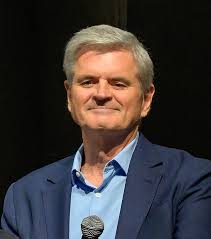
Okay. How many of you have heard of AOL? How many of you have not heard of AOL? Show your hands. Okay. Come on up. Yeah. We're Come on up. Steve Case, one of my heroes. Steve, thank you so much for joining us. I know you scrambled from New York. You were at the, you know, what it was at the Deal Book. Yeah. You know, which this is better than Deal Book.
Well, you're kind of like Andrew Ross Sorkin. The fact you do these interviews back to back. It's exhausting just to watch.
I saw him last night at the dinner and I said, 'You say the next two days are you going to just like crash?' He said, 'No, I have to be up at 4 in the morning to do you see him talk.' I like, 'Oh, geez.' So, I did yesterday at dinner and a coffee house talk before we did this. But it's great to you know Steve, tell our audience you know we're with one of my heroes. You know when you sort of meet somebody when I was in Washington fairly early stage and you know I think some of the debates ideological debates about economics you know what you do about you know I remember I worked for the Economic Strategy Institute and the other big institute some of you may be affiliated there was really interesting high-stakes debates about how to run an economy at that time. What did globalization mean? That was the time of Bill Clinton and you were building the platform on which all of these debates and businesses and economies were going on with AOL, but I don't want to stay in the past. You wrote a book a few years ago called The Third Wave, which was one of the most impactful books to me to sort of think about well in advance of the tech wave that's coming. And I would like you to start this, you know, sharing with our audience handicap where we are in terms of the tsunami of change you see coming because I think we're always a bit slow to understand what's hitting us.
Well, I think I wrote that almost a decade ago and the basic thesis was, you know, the first wave is obviously focused on the internet and technology. The first wave was just getting everybody online. AOL and others were part of that. When we started only 3% of people were online so we had a lot of work to do to get America online. The second wave, once all that infrastructure was built, the on-ramps were built, was really building software and services on top of the internet. This is where Facebook and Google and other things kind of came out. They didn't have to worry about the connectivity infrastructure because it was there. They could just build on top of it. I said the third wave will be kind of when the internet meets the real world and it starts impacting big industries: transportation, financial services, health care, farming, you name it. But it would be different than the second wave because it would require more engagement on policy because governments will play a role in these sectors and will require more partnerships. It'd be harder to go it alone. That is obviously now happening. You see that kind of rippling across the economy with different sectors being re-imagined leveraging technology, more recognition of the role of policy including at least a half a dozen venture capital firms in the last year have decided to have a DC office. 10 years ago they didn't want to come to DC, they thought it was kind of a waste of time, and now they realize that policies are being formed that are going to impact different industries and they kind of should be in the room where it happens.
Does that worry you that government is rising on the radar screen of concern for businesses?
No, I actually was worried that they were too separated. The innovators in Silicon Valley and the policy makers in Washington, Brussels, other places were not talking about what was happening or what was going to happen next. And as a result, policies could have been formed that were not optimal because they didn't have the broader set of information. So I actually was urging some of the innovators, whether it be entrepreneurs or investors in places like Silicon Valley, to spend more time here. So I think it's a good thing that they're doing. Obviously, there's always a risk of too much of that and having money influencing policy, things like that. That's a different discussion. But in general, as we're trying to make sure America continues to lead the way in this next wave of innovation, AI, and other kind of things, more engagement to figure out what's happening and what will happen, I think is positive. In fact, essential.
So, the other reason I was excited you'd be here is again in this, as we're discussing so many different slices of the American economic pie and what is American growth summit? Who should we have here? A very important part of this to me is entrepreneurs. And you're the CEO of Revolution. You've invested over $2 billion into lots of companies. It's a lot of money because you invest a little bit. So either you've succeeded only a little bit or you've failed a lot. I don't know. You can help us with that. But $2 billion is a lot of money in all these places. Some of the companies you've invested in are DraftKings, Tempest, Kava, Sweet Green, Anduril, and these are big names. There are many others out there. But my sense is that beyond the headlines, the world of startups continues to be one that's challenged. If you go to the Kauffman Foundation, you see a lot of the drivers of the ecosystem around entrepreneurship just aren't healthy. Are you worried about that?
Well, I don't think it's... there's room for improvement, but it's reasonably healthy in terms of the overall ecosystem of innovation.
What part's healthy? What's unhealthy?
The part that still needs work, and we've been trying to do it with Rise of the Rest, an initiative we launched over a decade ago, made some progress, but there's still a lot.
Just so people know, Rise of the Rest is a super cool thing. If you're ever lucky enough to be in like Madison, Wisconsin or any of the places, you know Steve goes, there's this big... you still do the bus? Okay, the what?
We don't do bus tours. We kind of... I think we've visited cities and we kind of run out of places to go, but we go back to cities, back to Atlanta, bus, we go on startup grinds and walk through startup crawls and they have pitches in places of the country that may have been flyover cities. We've got Mike Kio of Provalis that's going to a lot of these flyover places and kind of reinventing them into tech hubs and whatnot. But that's what Rise of the Rest is. The reason the focus on that still needs focus is, and you know this but maybe not everybody does, overwhelmingly venture capital goes to a few states. About 75% has gone to California, New York, and Massachusetts over the last few decades. The other 47 states get the other 25%. Some big states like Texas and Florida under 2%, most states Ohio, Michigan, etc. under 1%. California alone is 50%. Why does that matter? It matters because the data, and I didn't know this till about 15 years ago when I was asked to chair a White House initiative called Startup America, shows that while small business is hugely important in our country, and large businesses, the Fortune 500, are hugely important, they don't actually grow jobs as sectors. In small businesses, some are starting but some are closing. Big businesses, some are growing, some are declining. The real leverage is new companies under five years old. This is Kauffman data and others that were really quite stark on this issue, which basically says it's startups. So if you're not backing startups, you're not creating jobs. And if you're only backing startups in places on the coast like Silicon Valley and not in the middle of the country, you're going to create a lot of jobs and wealth there, and some of that will disrupt industries in the middle of the country. There'll be job loss in those places. So you've got to back entrepreneurs there to create companies there to create jobs there and drive economic growth there, or a lot of people will be frustrated, left out, left behind, which will impact our politics. It has, and unless it gets more attention, it will get worse, not better. So there has been progress, more focus.
Has Rise of the Rest been getting sticky in terms of...?
I think we're seeing a lot of different cities now focusing on what's happening, making it more of a priority from an economic development standpoint. In the last decade, 1400 new venture firms have started in Rise of the Rest cities, which means there are small seed funds and venture funds in far more cities than there were 10, 15, 20 years ago. So that's a big positive. Progress has been made to try to level the playing field, have a more broadly dispersed innovation economy. I think that's critical if we're going to continue to win and continue to fight battles in terms of innovation with China and other countries. We can't just be relying on a few people in a few places. We need everybody on the field. A lot of this morning's discussion is focused on AI transformation, productivity, what it means in a whole variety of areas. You've written a piece that kind of looks at, hey, maybe there's going to be an AI pop. I remember Daniel Gross's book called POP. It was a history of other booms, railroad booms, other kind of overinvestment in America. This still turned out okay, but you still had this massive rush of irrational exuberance into a field and then it consolidated. And you're already saying, hey, maybe we're getting there pretty quickly. But you're interested in teaching us moments about what happened during the IT collapse, if not collapse.
Well, the consolidation. In the case of the internet specifically, it had been developed by the US government more than half a century ago. It took a long time to build momentum, and then the '90s, particularly the late '90s, really took off. When it took off, suddenly everybody wanted to be online, suddenly there were a ton of people wanting to start new companies, a ton of investment going into that, and it did end up being a dotcom bubble. In 2000, things kind of crashed and corrected. In the case of AI, there are some similarities but also some differences. AI, even with the success of ChatGPT having 100 million users in 90 days, which was unprecedented, sort of like 'ta-da, this thing came out of nowhere,' actually had been under development for 75 years. The first focus on AI, folks even calling it AI, some of the work in labs was 75 years ago. It was just baking in the oven a long time before it took off as a consumer phenomenon. That's interesting. The fact that it took us nine years to get 1 million customers at AOL, and a few years later we were adding 1 million customers every month. Sometimes these things just take a while and really take off. But the level of investment now in AI is extraordinary. Of course, there's going to be some really bad things that happen. Some companies will end up being super successful and live up to their valuation. There'll be a correction at some point, whether it's a month from now, a year from now, three years from now, I don't know, but at some point there'll be a correction. But the overarching arc, like the internet, of what's happening in AI and how it's now shifting from a focus on the large language models, which tend to be centered in big companies in Silicon Valley, it's billions if not tens of billions of dollars sometimes hundreds of billions of dollars being funded there. That game is more concentrated with big tech getting bigger, which has some policy implications. Some new companies, OpenAI and Anthropic, a few that have emerged and are raising hundred billion plus in capital, that's completely unprecedented. Versus the internet when we started, in our first round we raised $1 million. Over seven years we raised a total of $10 million. We went public, first internet company to go public in 1992, we raised $10 million. The amount of capital going into this is startling. And obviously I'm also just a little bit jealous.
I think Red is spending 60 billion.
No, the amount of money being spent is... But now people feel appropriately that it's going to be transformative.
Do you think they're really spending that much money or are they just saying they are?