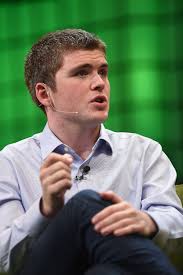
Please join me in welcoming to the stage Molly O'Shea and John Collison.
John, thank you very much. And Paul, thank you very much. I hope you guys are all having a really great day, enjoying everything Browserbase. So, we're going to talk about payments, agentic commerce, and everything that's going on in the computer. So, Stripe processed $1.9 trillion in 2025, up 34%.
How are you rebuilding for AI?
Yeah, look, it's really interesting right now because we've been working on Stripe for a long time, right? This is our 17th year doing it. And for many years in the payments industry, it didn't really change that much. And now there's just like some small changes happening where, I mean, leave aside everything that's going on in stablecoins and like all that other interesting stuff, but other than that, it's all the same old.
So Instinct is real, Muse is real.
All these things are real. Again, you have people in the audience — like you saw a significant fraction of the audience using them. And okay, I think it turns out one, filling out a web form is not a value-add activity for anyone. Like no one chooses to fill out web forms in their spare time. And so I think the whole conceit of these agents — and obviously again this is where Browserbase and, you know, computer use comes in — but when you have the stateful context where your agent knows things about you, like the basic one is it knows your shipping address and payment details and things like that, and then when it can manipulate a computer and go off and do things in the real world, it turns out it's much nicer to be able to say, 'Hey, please renew my driver's license for me,' or, you know, whatever the task is, rather than go play with web forms. And so I actually think one big part of all these personal agents starting to work is actually giving them a meaningful amount of compute so you can go do stuff. But another one is computer use actually becoming a mature enough technology, because computer use is the ultimate backwards compatibility layer for the real world. Like how long would you need to wait for, you know, the DMV to add an MCP? Like I'm not a betting man, but I'm betting we would have to wait a few years, but it doesn't matter because computer use solves that. And so again, it's the ultimate backwards compatibility there.
So you've mentioned that agentic commerce is a complete rewiring. What do you mean by it's a complete rewiring?
A few things. One is like it's rewiring things at the surface level where how businesses sell is going to change pretty significantly. Like the first-order change is that we think people's agents are going to be doing a huge amount of the commerce for them. The second-order change is it probably changes the commerce landscape a little bit. And so again, I don't know what people bought in their experiences, but my experience of doing AI-powered product research is it often actually surfaces niche brands or businesses you haven't heard of. Like I think it's quite a good story for the long tail of businesses. I think it's quite empowering that if you have a product that actually is well reviewed and that, you know, people like on the internet, it leads to more discovery of that. And so I think the existing aggregators are going to have to answer questions because in a way AI discovery is the new point of aggregation for commerce. And so you probably have a bit of a turning over of the top businesses. That's going to happen where if you are selling a really good product, if you're making it discoverable, then you can kind of shoot up in the rankings. I think the analogy for this is when like Facebook and Instagram ad targeting was so good that it led to a whole new generation of companies that were built around, you know, targeting on those platforms and they were native to it. Think of a Wish.com or a Teespring or, you know, even Temu and Shein, you know, to a significant degree grew up on those platforms and did a huge amount of customer acquisition on those platforms and they were able to more natively adopt it than the prior generation of big box retailers who in theory had all the same tools available to them but they were just less native to that kind of customer acquisition technology and it, you know, it's got to flow all the way downstream to the product creation and things like that. I feel like AI e-commerce will be somewhat similar where first order it'll make buying things more convenient. Second order it'll probably actually reshape the product and the merchant landscape to favor the people who can most successfully adopt it.
Well, how are you thinking about cybersecurity risk as that scales?
We have invented a new technology that is available to defenders and available to attackers. And, you know, people make all the, you know, trite analogies to, you know, the emergence of the motor car. You know, the bank robbers were the first to adopt the car to conduct bank robberies and pretty quickly, you know, police forces started realizing, 'Hmm, we really need cars to keep up with these bank robbers.' And so you always have this like cat-and-mouse offense-defense game that's happening. And so in our case, the new models have really advanced cyber capabilities and it's, I mean, somewhat intimidating because you're realizing that the standard for — I mean, the good news is that Stripe has been very paranoid on cyber for many, many years and so it's not like this is kind of totally new news for us, but we feel like the adversary landscape is getting quite a bit better quite quickly and so it went from something that we already had a ton of attention on to something that we're spending even more attention on and it does feel like over, say, over the next five years you're going to see more breaches than you did over the past five years.
This is true. Like there's no two ways about it because again in theory there should be some equilibrium between offense and defense but that's this very like assume-a-spherical-cow theory and in practice there are lots of organizations out there that are going to be too slow in how they adopt the latest capabilities. The good news for like the startups in the room is obviously I think startups are disproportionately in a good spot because it is easier for them to adopt the latest models with kind of the latest cyber capabilities and they just have smaller, more contained, more homogeneous tech stacks versus if you're running some like 50-year-old tech stack that has grown through acquisition where you have like a bunch of, you know, you're running on versions of Windows that aren't even supported anymore, like that's not a great place to be from a cyber point of view.
So you've talked about the singularity a bunch. You have a different perspective on it that I think is like a little bit more optimistic than the standard San Francisco doom. So how do you — I guess what is your perspective on the singularity? How do you make this?
Yeah, you know, we've been — we kind of somewhat tongue-in-cheek at Stripe started referring to January 1st as, you know, day one of the singularity. And so kind of like the Unix epoch is, you know, January 1st 1970, we decided that the singularity epoch is January 1st 2026. That's as good a day as any to decide that, you know, we are now in the singularity. And I mean it's not a total coincidence that we picked that date in that if you guys remember it was the end of last year that I feel like for many of us it was the holy-crap moment when it came to coding models and how they're getting that good, how they're getting so good. And in particular, you know, the thing that all the AI folks talk about is this idea of recursive self-improvement where, you know, the AI uses the AI to make itself better. And again, I think sometimes it's a bit challenging because people refer to the AI as kind of this monolithic thing, but we're clearly in a world where AI capabilities are helping with the rate of improvement in AI. I mean, just look at all the math announcements that we had this week and last week. We're in math wars now. It's just — it's not something that was on my bingo card for 2026 that we have math wars. But, you know, rival math factions — but we have, and kind of the same thing applies to the model development where the labs are using AI capabilities to go faster. So anyway, it feels like 2026 is this year where we're really feeling the effects of that recursive self-improvement. I think we're pretty optimistic at Stripe. Like we see the early economic indicators from this where as a result of intelligence on tap getting much cheaper, new firm creation is way up. We're seeing the highest rate of new firm creation that we've seen in recent memory on Stripe like right now because when you have all these tools, it's easier to start a company. It's easier to actually make it successful. I think this technology has a lot to be optimistic about and so we don't say the singularity in any kind of a pessimistic or kind of worried manner. It's just like we are in this moment of AI takeoff right now and you should enjoy it and it's kind of hard to deny that it's happening.
Should we be scared or is that just a marketing tactic?
In a business context. Firstly, I think you should be paying attention. Like the thing that we tell businesses, you know, that we're working with at Stripe is, you know, when we're talking about this cyber stuff, all the cyber stuff is real. And again, just as we're talking about the agentic commerce stuff earlier, the entire landscape is shifting. I'll give you another example. We spent, you know, again, the entirety of Stripe up to this point building for developers and using APIs as a selling point, like making the developer experience easy was what we focused on, what we spent a huge amount of internal effort on at Stripe. And this would be like minute details of the API documentation or how we make upgrades easy for a developer who's migrating from, you know, one version of the API to the other overnight, you know, relatively overnight. No one actually really integrates the Stripe API by hand anymore. You know, they send their coding agent to do it. And that's a related skill, but it's actually a pretty different skill because, you know, the developer ergonomics are different from the AI ergonomics. And so many of the things that we spend time on to make things nice for developers actually don't really matter to the AIs and what matters is a fairly different set of things, like it's very easy for them to, you know, integrate the wrong version of the API or something like this. And so we are having to kind of totally change what we're good at internally at Stripe. I think that's probably true for all the industries people are working in here where just everyone's chessboard just got a little bit of a jiggle and some of the pieces got knocked and, you know, the position moved around and so now you're working with this new chess position. I think everyone needs to pay attention to that. I think one should worry about specific concerns and so you should like specifically feel good about your cybersecurity or ensure that you can feel good about it. I don't think people should feel this like ominous, oppressive, overbearing sense of foreboding. Generally I think they should feel pretty excited to be living in this fast-takeoff world.
So Stripe is taking off even faster than before. You have most recently made a couple of really interesting acquisitions from Metronome, Bridge, Privy to also OpenRouter. So what are you assembling there? How are you redirecting for this era?
So if you look at the areas where Stripe has done acquisitions, they tend to follow that pattern where Bridge and Privy were in crypto and again there is a certain kind of crypto nativity and way of working in the crypto world that is different to the world that we came from. And so the folks on those teams are crypto-native in a way that it would be hard to get there that quickly at Stripe and they've injected a lot of that crypto nativity into the Stripe culture. You know, you mentioned Metronome which is usage-based billing because of AI. Everyone has inference costs these days and so everyone has to actually price their product differently. There are very few products these days that do not have some usage-based component or some overage. Like you can sign up for Chat or Claude and they will let you go a certain amount but then they're like, 'Sorry, you ran out of plan, you got to buy credits.' And so because of the underlying cost structure kind of everyone needs to have usage-based billing these days with AI products. And then you mentioned OpenRouter. We're just — well, one, I think we're obviously pretty AI-built like everyone else in the audience and what we notice is that a huge fraction — an increasing fraction and increasingly a huge fraction of businesses' spend is actually going towards just AI and inference and that could be, you know, you're doing R&D at your company or a lot of products actually have some AI inference as part of delivering the product. And you could say, 'Oh, we're iterating towards, you know, the single model that everyone will use for everything.' I think OpenRouter's belief is that like to believe in OpenRouter you have to believe that more than one model will be used inside a business, like the same business, and maybe that model will change and so people might want to, depending on the particular workload, send things to a different model. They may want to update that when new better models come out. They may want to — when you think about it, a really high-value user you can send to a frontier model but a lower-value user you route to a lower-value model and so it depends on the user's lifetime value to you, all this kind of stuff. But if you believe that you actually just need to use multiple models at the same time within a business, then you need something like OpenRouter. And as far as we could tell, they were the furthest ahead in delivering that marketplace to help businesses actually use multiple models.
So Stripe's goal is to increase the GDP of the internet. How much of this is coming from AI now?
Like I won't say the exact fraction, but a lot. And part of the reason I won't say the exact — partly because I don't want to, but partly because it's actually pretty hard to measure these days where there's, you know, AI businesses, you know, the Browserbases of the world running on Stripe, clearly, you know, at the core of the AI revolution, you know, allowing people to actually — allowing agents to actually use computers, that's pretty clearly in the AI category. There's a lot of businesses out there that are transforming their business with AI. They grew up in the pre-AI — you know, Meta runs on Stripe, grew up in the pre-AI era, pretty increasingly becoming an AI company. And so we find it very hard to segment companies into, you know, AI versus not AI because if you're not using a lot of AI in your business, you're probably not paying attention.
In terms of acquisitions and strategic thinking about the business and growth and new products that you're offering, when do you decide to build versus buy?