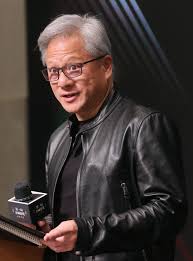
How are you guys feeling today in the morning? It's a beautiful morning.
I don't want to talk too much in the beginning. I'm just going to tell you that we have three and a half minutes before we begin. That's the ETA, and yeah, you can take your seats according to this time. Three and a half... three minutes and 20 seconds already. And we won't have many introductory speeches. We will just start with the fireside chat. We respect your time and the time of Mr. Huang. So it will begin right away.
doesn't see it.
for
Heat. Heat.
Absolutely.
So guys, you're welcome to sit here as well. We have many free seats to the right side of the stage. So please join us. Make sure you don't stand. This also does not look very impressive on the live stream. You guys standing in front of the cameras as well. So please make sure you don't do that.
Okay, we're almost ready to begin. Are you guys ready?
How are you guys feeling this morning? Is this, you think, a beautiful morning? Do you like it? I think it's beautiful. AI month is over exactly today. So exactly today we will have the award ceremony for AI month as well. So please join us after the fireside chat for that. It's going to be a very important part as well. And do you guys have energy to welcome our guests? How do you guys think? Can you show some love, respect and energy on one, two, three?
How do we do that? Celebrating.
Yes. And again, welcome to Alemi, the international center for artificial intelligence. Today is a special day for our country, our developers, and everyone who believes the future is built by those who dare to build it. We are about to talk about where technology is heading and the role Kazakhstan intends to play in it. And if you're ready, if everyone is ready, are you guys ready to begin right now?
Okay, then I think everyone is ready. Then please welcome our moderator, Jaslan Madiev, Deputy Prime Minister and Minister of Artificial Intelligence and Digital Development of the Republic of Kazakhstan.
That was a really, really nice rehearsal. We're going to do that again. One more time. Please welcome with a round of applause. I'm just waiting for perfect timing.
Please welcome again our moderator, Jaslan Madiev, Deputy Prime Minister and Minister of Artificial Intelligence and Digital Development of the Republic of Kazakhstan. Now here with us on the stage and joining him, and joining him, our distinguished guest, Jensen Huang, visionary entrepreneur and founder, president and CEO of Nvidia.
Wow, what a day. What a guest.
Here you go.
Thank you. Please. And before we begin, let's take a look at the journey that brought us here. Please turn your attention to the screen.
We're machines.
exclusive.
The future of AI is being ready to shape what comes next.
Jensen, welcome to Kazakhstan, and it's such a pleasure to have you here. Let me first start by thanking you and the Nvidia team for the partnership that we have. It spans from the first supercomputers, educational programs, and of course the HackAlmAI hackathon, which set a Guinness World Record. The local telecom operators are building their infrastructure powered by Nvidia technology, and of course our flagship project, the AI Data Center Valley, which is designed around tens of thousands of advanced Nvidia chips. And Kazakhstan is building one of the largest in the world AI gigafactories. So in Berlin you challenged Europe on how to build the AI economy, and today we would like to explore, with the development of AI, what the future looks like for Kazakhstan, for the people of Kazakhstan, and for the talents and economy. So let's start. We are talking about the five-layer cake, and Kazakhstan is also approaching the development of AI throughout the five-layer cake. The foundation and the most important one is the energy, and Kazakhstan is investing into the energy infrastructure. We are planning to almost double our installed energy capacity by 2035 and make it above 40 gigawatts. So energy is intelligence. It doesn't mean that the countries that have limited access to energy will have a limited access to intelligence. Let's start with that one.
Well, first of all, I'm so happy to be here. Thank you for the great welcome. I want to congratulate your president and Kazakhstan for declaring that Kazakhstan will be an AI nation. It's incredibly visionary, and it has... Yeah, that's right. You should be commended for your foresight in recognizing that this is a global technology reset, and what an incredible opportunity it is for Kazakhstan. I want to congratulate you.
For your leadership in helping guide Kazakhstan's AI journey, and in just a very short time, frankly, you've made incredible progress. While the rest of the world is deciding how to engage and how to build the AI economy, here in Kazakhstan, you're doing it already. I think... Yeah, that's right.
At the core, AI is a new technology that is reshaping every industry because this is a general-purpose technology, and because of its transformative capabilities for every single industry, for every single citizen, for every company, for every country. This is a technology-driven industrial revolution. This industrial revolution is going to affect every single person, every country. However, it is also going to be a new industry in itself, not just the technology. It's a new industry in itself because AI is manufacturing. It has to be generated in real time. It cannot be precomputed, and because it's generated in real time for every single use, it needs to have a new type of factory.
Nvidia creates the computing systems that power AI factories, and these AI factories require natural resources, and the natural resources it needs is electricity. It needs electricity. It needs data, and it needs offtake. The offtake is coming from the inspiration of the leadership in Kazakhstan. You're inspiring all of your young people, students, universities, scientists of the industries. You're inspiring them to engage the AI industry, to engage the AI economy. That's where the uptake is going to come from. Kazakhstan has a fundamental advantage because you have so much natural resource already. You have so much energy, and instead of just exporting energy in the future, you could transform the energy into intelligence and export intelligence. However, in order to do all that, you also need to transform your own data. And one of the important observations, and I'm very happy to see that there is Kazakh LLM, that you are already transforming, harnessing, processing your own data into your own intelligence. It's important to realize that your country's data embodies and codes your country's culture, history, your humanity, your values are captured in the data, and that data belongs to you. Just as your natural resources belong to you, the data of your society is also part of your natural resource. Now you're able to combine the natural resources of energy, the natural resource of the Kazakhstan data of your people, in combination with a computation system from Nvidia, you should be able to produce the intelligence necessary to drive all of the AI economy here in Kazakhstan, which is your vision. Your vision is to create the next economy, the digital economy, the AI economy for Kazakhstan. And so the five-layer cake is an excellent framework, and you have all of the assets, all of the natural resources to do so.
Yeah, yeah. We use the five-layer cake as the main pillar of our digital Kazakhstan strategy for the next five to 10 years. So too, because currently the total addressable market of AI exceeds 50 trillion US dollars, and you know at which layer there will be the highest value capture. So therefore, maybe we're in the beginning of the process, we have to move in a systemic way with all five layers. Jensen, you mentioned about Kazakh LLM. Yeah, let's speak a bit about sovereignty, sovereign AI. So the people are questioning whether we need to have our own Kazakh GPT. So we want that AI understands and speaks Kazakh and captures cultural contexts and cultural specifics. So we built several models, Kazakh large language models based on open-source, open-weight foundation models. So at what point does it make sense or is it worthwhile to build our own foundation model from scratch, or does it really make sense at all?
I think it makes complete sense, and in fact, I believe it to be a national security concern. And let me tell you why. Intelligence is foundational. Intelligence is general purpose. Intelligence affects every single citizen, every single company, every single country. A country's intelligence is produced from its data. And as we mentioned earlier, your country's data is your natural resource. It belongs to you. You cannot export something as fundamental as your people's culture and values, and export that to import the intelligence from someone else. It makes no sense. So you want to control your own data. You want to control your natural resource. You also want to control the delivery of the service to your people. Just as you have Kazakhtelecom, you have your own electric grid. In the future, you will have your own electric grid, your own internet, your own telecommunications, and your own intelligence grid. It makes no sense for the intelligence grid, which powers every part of your country, to be delivered from another country. It is okay to have another country and company supplement, but it cannot be complete. And so you have to have some ability to deliver the basic infrastructure services for your own country. The creation of a Kazakh LLM, KazLLM, is sensible because the invention of the technology is difficult, but the application, the adaptation of the technology is not so difficult. It's of course not easy, but Kazakhstan has a wealth of science and technology and mathematicians, and you have so many programmers. The developers here are rich. You're rich with expertise here. So you should be able to take open-source technology, open-model technology, apply it to your language, apply it to your culture, so that you can run and operate the infrastructure of intelligence yourself here.
Yeah, we also believe that open source allows us to be sovereign and use it on-premise with the sensitive data. And we have our own, we built our own tokenizer, collected tokens. We know how to train, to fine-tune. So this talent development and human capital development is quite important.
And I saw so many today already.
Yes, exactly. And you've seen, by the way, so many startups are here.
Yeah. And you've seen some of them are in the physical AI space. So let's talk a little bit about this physical AI, as you call it. It's a next wave. People got used to feeling AI through the screens, on the screens, on their laptops, computers, smartphones. But now with the next wave, it's moving into physical AI, where the robots and other hardware systems interact with each other and work together. So Kazakhstan is rich in heavy industries. So we have factories, mines, transport, agriculture, transport and logistics, infrastructure, and of course the talented people with deep expertise in those industries. So what should Kazakhstan do in order to become a hub, a hub for training the robots? You've seen some initial work already. So our specialists know how to train the robots, how to train the models and work with them. So what do you think Kazakhstan needs to become a hub and maybe one of the main partners for Nvidia to train the models for physical AI?
It's a fantastic idea, and I think it's also an imperative for you to do so. You want Kazakhstan to be an AI nation. AI starts with cognitive AI, cognitive intelligence, soft intelligence, but AI includes everything all the way to physical AI. Physical AI is the largest industry of all, of course, because most of the world includes interaction and understanding of the physical world. You also have very important applications here yourself. Mining and natural resources and agriculture, all of your own indigenous industries today would benefit from the next phase with physical AI. Now, physical AI is not just robotics. Robotics is going to be very important. The physical AI includes everything from seismic understanding to mapping mines and wells to understanding geography and geology, where to mine, how best to mine, understanding material science, the processing of chemicals. All of that is going to be part of physical AI, and AI will be able to tremendously transform each one of those fields, from the mining of the minerals to the processing of the minerals to the transformation of the minerals into new materials, and every single stage of that will benefit from physical AI. Now we're at the beginning of the physical AI journey. This is the next wave, and so everybody is in the beginning. This is a great opportunity for you to participate, to help shape this future industry in the future. Just as we will have artificial general intelligence for cognitive intelligence, cognitive AI, we will have artificial general robotics, and I saw some today. Cosbot was an example of the beginnings of artificial general robotics, and I have great, great hopes and ambition that this will be a very large industry, and we're delighted to partner with the robotics company here. I was so happy to see Nvidia is already working with all of them, and so it's great to see.
And we will try to produce artificial general engineers.
That's right. Artificial general farmers, artificial general miners, artificial general scientists, every single field.
Great. One of the main questions that concerns people sitting around us is their jobs and how AI will transform their working lives. So everyone is curious about whether AI will help make their jobs better or will lead for them to be left behind. So what do you think, what should people care about and use their energy for developing them in the next five years?
The only thing that matters is: do you have ambition? If you have ambition, then AI and robotics will lift you. It will empower you to do more. If you were a farmer and you have ambition, the robots will help you farm. But because you have ambition, you can expand your operation. You can expand your horizon. You can expand your business. If you are a scientist and you have ambition, then your AI assistant will expand the universe that you can explore. If you are an engineer and you have ambition, then your AI engineer will allow you to explore better designs. And so the question is simply: do you have ambition? If you have ambition, and I believe you do, this is the first country that I've been to where the president declared the country to be an AI nation. In that case, AI will lift your nation. AI will lift your people. AI will expand your company so that you can compete and expand globally. AI will transform your society. That's how I would think about AI.
Ambition and the talent and creativity should be taken through since childhood. So you've seen all these kids today, the Tumo program that spans from 12 to 18 years old. You've seen the Tomorrow School in partnership with the 42, the peer-to-peer education which is 18 plus, and we...
Those are all people with ambition.
Yeah. So we embed AI into education, into schools, universities, and the concern that people are expressing right now: how do we make sure that AI helps children to become better thinkers rather than just relying purely on AI and to make it harmful for them?
Again, the question is whether that child has ambition and aspiration. If the child wants to learn more, AI will help them learn more. If the child wants to do less, then AI, of course, can help them do less. And so it is our job as parents to imbue our children, instill our children with hope, ambition, aspiration to help them dream bigger. And when you dream big, then AI will lift you to achieve that. Same exact idea for children as well as for adults, for companies as well as countries and nations. If you have aspiration, if you have ambition, and it requires the leadership to instill ambition, just as President Tokayev instilled ambition for the nation to be an AI nation. That's ambition. As for all the companies that I've met so far, you have ambition to be great. You have ambition to be global. You have ambition to be international. That ambition will be powered by AI. And so the most important thing we need to do as country leaders like yourself, as CEOs like myself, my friends, as parents, is to instill upon our people, our families, our companies, our nation: instill upon them ambition.
Let me give you a real example of ambition then. So we talk about this youth ambition and a real case of ambition. So let me turn to our AI unicorn, Higgsfield AI. So I think this is the greatest example of ambition of young people. It's our first AI unicorn. The average age of the team is 25. And by the way, we have the main co-founders here with us today, and we have Alex Marshov and Yad Bulat along with their broader team here. So please stand. Yeah, the company is valued at a multi-billion valuation right now, and I have a good update, good news for the people around us and those watching online. Nvidia has invested into Higgsfield AI.
Jensen, just a few words about Higgsfield. So what really made Nvidia decide in order to invest into Higgsfield? So just for the other founders out there, what should be a northern star for them in order to be in compliance with the investment decisions of yourselves?
Well, the first thing is this. The first thing and the last thing is you invest in people, not companies. And the founders of Higgsfield are visionary in the work that they do. They had a wonderful idea. It's not easy to do it. It requires... and they have global competitors. They have global competitors. Many of them are in San Francisco and the United States, incredibly well-funded and formidable expertise. But these are some of the brightest people in the world. They have 600 people here in Kazakhstan, excuse me, Kazakhstan, and you have an average age of 25 years old. Many of them are deep tech engineers and deep tech computer scientists already, with offices here in Kazakhstan and in the United States. You're able to bridge the culture and the expertise from two different nations, and they're competing globally. And so, you know, when you're investing in a company, you're really investing in people. And so you have to select the best people. I've been to their offices once. They start their work at 5:00 p.m. They're sitting, they're looking for a new office. They're expanding. They used to be like 150 people.
You start at 5:00 p.m.? I want my money back.