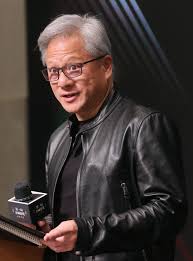
Good morning, Morgan. I am at Nvidia's GTC conference here in Berlin and I have none other than Jensen Huang, the CEO of Nvidia with me. Jensen, thank you so much for making the time. You've had a busy morning. We're here in Europe. You've been traveling around London, Paris, all of these different cities around Europe. You've announced around $10 billion worth of investments across the continent into around 14 startups. What are the thematics behind those investments? What's getting you excited?
Well, we're trying to kickstart the AI economy in Europe. Of course, you know, Europe has a tremendous amount of technology, tremendous amount of industrial know-how, incredible science and technology, and it's ready to engage and build the AI economy here. In order to build the AI economy, you need to invest in all five layers of that industry: energy, chips, infrastructure, the models, and of course, all of the AI applications. Each one of the industries, every single company here in Europe is going to become an AI company someday. I'm thinking that in five years' time, whether you're MediaMarkt here in Germany, Mercedes or Siemens or Merck, all of these companies are all going to HSBC, they're all going to become AI companies. And so we're just accelerating that journey, a journey that we started a couple of years ago and it's really picking up.
Look, Europe, like many other places in the world, has several challenges, whether it's access to capital, whether it's energy prices. There's often this discussion around, you know, who is strong in AI, the US or China? And there's this view that Europe kind of gets sidelined in that discussion. Does Europe have what it takes, given some of those challenges, to compete with what we're seeing out of China, what we're seeing out of the US in terms of AI capability companies?
Absolutely. The most important thing about leadership in AI is actually the application of the technology in your industry. And so whoever, whatever region, whatever country diffuses AI most and quickly will ultimately win. And the reason for that is because you want to lift the entire industry, every single industry with AI, not just create a new industry of a few companies. And so you want every part of your economy to be accelerated by AI.
Jensen, the market always loves to hear what you have to say about the state of play of the industry across the board. And at the moment there feels to be a bit of nervousness in the market, and particularly around Neoclouds. We've seen, you know, Nscale looking at investors telling it to reduce its valuation, a firm pulling its IPO, concerns over the debt levels of some of these Neoclouds. Is there a problem right now with the Neocloud business model, or are these just teething issues?
If you look at the fundamentals, the demand for the Neoclouds is off the charts. Their capabilities are extraordinary. And so what is missing in the middle is the working capital to fuel that growth, to fund that growth. And because there's just so much demand across so many sectors of AI, there's a scarcity of capital. The demand of the capital is much greater than the availability of the capital. That's going to get solved. And that's going to get solved because fundamentally the most important things are the values that these guys are providing, these companies are providing, the demand for it is so strong.
Just given the number of players in this space, there's dozens of companies kind of described as Neoclouds. Do you expect any kind of consolidation and M&A to take place in this particular sector of the industry?
Ultimately, they need scale. They need regional excellence. Like for example, here in Europe, the energy is scarce. It's scarce everywhere, but you want to allocate the energy to your own companies. And in the case of the UK, they want to allocate their energy to Nscale. In the case of France, they want to allocate their energy to Mistral. Around the rest of Europe, allocate your energy to Nebius. There's a fundamental reason why you want to make sure that your natural resources are allocated to your own companies first. If the Neoclouds in Europe are able to establish an infrastructure here, then you can build the AI ecosystem, the AI economy on top of them. And then the flywheel of the AI economy will start in Europe. It will terminate in Europe. You can bring investments into Europe. But you have to start with having your own infrastructure.
Do you think that scale comes from some form of consolidation to grow those big plays?
Right now you have so much demand. I think you have more than several companies you could start up. Of course each one of the countries probably don't need more than a couple. But across all of Europe, you're going to need a lot more Neoclouds.
The working capital part of the equation is an interesting one, Jensen, because obviously earlier this year, you along with a number of financial players announced this sort of $500 billion financing mechanism. What is the demand at the moment for that? Is that something that can be tapped as these Neoclouds look to scale?
Well, that's ultimately what we need. One of the things that we're trying to do is to establish NVIDIA's compute as a financable asset. The residual value of our compute, because it's fungible, it's so productive, it's so fungible, and it's so durable, it is now becoming an asset class. The more that the institutions recognize this, the more that the lenders recognize this, the more the capital becomes available to the Neoclouds. And so we're working to establish that NVIDIA compute is really a fungible, productive, durable, financable asset. And I think that's going to be a game-changer.
And Jensen, what's your take on the current health of the frontier labs at this point? There was a lot made about Anthropic's Q3 numbers, 45% growth. A lot of people saying, well, this is a significant slowdown from what we've seen. At the same time, you know, both OpenAI and Anthropic are aiming for these very highly valued IPOs. Just wanted to get your take on whether you're worried about any kind of slowdown at the frontier labs and, you know, are they going to be able to justify those valuations in the end.
We're looking at two of the most consequential technology companies in history. Incredible management team, incredible technical skills, incredible technical capability. They're also the two fastest growing technology or any company in human history. And so we could nitpick around the corners. I don't think it's, I don't think, I think it's maybe interesting, but it doesn't change the fundamentals. We're talking about AI, which is the most consequential technology in history, two of the most consequential technology companies in history, incredibly well-built, and also the fastest growing ever. And so, I think that's all that matters.
Jensen, I know you've been talking a lot about safety and around social and societal impact of this technology. One of the most interesting discussions has been around how do AI companies do good for society? Anthropic came out and said, 'Hey, we're going to commit 5% of our shares to a new public benefit fund.' Something that Elon Musk backed and said, 'We're going to give kids in America some SpaceX shares.' Have you considered any kind of initiative like this at NVIDIA?
We do all kinds of things for social good and everybody has their own way of doing it. The most important thing, you talked about AI safety. The most important thing that we need to do as an industry is to create an optimistic future but do it responsibly. This technology has the potential to do incredible good. Whatever industry you choose, whatever economy you choose, whatever country you choose, there is an extraordinarily optimistic and exciting future, but we have to build this technology responsibly. One of the most important things that we've done is created this technology called OpenShell. Anthropic is a very early adopter of it. Very enthusiastic collaborator. Really appreciate their collaboration. We all want to see this technology advance in the safest possible way. And we have the technology and the responsibility to do so.
Yeah, I want to talk about OpenShell in a second, Jensen, but just in terms of this kind of broader discussion about how to give back, do you think this sort of direct equity method is a good path to go down?
The best way for those companies to give back is to contribute in the way that they fundamentally contribute. Elon's best way to give back is to inspire a whole generation to build things, heavy industries, launching rockets to space. What could be more consequential and inspirational than that way of giving back? Anthropic's way of giving back, number one, is to advance this technology, invent this technology, and bring it to the world safely. The way NVIDIA gives back is all of the things that we're doing here. Supporting the global economy, helping every industry thrive, new companies to be created, invest in inspirational entrepreneurship. That's our way of giving back. The best way to give back is to help the economies grow. The best way to give back is to create new economies.
Jensen, your view on the safety issue really is that if a company believes that a model is dangerous, they should just not release it, right? There doesn't need to be some kind of new broad regulation, etc. How can the general public trust the leaders of these companies to make that right decision?
Because they're incentivized to do so. Regulations take a while to come.
If there are concerns that exist today, it is your responsibility to take accountability and do something about it now instead of waiting for laws and regulations to happen, which takes time, as you know. And so the reason why I trust them to do so is one, I believe in the leadership. Two, I believe that the companies are incentivized to do the right things because there's no such thing as a good product that's not safe. And so it is absolutely in their incentive-aligned interests for their company to advance the technology as responsibly as necessary.
And part of the solution you have is OpenShell, right? Is being able to monitor these models because to contain and monitor.