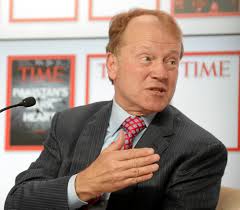
There's no better person, I think, to give me some more context on all this than my man, my longtime man, John Chambers, JC2 Ventures founder and CEO, former Cisco executive chair and CEO. John, good to see you. It's been a while.
Good to see you, my friend. Your energy is amazing. You haven't lost a beat, and I know we've got a bunch of topics to cover. I was looking back over the last six years. Each of the sessions we've done, we called the trends remarkably accurate all the way back to calling COVID, unfortunately, in March of 2020, and then the AI boom and bust that was supposed to occur two and a half years ago and didn't. So I'm excited about where you're going to take me today.
John, you haven't lost a beat. You have all the energy still. So look, if you were leading a hyperscaler right now, how do you get investors comfortable with spending hundreds of billions of dollars on something that may not earn a return for 10 years?
Well, I think you break it into pieces, Brian. And I'm going to first answer your question directly and then answer it for tech as a whole and then business as a whole. In terms of the hyperscalers, this is either you invest or you get left behind. And you have to outline how much you're going to spend. You've got to say what the most likely returns are going to be, when should the investors anticipate that, etc. Then I'd go over, assuming I wasn't there, but I was the head of an AI organization. And I have 22 AI startups, as you're probably aware, 12 unicorns, two decacorns in it. Their average growth is 50% a year and we're seeing productivity of 20 to 40% per year per full-time equivalent. Then I'd go over to the Walmarts that you mentioned earlier, the Costcos, the JP Morgan Chase. All of those companies are looking at investing dramatically more in AI this next year. And I think Brian Moynihan said it very well that he holds himself accountable for 200 to 300% return on AI investments, but they are going up. I think it's almost 100% year-over-year. So enterprise is going to spend. Are there going to be some train wrecks which has the market nervous? Absolutely. And I don't want to mislead you. It was like the internet. I think we're in the very early stages of this one. But there will be major train wrecks and a rising tide does not raise all boats. I would not bet against Nvidia, however, or Oracle, two of the companies you mentioned earlier. I think tech is going to be the better returning industry over the next three, five years and beyond, but I think there will be a large amount of more big winners and, candidly, unfortunately, a lot of losers in terms of the AI shuffle.
John, you made a good point there. And look, over the past week, a lot of these valuations have compressed. They have come in, but look, I mean, Intel, I mean, they warned, but it wasn't that big of a problem quarter. They're still a good business by and large. They are going to play a key role in building out AI infrastructure. Lisa Su or AMD, you were the first person that ever told me about Lisa Su. They're doing well. Like, basically, are these sell-offs justified?
Well, I think the market got a little bit ahead of itself and a little bit overenthusiastic, and then when a couple of concerns come along and they're valid concerns, it gets people nervous. Number one, your question about debt companies are raising. Number two, the Americans are concerned about AI, the future, what it means to them personally and to our country, and they're concerned about the ability to, due to data security and data center growth in this environment. So I think you're having some balancing going on. I never invest for this next week, this next quarter, this next year. I place my bets long term. That served me very well, Brian. So if I were investing, I'd invest heavily in AI. But a portfolio play, nobody can pick the winners or losers. I would do a mix of that. And I think the portfolio play in AI will outperform the market as a whole and tech will outperform the market as a whole. But there will be some train wrecks and we should be prepared for that.
John, just as we started talking here, we got the amended release or the prospectus from Anthropic and they lost more money in the third quarter versus what they lost, I believe, in the prior quarter. Question twofold: one, is Anthropic a good business, and how important is it to your companies that you are invested in that this Anthropic IPO goes off without a hitch?
Two questions and a third one I will add. I think Anthropic is in a very good market position in terms of the technology. The position of Anthropic in terms of long-term leadership is extremely strong, so is OpenAI. In terms of the importance of the IPO going without a hitch, I think more important than what it comes out at is after the IPO is out, do we see steady gains in terms of the stock and therefore encouraging others to go public and follow forward on it. In terms of the mix, I think they're going to be a number of players in this and I just mentioned two of them but also new challengers within it. So in terms of the importance of the market, very important. Number two, are they in a dominant position? No, they're not. It's about execution and then as they place the stock and go forward it's about underpromise and overdeliver. You saw me do that for, what, how many, 40 straight quarters at Cisco with Larry Carter and my other CFOs. I think it's important to not let the market get ahead of itself. But I think the leaders here long term are going to be a good bet in a portfolio package. And that would be the way I'd play it if I were an investor listening to you today. What you hit earlier, I agree with. Bet on the Walmarts, the JP Morgans, the Costcos of the world who are using AI to really drive dramatically faster their productivity, the Federal Expresses of the world, etc. And you watch, they're driving not only productivity, but they're moving to new revenue sources and so their earnings are going to be higher. So every company becomes an AI company just like every company became an internet company back in the 1990s and 2000s plus.
You mentioned, John, I think twice, there will be train wrecks. What does an AI train wreck look like in your mind?
Well, you're seeing some elements of it and some of these companies will occur borrowing a lot of money and going at a tremendously fast speed. It's probably five times the speed of the internet, Brian, which I didn't think was possible four or five years ago. And remember, I bet on AI 10 years ago. So, this is not a new bet for me. All my companies are there. And you'll see some of these companies spin out and get back on the track. You'll see others spin out and not come back. Same thing was true with the internet, except it just occurred at a slower pace in terms of the direction. So I focus on the positives of portfolio play as opposed to just betting on one. And it's about execution and operation as much as it is strategy. Key takeaway for your listeners: this is the year CEOs will move from AI strategy and AI pilots and saying they're going to take the company there to they will be measured on their AI outcomes. And so it's all about delivering outcomes, profitability, and cash flow. So, in that way, I do think it's back to the future.