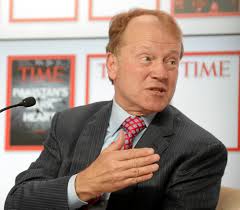
John Chambers, founder of JC2 Ventures and former CEO of Cisco, says he was not surprised by the pace of AI growth or capital formation, noting that he backed AI startups nine years ago. He speaks on "Bloomberg The Close."
--------
More on Bloomberg Television and Markets
Like this video? Subscribe and turn on notifications so you don't miss any videos from Bloomberg Markets & Finance: https://tinyurl.com/ysu5b8a9
Visit http://www.bloomberg.com for business news & analysis, up-to-the-minute market data, features, profiles and more.
Connect with Bloomberg Television on:
X: / bloom...
What John Chambers said
Written from the verified transcript and checked against it. Every figure links to the moment it was said.
John Chambers, CEO of JC2 Ventures, said he was not surprised by the pace of AI growth, having bet on it nine years ago with 22 startups. He predicted productivity growth of 3 to 5%, five times the speed and results of the Internet boom. On midterm election concerns, he argued for a playbook where tech, government, and communities collaborate on data center build-out, citing that 35-plus of 43 ballots initially restricted such projects. He emphasized the need for environmental responsibility, net-zero emissions, and local job creation, giving the industry a C grade for teamwork. He remained bullish on semiconductor companies like NVIDIA and AMD, noting Lisa Su as a mentee. He highlighted AI cybersecurity as the hottest tech area over the next two to five years, citing investments in Safe Security, Rubrik, and others. He also stressed that CEOs will be measured on AI implementation for bottom-line benefits and job creation.
Key takeaways
AI productivity growth will be 3 to 5%, five times the speed and results of the Internet boom.
35-plus of 43 initial ballots put restrictions on data center build-out, requiring a collaborative playbook.
JC2 Ventures portfolio has 22 companies, 12 unicorns and two decacorns.
0:00Were you surprised at the pace of growth and the pace of capital formation in the AI cycle?
1:18... might slow given the outcome of the midterm elections, where there were a lot of folks running for office that were clearly opposed to either the build-out of data centers or at least willing to consider moratoriums on that build-out?
3:02But he's not going to be in that job now. So what happens?
4:30... Newsom, or Illinois, or New York even — that if there's a law passed at the state level, that it will be much easier than to block data centers at the federal level, where right now it's sort of open season for big tech and data centers?
6:43Is that the general idea when it comes to the tech journey?
I want to start off because you will always get these predictions every year, and one jumped out at me. You said at the start, coming into 2026, and I'm just going to read verbatim: 'AI drives growth, profits, and productivity dramatically faster than the market anticipates.' That actually might be an understatement given what we've seen so far this year. Were you surprised at the pace of growth and the pace of capital formation in the AI cycle?
No, I was really not. I bet on it literally nine years ago with 22 startups before people could even spell AI. Secondly, most of the projections that we made at the beginning of '26 sounded like very aggressive projections, but we overachieved most of them. You saw the GDP number, growth from the other day. Productivity numbers are probably going to be not at 2% like we saw during the Internet boom, Romaine. We're probably going to be at 3 to 5% growth in productivity. Most companies are moving aggressively on this, and they're doing it not just to be more productive as a company, but also to create new jobs and new opportunities. So I think that speaks to the breadth and depth of the AI cycle, which will probably be five times the speed of the Internet and probably five times the results as well.
Is there any concern that that pace of that cycle might slow given the outcome of the midterm elections, where there were a lot of folks running for office that were clearly opposed to either the build-out of data centers or at least willing to consider moratoriums on that build-out?
Well, I think it points to a point even bigger, Romaine. If you reflect back on the Internet era and the revolution, when Cisco had the honor of leading that, 90% of Americans felt it'd be good for them and good for the country. I think we need to work much closer together with AI, in the data center build-out example that you used, between the tech companies, government, and communities, and say, how do we do this in an environmentally responsible way? How do you bring your own power, your own capability? Do I think the momentum in the AI industry is going to continue to power our country? Yes, I do. But I think you'll see people work closer together on it. You look at the Nasdaq today, it's up about two percentage points. Normally, the day after an election, midterms, over the last forty years, it's only been up a half a point. So most people feel that technology will continue to play a key role, and that's true of Democrats and Republicans in leadership. That's what I saw with the Internet. What I think we can do better is develop a playbook for how these communities work together and work together on very realistic regulation and responsibilities. It isn't about innovation just for the tech companies. It's about how to be socially responsible. I think we can do that, and we did that pretty well during the Internet era for literally three decades.
If we move to the semiconductors, John, what's the outlook for those? I mean, you know, the former speaker, Mike Johnson, obviously — well, I guess current speaker — had been a big protector of them, right? But he's not going to be in that job now. So what happens?
5 more exchanges in this transcript
Sign in free to read the rest of this interview. No card required.
Chambers, J. (2026, November 4). John Chambers Makes the Case for AI, Calling It a Win for Society [Interview transcript]. Bloomberg Television. CEOInterviews.AI. https://ceointerviews.ai/interview/3199992/
MLA
John Chambers. "John Chambers Makes the Case for AI, Calling It a Win for Society." Bloomberg Television, 4 Nov. 2026. Transcript, CEOInterviews.AI, https://ceointerviews.ai/interview/3199992/.
BibTeX
@misc{chambers2026_3199992,
  author       = {John Chambers},
  title        = {John Chambers Makes the Case for AI, Calling It a Win for Society},
  howpublished = {Interview transcript, Bloomberg Television. CEOInterviews.AI},
  year         = {2026},
  month        = {nov},
  url          = {https://ceointerviews.ai/interview/3199992/},
  note         = {Speaker-attributed transcript with timestamps}
}