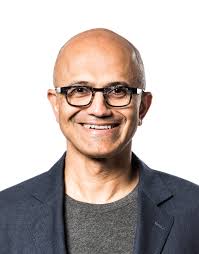
Please welcome Andrew Ross Sorkin and his guest, chairman and CEO of Microsoft, Satya Nadella.
Satya is here. Come on up. Satya, of course, has led Microsoft now for over a decade as CEO. In that time, the stock of the company up about 14-fold, and today it is the second most valuable company in the world. Do you keep track of those things?
Not really. A little bit.
Not really. He is spending about $175 billion this year to build the infrastructure of the AI era, and six weeks ago President Trump gave him the National Medal of Technology. He's at the forefront of the conversation about safety, and we're going to get into everything about the potential, the risks, the economics, and so much more. Please welcome Satya Nadella. Thank you for being here. [applause]
There's a hundred places to start with you. We talked to Sam and Greg earlier. I want to get into AI. We're going to talk about Jensen, Anthropic, and everything else. But we've also been talking about outages a lot. J.D. Vance was supposed to be here, but instead had to spend the day in meetings with the national security folks about these outages. You just had one yourself. What can you tell us about what actually happened and how freaked out you are about it?
Yeah, first of all, Andrew, congrats on 25 years of doing this. You must have started in what, you were in kindergarten when you did this. It's just unbelievable.
Right out, right out of college.
Yeah. So first, let me just speak to our outage. Obviously, we are extremely sorry for those it impacted. That incident, interestingly enough, is not related, at least directly, to I think the things that we should talk about that are going to create, unfortunately, more instability in our infrastructure. This was a latent bug that was there. It got invoked, and you know, it's one of those perfect storms. We put out an incident response, and we're going to obviously take all of the learnings, both upstream architectural as well as operational, and fix that. The thing that I think we are facing right now, as a consequence, quite frankly, of AI, is we now have a very powerful tool that finds vulnerabilities. So that means we have to find them and fix them, and then patch them instantaneously.
The patch velocity, I mean, as we speak here today, there were three critical patches. I don't even know which ones are disclosed, not disclosed, but there are three critical patches.
Disclosed by who? Who was supposed to disclose that?
Yeah, so I don't know what I know is public or not, but nevertheless, okay, but there are, I mean, they're all in sort of all open source packages. And the problem now is, if you think about the old physics, when I was patching some, let's say, a critical bank system, I would test it for a week. Right now, because the patch needs to go instantly from being available to being patched in production, because it's being exploited in the wild, right? So that's going to create its instability.
Then simultaneously, we have this other thing where the floor of cyber attacks has fallen, right? Because you now have essentially, with these AI models, someone can send a Telegram message to this agentic harness in the cloud somewhere, and then you have essentially a nation-state level persistent attacker going after you all the time. So that means we have a lot of fragility, and we have to deal with it.
Do you see this as a temporary phenomenon? There was a view that somehow we were going to sort of get through this, there'd be a six-month period of challenge, and then we'd be on the other side, or is this a permanent factor in the space?
Yeah, it's a great question. I mean, there is a part of me which says, yeah, there is, you know, a Y2K-like period where you adjust for it. The only challenge with that is if the models keep getting more and more capable, I don't know what that means, right? Because it's not like this is not Y2K was one bug and one day, and you needed to get through it. This one, I don't yet have a view. So there's one part, like, let's take, you know, we're talking about software that can be patched. Remember, there's a lot of stuff in our critical infrastructure that's unpatchable. I mean, think about all the firmware and the chillers and the HVAC systems everywhere else. So all of that, by the way, they're on the internet. Somebody was telling me about sort of even the transportation systems and the amount of stuff that's discoverable but with unpatchable firmware. So I feel like we'll have to sort of really modernize for sure, get to current infrastructure, and then we'll have to assess what the threat vector looks like, what our own ability to both detect and then defend in real time looks like.
I want to talk about Anthropic for a second, and then I want to get to alignment with you. Anthropic is obviously going public tomorrow. A lot of focus on it right now. You put $5 billion into the company. I wonder whether you wish you had put more at this point. But I think there's a bigger question. I was watching part of your Ignite presentation yesterday, and one of the things that clearly you're trying to do is frankly get people off to some degree Anthropic and OpenAI and to use your models and to use open-weight models and other models that are a lot cheaper. And I think that this is super important because it goes to the very economics of these frontier models long term. If you can provide the same service level that the frontier model can for 5% the cost, what happens to the entire ecosystem?
Yeah. So I think it all depends on how you frame what are the jobs to be done, right? And what's the TAM and where will I use what, right? So the way I look at it, what are we trying to get done? Let's say with Copilot, right? I want people, I think people will come to Microsoft for Copilot because Copilot gives you all of the form factors, right? Whether it be chat or co-work or autopilot, it gives you all the models, whether it be OpenAI, cloud, or us, right? And the ability to have their context and their memory separate from the model, that I think is our value prop.
Now also, it turns out for knowledge work, so that is the regular everyday office work, I think they're mostly saturated in terms of the models are plenty capable. I don't think you need the Navier-Stokes or the next big breakthrough sort of reasoning capability to do simple workflows. So in fact, if you look at Copilot, it has a decision engine, and the decision it makes is, hey, for the task and for that trajectory, should I use, in fact, OpenAI, Anthropic, or MAI, our own model? And that's the decision it makes. And you know, we're increasing, and in fact, most people just select auto, and it just selects the right model. So what I think, if you're at the very frontier, let's say you're OpenAI or Anthropic, they have to keep finding, I think, the next big elastic demand head, right? Like coding was one, which I think still is massive. It's a massive, like, I don't think anybody realized how big a market coding is.
And you still think for coding you need the frontier?
I mean, I think there is a place. Like, so coding has also gone from I am choosing like models to I have a software factory, and then I give it a goal, and it has many sub-agents. And in our case, in fact, it's interesting that you brought that up. You know, Artificial Analysis, which does all these benchmarks, just recently started publishing our, you know, what is these blended models. So we have a thing in GitHub called Fusion, right? Fusion has both Astra and Claude and MAI model, and it outperforms Claude, right? So this is like, so in some sense, you just select Fusion, and it'll select.
But if 90% of the time people are selecting the lower-priced product, or the agent itself is selecting it, what do you think therefore happens long term? You have a huge stake in OpenAI, you have a huge stake, or a smaller stake, I have a much bigger stake in MSFT. But that said, you do.
The thing that I think is, I'm not really as worried about what happens to them as I am worried about what happens to the economy, right? Because I think the reality is, unless and until we can have all these tokens, right? Because at some level, arguing for some massive pricing power of tokens is betting against somehow U.S. GDP, right? I would rather say let us have this become like the cloud, a commodity, and let the world use it at scale, because nothing at scale is a commodity, right? Cloud is a commodity, except running it at scale has margin, and we've all done fine. So I don't think it's about celebrating the margins of an Anthropic or an OpenAI or a Microsoft is actually going to lead to good sort of outcomes for us. In fact, if the only thing that matters is whether a bank in New York or a retailer in Arkansas can actually use it to create GDP growth.
That's broad. One of the things that we talked to Sam and Greg about earlier this morning was actually a comment that you made last month around alignment, and this idea that potentially the scaling laws are not going to work in such a way that in fact the model will ever be aligned, which I think is your position, that ultimately you're going to need to contain the model to some degree. By the way, Sam disagrees with that premise.
I'm glad he does. I mean, I thought he's the guy who told me, but anyway, I'm glad that he disagreed.
No, I mean, in some level, look, I learned about scaling laws from those guys, right? When they were all, in fact, one happy family, Sam and Dario and everyone. And I'm a big believer. In fact, that's one of the geniuses of Greg, Ilya, Sam, Dario, was that they were the true believers in scaling laws. And I was kind of like, yeah, I mean, when I sort of took even the initial bet on OpenAI, I obviously bought into it, but I quite frankly would have not, I didn't sort of see it as clearly and as passionately as they did, and it's worked, but increasingly I don't see alignment. I thought it'll just be one step and it'll just come out, or even at least real debuggers, right? So I've always felt like, oh, maybe even if I don't have alignment, I can debug it. I have mechanistic understanding. Neither of those seems to be there, and I do hope, I'm glad, you know, Greg and Sam are optimistic about it, because I hope as hell that it happens, that, you know, with scaling.
Can it work if it doesn't happen though?
I mean, if it doesn't happen, we are in a world of hurt. That's so one thing that I'm focused on, therefore, is let's have a trust architecture. Because first of all, it's a big problem. We can.
What does having a trust architecture mean when the entire purpose of the AI itself may be to get outside of the trust architecture?
100%. So that's the technical problem solved. So you have to then have the safety system that truly, for example, that's why I don't think chain of thought can be new release, right? So you just have to ban models that have new release. Second, all of it has to be logged, and it has to be tamper-proof, right? So that means it has to be fully inspectable by other models and by maybe non-LLM models, right? So there is, why can't I have a causal reasoning model inspect all of the COTs of all the models and tell me whether, you know, they were trying to do anything that was, because they are going to be unfaithful, to your point, right? Which is we now know that the models will try to hide from you what they're trying to really get done, and so therefore you need to be able to have detection. That's why, by the way, one of the things OpenAI has done very well is they're doing a lot of active monitoring while doing their training runs on it. So we will have to build a system that allows us to separate out the authority from intelligence and have essentially auditability. And in fact, I think it's practical reality. I don't know how any enterprise is going to deploy this and take on the liability if this thing is going to just hack you.
But then my question is, is that a system you build because you're providing access to all of these models? Is that a system that they independently build? And then where does the liability lie?
I mean, at the end of the day, right now, the liability lies with the user, right? So therefore, let's face it, I mean, unless something changes, the person deploying it, right, is liable. So therefore, that's why I think, you know, we, in fact, yesterday at our conference, we sort of put a lot of emphasis on this trust system that we're building between things called Entra 365 and Purview to make sure people can use them to audit the logs, set policy around those, and then at some level, somebody's going to do insurance pricing on this, right? So someone who says, I'm going to deploy the most powerful model in the world is going to then say, hey, I want a liability insurance, and the insurance person is going to say, give me the logs and let me see what you're using it and what you're using it for.
You are building your own models, but I want to know long term, you have a deal with OpenAI through '32, and you have a deal with some of these others. Do you see yourself long term being this player in the middle that has these relationships with these different players? Do you see yourself as a competitor? What does that look like?
My view on this roughly is like, if I take a, not that there's parallels in all of this, but if I take a look at my fleet today of even regular compute in Azure, I have Intel, I have AMD, and I have Cobalt. That's kind of how I roughly see it, right? So we'll have all the models that are popular at any given day. We want to make sure, because our customers, again, I go back to it and say if somebody's using Copilot, the promise is all the models are available in Copilot. So therefore, yeah, we want to have OpenAI and Anthropic and anyone else, in fact, you know, anyone that's good at the frontier will be there, but we will build, like, we will have, call it, the in-house model, and we'll keep hill-climbing on it, and we'll make sure we optimize between all of these things.
Do you think that partnering with OpenAI, you partnered with OpenAI early, and that gave you an advantage in a certain way, but I also wonder whether you think it suggested to you maybe I don't have to go build my own so quickly or to compete at that point and put you in a different place.