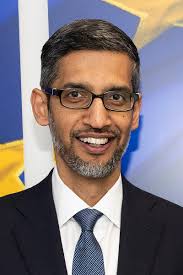
Sundar Pichai is one of the most important business people in the world because he is the CEO of Alphabet, the parent company of Google, which means he is involved in so many aspects of our lives. He has given an interview to the BBC where he's asked some really big questions: is the economy at risk because there's a massive bubble around investments in AI, can we trust the results that AI gives us, and can you invest in AI and fight climate change at the same time? My colleague Faisal Islam is the person who's been asking him those questions. So I'll chat to Faisal and hear from Sundar Pichai on this episode of the BBC's daily news podcast, Newscast.
Hello, it's Adam in the Newscast studio and it's Faisal in the Newscast studio too. So Faisal, the person you went to San Francisco to meet is Sundar Pichai, who is the CEO of Alphabet, the company that owns Google and YouTube and various other things. For example, their AI assistant Gemini, and they bought a British company called DeepMind, which is now a very important part of Google. And Sundar Pichai is in his 50s, classic Silicon Valley look, those little thin black glasses, wears the quarter-zip top. He sits at the top of this company that is worth trillions, that is in a massive fight for the future against its rivals like Microsoft and OpenAI, who are the people that invented ChatGPT. He's also thinking about how America, where the company's based and funded, is going to compete with China, where they're trying to win the race too. And of course, he does loads of business and loads of investment in Britain, and the British government's trying to work out where it's going to fit in all of this. And the other battle that not necessarily him but lots of the people in Silicon Valley are fighting is against economics, because there's loads and loads of investor dollars flowing into the technology, but it's all quite speculative because this technology isn't delivering actual physical financial returns for everybody yet, and there's been some wobbles in the American stock market on that basis in the last couple of weeks. Plus, there's then all of us just working out how is AI going to affect our work, our life, our families, our health, our leisure time. Oh, and our electricity bills. So, an amazing opportunity to get some CEO time with him. Why do you think he wanted to give up half an hour of his very valuable time to speak to a journalist from the BBC? It's pretty rare that this sort of stuff happens.
Well, there's been an increasing trend of these sorts of CEOs doing interviews with very interesting, detailed, nerdy tech bros doing podcasts, and they go on for four hours. Or they get other CEOs to interview them or they get their investors to interview them. So some credit for someone of this importance to sit down, no agreed questions, and answer across the piece. And it shows, I think, essentially because of the importance for every aspect of politics, economics, our future in terms of how AI is going to affect us all. So I think that they wanted to talk about that. I think they felt they had something to talk about because a year ago they were significantly under pressure from the emergence of ChatGPT. People thought that was going to eat their lunch in terms of the standard sort of 10 blue link search business. People would prefer to get ChatGPT-type answers and not have to research themselves. And they didn't say this, but what I deduced was that they feel a lot more confident that their strategy is being appreciated, hence the increase in the share price, because they've basically invested across the supply chain. So not just the models and things, but also things like the chips and the infrastructure and the data. So they feel they had a good story to tell.
Yeah. I mean, you don't do this in the middle of a crisis.
Their tails are up, and they certainly weren't up a year ago. But also this is a massive transformational moment not just for tech, not just for finances, but for politics, for diplomacy, for who's going to win the 21st century. And I think a lot of the next generation of these sorts of technologies is going to require a lot of trust from users in terms of the tech companies. You know, these AI experiences are going to get more intimate. Forgive me, intimate as in you will have to trust that you will talk to the AI instead of typing it in, and they will interrupt you and things like that, and they will know everything that you take a picture of and they'll buy stuff for you.
Yeah. And that's interesting that you say that because actually one of the themes that comes out of the interview is him saying to people or trying to build trust with his users, with the wider audience.
Yes. I thought that I hadn't quite noticed that when I was listening to it, but now that you frame it in that way, it's like, oh yeah, he was trying to be very open and transparent and reassuring and collaborative, and he talked about different stakeholders as opposed to just shareholders or his engineers.
Well, it does really matter. And if you think about it, Google invented search and it was built on that, and then it sold advertising against that. And that is a very delicate dance of trust. Now, do I trust the ranking of this search? Imagine that with AI. Imagine you're trusting your AI to answer a question of advice in your personal life or medicines, which people are doing and there's a big controversy about that, or how to teach stuff to your kids, let alone some scientific thing that you don't understand. That level of trust, the level of trust when they start putting advertising into these sorts of bits of software and programming, do you trust that you're being told this fact? So I listen, they didn't tell me this, but I feel that that's why. I think that the team at the top of Google also saw a piece I've discussed with you that I did, which was pretty techy but I felt it was very important to tell, which was the story of TSMC that make all the chips in the world. They moved a factory to America, Donald Trump which you went to see, which I went to see. I don't know if they are customers or not and they work together, but I hear that that was the sort of story they thought they wanted to tell about themselves as well, so it's a nice tribute to some of the journalism of the teams at the BBC.
Absolutely. So Sundar Pichai is the CEO of Alphabet, which is the parent company that owns Google and lots of other services that we use, including YouTube and presumably lots of things we lesser mortals have never even heard of. Gmail, and Gemini, which is their AI offering, and they've just at 4:00 today released the new version of that. And they make all sorts of claims that it's kind of faster and does more stuff, but you know, it can help you learn and things like that. So that's their competitor to ChatGPT. What is actually going on in Silicon Valley right now? What is this boom we're talking about? What is the potential bubble being burst?
The boom is the back end of all of us typing into these AI chatbots, these LLMs like ChatGPT and Gemini, all of these queries. It is billions a day. The back end of that is a whole load of machinery, data centers and chips. And these chips, there's literally a story about I think it was Elon Musk and Larry Ellison begging Jensen Huang, who we've talked about before, at some sushi restaurant near the HQs, just begging them for chips, we want 100,000, we want a million. And so what Google has that I have to say I wasn't really across until a month or so ago was that they have their own supply of these chips. So the money is going in to build out the chips and data centers, and that requires all sorts of tradeoffs. We'll talk about it in a minute: climate change, water, all this sort of stuff. There is an insane rush, gold rush doesn't quite get it, all around the world, but especially in America, to build this stuff out, but there's also like you need to get your hands on the chips. And so in that regard, Google suddenly there's a new appreciation for the fact that they've got what are called TPUs, tensor processing units, that can compete or be on a par with those Nvidia chips. So that is one of the stories. It's a very techy story, but I feel like especially on Newscast, we can just like what is it? What is the core thing that causes us all to be able to type a query about some academic topic that we don't understand? Because actually it seems like a bit of magic, but actually there's a huge amount of technology and geopolitics and money that goes into that simple query. And I'll tell you what, we take it for granted. We take it for granted that we can type in and up comes this answer. But when you see the physical infrastructure buildout, when I ask the questions and this man who's really top two or three important people in this world across the world explain the sheer extent of the amount investment going in, it really hits home the effort that needs to be if you're going in if you're serious about this, but also the consequences, foundational consequences to our lives that may occur.
Well, he explains very well the scale of the investment that's happening now compared to the scale of the investment in the recent past. So let's listen to how he does that.
One way to think about the scale is the what we are all investing in capital to build out the infrastructure that's needed for artificial intelligence. You know, maybe four years ago, Google was spending less than $30 billion per year. This year, that number is going to be over $90 billion. And if you collectively add what all the companies are doing, you know, we have well over a trillion dollars of investment going in in building the infrastructure for this moment. And one way I think about it is in the next couple of years, we'll end up building what we probably built in the past 10 to 20 years. So hopefully in a couple of years.
That's right. So that gives you the scale at which this is ramping up.
Yeah. That just gives you a sense of the scale of how much money is pouring into this tech. Absolutely. And so that was 90 billion a year is a huge amount, triple what they were doing before. And he has this figure that there's a trillion dollars going in in terms of the US, mind-boggling sums. I mentioned that the market capitalization of these big firms is now 15 trillion. And that has been the frenzy in US markets, and again, even if you take the financial consequences of that, that is what's kept the US economy buoyant during a period of profound uncertainty under the Trump tariff trade war issues. It's been hugely impactful. But actually the economic consequences of this gold rush of all this money flowing into one type of technology and a handful of firms, well, that has consequences, as you discussed with Sundar Pichai.
And the obvious question it's around the whole of this country and the whole of the world right now is: is it a bubble?
Look, there are two ways of thinking about the question. I look at the actual progress we are making in terms of the model capabilities, and the progress is palpably exciting, and people are using this, and we're deploying it in our products. Consumers are excited about using it. We're giving it to companies. They're using it to make their companies better. So you see real demand, and we are constrained in our ability to serve that demand. So given the potential of this technology, the excitement is very rational. It's also true when we go through these investment cycles, you know, there are moments we overshoot, right? Collectively as an industry, we can look back at the internet right now. There was clearly a lot of excess investment, but none of us would question whether the internet was profound or did it drive a lot of impact. It's fundamentally changed how we work digitally as a society. I expect AI to be the same. So I think it's both rational, and there are elements of irrationality through a moment like this.
So just decode what he's talking about there. Irrationality is that people betting too much on the technology, and actually once the bets get too large, you're heading for a stock market crash and loads of people lose their money. So listen, a general proposition like a technology can be investable. The railways, the internet, AI now, and you can see that it's going to win over tulips 500 years. But at the same time, that doesn't mean that every prospect in that market is going to win, or indeed the majority of prospects in that market is going to win. Most will fail. And if we go back to the dot-com bubble, which was analogous to the dot-com experience, so we're talking 25 years ago when I first cut my teeth in journalism. Some of us will remember that the likes of Amazon's share price fell to $6. Everyone was laughing about how stupid all the stocks were. Pets.com was one of the most valuable companies in the whole world. I wrote my first long read about something called World of Fruits.com, which was selling bananas on the internet, which seemed a tricky business model, I have to say. But Amazon is still around and worth trillions, right? Google was around and was just about to float and is as we are describing is worth three and a half trillion, doubled more or less in the past six or seven months. So that's what he was talking about. If you like, some proportion of the edges of this, or is it a large proportion? He wasn't really going to be drawn upon that. It has elements of irrationality, but most of it's real. He said that they can't even serve all the demand that they have. He's also saying it's real for us. Maybe it's not real for that guy over there now. Who's that guy? What Google does, what Amazon does, what Microsoft has is that they have loads of revenues from sales of software and ads and all the like. Google is making a hundred billion dollars a quarter. They're investing a huge proportion of that straight into AI. What is happening elsewhere is that they're borrowing the money, and they're borrowing money increasingly exotic debts, evoking some memories of what happened during the financial crisis in 2008 with mortgages.
You mean exotic as in sort of configured in a way that they could potentially be a bit dangerous and a bit kind of fine if everything's going, no problem. But as soon as people start saying, 'Hmm, how much revenue have you actually got? Can you actually afford?' They look safe, but they're quite risky. Is your interest going to cover this? Are people actually paying for all this AI search enough to justify how much you're paying to build it out? Are we going to ask these questions?
So those, and then I think there is some questions, and I saw this when I was out in Silicon Valley, about the sort of apparatus around the maker of ChatGPT, OpenAI. It's done a fabulous job of building an amazing amount of users and it's got incredible technology and it's got incredible partners. But it was quite notable that, for example, Sam Altman in one of these podcasts with an ally, an investor of his, the boss of OpenAI, he was asked, 'Can you support $1.4 trillion of investment based on $13 billion of revenues?' Now those revenues will go very high very quickly, and he didn't react with great, he wasn't entirely chilled about that reaction from an ally. And since then, as people have been like, 'Hang on, let's kick the tires on this. Is OpenAI too big to fail in the sense that is it now enmeshed with so much critical investment for the US that they'd have to keep that going?' So I think you're seeing different pockets of appreciation for different types of roll out of AI, and I think the message I was getting from Sundar Pichai is that Google is on the right side of this and can more than thrive, it's not just survive in any shakeout. Of course, when there's a shakeout, the survivors do even better. And obviously he would say that, wouldn't he? But it was fascinating to hear that. Now, I'll be really clear here, he didn't point the fingers at any other companies. No, I'm deducing about where the market is. It's companies you've never heard of that are supporting the wider roll out.
Well, and also there's some evidence of this in the stock market this week, isn't there? Like when you came into the studio, you were like, 'Oh, I just better just check the markets.' It's never a good sign when I do that. Is that because the bubble is like showing signs of bursting?
People are asking the question: AI is going to transform things, it's going to cause a lot of efficiency, people are going to make a lot of money. But is everybody actually at the same level here? And when the party stops and the money stops flowing, the borrowed money stops flowing. I think what is it? When the sea goes out, you see who's been swimming naked.