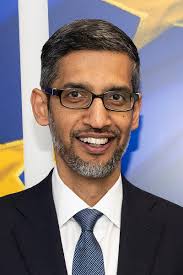
Sundar Pichai, welcome back to Hard Fork.
Thanks for having me. Great to be here.
So, the last time we had you on the show was in 2023. Bard had just come out. And I think at the time the perception was that Google was catching up in AI. How are you feeling about your position in the race these days?
Well, that brings back memories. So, it feels like eons ago. You know, those three years feel like a long time ago now. But I think it's staggering to see how much both the technology is making progress. We've made progress as a company. And I think it's a very dynamic moment in the industry. I think our models are at the frontier in some areas, and there are areas where we are behind the frontier, and so it's a combination. I think if you look at overall capabilities including text, multimodality, voice or audio, reasoning in general, overall intelligence, I think we're very capable. When it comes to agentic coding with tool use and instruction following, long horizon tasks, I think we are a bit behind at this moment. But we are hard at work. And the space is so dynamic. You know, all of the leading labs have their own pre-training cycles. So you have these cadences and they may not exactly match up. I think the moment is intense enough that if you're slightly off, you know, three months ago people are like, 'We are ahead and no one could catch up with us,' and then now the conversation flips. But that's part of the territory of being at the frontier. I think we are the only large company which is actually at that frontier. Right. So one way to think about it is there are a couple of startups which have made extraordinary progress and we've been deeply working on this for a long time. I think we took a big step forward with 3.5 Flash. It does address some of the areas we've been behind. And I think obviously getting it out in the real world and iterating with that data coming back is going to really help us. I think coding was the area where getting access to the data flows was important. I think we maybe quite didn't have the surface like Claude Code as an example or what Anthropic maybe had with Cursor too. And so getting Gemini 2.5, we've been using it internally at Google for a while. I shared the token usage at Google I/O. I've never seen anything like it internally, right? We are doubling every week and people are really putting the models to work and so that is helping us hill climb quite a bit. But the frontier is very dynamic, but I'm very, very optimistic and confident we'll push through there.
It sounds like if there's like any place where you feel maybe not quite at the very lead where you actually want to be, it is coding. Is that right? Like is that where you're sort of putting the pressure?
Look, I think coding ends up being very foundational in everything we do. So I think it's an important frontier to be on. There are areas in coding where we've been very good, you know, we've been very good at creating single-shot web front ends, everything. But in terms of this long-running task where serious developers are working on complicated code bases, I think we are making progress. It is just that there is a gap to the frontier where others are, but we are working, you know, we are well aware of it and making progress there.
3.5 Flash has been out for a day. I do think it typically takes a few days to really put these models through their paces. We have seen some complaints though about pricing, model quality. Curious like what you've made of the reception so far.
You know, I'm looking forward to being done with my interviews and so on so that I can spend more time with the teams.
No, look, I'm going to meet the teams right after this. I think we are definitely, you know, it'll take a day or two to settle in. I think it's a new model and in a new area where we've made some progress, there could be some regressions, but we will be able to quickly address them through our post-training pretty quickly. I think there are some artifacts and behaviors we are seeing which I think are easy to address. So we will, I do think given it was a day after us putting out a lot of things, I think we had tightened usage limits to avoid outages, but you will see us make progress on usage limits very soon. That is rightfully a source of frustration when you encounter it. I feel the same, but those are areas we will address pretty soon and make progress.
It seems like one thing that some of the AI companies are succeeding at is focus. Just, you know, Anthropic and OpenAI have this sort of relentless focus on coding and OpenAI was criticized last year for sort of spreading their bets too thin, trying to do too many things all at once. They've now sort of tightened that. Do you feel like Google is appropriately focused on coding or are all the other bets you're making taking away resources and time and focus from the main push?
I think all of us saw sometime around, you know, there was an inflection point in coding and I think we are all responding to it. I think we all have pretty serious efforts around this area and so I don't see it as an issue for us. We are a large company and we have scale so we will be able to focus on multiple things at the same time. I don't see it as any fundamental issues as much as we are making progress. We're going to make progress. I think we are in a moment in time in this field where 30 to 60 days look like five years. That's all it is.
Yeah. Another thing that got a lot of attention this week was the changes that you all made to the search bar and the sort of front door of Google. The biggest change in 25 years. I think a lot of people expect that at some point the kind of normal Google sort of classic search interface goes away. The 10 blue links maybe go away and you just kind of have this AI mode as the default. But you haven't sort of done that yet. There's a lot of integration, but you still can get the 10 blue links if you want them. Do you think that goes away at any point? That you sort of rip the band-aid off and just go full AI mode?
You know, I think it's important to bring users along the journey as well as making sure the product is working for their expectations. So, you know, I try not to get ahead of that. I think it is very clear as we evolve through these changes, people are responding positively, we can see it in the long-term metrics of the product in such a clear way, right? And so I think we understand that, but you know, people want search to be fast. I do think through search people are looking to connect with what's out there on the web so that's important to us. So it's all of that. So I think you're seeing us evolve the product and I think you'll continue to see it be methodical. But you know, we didn't have AI mode a year ago, but now a lot of people are experiencing it. I think we have made it more seamless to go there than before and so it's a continuum. But I don't see sources and links will always be there as part of it.
He was telling me on the ride down that he feels like he basically has not done a traditional Google search in the past year, that he's sort of fully doing these AI searches. When you hear that are you like, 'Cool, this is the kind of user that I want right now,' or does it send you a little chill because you know the sort of traditional search ads business is a pretty good one for you?
Well, you know, I think we will, if anything, in the AI mode, you know, in an agent, these things are going to do a lot more for you than what we were able to do for users 10 years ago. I think the economic value is always a function of the total value you're giving users. I think all of us would say over time the value we are providing users increases. There's more competition and there are more choices. So I feel comfortable between a combination of subscription and ads that the right models will continue to be there. Adam Smith's rules don't change in this new world.
Right. Let's talk about public perception. The New York Times did a poll this week found that only about 16% of people say that AI is mostly good. About 35% say it's mostly bad. What do you make of the AI backlash that we're seeing right now? And how much leverage do you think Google has to change that perception?
I mean, AI is, you know, I've always viewed it as the most profound technology humanity will ever work on. It's progressing at an extraordinary pace. You know, humans aren't evolved to process that much change and there are, I think people rightfully so are anxious about, you know, what is the future that this technology will bring. So to me, you know, I understand it. I think it feels to me natural with like such a profound technology shift. We've had far simpler technology shifts where there has been anxiety around those shifts. This is of a scale unlike anything we've seen before. I think we as an industry have to do a lot more to continue driving and showing the benefits that's possible with the technology. So that is something in our control. We have more work to do to make sure when we are scaling up the infrastructure investments, etc., you know, what are the things we can do to make some of that work better. But I think people's concerns are a bit more fundamental around the shift than all of that. I think a natural part of this is people are anxious about their economic future in this world and you know, you have a lot of conversation where people saying, you know, jobs are going to radically change, some of it will go away, etc. I happen to think, you know, the outlook is better than some of those dire predictions, but you know, as a society if you're hearing it, it's natural, you know, I would be surprised if people aren't more anxious about it. I do think it's important because the change is happening so fast, you need people to, in democracies you need citizens to be engaged, be aware that this is happening and make their preferences known. That's what causes action in society. So I think there's something healthy about this dialogue too which is happening and given the pace at which the technology is moving forward, it seems right to me, both the concerns and the fact that we need to take it seriously.
You're giving the commencement speech at Stanford next month. I'm sure you've noticed or heard that a bunch of commencement speakers have been booed recently by college students who are worried about AI. What are you planning to tell the graduates about AI and do you have your like boo strategy in place?
Anytime we have driven technology progress, I think it helps drive progress in the world and in some ways these graduates are actually both going to be a big part of that, driving that progress and also dealing with the impact of that technology. So I think we have to be very mindful of that and, you know, I've always been extraordinarily optimistic about the next generation. I think we all always have this view in the world, you know, we are anxious and we worry about the next generation, but I think the next generation rises to the challenge and, you know, builds a better world. And so I view it as no different from those moments and, you know, my goal would be to share, you know, my experiences and share that with them. And that's what I'm looking to do.
You could just pretend they're saying Google. Like it's close enough, you know? I'd be curious to hear a little bit more about your case that like, that you think that sure jobs may change a lot but you know, entry level graduate, the economic future is still bright for you. Like what is that case in your mind?
You know, at a basic level I do think we are, you know, there is a new level of capability all of us are going to have to be able to do things. And you know, I wasn't there like when spreadsheets rolled out to people, like, you know, I won't know how you did financial analysis before that, like, you know, how did people do it, right?
I'll say it, I didn't do it. I had no idea how to do it.
But you know, spreadsheets changed that. And so there's an aspect of this I think it just is going to change the starting point for many, many people. Just even coding, I think if you fast forward the progress we are seeing there, so many more people are going to be able to code in the future. And you know, I've heard you two might be examples of that and like, you know, in that journey, but I think you're just at the leading edge of what is going to happen more and more. So I think those are the new serendipitous ways this will all work out that we underestimate. I think people are going to be more productive. They will have more time for leisure. All of that will simultaneously be true. There are so many areas where today people's work, you know, involves a lot. You know, doctors have high burnout rates and it's because they train and their calling is to spend time with patients, taking care of patients, but you know, most doctors would tell you if you actually watch their time, the percentage of time they spend with patients is less. So I think AI will actually help them do more of that. I think those are examples of it. The radiologist analogy has been fascinating. It's been now a decade running. I look at myself and I say, well, I've gotten a lot more scans in my life than my dad ever did and each of the scans have like 10x amount of information than his scans had because they were constrained by printing film versus us being digital. And I think that number is going to be 10x in 10 years. So where is that projection going into, you know, you are actually going to need AI to keep up with that demand coming. So I think it's nonlinear how the impact of all this will be. This is not, I don't want to be, I don't want in any way to minimize, every technology shift brings disruption with it and, you know, I think there will be disruption and we as a society need to be super serious about it and engage. And so some of the conversations I think are rightful in like, you know, thinking through that. But I do think there are many positive dimensions to it which are maybe not being talked about and also there's overly deterministic dire scenarios which I quite don't agree with as part of it.