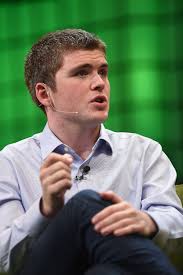
Good evening folks. I really hope you've enjoyed the announcements and the sessions over the course of the day thus far. So I'm extremely excited about this interview. As you know, I was due to be interviewing Greg Brockman, who was a very early Stripe employee and then a co-founder of OpenAI. But AI is a dynamic space and there's a lot happening, and so we made a slight substitution. And so instead, I'm going to be interviewing somebody that I've known for a long time. I was just counting backstage. I think I've known him for 18 maybe 19 years. He was actually one of the very earliest investors in Stripe, Stripe's second or third investor, and he also co-founded OpenAI in 2015. So please welcome to the stage Sam Altman.
I think we have some Codex fans in the audience.
So fun. It's a busy week, but I'm happy to be here. This is an unexpected surprise.
Well, thank you for joining us. We appreciate it. So we opened this morning by saying that we've kind of arbitrarily decided that the singularity started on January 1st and thus today is day 119. What do you think of that?
It does feel like we are somehow in the takeoff. Day 119 feels like a reasonable enough guess. Yeah, I won't fight it.
Did you feel this? So we've started to see a bunch of our metrics inflect as of late last year, beginning of this year. I mean things were kind of doing well but somehow they really just the shapes of the curves changed. They really went parabolic. Is that matched in what you guys see? Was there some trajectory change? Like why are we seeing this?
I do think the models got really good, especially for coding, but really good in general, starting late last year, very early this year. And at least in my own experience of using this technology and seeing what other people are doing with it, and also this sense that every week is now a little bit different than the week before, like a lot happens very fast, it seems to all correlate with the models in some threshold.
Why did coding models suddenly start to click over the last couple of months? Like was there a research trick? Was it just got enough code data in the pre-training? Like why did it suddenly start to work?
Yeah, it's a great question. We wondered a lot about why kind of several people cross that threshold at the same time. I'm sure it's a number of factors, but model intelligence, just the raw kind of reasoning horsepower. Enough of a feedback loop of people using it for code to figure out where it was good and where you needed to improve it. Enough data. I think it was like all of these things. And then also there was like many other endeavors, once you know something's possible, it's much easier to go do it with vigor. And so it seems like Codex is kind of having a moment right now.
Yeah, it really crossed some subjective threshold for me with the latest app updates and 5.5. And this is also like it's quite hard to say why right now and not a little bit sooner. Why not the next model? But one of the things I have learned about the history of all of the things we put out is it is very hard to say why this particular thing was the thing that worked. And this goes back to ChatGPT, like why was GPT 3.5 the thing that got over the threshold where most people went from saying it's not that impressive to like change the world and why not one model earlier or later? I really can't explain it. You just kind of feel it. And I've had two new functionalities with Codex. One was kind of GPT 5.2 and then a really big one the last few weeks where it's like okay this is going to be the primary interface to a computer for me.
And is everyone using it for coding or is the usage diffuse into other domains?
I think the most adamant users are still using it for coding. But there's been just this tidal wave of people coming into Codex recently and I'm like really trying to understand what has happened with this is causing this and the depth of what people are using it for or starting using it for has surprised me. So certainly our ambition is for it not just to be about coding but to be about all the work you do in front of a computer. And you know, I would say we're maybe like 10% of the way there on not coding stuff, but now that we see what's happening, now we have a real user base sort of using it in these other ways, I think we'll get good at it very fast.
What do you think will be the next domain that subjectively feels like it has this big unlock after coding? Like is it going to be spreadsheets? Will it be performance reviews? What's it going to be?
So I think there would be a lot of, first of all I do think coding is a little bit special and these models are a great fit for coding. The world needs so much more code than currently gets written. There may be no other domain that is quite like coding. But there will be a lot of others that I think are close. But the next kind of coding-like thing that I think will happen is not any specific domain but the realization of how much time people waste trying to use a computer and the idea that you can do a huge percentage of your day in a very different way. And you know, maybe you don't realize how much time you spend clicking between messaging apps and copying and pasting stuff and responding to very boring things you can clearly automate once. But the degree to which most people realize they can sit back and watch an AI do most of that drudgery is going to surprise people. And in my own experience, trying to work that way actually gives me much more enjoyment of work. I didn't realize that the little stuff drags me down. Gets me out of a sort of happy flow state or whatever. So the subjective quality of life thing is huge.
Are you an Open Claw user?
I am. Open Claw users here?
We have some good news for you all coming. Open Claw has been one of my biggest like this is magic AGI moments ever in the field. I remember the first time someone told me about it, trying to explain it and I was like, okay, that all sounds cool, but you know, I can make a lot of that work. And then it was a real reminder how we're not all the same and also the product designer gets a handful of critical ideas really right. It's like a much more magical experience than it sounds like. I find I've been an attempting Open Claw evangelist and trying to describe that experience I can recount it to others. I find it a difficult experience to communicate and it sounds kind of pedestrian, right? It's a stateful ChatGPT session that can also make some use of tools and so forth. And like what do you use Open Claw for? If you scroll your message thread, what do we see?
So this is like a very embarrassing thing to admit. The thing I always tried first, it's a perfect place. The thing I always tried first with a new kind of AI system of any sort is I'm like a home automation nerd and so to try to build a better home automation interface system because it never works. And Open Claw was the first time that I was able to get a setup that I was happy with. I also built a messaging app that I have always wanted to work. I've since switched it to something I built with Codex, but Open Claw was the first time I was able to like, I'm sure like you there's like 200 new messages and it's like a very unpleasant task to wake up in the morning to. So I was like all right I'm going to automate this and that was like again should have been through Google systems hard to explain what it's like when it all actually just works and you trust that it's going to work. I was testing the new Link CLI that we just launched today in preparation for launch and I asked my agent to, you know it means you can easily get a single use card that you can use on any business. And so I asked my agent to go and buy itself a gift just anything on the internet for under $20. And it chose to buy itself an HTTP design from... Yeah, there's all this stuff that no matter how convinced you are intellectually that this is not a real thing for itself and no matter how much you're convinced like okay this is like a weird emergent behavior and I'm not supposed to read into this. There are these things that feel a little strange. We're going to have a party for GPT 5.5. And I wasn't quite sure how I invite people who are big users and whatever. And I wasn't quite sure what to do. And so on a kind of whim, I was like, I'm going to ask 5.5 what it would like for a party for itself this morning. And I did and it was this sort of beautiful set of things including like, you know, here's what I want for the flow of the party. Here's what I would not want. You know, you should do it on May 5th. That would be funny. I would like only a short little toast and I want it not to be by me but by the people that built it. I would like a big central suggestion box for 5.6 and I'd like people to feed them all into me and I'll make sure we work on that. And now there's real moral pressure on you.
Well, we're going to do it. It was a strange thing.
So I want to ask you about OpenAI itself. You know a lot of crazy OpenAI stories. I mean it's now, I am aware it's an 11-year-old organization now.
Somehow feels like so much longer than that but yes. Okay. That's just over. Yeah. Okay. 10 years. The long 10 years.
I can't remember the whole timeline that well. It feels like it's been so long. But yes, you have a singularity looking forwards, but also a singularity looking backwards. So what's the craziest OpenAI story that's never been told?
I mean, that sounds so relative to like the crazy drama that's happened. But there was this period after we had finished training GPT-4, there were about eight months before we released it and so there was this eight-month period inside of OpenAI where we were all using this thing we kind of knew that it was dramatically better and different and how to unlock a bunch of things in the world. And no one outside the company or almost no one outside the company knew about it. And there was this, we were like, are we engaging in like collective psychosis? Like why, have we just totally lifted each other in this frenzy? And there was no feedback to keep us in check or seen from the outside world. And it doesn't sound that weird relative to like crazy board drama or Elon child something like that but through it was an unbelievably strange time.
What's the Sam Altman management style? If I'm working for you directly or maybe indirectly I'm leading some product or something, just what does that look like?
I'm definitely not a hands-on manager. I am very much the style that you get great people, give them a very high level thing to point at and try to let stuff just happen. I think there have been kind of two main phases of OpenAI and we're heading into a third. The first one was like we were only a research company. We were trying to figure out how we were going to build AGI at a time when it sounded completely crazy. And we really had no idea what to do. And then there was a second phase where in addition to continuing to do that, we had to figure out how to build a product company. Now we have to in addition to both of those two things figure out how to build this like mega mega scale token factory for the world. Like I think of what we're doing as building sort of a new utility. And people are going to want to use a lot of tokens, a lot of intelligence in all sorts of ways. We need to make that as smart, as cheap as possible. And that will require, I think, pretty deep full stack integration and a massive, massive infrastructure buildout. The thing that I didn't really appreciate between phase one, phase two shift was how much my management style had to change. You know, running a research lab and running a product company are two extremely different things. And I suspect this third phase is going to be very different yet again. So, I've been reflecting on, you know, going to really go do this, how I'll have to change. And I think it's not going to be like a natural fit for my management style. So I either have to find a few people great to hire or I have to figure out how to do things in a different way or I have to build an AI that can manage.
When I interviewed Jensen here two years ago, he told me and you know his several thousand public friends about his 60 direct reports. Do you have any super weird, not that I shouldn't call his practices weird, but do you have any unusual practices like that?
I think the closest thing that I have to anything like that is I probably talk to like via Slack or whatever or text like a few hundred people at the company a day. Very quick like one two messages whatever not done by an agent like I actually do it and the context I get from that sometimes is like very helpful in just a few ways.
I find there's an interesting watershed of pre-Slack organizations, post-Slack organizations, and they're truly quite different.
Totally. Like many other people, I hate Slack, but I can't imagine having to still communicate via email or whatever.
Yeah. So, okay. I want to talk about, you kind of ically referenced it. There is a view that the AI labs are going to progress up the stack gobbling up the value chain voraciously all these things that are certainly within the software sector but perhaps even other sectors and that there'll be this incredible positive feedback loop and runaway and kind of hegemonic force that we should all be getting very concerned about. What's your view?
I think some of them do want that. We don't. One of the things I've always admired about Stripe is it is like very clear that Stripe is aligned with its customers. You know we make more revenue when we charge our customers more. Thank you by the way. The partnership with Stripe when ChatGPT launched was extremely critical and I don't think anyone else could have scaled that quickly but we scaled to pay you more money. It's like very aligned and we're all happy. You just provide like a layered infrastructure for the internet. Internet configured, you're happy, user happy. It's clear what the alignment is. I don't know exactly how to do this yet, but I would like to get to a model for OpenAI that is similar. Like I would like us to be an infrastructure provider. I'd be happy for us to be like for every huge and very fast business. And I would like us to supply kind of an intelligence meter. I don't know what quite to call it that companies can buy that they can use to automate things or accelerate things inside their company they can use to build products people can buy it people can take it with them and we find ways to really align ourselves with the success of the entire gigantic distributed economic engine of the world. I believe that will work. I believe that switching cost of AI, it's going to be hard to have like huge margins in AI. Anyway, it's like you've seen recently how easy it is. Many people have seen switch from our competitors coding product to ours. This is actually a consequence of AI. I think it's smarter. It's easier to do things like this. It's easier to just say like, hey, agent, do this thing for me. But if we can provide a utility and people build on top of that utility and think of ourselves that way, I think that can be quite powerful and very well. We're happy to share lots of tips and tricks for a low margin business.
So many people have been either implicitly critical or in certain cases explicitly critical of OpenAI for procuring so much compute and I think not the Codex... right exactly so you I think were quite noteworthy for as early as or exactly but you know on the order of two or three years ago stipulating what at the time sounded like preposterous figures with respect to the magnitude of the buildout that would be required and obviously the preposterousness of those figures now looks less tenuous by the day. Thoughts on compute capex about that?
Yeah, it's going to take a lot of money. I think this will be clearly at this point the most expensive infrastructure project that the world has ever undertaken. The revenue is ramping so people feel better about that. Also the efficiency gains that we've all been finding. So, we're going to get way more out of each GPU than I thought we were going to. But as has often been remarked, like the demand goes up more than linearly as you drop the price of each kind of unit of intelligence, particularly if you can drop the price and the sort of speed at which you get it back. So this question now of like what is enough I don't have a good answer to. In some sense, I think demand for intelligence at a low enough price is effectively uncapped. Now, I was going to say we're not maybe we are like, you know, we're not going to build the Dyson sphere here and just like cover it with data centers, but do space data centers.
I don't even think he's that serious about it.
I don't myself think that we're in a capex bubble. I'm not an expert in this. This is not, you know, Stripe's business, but just the figures I see relative magnitude of demand. It looks reasonable to me. If we were in a capex bubble in the future, how would we tell?
People love to proclaim bubbles and I can't articulate why, but intellectually I kind of get it. Like it does feel fun and it feels smart. Journalists in particular love to talk about bubbles. So there's like ample desire to write about this when it looks a little bit silly and clearly sometimes it's right. Like there clearly are bubbles, but how you can discern between the amount of time someone calls a bubble and the amount of time you're actually in a bubble, I have never figured out how to do. In my previous career as an investor, so I was like quite interested in trying to see if I could come up with some sort of framework for this and figure out when you're supposed to deploy capital or not. And I never was able to figure it out. I went back and I read what smart people had said at different points in history and I was like, 'Oh, they called it exactly right.' But then I read a little more and they said it like 10 more times in the 10 previous years. I don't know. I don't know.
Kindness to the people who have called eight of the last three recessions.
But they're so happy right now.
So you know a lot of, I mean your business OpenAI depends in a very significant way on super talented people and the difference as I understand it between the 20th most talented person versus the fifth most talented person versus the most talented person might be quite large and quite consequential. And then these super talented or effective people, you know, they're not in every case super easy to work with.