CEOInterviews.AI
Start App
Try: AI strategy tariffs earnings guidance layoffs interest rates growth

Kevin Weil

VP, OpenAI for Science, OpenAI

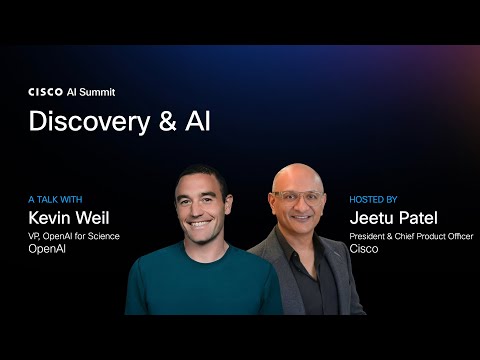
Search every verified Kevin Weil interview, podcast appearance, and on-the-record quote — each transcript cross-checked by AI and human review to confirm speaker identity. Kevin Weil, Vice President for Science at OpenAI, discussed the role of evals in AI product development during a recent summit appearance. He described evals as tests that gauge a model's ability to handle specific tasks, comparing them to quizzes for assessing knowledge. Weil said that writing evals is becoming a core skill for product managers, arguing that models' performance varies significantly across use cases—such as being right 60% versus 99.95% of the time—which requires different product design decisions. He explained that OpenAI used evals while building Deep Research, turning hero use cases into measurable benchmarks to iteratively improve the system. Weil also addressed the limitations of base models, noting that much of the world's data and processes are not public. He stated that models can be taught company-specific or use case-specific information through fine-tuning with custom data, and that custom evals are needed to measure performance in those tailored contexts. He characterized intelligence as multi-dimensional, suggesting that a model's proficiency in one area, like competitive coding, does not necessarily extend to other tasks such as front-end development or code conversion.

Recent appearances

Verified interview transcripts

Notable quotes

“The people that we want to have that compute are the scientists who are going to do the most amazing things with it. But those are sometimes the people who have the least ability to pay for that kind of compute. And so that I think is a problem that we're going to want to solve as a as a community, as a you know, as the US. Like we're going to want our scientists in order to accelerate discovery. We're going to want ”

“When we launch a new model, we have an entire safety team — a large number of people that spend all their time doing AI safety research — and we work with third parties and government groups to red team our models up front so we make more small mistakes rather than a big mistake.”

“We're completely maxed out at all times. This is one of the reasons that we talk about Project Stargate, where we're going in with a bunch of other groups and building out more than $500 billion of infrastructure.”

“Our mission is to ensure that AGI benefits all of humanity and the way that we do that is to put AGI in people's hands as much as possible. We believe in a process of iterative development and iterative deployment — rather than holding it back and bestowing it fully formed upon the world, we want to get AI out to people as soon as we feel like it's ready.”

“That's your data. You should be able to take it to whatever AI you want to take your data to — you're paying for that data.”

“I think we definitely are in the camp that it is way too early to obstruct American AI with useless regulations. We don't even know what we should be regulating — it's like regulating the auto industry out of existence early; it took us 40 years to realize we needed seat belts and airbags.”

Other executives at OpenAI

The summary and quote tags on this profile are produced with AI assistance from verified, first-person interview transcripts, then checked by our team to confirm the speaker's identity and the accuracy of every quote. See how we verify →