CEOInterviews.AI
Start App
Try: AI strategy tariffs earnings guidance layoffs interest rates growth

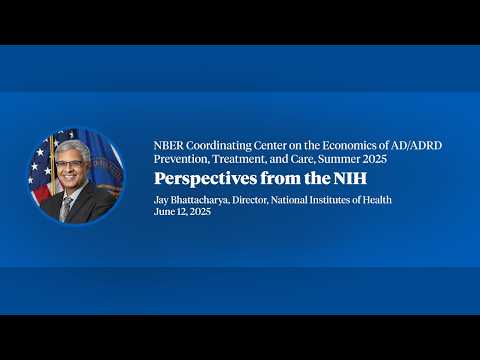
Jay Bhattacharya

Director (18th Director of NIH), National Institutes Of Health

Search every verified Jay Bhattacharya interview, podcast appearance, and on-the-record quote — each transcript cross-checked by AI and human review to confirm speaker identity. Jay Bhattacharya, the 18th director of the National Institutes of Health (NIH), has recently discussed his priorities for the agency, including open science, free inquiry, and scientific humility. In a September 2026 keynote address, he argued that these principles are essential for the future of public health, stating that scientific decisions should not be made by a few authoritative figures. He also outlined plans to reform NIH processes, such as creating a venue for publishing replication studies and improving literature search tools. Bhattacharya has emphasized the need to restore public trust in health institutions by addressing chronic disease and improving health outcomes, noting that U.S. life expectancy has flatlined since 2010. Bhattacharya has also reflected on the COVID-19 pandemic, reiterating his criticism of lockdowns, which he said ignored the well-being of children and failed to protect vulnerable elderly populations. He has stated that the scientific evidence shows lockdowns did not protect human life and had negative side effects. In an August 2026 appearance, he criticized public health officials for not sharing their private concerns about the COVID vaccine's safety for pregnant women and children, calling their public confidence "irresponsible." He has also discussed the Great Barrington Declaration, which he co-authored in 2020, and its focus on protecting vulnerable groups while allowing less vulnerable people to resume normal activities. Additionally, Bhattacharya has spoken about Alzheimer's research, highlighting an NIH-funded 25-year study that found lifestyle interventions like better metabolic health and sleep can influence cognitive decline progression.

Recent appearances

Verified interview transcripts

Notable quotes

“There's a philosophy here which I entirely oppose, which is that in order to get people to do what you want, what you do is you control what they see and say. That's the philosophy that I think Margaret Brennan has. My philosophy, and this is how we've led the NIH and the CDC, is let there be public discussion about controversies, let people have their say. Science moves slowly, and if you give it an environment wher”

“I think it was irresponsible of them. Just full stop. When you have a new product like that COVID vaccine was, and you're an official who has worked very hard to get those products on the market, even if you aren't a top public health person who everyone is looking to for advice, you have an obligation to share your honest thoughts about potential harms to people that might take the thing. Instead what they did is th”

“There was a 25-year study that the NIH supported that looked at a huge cohort of people, some of whom had interventions for better metabolic health, cognitive training, a whole host of things. In 2012, there was a National Academy of Sciences report asking is there good evidence that these kinds of things actually have an impact on Alzheimer's progression? And the answer at that point was no, we didn't know. But now,”

“The estimate is that we are as a country going to be spending $800 billion dollars a year with with a B. I mean, it's a tremendous amount of money. And it's not just the medical care cost, that's only a fraction of it. This is a study run by actually former colleagues of mine at the University of Southern California. And it's just fascinating because what it means is that if we can actually get ahead of the disease, ”

“So when the pandemic hit, one of the thoughts I had was the 2009 swine flu pandemic. In that pandemic, it was really interesting in some ways it followed the same pattern of this pandemic. In the earliest days of the pandemic, the World Health Organization put out a death rate estimate that was like four, five, six percent—very, very high. And it turned out that there was a whole bunch of studies done to measure how ”

“The Great Barrington Declaration is a single page document. It's written not for scientists, it's written for regular people to understand. In October of 2020, I wrote it with Martin Kulldorff of Harvard University and Sunetra Gupta of Oxford University. The idea of the Great Barrington Declaration is based on two scientific facts about COVID. One is that there's this very steep age gradient in the mortality risk fro”

The summary and quote tags on this profile are produced with AI assistance from verified, first-person interview transcripts, then checked by our team to confirm the speaker's identity and the accuracy of every quote. See how we verify →