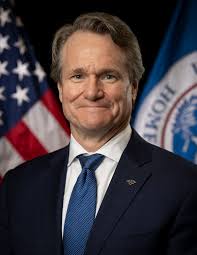
Hello everyone, thank you for joining Axios. We have a very exciting guest for you today. Thank you for putting us center stage. Okay, wow. Thank you very much and thank you to Lightspeed for this incredible week of events, such a great Davos. We're very appreciative to you in this incredible space. Thank my colleagues at Axios events who have put on an incredible week. And Brian Moynihan, Chairman and CEO of Bank of America. Brian's celebrating 15 years as CEO, an incredible track record. Banking and the bank were in a very different place 15 years ago, so we're going to talk to them a little bit about that. Brian and Bank of America have been a friend of Axios from day zero. We just turned eight, and Brian and his colleagues at the bank believed in us before we even had a name, so we're grateful to you for supporting our journalism over the years. Our friend Larry Dorita, our friend Jessica Oppenheim are here, some other friends from the bank. So I wanted to thank all of you. Brian, Axios is big on leadership, like how you can get ahead, how the very best can do even better. Before Courtney plunges in, I'd love if you have one thought about how someone can take a bank that, take an organization that was where you were coming out of the troubles, coming into 2010. And last week Brian celebrated his anniversary by announcing that Bank of America had 2024 revenues of 27 billion and revenues had gone back over 100 billion. So I think...
Just I was thinking this. I just walked out of the room where I remember walking out of in 2010 January here, and there were 150 reporters waiting for us to walk out of a meeting to, to what was going to be decided about banking regulation, as if the people in that had any right to make a decision. And it was the regulators and stuff. They thought that we were going to come out and announce Dodd-Frank, you know, and you're like, so it was an interesting time because the world focused on a set of institutions globally. And you know, the way that you had to step when I stepped in, I came through a very difficult process in the fourth quarter of '09 that was all over the TV. And basically we had to make a simple solution. We had a wonderful set of companies and franchises and the core business, and we had a problem. And the problem actually changed. In the first three years, people would have said it was a Merrill problem and the capital markets problem, then it became a mortgage problem, and it became a credit card problem. But it was a problem which was the aftermath of the credit crisis in the United States. So we divided and conquered. The simple question of leadership: you can't take 285,000 people and try to have them figure out the bad side of what's going on. You got to get somebody to go out there and serve the clients and customers and do it. So we divided and conquered, put a team against A, a team against B, and off we went. And then the second part was to remember why you were there. So the idea of saying, you know, people talk about profits and purpose and focus, and you know the different ways you think about it. If you can't remember why you're there and you're not making a lot of money because the world's going under, you're going to kind of depress yourself. So you had to keep people focused on what do we do? We help clients live their lives, people, companies, institutional investors. Go out and focus on them, go out and get your energy off of them, as opposed to stuff of regulators and congressional hearings and things like that. And so that was the beginning of us really being declarative of profits and purpose. The genius of the 'and' not the 'or'.
Great advice for any industry. My colleague Courtney Brown, we were lucky enough to lure her away from CNBC. She's been a big part of the Axios success. She's co-author of our midday newsletter, Macro According. We appreciate your expertise. Take the ball.
No, thank you for including me in this. This is great. And Brian, it's good to see you. So at Axios, we start with the news, right? So Trump will speak to the World Economic Forum later today. We learned that you're going to be one of the few people who get to ask him a question. Give us a sneak peek of what you're going to ask him.
I have to try. Well, let's crowdsource it, right? I think that look, for the last 72 hours I've spent, I've gotten a lot of questions about what's happening in America, what could happen. And so I'm going to take the opportunity to ask him about those questions, which is really how tariffs factor into his visions of growth, how does an immigration policy factor in, what our business customers are telling us, there's still labor shortages in certain areas, and try to get him to discuss how he's balancing that. Because he will judge himself, I think, by his growth in the economy and value of the stock market, two major things, and solving some of the geopolitical context. And I think it'd be comforting, so to speak, if people could sort of understand how he's going to make those decisions that are trade-offs between one thing and another thing in real time. So if we get to that point where we get to ask a question, it'll be something on that. What if someone asked that question? What's your backup question? I just think that I'd be a little more... There's only three of us asking questions, hopefully we won't screw it up, might be a little collusion there. So I got to come up with another one, so keep thinking and send me something. A little bit like being a reporter at a press conference scared another reporter is going to take your question. What's your relationship with Trump? Look, that's interesting. In the first part of his first term, I was head of the thing called the International Business Council here at the WEF. The president came and we walked through 150, 175 CEOs and had a session where he walked around and he was introducing himself to a lot of these people for the first time. I think it was 2018, so it was very early on. And you know, he wants to get things done. And I think what you saw reflected in the American election is the decision about lower regulation, lower centralized government, lower taxes, and ability to focus on America. And this is an international setting, so this when you're Bank of America, this sounds doubly sort of narrow-minded, but focus on America and its role. And I think that's good. And everything I see about him working with him actually in early stages of COVID and 2020 and other things has always been how do I improve the country? But by the way, that's every president, and we've worked with every president since George Washington in our company, so it's not like this is a new capability. Yeah, his thing of getting things done, like as we talked to his inner circle, they're very confident. And what you hear a lot is the president now no longer listens when people tell him you can't do that, that's not how it's done. Usually a senator, he says like he just doesn't listen.
Brian, over 15 years I've been privileged to have lots of conversations with you. I know that you're both an optimist and a realist. What does the optimist side of your brain tell you about the new administration? What does the realist tell?
I think the optimism is when you talk to our customers and clients over the last 12 months, the concerns about inflation were coming down, the concerns about interest rate increases, it was a fivefold increase in the base rate at which commercial borrowers borrow. That is small. It has given way to an enthusiasm, but that was overwhelmed in the last six months by the regulatory burden. If you talk to our larger customers, you couldn't get deals done. Talk to our midsize customers, a new rule of regulation was coming out every day, and they don't have the staff that we do to figure it all out and apply, whether it's on labor practices, whether it's on disclosure, not on disclosure to larger companies, whether it's on labeling practices for a good or whatever it was. So I think all that people feel very relieved about, and that's the optimism. Because the question is how much does that uncork in the United States, and how much was being held back? As rates have come down a bit, it'll still stay higher than people are used to, as growth has slowed down actually, but still stronger than we all thought it would be. How much can regulation help? And it's so much that our team, our research team at Candace Browning, we have a wonderful research team, basically thinks that that will outweigh tariffs as long as they're in the 10-15% range. Just that lower regulatory burden will result in higher profit margins, which will then allow us to manage the tariff burden differently. So that's interesting.
So you're essentially saying that there is all this economic concern about how tariffs will blow back on the US economy and the global economy to some extent, but as far as the US is concerned, you think that lower regulation, lower corporate taxes might offset whatever weakness that comes on that front. So the...
One of the wonderful things about running Bank of America, I have a team of several thousand people who study this and do it, so that's what they think and it makes sense to me. But they're much more skilled at the analysis. But it's really in moderation. I mean, we absorbed, if you go back and think about it, we absorbed the tariffs that were put on in the first administration and they never came off, and 10 years later we're talking about outsized growth relative to trend and relative to the rest of the world. So obviously those tariffs didn't hold back. It takes a while to get through the system and adjust and everything. But I think people have to be careful about saying tariffs are bad because it's against free trade, because that is one point of view. But on the other hand, what are you trying to accomplish is really the question. And that will be the plus or minus. If they get very high, obviously has a bigger impact.
That's an interesting point to make at a conference that I think was founded on this premise of globalization. But as Davos comes to an end, I'm curious, you're here, you're taking lots of meetings, you're talking to a lot of people. What's different this year and what's the same?
You know, I think a couple things. I think one, one of your colleagues asked me for my one word to explain, I said enthusiasm. And they sort of, when you listen to the community, there's enthusiasm that there's a push in Europe for competitiveness and growth, there's a push in the United States for growth, there's a push in India, it's been a long-term push for growth. So the idea of growth, building a bigger pie, then worrying about how to mete it out equitably and how to accomplish the purposes, that's an enthusiasm I see. In prior years, I was focused on how we regulate the outcomes, and now it's how do we build the economic engine that can pay for the outcomes. And that enthusiasm is different.