Very good afternoon, everyone, across Bloomberg platforms. It is Wednesday, October 14. Yes, the Beige Book will be crossing in a moment. We will check those headlines and get you that a little later on, but right now, we have a market where stocks and bonds are lower. Tim:
Suffice it to say, tech getting hit most. The S&P down about 1.4%, the Dow down about 0.5%. The concern is that the Fed will keep lifting interest rates. Kind of throws water on the idea we heard from New York Fed President John we heard yesterday. Carol:
Most names in the S&P 500 are lower today, so, yeah, exactly. Does the Fed have to hike rates more than not? There is that. There is also that second drop in big bank earnings. We will hear from Bank of America CEO Brian Moynihan. Shares dropping the most in years. Years of lapse is coming to light. Turns out, BofA earnings not the headline story. Tim:
Plus Bank of America and all the big bank earnings, we will be sitting down with Meredith Whitney. Carol:
Also from Anthropic's investor data to Nvidia's Jensen Huang struggling to keep up. 10: All that and more coming up on this hour of "Bloomberg Businessweek Daily." Charlie:
Thank you. Right now, we have stocks tumbling. Banks are stumbling. Higher energy costs in the mix, also add semiconductors selling off, you have the recipe for a selloff right now. S&P down 110 points, we are trading at the low of the day. It bears repeating, Dow Industrials trading lower by 0.6%. Nasdaq down 2.1%. Nasdaq 100 index down 2.2%. The Philadelphia Semiconductor Stocks index down 2.4%. Spot gold down almost 2%, 4082 the oz. West Texas Intermediate crude oil, 1.3%. I'm Charlie Pellett. That is a Bloomberg Business flash.
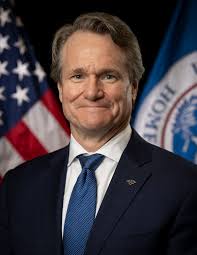
Thank you so much. Turmoil at Bank of America pushing shares to their worst earnings day in more than a decade. You heard Charlie with the market roundup, piling on the pain for a bank that has been one of the worst performers among the six U.S. banks in the last five years. It's also a major black eye for CEO Brian Moynihan, the lawyer turned executive who has led the bank for more than 10 years. Tim:
The bank's results also hurt by a charge tied to regulatory penalties over money laundering and sanctions violations. Carol:
Right now, we head to the home of Bank of America where CEO Brian Moynihan is sitting down with Jonathan Ferro. Jonathan:
Welcome to the program. It is good to see you, as always. We have to start with that fine from regulators. The language from Treasury is quite damning. What is your interpretation of what went wrong here? Brian:
At the end of the day, we had an examination a few years ago. We got a cease and desist order. We have to do that work. There was a debate about what exactly we had to do. That is resolved. That is behind us. We have been expending the money in the run rate already to do the remediation because a few months ago, we started picking up the cost structure and putting it in, so we will get it done. We take it seriously, and as time goes by, people will understand it better. Jonathan:
I imagine you want to draw a line under the whole issue, but to extend the topic a little further, I imagine you also do not want to be drawn into how much of this there is to be completed. This afternoon, given where the stock is, there needs to be some confidence for investors that the costs associated with remedying this are in the baseline and there will not be any more surprises in the future. How confident can investors be that's the case? Brian:
For the operational cost to do the work, we have had a lot of expense and it is in our baseline. It does not add additional expense that we have been running through. We have been completing a lot of tasks over the last several months, and we will continue to finish it up. It came up a lot about how thresholds are set. There's a lot of technical discussion, but at the end of the day, we understand what we need to do, we are doing it, and we will deliver. Jonathan:
What are discussions like with the board around accountability, and would you be open to aligning remuneration with some of these difficulties? Brian:
We have accountability for everything we do in the company, including a fine. We've gone through it before. In 2004, there was accountability for the examination of the order already taken.
This was overshadowing what was otherwise a mixed quarter for the bank. Trading, capital markets, investment banking, that is one side of the business. The Main Street side of the business seems to be performing well. The path to net interest income looks pretty good from here. Can we sit on that a moment? Do you see the path to improving even more as durable? Brian:
The market's contribution, which other people have, too, was basically flat. So as you look forward, what is happening is the core loan book is growing. The core deposit book is growing. Loans grew 6% to 7%, and core businesses grew. That's great activity and also bodes well for the U.S. economy because companies are borrowing. But what we said last fall was this year would be a 5% to 7% increase over 2025. We have raised that and confirmed 8% for the year. At the same time, we said 5% to 7% for 2027 and just raised that to 8% plus, and that is just climbing up stair steps to put more loans, more deposits, and repricing of the balance sheet. We are up 15 basis points on net interest yield while others are falling. We made $8 billion. There is a lot of momentum.
There's a lot of good things around the Main Street side and even on the market side, we had a $5 billion trading revenue quarter against our peers that did not hold up as well, but the reality is it was one of the stronger third quarters we had in trading. We feel good about the franchise. The pipelines are full, etc., but it is a good core engine growing at 8% when others are not coming close to that, that is driving our earnings forward. Jonathan:
This is against a backdrop of much higher interest rates. There was some discussion into the last month and to some extent, it was hitting bank stocks across the board. To what extent will these higher costs eventually eat into net interest margins? Brian:
If you have $2 trillion of deposits which you pay 149 basis points for and rates go up and you go up a lot less because a substantial part of those deposits are not interest-bearing, higher rates are an offset, less because higher rates are because something is going wrong in the economy. When rates come down, that is what crunches you. Simply put, our exposure to higher rates is always positive. It is less than it is because we try to manage both the down and up, but the reality is we told people what we thought with a rate environment that was sort of flat, but we are now saying because we see good core loan growth and good deposit growth and having a trillion dollars of deposits that are very advantaged, we can see we push it to 80%-plus for next year. Jonathan:
I'm not sure how well understood this actually is for people outside of your world, but the growth and overall mix is heavily skewed to non-interest-bearing accounts. People talk about how sticky those deposits are and the threat of technology disruption in the next couple of years, potentially pulling some of those deposits away. How do you think about things with that in mind?
For your customers, they have the ability every single day to move their money to higher-rate off-balance-sheet money market funds. They could do that every day. The thing is, when you have the core operating account, that is the money to pay the household bills with, the car payment, the house payment, so that is running in and out. Through it comes a bunch of granular accounts, all of which is money in motion. Even in our wealth management business, which is by definition affluent and wealthy America, it is $285 billion, and a lot of it is priced to yield a higher rate for customers, but a lot of it is core checking accounts, so that is not well understood. People put money in transactional accounts, have it for transactional purposes and have it to make cash return on investment. The investment capabilities are there today. In transactional, you have to have a trusted person who will process your different types of payments and be there and be open and not have issues around it. That is what our industry represents.
That is why the core deposit growth is what drives consumer business and likewise, in the commercial business, small business deposits, business banking and commercial banking deposits, any operational work around them, that grew 10% year-over-year. This is not a new concept that money can move to high-yielding things. The money market funds have been there for 40 or 50 years. It's not a new concept. It's just that we do not need the money so we put it in the markets.
Are there operational wrinkles that you think need to be ironed out before we see things like agentic AI use ramp?
Agents go in and transact and it does not do what you want because they make mistakes, and it is a massive, complex environment in which to operate. The question is what happens next? What we have found in the past is people saying you should not let those payments go through, but when you authorize that agent to make the transaction, you have authorized that transaction. Letting customers know about authorizations we have found is a good way to manage that risk, but we have heard already — it did not happen here but happened at other places — people come back and say why did you let that happen, and it is because it is you that made it happen. So we are trying to get that straight, and the scams and things that go on that now have the capability which they can run 24/7. It used to be constrained by human beings but now they can run full-time and that's why we are working closely with companies to develop protocols so the human stays in the loop. Jonathan:
You can see how that can get messy quickly and that is just in the operational layer. The other thing people are talking about is the cost of the build-out. I talked to Jim Bullard, and he made the point that he thinks this build-out is a bubble that will eventually burst. You have been more engaged in lending and financing this build-out. I just wonder where you come down on the debate about how sustainable this is and how active you want to be with that in mind. Brian:
We are active, but we focus on individual transactions. The owners of the assets, the lessors of the assets, how the cash flow goes. Where are we in the duration of the capital structure? So as a principal lender or underwriter bringing money to capital markets, we focus a lot on that. The reality is, at the end of the day, the success of all this will be dictated by where the revenue comes from with these companies. One of the challenges is as we implement AI and spend around roughly $250 million, $300 million, as we spend that money, we are getting good benefits out of it. The constraint on doing that is if models will create problems, we are spending $100 million trying to remediate against frontier models' impact on potential systems' patching.
This has got to work out. So the reality being the final revenue stream from the corporate world dictating how good the final models are — centralized, non-centralized agents, autonomous agents, assisted agents. The question of the consumer model is not as important to us because we don't engage in commerce. We engage in payments around commerce. In the long term, that will determine the efficacy, and that is still playing out. And I think people having a long-term view are judging by their opinion of what will happen, and I'm more making sure we are structured around credit. Our team does a good job there and making sure we get value out of it. Jonathan:
I'm looking forward to continuing the conversation with you. A busy 24 hours for you and the team.
Thank you so much. Of course, Bank of America Chairman and CEO Brian Moynihan in Charlotte, North Carolina. When we talk about Bank of America, shares are down about 6%, off their lows of the session but quite a haircut for the company. Tim:
John started that interview asking about that charge we learned about just after markets closed yesterday. Moynihan said he debated a bit about how to resolve issues. He also said that we will get it done and take the government order seriously, and we have accountability for everything we do at the firm. Carol:
He did also go on to talk about the business. He says lots of momentum for Bank of America with the fines aside. He says as interest rates crank up, we will make more money, and he says moving money to higher-yielding accounts is not new. Be sure to check it out, the entirety of that interview. It is on the Bloomberg. We need to talk quickly about the Beige Book. Tim:
That brings us to the summary of economic conditions for the month of October, just crossing the Bloomberg terminal during that interview with Brian Moynihan. Half of the districts saw robust or intensifying price pressure. We also learned firms have a positive economic outlook in most districts and also the majority of districts reported some growth. Carol:
Yields are near lows of the session. Looking at the shorter end of the yield curve, 4.81 after a hot inflation print we got earlier this morning, so we are bouncing around here, no doubt about it. Coming up next, she made her mark during the Great Financial Crisis. She has followed financial services for years now. And Meredith Whitney joins us next when "Bloomberg Businessweek" continues on this Wednesday.
We do check markets all day long. We have the Dow, the S&P, Nasdaq all declining. Stocks are tumbling as the rout worsens. S&P began the day over 7800, now lower by 1.2 percent. Dow Industrials down 0.4%. Nasdaq Composite down 1.4%. The Russell 2000 index of small-cap shares down 1.2%. Nasdaq down 2%. The Philadelphia Semiconductor Index down now about 4%, the two-year currently yielding 4.80%. The 30-year, 5.51%. Gold is down 1.7%. Energy names moving higher along with the price of oil. A barrel of Brent pushing higher by 0.6%. GlobalFoundries plans to build two new chip plants with the backing of as much as $21 billion from the Japanese government under a broader agreement with GlobalFoundries. The Commerce Department will be taking a roughly 4% equity stake in the company. Digital Realty Trust is offering $10,000 a year for the next decade to every household in De Soto, Kansas, near its planned data center. The money will come from its $20 million community investment fund. The city is working to finalize details of how the proposal will be administered and distributed. S&P down 1.2%. 10-year yield, 5.18%.
We just heard from Bank of America CEO Brian Moynihan. Shares tumbling after a $2 billion non-tax-deductible charge for fines related to money laundering and sanctions violations, something we have been talking about all day. That cut into net income by $0.17 a share. A miss on stocks and income. Trading also sending the stock lower. When it comes to that fine, Moynihan says that they debated a bit about how to resolve the issues. "We will get it done, we take the government orders seriously, and we will have accountability for everything we do at the firm." Tim:
Meredith Whitney, CEO of Whitney Advisory Group, joins us on the show. I think it's fair to say Wall Street was a bit surprised by this. Look at the share reaction today. What is your view?
It is ugly. It is not insignificant, and importantly, Moynihan said they have known about this for two years, but investors really found out about this last night. It harkens back to all of the fines that Bank of America and so many other banks paid, and one thing Bank of America has done well has been managed expenses since 2010. I think what this announcement did was to scare investors that they may not have as strong operating leverage over the near term, and that has been one of the stories that investors could count on. I would not rule it out, but mostly bank stocks have sold off since they reported, and the reaction today is stronger for Bank of America, but it has not been great for, really, any of the banks because each bank did not deliver what investors wanted from the get-go, and Bank of America has been underperforming since Moynihan had negative comments at the Barclays investor conference in September. That is when the stocks as a group started to underperform. Investors are starting to get worried. Higher rates are a positive for banks in the way he described in terms of they will out-earn net interest income versus interest-rate expense, but there's another thing higher rates do, which is lessen the values of many of the assets on the balance sheet. The banks have exposure as lenders to private credit, so there is a lot going on underneath the surface this earnings season. Expectations were not good going in, and the moves show these banks disappointed or fears increased of a weak economy.
So good to have you here and talk with you again. Going back to the crisis, you just were here all the time.
I know, I felt like I lived with you.
Brian Moynihan, I think there is a perception of him as a CEO — to hear that they knew this for two years — if you sat down with him, what would you want to ask him or push him harder on right now? Meredith:
I think it is just managing expectations. Usually, he is very good at it. I think he was more revealing than he has been in years at that Barclays conference, and I think that is what really shook investors, and that spilled into the whole group. Today, both on the earnings calls and just in the interview with Jonathan, he did not settle the score that this was behind him. He and so many other bank CEOs have really bad PTSD from all the fines that were levied after the financial crisis, and I guess you could see that his delivery was not as it has been consistently over the past years.
I feel like a bunch of us have PTSD. I am curious what you see as our next crisis. Here we are trying to square the AI spend. How many people come on and are like, wait, the demand for orders are not just the next six months, it is the next two years, and then there's the circular financing, and it's hard for me and I think a lot of us to be like, is this really that good and that significant in that it can go on for so long? I'm curious about your thinking on this. Meredith:
If you look at CoreWeave and the impact on the stock today, that was — I think that was something hiding in plain sight for a long time and has finally come through, which is how much debt some of these cloud companies and associates have put on, and it is weighing on corporates. The other thing I would focus on is the refrain from BlackRock has been going on several weeks saying if we slow down on AI investment, we will go into recession. I don't agree with the idea of not slowing on AI investment, but what is clear is the underlying U.S. economy is so dependent on this investment and that consumers are weaker, but the spending is a direct result of the wealth effect that has come from all of this AI appreciation in the stock market. I think the fragility of the market is significant. There is always a debt issue that causes a great crisis.
If you look at the dot-com bust, it was the debt that caused so many ripples across the market and also the amount of debt that Enron had, so it was really a debt issue. The debt here is what is disturbing, and then how rates go higher and higher with or without the Fed moves. Look at what housing has come to a grinding halt, so it will be the worst sustained home sale market on record this year. That obviously has an economic impact and also confidence impact.