Hi, I'm Sarah Kirk, I'm the Provost and Dean of Faculty, and it is my absolute pleasure to welcome you here tonight to the Anderton Economic Policy Forum.
Established in 2022 by former trustee James F. Anderson IV from the class of 1965, this symposium brings the HWS community together to engage with diverse perspectives on some of the most important and complex economic issues of our time.
Since its founding, we've welcomed leaders from the Federal Reserve Banks of Minneapolis and New York, as well as leading scholars in financial regulation and banking stability. These conversations give our students and our entire community the opportunity to hear directly from people whose ideas and expertise are helping shape economic research, monetary policy, and financial systems.
We are especially grateful to Jim Anderson, who is sitting with us this evening here, for making these conversations possible.
Jim is the founder and executive chairman of Crimson, a property management and real estate investment and development company. He earned his PhD from Michigan State University, his MBA from Cornell, and his BA from our very own Hobart.
A long-time and deeply committed supporter of HWS, Jim has also established the Anderton Forum for global engagement, bringing diplomats, scholars, and policy experts to campus to explore the forces shaping international affairs. Jim, thank you for your leadership and for your commitment to creating opportunities for thoughtful, substantive conversations at HWS. We are so grateful.
And now I am pleased to welcome Professor of Economics Bessel Khan, who will introduce tonight's distinguished guest.
Thank you, Sarah. And thank you all for being here this evening. And thank you, Jim, for making this possible. When I was talking to Jim about, you know, who we might have as our next speaker — now, this is months, months, months back — Jim said, "Well, what about Brian Moynihan?" And I thought, "How the heck am I going to get Brian Moynihan here?" I don't... And Jim said, "Well, I know someone and we can ask." So, thank you again, Jim, for that. And thank you for giving us this, you know, fantastic opportunity.
So, I was going to tell a few of my incredibly funny econ jokes, you know, just to warm up the crowd a bit. But, my wife, you know, Jenny, who is a better economist than I am, said, "Okay, I can see the supply, but is there a demand for it?" So, I'll just, you know, skip those jokes.
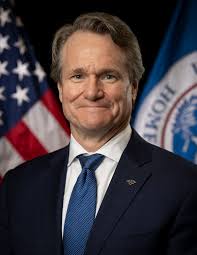
So, our guest this evening is Brian Moynihan, as you all know, the president of Bank of America — you know, CEO. No, I beg your pardon, you know, CEO and chair of the board of Bank of America.
And he's our first speaker from the private sector, because we've had, you know, policy makers from the Fed. We've had, you know, academics. So, we thought it's about time to have, you know, since talking about banking and finance, maybe we should have someone from banking and finance here as well. And we're very excited to hear from, you know, one of the most influential business leaders in the US and one of the true movers and shakers of, you know, of US corporate America.
So, Brian Moynihan has been the CEO since 2010 and chairman of the board since, you know, 2014, steering, you know, one of the world's largest and most systemically important, you know, financial institutions through the aftermaths of the great, you know, recession and, you know, the massive economic dislocations of the COVID pandemic. And under his leadership, BofA has grown to roughly 3.3 trillion — with a T — in assets, about 113 billion, I mean revenue, and serves about approximately 70 million clients worldwide and has a presence in about 35 countries, workforce of approximately 211,000, etc., etc.
I can keep going at that second largest bank, you know, and all, but I think you all get the idea, you know, basically, that it is a very important financial institution. And you know, covering everything from Main Street mortgages to underwriting at a sovereign debt, you know, the whole gamut, BofA.
So, under his leadership, BofA continues to maintain its 2021 10-year, 1.5 trillion-dollar commitment to back environmentally sustainable energy and infrastructure projects. And BofA is consistently among the world's largest backers of, you know, green bonds for, okay, project finance.
Brian is on the board of many, many, many civic and business organizations, far too many for me to list here because then you'll just be listening to me all evening and, you know, some of you hear enough of me in class anyway. So, you know, one in particular that I wanted to mention is that he's on the steering committee of the Council for Inclusive Capitalism, which is an initiative of the late Pope Francis.
And so, in the spirit of inclusive capitalism to work, in 2025, BofA, you know, raised its US minimum wage to $25 an hour for all full-time workers, and its minimum salary for salaried workers to 50,000 a year plus benefits, right? So, in the spirit of inclusive capitalism.
So, anyway, as I said, I can probably go on all evening, you know, listing things off that BofA has done, and, you know, Brian has been a very instrumental force in doing that, but you're not here to listen to me. So, without taking up any more of your time, please welcome, you know, Brian Moynihan and our very own President Gearan, who I don't think I need to tell you anything about President Gearan. So.
That was good. I like the economics jokes. Well, good evening, everyone. Welcome. First come, those were pretty good jokes. Thank you for that. I thought it was reasonable.
Well, thank you all for being here. Provost Kirk, thank you for kicking us off, and most especially to Jim Anderton for bringing us together. I appreciate everyone's acknowledgement of what Jim has brought to this campus from these important forums to his own fraternity, to really engaged as an alum. He's a model of someone who has indeed led a life of consequence and reaches back over the arc of time to support Hobart and William Smith, which we're grateful.
The Anderton Forum on Global Engagement, which you should be on the lookout for, will be — I believe it's April 5th here. We have Dr. Nita Crawford, who is the co-founder of the Costs of War project. She, too, is a Brown graduate. The Costs of War is really out of Brown University or Watson School. So, we very much look forward to her presence on campus and we're grateful for that.
So, let us begin. He arrived this morning and has had a busy day here on campus meeting with students and engaging. I'm going to ask him a few questions and then we would like to — he wants to turn it out to you. So, get your questions ready. You have a lot of smart Hobart and William Smith students here, Brian.
So, let me begin at the top of your day here. Tell us of your own impressions of Hobart and William. This is your first visit here.
It is my first visit here. I, you know, I think the reputation of the school is tremendous. It's wonderful to be here. At the end of the day, the school is made by the combination of students and faculty and leadership and watching the — as I said earlier, watching how the young students engage and thoughtful and thinking about life, the careers, what they say, how they do means the faculty is being successful and that the curiosity I saw, which obviously means that the administration is helping make it all work.
So, it's been a great day. Very impressive group of students, one of whom is coming to work for us, so might be the most impressive of all.
Emily, where are you? Let's give her a shout out. Well done.
You have a few more if you'd like to hire a few more.
Yeah, we hire a few every year and one or two, and so it's a great tradition. But it's a great school. Learn, be curious, and it's been great to meet the students and faculty and learn about how you have the culture here is terrific. So, thank you. And what you do is important. And it's important for the professors here.
The stewardship of students through this time of life is one of the things that makes our country great. It makes our society great. It makes the world a better place. So, thank you.
Very nice. Well, you're right. We're grateful for Emily's experience and internships. They're one of our Board of Trustee members, Eileen Gleason, has just stepped into retirement after a successful career there. We are thankful for her leadership on the board. But let me take you back a bit if I might, Brian, as someone of a self-narration of your own background. I've been studying all things Brian Moynihan over the weekend. So, take us back.
Must have been a rainy weekend.
It was big here for me. Take us back to 1981.
You're at Brown University. You grew up in Ohio. The sixth of eight children.
You're a history major.
You're co-captain of the rugby team.
So, you're in the audience at Brown in 1981. And you're listening to David Rockefeller, who in 1981 is probably one of the most accomplished bankers at that time. Tell me about Brian Moynihan of 1981 and how you think about that now given you're our David Rockefeller.
So, there's an interesting thought and the Professor mentioned that inclusive capitalism. I grew up in a household where it was all scientists. And my dad was a chemist. My brothers were computer science. My sister did computer science. The closest thing to me before me was an architect. And my brother was a very talented architect. Wanted to be an artist. My dad said you can't do that. So, the idea of being a history major was sort of — you're already in sheep — I was going to go to law school, a sheep, but more importantly for this conversation, I didn't understand business and capitalism and I had that economics course but didn't understand how it all works.
And I think, you know, it was helpful to learn about it and it would have been more helpful probably. We had a professor at Brown named Barrett Hazeltine who actually did the small business case study courses which was like the closest Brown would come to allowing a business curriculum on campus, you know. And Dean Hazeltine didn't take a salary, had been a successful business person, they put him in the engineering department to hide him and he is apocryphal. He's taught almost half the Brown alums to give you a sense. He just retired at 94 or something. He's still...
So I think I didn't know much about business. I didn't know what it would mean and I think you the crowd is benefiting better than I did by having the professors I talked to in the economics department business to have people think that you have to understand how business works from maybe being a participant in it. Doesn't mean all of you have to go in business but also that can accomplish great things.
And I think with a Rockefeller somebody you would have seen that the way our industry has practiced capitalism, practiced thought hard about how the impact they'd have on the world and we at our company did the talent and teammates I have have been able to have an impact on the world. And a bit of was because I didn't come at it thinking I was ever going to make any money doing it. Didn't care about that. I worked hard. I never thought that this was going to be where I was but I did think I wanted to affect things in a structural way. I wanted to learn. I wanted to help people get better at but then sports and other stuff I'd done and work through and then becoming the CEO but it was never like if I wasn't — I wasn't trained in back room. My dad was a CEO and I had to be a — nothing like that at all.
And you came as a lawyer.
Which is somewhat...
Yeah, I got lucky. I tell you the concept there's Jim Collins is a business writer has a concept called return on luck. Everybody gets lucky, who returns on it. He studied people and I got very lucky at...
I'm a partner in a law firm, I have two kids, I'm making for the first time a good amount of money. Very successful and had a client say come in and work for him. And leaving law totally to go into work and I got lucky and they made the offer and I accepted the return on luck because I took it. And it would have been easier not to take it. I mean very easy.
And so the other lesson of that is you're going to get lucky at some point. Make sure you get the return on luck. And that's the lesson I tell myself and that then started me a business career. And you know, it wasn't very linear but it ended up being CEO 29 years later. But it was really built on just, you know, learning what we need to do, helping the company be successful, helping the team work.
But it was really a leap of faith. I had not taken math since high school. I had calculus and stuff. I had not taken business courses other than the ones at Brown which... and I went and had 25 MBAs to work for me, did strategy, we did models, we brought in — I think we had the first PowerPoint. You guys think this is old. It wasn't invented. It was a stack of stuff. We used it the first time. Everybody loved it. Then the world took off. We probably polluted intellectual thought for a lot of years by then. PowerPoint proliferate and writing skills.
And I'd say that the second lesson is in that case three is I got lucky and I had a wonderful family and my wife would allow me to do it and, you know, I could have bombed out and been — I could always go back and practice law if I — but I could have bombed out and interrupted my career and been unsuccessful at this and so I had to get the return on luck by going to work. And then that was it but it all came from Terry Murray saying to Bill Mutterperl who was the brightest guy I've ever met. He's too smart to be a lawyer. Get him in here and we'll have him do something else. And the general counsel I still keep up with that. He still tries to figure out what Terry was saying about him. But yeah, and it was good. And then it's sort of all different parts of history since then.
So I usually ask guests, you know, something that's the news of the day. But I think in your case it would be really interesting for our students and faculty members, our Geneva neighbors here. Our mayor of Geneva is here. Thank you for coming. What is the news story of the day you're looking at? What is most captivating to you today?
Well, the one story doesn't work because there are probably two or three stories which are really sort of driving what could happen next. AI — I don't need to — the question of what's going to happen to resolve the war situations in Ukraine, Russia, and the Middle East and other places. And then the third is the question of how's the world going to adapt to a real interest rate environment and handle the debt on one side of our country and other countries and the other side the cost of the debt and the other side the cost of the people because the rate structure's higher.
And that to me is lurking there, but the AI one gets all the attention and it — I mean, it's been interesting three weeks when you had people, you know, leave a company and say, "We could kill everybody by 2030." You guys all have gotten party for the rest of the time because what the heck you're just... but it's pretty remarkable.
So we spent a lot of time working on that, but I think that news story drives it not necessarily because of the device, but because of another way of technology. So we're on the cusp of another industrial revolution, another revolution in methodologies. That then feeds the question of war, that then feeds the question of, you know, how well is this aggregated accumulated as well as spread. That then feeds that and all the things.
So there's a lot there. Let's unpack that. That's so interesting to me. So let's start with AI.
How do you think about it and what kind of advice do you have for students and how are you integrating into your business model?
So the interesting question I asked the team, the colleagues earlier from the students, and who was afraid of losing their job to AI. And I asked that question a couple years ago to a group of colleagues that are just coming to be an intern in our company. Everyone raised their hand. None of the students today raised their hand. I think that is the difference is that people now understand this is a tool to help them be better, help them do more stuff. And they also are using it. So they understand it's not quite as odd and scary and different.
You and we and academia — I'm the chair of Brown's board, but you — that Chris Dodd runs a great show, but you and academia have a challenge to harness this engine and also make sure that you can still have brain development go on with this engine in existence. It's really going to be interesting how this plays out and all the rules and mores and stuff. But I'm telling you it's a powerful engine.
And so what I think is it's powerful because it can do things in an organization like ours, 209,000 people. We have 3,600 processes, we have 30,000 controls, we measure every one of them, blah blah blah blah blah. Even though we're a bank and people, it's actually that process oriented. That's how people say how do you manage that?
Traditionally we'd be able to take costs by re-engineering processes and operations groups. This allows us to have the auditors change how they work, the lawyers change how they work. That's a completely different concept than any technology. You either got more efficient by Word or, you know, search engines and this stuff. But the idea that you can actually take the task and do it. So, my advice to people is harness it, learn from it, and make it your tool to make yourself successful.
The danger of this: don't lose your curiosity. Don't lose your willingness to learn. It is wrong a lot of the time, and you will look like a fool if you rely on it and it's wrong.
So, the most encouraging thing I've heard about AI is when I had a young investment banker demonstrate a thing called Rogo that you read about, and he said, "I have accountability when it's right, whether Rogo got the information or not." That to the students, you can't say the model may be doing — you can't say my numbers are wrong or my analysis is wrong, or frankly my sentences are misconstructed, you know, because the model may be doing — or you will have a mad boss or professor or whoever.
So, you got to make it work for you, but you got to do it. And the second is you got to keep learning. And if you let this replace your learning, you got a problem. And that's that curiosity you're already... Our world now is so curated. This actually takes it to the nth degree. So, the feed that everybody gets is the stuff they want to read. The algorithm keeps pumping you with the same stuff. That's the way those models are built. This has the same thing.
So, make it your oyster. Learn, use it, become fast with it, and you will be extremely successful because you will have more experience on it. It'll be a complete leveling of the experience track between you and people five years your senior because you'll be faster with it than they will.
So, as the Chancellor of Brown, I'm thinking about higher education and AI. I mean, is a liberal arts and sciences education in the AI world, arguably with this curiosity admonition that you give us, the best preparation for this?
Yeah, I was a history major. So, I think wonderful universities like this, the one for colleges like this one, teach kids to think and I think you're superior at it. I think you got to figure out how AI doesn't get in the way of that. And I think Brown has the same thing. Its undergraduate programs are top shelf, but they got to make sure the exposure of the professors and the students is quality and depth and pushes it out past.
I had a professor named Gordon Wood who may not mean much to many people, but he was the preeminent American history professor and I took three courses from him. Completely incapable of keeping up with him. Starting my freshman year at 17, I wander in and I thought I was pretty smart because I'd taken a year of history at the local college and I got run over by a truck.
And Gordon was unbelievable and he still is to this day. He just passed away recently, but he still is to this day. You know, Ruben said we have to go talk to Congress to teach him what really happened in the revolution. You watch Ken Burns and I — but Gordon's there talking about what really went on and the understanding of how unbelievably revolutionary that revolution was.
So, that it kind of left your past. If I didn't listen to him in class or I didn't read all the books he made me read, if I did, I would have never picked up. After three times I finally got caught up with him. Maybe I didn't ever catch up with him, but I finally caught up more with him. And, you know, knowing him 20, 30, 40, 50 years later and interviewing with a bunch of rugby players who all were spellbound by the guy.
He just realized how unbelievably bright he was and the college gave that exposure. And I think so, we can't forget the colleges and universities give that exposure, that thing, and we can't let anything get in the way. And that's where you worry about tools which now can emulate, then you can get in the way of that.
So you threaded the AI through their news coverage or news focus on the global economy. And as Professor Khan said in the introduction, you preside over the second largest bank in the world, $3.5 trillion, 209,000. So you're uniquely poised. But we're in a time of all these shifting economies, tariffs, economic disruptions, technological disruptions. What advice or what do you see as the risks and the opportunities for business in this kind of, in the global economy in the next few years for business?
I think there's just, you know, the gross economy is going at a 5% clip, the net economy is going at a 2% clip. A 5% gross is a lot of activity. And so there's just lots of opportunity for businesses, whether it's the AI build-out, whether it's the application of AI to process, whether it's application of other technology process, whether it's the purchase power of the American consumer just keeps rising and they keep spending. They're pretty good at it.
And so I think — so if you look at businesses, you know, you're going to up in here in this area, there's going to be huge — Micron plant build. All this stuff just has this tremendous effect. The research plant that the United States has, which is something we got to be careful of because it is a unique — just like your university system is unique in the world in its breadth and its depth and its multi-faceted makeup and its invitation to the world to come utilize its assets. Our research is really unique.
So I think the business opportunity is huge. If you think about in the health care system, what we just did, the World Medical Innovation Conference with Mass General and ourselves, and you just listen to these companies get up and say, "I'm going to use this to change the pace at which I can figure some of that." Doesn't mean they're figuring it out. It means they can change the pace of it.
I can use it to simulate drug testing. I can find the testing of drugs — not drug testing for illegal drugs, but testing of drugs and applications. I can find — I have the haystack. I can find the needle. Because it's a sink and process the haystack. That's always been the problem. I couldn't find the needles. Now I can find the needles. The data's been arrayed. I can find — I can go look.
So there's just tremendous opportunity out there and I think so the US economy's growing. We have a growth of two, two and a half percent this year, 2%, 2%. And that's a better growth rate for a big economy. And, you know, we don't see stuff interrupting that. All the parade of horrible stuff that I could look like and we could all sit here and conduct a list of them and depress ourselves. We were all true six months ago, 12 months ago, 18 months ago, 24 months ago.
You know, ever since October 7th the Middle East has been tricky, hard to figure out what's going to happen next. Ever since Ukraine and what is it, four years ago now? You know, so this stuff is not new and yet the economy could go through — that's an interesting question.
So the productivity capability of business investment and stuff is strong and by the way, Europe's waking up a little bit more and Japan is much more active. China's still bumping around a little bit because there's some structural problems. India's 6% growth and we think it grows at 6. Europe we have a plus one plus which is, you know, unusual because it was always sitting at point something in terms of growth rate.
So there's lots of opportunity and, you know, there's lots of markets, lots of competition and all that will benefit corporate, you know, clients because, you know, we're at a war to give more and more for less pay. It's a constant when these businesses are driving down the cost curve, but believe me a lot of it's going to the...
So help me out though because you said consumers keep spending.
Right. And with this stubbornly high inflation, what do you see happening? And how can we...
Well, there's a say-do paradox that's going on. So, if you read how consumers feel...
The data — I just came out of one of the surveys today. It's, you know, lows and 82 is 89 last video. That's how they all feel. If you look at our data, which is 70 million consumers moving money, you know, by debit and credit card charges, by, you know, Zelle payments, cash on the ATMs, by checks written, by all the ways they move money, it's 5% bigger this month of September this year versus month of September last year.
If people were that worried, they wouldn't book 13% more on cruises this September than they did last September. They wouldn't go out of home and entertain for 13%. They wouldn't be in restaurants at 3 or 4% more spending. And the inflation could push it up, but the inflation is less than people think in some ways. It's high in energy, but actually food prices and food at restaurants flattened out. It used to — it had a bump and the economists tell you you're only looking at one year, so they don't look at 10 years ago. They look — so it's kind of interesting.
So, we see the consumer continue to spend. The second question is there a big difference between low and middle and the higher income people. So, we take our research, we give it to our institute to work with, and then they publish information and they do low, medium, and higher earners. So, this covers 70 million of Americans, so it's a very big sample.
And they look at the paycheck growth of low is actually growing at an equivalent rate as a high as now, and that's come back together. It was a little bit — it was lower, it was higher right after COVID, came lower, and came back up. So, that's kind of interesting. The spending growth rate has gotten to do. That doesn't mean the gig economy concept is over, but it does mean that when people are employed, unemployment is 4.1% and the wage growth is 3% plus, they feel pretty good.
And the credit available to consumers is — the credit quality is high and availability is high. You know, they will make loans. So, it's kind of a — they, if you read...
The paper every day, it's, you know, inflation. And by the way, it stings people who use a lot of gas to get to work. It stings farmers who are mad about diesel. It stings people about milk price. But when you look at it in the aggregate, it's very consistent with a growing economy. And so I avoid talking about a consumer or a person. This isn't aggregate statistics. The economy goes off the aggregate, not off one consumer's.