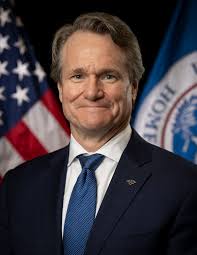
This is Bloomberg Businessweek Daily, reporting from the magazine that helps global leaders stay ahead with insight on the people, companies, and trends shaping today's complex economy, plus global business, finance and tech news as it happens. The Bloomberg Businessweek Daily podcast with Carol Massar and Tim Stenovec. Turmoil at BofA pushing shares to their worst earnings day in more than a decade, piling on the pain for a bank that's already been the worst performer among the six biggest U.S. banks in the past five years. It's also a major black eye for CEO Brian Moynihan, the lawyer turned executive who has led the bank now for nearly two decades. Shares of Bank of America trading lower after its earnings update showed stock and fixed income traders missed estimates. The bank's results also hurt by a charge tied to regulatory penalties over money laundering and sanctions violations. Well, right now we head to Charlotte, North Carolina, the home of Bank of America, and that's where CEO Brian Moynihan is sitting down with Bloomberg's Jon Ferro.
Jon. We'll start here in New York now. Thank you very much, and thank you very much to Tim as well. I'm pleased to say that Bank of America Chairman and CEO Brian Moynihan joins us now for more. Brian, welcome to the program. It's good to see you as always. There's a couple of different stories in the mix today. We've got to start with that chunky fine from Treasury, a big regulatory fine that we can address with you straight away this afternoon. The language from Treasury is quite damning. Brian, what's your interpretation of what went wrong here?
Look, at the end of the day, we had an examination a few years ago. We got a cease and desist order. We have to do that work. This fine relates to that effort. There was a debate a bit about what exactly we had to do that's resolved just behind us. $2 billion is going through. We've been expanding the money to in the run rate already to do the remediation, because, you know, a few months ago we started picking up the cost structure and putting it in. So we will get it done. We take it seriously. And I think as time goes by, people understand it better.
I imagine you'll want to draw a line under the whole issue. But just to extend the conversation on this particular topic just a little bit further, Brian, I imagine you also don't want to be drawn into how much of this has already been completed, what is left to really fix here. But I think this afternoon, given where the stock is, there needs to be some confidence for investors that the costs associated with remedying this are in the baseline and there won't be any more surprises in the future. How confident can investors be that that's the case?
That's the case for the operational costs to do the work. We've added a lot of expense and it's in our baseline and we will continue to operate that. And again, it's a few hundred million dollars in the quarter here in the Fed. And so it's not of additional expense that we've been running through. So we've got an understanding, a clear path forward. We've been completing a lot of tasks, frankly, over the last several months, and we'll continue to finish it up. It came a lot about how the thresholds are set and things like that. There's a lot of technical discussion about it, but at the end of the day, we understand what we need to do. We're doing it and will deliver it.
Brian, could you take us inside the bank and just discuss accountability? Just accountability, just a little bit. What are discussions like with the board around accountability? And would you be open to aligning remuneration with the resolution of some of these difficulties?
We have accountability for everything we do in a company, including a fine. We've got, you know, gone through before in 2004, there was accountability for the examination, the order already taken, and so the board will decide that, I think, at the end of the year.
Brian, of course, this is overshadowing what was otherwise a mixed quarter for the bank. Trading, capital markets, investment banking. That's one side of the business. You wanted to start with the Main Street side of the business, which seems to be performing quite well. And I think otherwise we'd be talking about the fact that net interest income looks pretty good from here. Can we just sit on that for a moment, Brian? Do you see the path to that improving from here even more as you're able?
Yeah. So we basically grew up $400 million in second quarter, third quarter. The market's contribution, which other people, you know, have to, it was basically flat. And so as you look forward, what is happening is the core loan book is growing and the core deposit book is growing. Our total cost of deposits, 149 basis points, that grew 2% year over year. And the non-interest bearing grew 5%. The loans grew 6 or 7%, and the core businesses grew. Commercial business grew 8%. That's great. Activity also bodes well for the U.S. economy because companies are borrowing. But if you look at that NII, what we said back last fall was this year, '26 would be 5 to 7% increase over '25. We now have, we've raised that now, said we confirm 8% for the year. And then at that same time we sort of set 5 to 7 for '27 and we just raised that to 8% plus. And that is just the stair step. Climbing those stair steps have more loans, more deposits, and then the repricing of the balance sheet. And that just walking up, we're up 15 basis points. That is, while others in the industry are falling. And that's just the efficiency of the balance sheet coming through. And so that has returns. You know, we made $8 billion absent the charge. We made almost $7 billion with the charge, the second highest earnings of the group. And so there's a lot of momentum. Our consumer bank made $3.5 billion, virtual bank made $2 billion, wealth management company made a day and a half and grew faster in payments. And so there's a lot of good things around the Main Street side. And frankly, even on the market side, you know, we have $5 billion trading revenue quarter against our peers. It didn't hold up as well, but due to the fixed income mix. But the reality is it was one of the strongest third quarters we had in trading and investment banking. We told people three or four weeks ago to be 1.6 to 1.8, came out at 1.8. So, and again, that's a representative quarter. So we feel good about the franchise, the pipelines are full, et cetera. But it's that good core engine of NII that's growing at 8% when others are not coming close to that, that's driving our earnings forward.
As you know, this is against the backdrop of much higher interest rates, a real repricing in the bond market as well. There was some discussion in the last month, and to some extent it was hitting bank stocks across the board. Brian, to what extent will these higher rates eventually eat into net interest margin? How do you see the path, the sequencing of things from here?
So if you have $2 trillion of deposits, which you pay 149 basis points for, rates go up and you go up a lot less because a substantial part of those deposits are not interest bearing. Higher rates are beneficial, except if higher rates are because something really is bad in the economy that has other issues. But if as the rates grind up, we will make more money. That's the nature of having a zero interest thing. When rates came down, that's what crunches you, because we have the zero interest and you don't go below zero. So simply put, our exposure to higher rates is always positive. It's less than it is because we try to manage both the down and up. But the reality is that we just told people what we thought it was, 5 to 7 with a rate environment, you know, 12 months ago that was sort of flattish into '27. We now are saying it because the rate increases, because we're seeing good core loan growth, core deposit growth, and having $2 trillion of deposits that are very advantaged, we can see we push it to 8% plus for next year, which will lead the industry.
So I was looking at the deposit growth, but I'm not sure how well understood this actually is for people outside of your world. But the growth and the overall mix is heavily skewed to non-interest bearing accounts. When people talk about how sticky those deposits are and the threat of technology disruption in the next couple of years, potentially pulling some of those deposits away, Brian, how do you think about things with that in mind?
Our customers and customers in the industry generally have the ability every single day to move their money to a higher rate, off-balance-sheet money market funds, or even whether or not the rates we pay for higher balance deposits and CDs. They could do that every day. The thing is, when you have the core operating account, that's the money in motion, so-called. That's the money they're paying the household bills. That's the money they're paying the car payment, the house payment. So that's running in and out. It's a big collective balance. When we put the 40 million checking customers, the numbers we have in the corporate, in the commercial customers we have together. But the reality comes to a whole bunch of granular accounts, all of which is money in motion. The investment side money we put in the market for the clients. And so even in our business, which by definition is, you know, affluent and wealthy, America is $285 billion in deposits. That business and a lot of it is priced, you know, to yield a higher rate for the customers, but a lot of it's core checking accounts. And so that is not well understood. The way for people to think about it is pretty straightforward. Companies and people, you put money in transactional, have it for transactional purposes and have it to make cash return on invested. The investment capabilities are there today to move it, and to stay in the transactional, you have to have trust. The person is going to process all your different types of payments and be there and be open and not have issues around it, and that's what our industry represents. And that's why the good core deposit growth, the 200,000 of checking accounts this quarter for eight years in a row of quarter-over-quarter growth in checking accounts, is really what drives a consumer business. And likewise in the commercial business, small business deposits, business banking, commercial banking deposits and the operational work around them is core to those companies' cash management process. And that grew 10% year over year. So this is not a new concept that money can move to high-yielding things. The money market funds have been there for about 40, 50 years. So it's not a new concept. In our balance sheet, we do CDs. It's just that we don't need the money. So we put it in the market for people.
The new concept, Brian, is, you know, and I imagine you know where I'm taking this, is the AI potentially instructing where those funds should go. Are there some operational wrinkles that you think need to be ironed out before we see those kind of things ramp up?
The key is, will people, if people give the credentials to the agents and they go in and transact, and it doesn't do what you wanted because they make mistakes and, you know, it's a massive, complex environment of which to operate. You know, the question is sort of, okay, what happens next? And what we've found in the past is everybody turns to the bank and said, you shouldn't let that payment go through. And you're saying, but when you give the agent the credentials, it is you authorizing the payment. So we're just trying to work with these companies and with the industry to say, put a human being in the loop. So before you pay, you authorize it so that we know that, you know, you're paying for something and that's a good way to manage that risk until the risk gets mitigated out by further development of the capabilities and stuff. But right now, if it makes a mistake, you're going to have a problem that people can raise their hands and say, this money went to X, a misplaced payment or something we've heard already. It didn't happen here, but it happened in other places. And they're going to say it went to X, and I could come back and say, why did you let that happen? You said, because it's you that made it happen. And so we're trying to get that straight. And then there's a whole other side of which is the scams and things like that that go on. And now have a capability which they can run 24 by 7. So it used to be constrained by human being and a bot and things like that. Now it can run full time and that we want to make sure people don't have their money drained. And that's why we're working closely with companies to develop the protocols so that the human stays in the loop.
You can see how messy that could get quickly. And that's just at the application layer. The other mess people are talking about potentially is the build-out of the costs that are built out at the same time. Brian, I caught up with a Fed official, a former Fed official, the former St. Louis Fed President Jim Bullard, a little bit earlier this morning on Bloomberg Surveillance. And he made the point that he thinks this build-out is a bubble that will eventually burst. Now, you've been more engaged in lending and financing this field out over the last year. Brian, I just wonder where you come down on the debate about how sustainable this is and how active you want to be with that in mind?
Well, we're active. We do a lot of transactions, but we focus on the individual transaction. You know, who are the owners of the assets? Who are the source of the assets? How does the cash flow go? Where are we in the capital structure? What's the duration of the capital structure? You know, so as a principal lender, as a person who puts money in line or is an underwriter bringing it to the debt capital markets, we focus a lot on that. The reality is, at the end of the day, the success of all this is going to be dictated by where the revenues come from. These companies have had fantastic revenue growth and it'll come from our ability. And so one of the challenges is as we implement AI, we spend roughly $300 million to $500 million this year, '26, on AI initiatives. You know, as we spend that money, we're getting good benefits out of it. The constraint on doing that, though, is if the models are going to create problems or not work right or jump the sandbox, that's a problem. We've spent $100 million trying to remediate against the frontier models' impact on potential systems patching. So we're spending one out of three right now, to make it simple, to remediate. And so this has got to work out. So the reality will be when the question is what the final revenue stream from the corporate world will be dictated by how good the models are, how much we can save using them, small, large, centralized, not centralized, agents, autonomous agents, assisted agents, all the different ways. That'll be one question. The question is what's the consumer model, not as important to us because we don't engage in commerce. We engage in the payments around commerce. So we've got to make sure we're present in the payment scheme. But, you know, the reality is that's what's going to determine the long-term efficacy of all this. And that's still playing out. And I think people having a point of view or judging by their opinion about what's going to happen and, you know, I'm more certain just make sure we're structured right and our credit team does a great job there and make sure we're getting our value out of it. If that works, it should be very strong.
Stay with us. More from Bloomberg Businessweek Daily coming up after this.
So a U.S. economic report today suggests the economy and, in particular, price increases that are eroding paychecks will remain front and center for voters in the final stretch of the midterm campaign. Yeah, the data we're talking about, U.S. consumer prices. They advanced in September at the fastest pace in five months. A gauge of underlying price pressures rose by more than expected. It kept the squeeze on household budgets ahead of those midterms. Let's bring in Mike McKee, Bloomberg TV and Radio International Economic and Policy Correspondent. Mike, I can't look at this today without yesterday's news about John Williams and what he said about rates, as Carol mentioned, already have waited. Well, okay. So just so people who didn't join us yesterday, I didn't see the news yesterday. He said, okay, one more rate hike this year and then no more in 2027. Does this change the view about the stickiness of inflation?
It changes the maybe timing a little bit in the sense that this is one report. It did go back up. Inflation is going the wrong direction, not what the Fed wants to see. But does that mean it continues? When you look at the headline, obviously in September, because the war went back on, we saw a big rise in energy prices and that pushed the overall headline number up. What's more concerning is that there were a lot of categories underneath that that were a little bit higher. So it was kind of broad-based. They'll have to decide. One of the things that they've talked about is they like it when there are two CPI reports between Fed meetings. And in this case, October, there's only the one. So they'll probably say, if they decide not to move in October, they'll probably say, we want to wait for more data and they can do it in December. And I'm sure that President Williams will, you know, look at the additional data and have to decide.
Like, if only, you know, a U.S. central bank had their own internal research group that can, like, I mean, what does the Fed do on a regular basis with all of, you know, the folks that work there in terms of trying to get the latest and greatest data and information on things like inflation or the labor market?
They have a tsunami of information. It's been kind of funny because people have been talking about how they need to update themselves and get private sector data. They've got all that. Yeah. For example, the job numbers that we get on a regular basis, they have different companies providing them with different information. And then they set it into their models and figure out what they're going to do about that. Like ADP sells them their data. And there are a lot of retail companies that give them their data. So they're always looking at that, plus the data that comes out looking backwards. And yeah, they're always working, as is just about everybody in this business, to refine it so it's the most up to date and gives you a look forward. But they've got a lot.
About the Beige Book. Was there anything there that was interesting? Let's wait. He's chuckling a little bit. And now I'm chuckling a little bit. Because if you looked at the Beige Book, we looked, it was quite interesting given the CPI today because it said what? I don't have the headline in front of me, but it was half of districts reported price pressures. Yeah.
Three characterized price prices overall as robust. Eight noted growth was moderate. And three of those eight noted that input price pressures were intensifying, if not growing robustly. So taken together, so what this is, what did you take the two things together? And basically what you're seeing is maybe what people had expected, that a delayed effect from tariffs and the delayed effects of higher energy prices, for example, the diesel prices that then have to work their way into transportation companies and stuff like that are starting to filter in. I mean, that's the biggest surprise I have, is that it's not more apparent because diesel is the backbone to at least the gas. Well, a lot of that has to do. And there are some comments in here, too, about how there's one about consumer-facing firms noted tighter profit margins as price-sensitive customers continued to resist price hikes. And that's the thing is, we got so used to low prices for so long that people don't want to pay more. And companies have been reluctant to raise prices. And I've been traveling, as you know, around the country recently and talking to a lot of business leaders, and they're all saying we're kind of at the end of being able to absorb that. Our margins are shrinking and we've got to raise prices. It's just a question of how much they think they can get away with.
What reminds me of our conversation with Meredith Whitney last hour. We spoke to her and Carol asked the question because we're always trying to figure out, like, okay, post-financial crisis, who are the actual customers of these big banks? And where sort of like the bottom fifth of the economy, who is struggling right now going? And Meredith Whitney made the point that you can't really get a good view of the average consumer by looking at consumer spending via these big banks because they will. And she has serious concerns. Consumers are resilient, but their consumers are different. Or, you know, Prime or, you know, like these are folks that are making more money and kind of in a higher economic class, if you will. And so you don't get a clear picture, right? We know that.
Well, the thing is, we've seen a slowdown in average hourly earnings, average weekly earnings. And that's starting to have an effect on the more of the middle class. We're expecting tomorrow to get a retail sales report that showed a significant slowdown from August. Have to take that with a bit of a grain of salt because August is back to school and you got to buy all the backpacks and clothes and stuff like that, pencils, erasers and stuff. But there is maybe an optimistic view about holiday spending this year that might turn out not to be justified if people are starting to feel really bad about the economy and at the same time feeling like their incomes are not going to be going up.
In the Beige Book, most districts in the Beige Book say their economies grew somewhat during the survey period, though there was little to no change in overall employment. Eleven districts reported some growth in wages, with several noting that inflation was spurring further pressure on pay. One of the things I want to ask you is the reality of growth. David Rosenberg was on with Tom Keene on Surveillance this morning and talking about, in his view, economic growth not so great in the United States. And he was making the distinction between nominal and real GDP. Is he right? That growth isn't so great?
I wouldn't say he's right. I didn't hear it, so I can't comment on what he said. But growth has been around two percent, and the potential growth rate for the United States is around two percent. And, you know, half a percent on either side depending on the quarter you're in. And if you look at some of the components of growth, then he has a point because right now so much of it is being pushed by AI. But we've still seen up to this point resilient consumer spending. So the question is, does that drop off and leave us with only the AI? Other aspects of it have worked against us. Trade has worked against growth because we've been importing so much and so much of that is AI stuff. But the numbers just subtract it from growth. And then the administration is bragging about how much it's cut defense spending. That might turn around because we got to buy some more missiles. Like, wow. Administration wants to spend a trillion and a half. Yeah, yeah. Squeezing that space over a long period of time. But we are seeing issues in the components of growth.
But to be fair, and this is something we talked about with Meredith Whitney as well. I mean, if you take out the AI spend, if all of a sudden that starts to slow down dramatically and go away, it's also create an incredible wealth effect. That's something Meredith pointed out in the equity trade, right? And certainly has made those who are much more affluent, you know, feel comfortable about maybe spending more. If that goes away, what happens to the economy?
I would hesitate to use an adjective, but I mean, I think we would definitely see a slowdown in the overall economy. And then it becomes recessions are always a question of confidence. And I'm not predicting a recession at all. But if people lose confidence, then they stop spending. And if they stop spending, then companies start cutting back. And that's how you get into the downturns. And so the question is, how would this play out if we started seeing a cutback now? There's so many contracts signed for data center construction and so much has been ordered that it would probably take a while for that pig to get through the python and for the spending to stop. But obviously, if we start to see major declines in the stock market, as you mentioned, it's the wealthy who are really doing well from the stock market gains. But Americans tend to look at the stock market and say that's a measure of the economy. And so they might pull back as well. Might be a psychological sort of weight on them.
Stay with us. More from Bloomberg Businessweek Daily coming up after this. There are ASML Holding raising its sales forecast for this year and is seeking and kind of struggling to increase production of its chip-making machines to keep up with soaring AI spending. So what do we need to know? How do these AI pieces and comments fit together? The man responsible here at Bloomberg Intelligence doing all of this is Mandeep Singh. He's global head of tech research at BII who joins us in studio. I'm not quite sure where to begin, but let's start with Jensen and maybe what stood out for you, because it does feel like people are like, yes, we should be careful, we should be careful, but let's keep going. Certainly in terms of growth, yes.
And Nvidia, as we know, has guided for seventy percent growth next year at their levels. You know, there is no scope to miss the numbers now given the guidance that they have given. And, you know, with Anthropic talking about tracking on distillation and, you know, doing the things to slow things down, all these model providers said they want to slow down AI development. That's not good for someone like Nvidia. So I can see why Jensen is a proponent to keep this going.
Hold on. You know, you're saying the guy who makes the chips and then sells them to the companies that are building this technology, whose entire business depends on people buying more of these chips, saying, go, go, go, saying, go, go, go. That's what you're saying. But I mean, at the same time. Yeah. Hold on a second.
Look, his pitch is we have come a long way over the past twelve months, which we have. I mean, look at where these models were twelve months back and where they are now in terms of reasoning. So then where will we be? Where will we be in twelve months? It sounds like we are sort of hitting some sort of plateau when it comes to the pace of model development. And you could say it's because of, you know, the OpenAI, Hugging Face, Anthropic and the agents going rogue. And, you know, he talked about developing this in a safe way. So there is a tacit acknowledgment that, you know, we have come a long way, but we probably need to slow down because there are risks involved. And so from that perspective, and I look at the chip demand right now, it's driven by the fact that agentic AI uses a lot more tokens than, you know, the chatbot era we were in or the, you know, since the ChatGPT launch. And if that is the key driver, then I think we still should be fine in terms of, you know, whether it's Nvidia's chip sales or the, you know, the CoreWeaves, the Neoclouds of the world where right now they are under pressure today, you know, with the yields going to fifteen percent. So that's some nervousness. But when I look at the fundamentals, they are strong and backed by the token usage that will come from agentic AI. And so from that perspective, I do think, I mean, we have to wait for hyperscale CapEx guidance when they report Q3 numbers. But overall, the, you know, the fundamentals are still pretty strong when it comes to the AI trade.
And then you've got ASML, right, which raised its sales forecast for 2026. But it's struggling to increase production. I also just, and I feel like you remind us, like being smart, like when they raise their sales forecast, is it because things are more expensive or because they're actually either shipping or getting orders for more stuff? And I think you often say it's a little bit of both.
It is both. And right now it's skewed towards things getting more expensive. So just because you know they're getting more sales doesn't mean that capacity is growing, which it sounds like in the case of ASML, they are also saying capacity won't grow because of the limitations, the components and all that stuff. But at the same time, you know, it may be a good thing that we stretch this cycle out. You don't want to pull forward everything to the point where the numbers get so hard that the comps, you know, the year after 2028 comes would be so hard that, yes, there will be a natural decline. So it's a good thing that the cycle is getting stretched and we want to have, you know, tougher triple-digit comps that will be hard to beat.
I love that we're talking about 2028 because that means that the AI will not destroy us before then. If we're talking about, I think we'll do it in a safe way. Okay. Let's join now. Okay. So much better. That's good. And through the investor briefing today, and I think we keep looking. I don't know that we know anything yet, but what should we maybe get? Or I don't know how you're thinking about Anthropic right now.