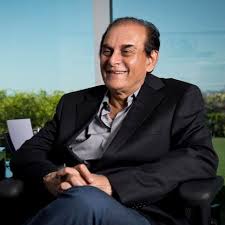
So, first of all, thank you very much for calling me here to speak at this event. This is my first visit to Flame. I come to the Oxford Golf Club all the time, at least two to three times a year. And I always see this Flame board outside, and today I could see what Flame is all about. I had a short tour also, some parts of the campus, but very, very impressive. And I'm sure all of you enjoyed spending time here. And I would like to start by complimenting the donors, the governing body, and of course the faculty for making Flame happen.
Having said that, let me talk a little bit about my own story and what could be the learnings for the graduates. From my learnings, I am just a commerce graduate. I was in college with one of the governing founders, Vallabh Bhansali, and then he asked me to speak here. So, I couldn't say no to him. I stay in Bombay, so it was not so bad, and now the roads are also a little faster. But at that time, I'm coming from a business family, but we had a small business, and I wanted to study further. I was not that bright to get into an MBA school. My father said I wanted to go abroad for doing my MBA. And my father said, 'No, you're not going.' See, those days, we were far more obedient than today's kids. And I agreed to what my father said, 'That's okay, why don't you join the family business?'
So, at a very young age of 20, I joined at that time Bombay Oil Industries, which was a typically family-managed organization, located in the heart of commodity markets in Masjid Bunder in Bombay. And I was the first person from the next generation to join the business. So, my father being the eldest of three brothers, and it was typically family managed organization where the family was doing everything. We had, of course, factories where it was manned by some technocrats and family friends and relatives, but most of the decisions were taken by the family. So, here my father let me loose. There were no professionals to train me or guide me. And if I look back at my journey, nobody has guided me from the top. But, when you have that inner desire to succeed, and that's what I want to tell all of you that all of you have to have that inner desire to succeed in whatever you're doing. You will find your own answers. I had to find my own answers by contacting thought leaders, reading, whatever else, but the key thing was that inner desire was there for me to succeed.
One thing I was sure that I am going to be in business. I am not going to work for anybody else. And I mean, that's what I — maybe born in a business family, that's what is maybe genetically ingrained. But as I started moving around different businesses in the company, I realized that the edible oil business, which was mainly selling edible oils in bulk and selling it to industries, was not a profitable business. It was a very low margin commodity value-added business. So, I said, 'Okay, can we convert that business into a branded business?' Branded business would become bigger with India prospering. It'll be far more stable as a business. It'll be far more profitable. So, I remember in those days, I'm talking 50 years back, I started traveling into interior markets. My first trip started from Nagpur and I covered all the villages and small towns from Nagpur to Jalgaon. I had recruited by then a sole sales supervisor and we had these two brands, Parachute and Saffola. I have done basics like appointing distributors. In those places at that time, there were no hotels, no good hotels, so I have stayed with distributors at their houses. And did all retailing in terms of selling it to the retailers. What I'm trying to say is that when you want to learn, you have to actually — don't worry about who you are, but you have to go to the brass tacks and how sales are happening. After that, the brand's getting popular. So, we said we had to advertise, but I don't know anything about advertising, so we appointed an ad agency and my first request for them was that please I want to spend one week in your ad agency. Teach me how advertising is created. So, in a way my journey has been very much bottoms up and learning from those basic steps to understand the business.
See, in a way this business was suited to me. And I'm saying that each of us has some God-given gifts. There is not a single human being on this earth who doesn't have that gift. But many of us don't know what that God-given gift is. So, my suggestion to all of you is that please sit down with your parents, with your friends, with your relatives or those whom you know and try and determine what are God-given gifts because if you base your future on your strengths, on your God-given gifts, then you will enjoy the journey. You know, I don't like this work-life balance. You know, to me work has to be enjoyable. If your work is enjoyable, there is nothing like work-life balance. Of course, I don't believe in making people work for 70 or 90 hours a week, but you have to enjoy your work. I think if you enjoy your work, you will not have issues of work-life balance.
So, as the business grew, we reached — over a period of 5 years, we built an all India distribution network. And then, our market share was stagnating. So, we said, 'What can we do to improve our market share?' And we said that coconut oil market and edible oil everything is packed in tins. Can we convert that market into plastics? Plastics is cheaper than tins. It's relatively more attractive. It's convenient to use. So, we thought we had a winner on our hands. But then, normally in any consumer business or any business, you do what we call consumer insight. You go before the idea is implemented, you try and find out from the customers, potential customers, consumers, what they think about this idea. So, we went to the consumers and they felt it was a great idea. And then, we went to the trade, which is our products at that time and still today are being sold through retailers and wholesalers, but they rejected it. They said that this will not succeed because apparently 10 years prior to our launching plastics, somebody else, some other player in coconut oil had launched plastics in a square-shaped bottle, and lot of oil on the outer surface of the bottle. So, when the retailers closed the shop and opened the shop next morning, the rats had eaten away all the coconut oil bottles, and not only the product was damaged but the shop also was damaged. So, there was huge no from the trade. Now, how do you reach the consumer? Those days there was no e-commerce or q-commerce. So, we had a big problem.
But as entrepreneurs and as human beings, we don't give up. I don't believe in giving up so easily if you think that you have a good idea. So, we went back to the drawing board. We went to the packaging vendor, told them that can you design a bottle which is difficult for the rat to bite. So, that's how the round shape bottle of Parachute came in. And then we went to the factory and told them that can you ensure that not a single drop of oil is on the outer surface of the bottle? So, that they did. But then we had to be sure that there is no rat biting. So, we actually took a few bottles, got a few rats, put them in a rat cage for a day and nothing happened. So, we were so confident that we have a winner on our hands now. So, the learning from this is don't give up easily and multiple examples I can give that you should not give up easily if you have something good going. Because each person will have setbacks and if you just accept the setback and give it up, then you lost that opportunity. So, the world is great. You have to combine passion with perseverance and determination and that's how you get great. So, grit is very, very important in each individual's life.
The business grew and we went public in 1996. Hindustan Unilever, which I'm sure all of you have heard of, they acquired Tata Oil Mill companies and they also acquired one more brand in coconut oil. So, they wanted to scare us first. So, they started spreading the word in the capital market among the analysts saying that we are going to acquire Marico. So, a lot of fear happening within the organization that how can Marico survive such a large — much bigger at that time they were almost eight to 10 times bigger than us, much better distribution network, more resources in terms of ad spends. So, a lot of bankers approached me that please sell out otherwise you will not be able to meet this competitor threat. And I don't know why I thought that I was very, shall I say, stubborn. We thought that we'd build a good business and we can't just sell it. I am not enamored by money. I'm very proud of the fact that we built an Indian brand. And why should we sell out to a multinational? Somebody suggested why don't you meet Karsanbhai Patel who at that time was fighting in the detergent category through their brand Nirma with Wheel. And I met him. I went to Ahmedabad, met him and he said that don't sell, you know, you'll be able to take them on. So, I got a lot of courage from my own team as well as through external inquiries and we realized that for Marico it was what you call a resource generating engine. It was the most important part of the business, most profitable. And it was getting attention from the top starting from me to my top team. But if we sold or if a Lever was managing some other coconut oil brand, it will be managed by somebody three levels lower and our ability to take them on will be better. So, we took steps to improve our distribution network, to improve the quality of the product. In advertising what we did was we actually put an emotional twist to our brand. This coconut is a very auspicious fruit. And when you are getting married or when you enter a house, you break a coconut. So, our campaign was bringing the auspiciousness of coconut and associating with the brand Parachute. So, that really succeeded.
And Levers at one stage — before — the chairman of Levers whom I had never met, he calls me up one day in the evening and tells me, 'Mr. Mariwala, I'm giving you a last chance. Please sell out, otherwise you are history. If you sell out, all your future generations will be taken care of financially.' But as I said, I was very determined not to sell out. So, I said, 'No, Mr. Dadi, I will not sell out.' And then the battle began. Being a public company, the market thought that I was crazy not to sell out and we will not be able to take them on. So, our price to earning multiple when we went public was something like 13 or 14. It fell to seven. We gave guidance to the market saying that for next 2-3 years don't expect any profit growth from us. So, they launched once, they launched twice. They got some market share. They got in their own Nihar brand. Their market share went up from 6-7% to 12%. Now, Nihar is a brand which is strong in the east and north part of India. At some stage when they couldn't increase their market share, our market share didn't fall at all. They took market share from some smaller players. So, at some stage they started losing interest in the category. And at that time Hindustan Unilever was getting more Unileverized in terms of what Unilever the headquarters was saying, 'This is not a global category for Unilever.' So, their market share started falling.
And it fell from 12% to something like 7-8%. And by then the leadership had changed and I used to play golf with at that time the chairman of Hindustan Lever. And I would tell him that why don't you sell this brand to us? You are not doing anything. It took me two to three years of persistent efforts to convince them that they should sell off. I thought that they would come to me and say buy the brand. But they were smarter. They put the brand for auction amongst all the players interested. So, all the Indian FMCG companies starting with us to Dabur, to Emami, to Godrej, all of them were bidding for this brand. We were very clear that we have to buy this brand. It's a very good strategic fit for us because it's stronger in the east. If it went into some other hands like Dabur, we'll have increased competition. So, we went all the way in terms of our valuation. And the management was told that okay, go to the extent that you should not lose this deal. So, we went all the way. And we were way ahead of other bidders. And because of that, normally if there is a very small difference, the seller again calls for re-bidding. Because we were way ahead, they sold the brand to us. So, from selling to a multinational, we acquired their brand and that was a huge source of happiness, satisfaction for the organization.
So, today that brand, we bought it at that time in the year 2002. It has done well. It has been our best acquisition. I mean, we have made so many acquisitions. We made some 25 acquisitions. I strongly believe in growth. And one way to grow is through inorganic as well as organic growth. So, today the brand, if I had to sell from 200 crores, I can easily sell for 5 to 7,000 crores. So, it's been a great acquisition.
So, I think I'll talk about growth. I think it's very important for organizations to grow, individuals to grow. But, there has to be a growth mindset. I think organizations realize that growth is like oxygen for any company. There's no growth, people will start losing interest, whether your employees or associates or promoters. But, growth has to be profitable. And you can grow in different ways. We can increase market share. When you become market leader, then increase market size. You can acquire, you can do geographical distribution. In our case, we will launch newer brands. And of late, we have seen the emergence of D2C brands. And all of you must have been aware of D2C brands being young. We are the most aggressive D2C acquirer in the FMCG segment. We have acquired seven brands in the last 3 years. And that has really given us a new growth engine to grow. So, I'm saying growth mindset and I think everybody has to go on trying to grow.
Innovation plays a very very important role in any organization's journey. So, how do you create an innovative culture? You want people who are young, who are diverse, who are continuously looking at new ways to improve. And then, you have to encourage people to experiment. The biggest deterrent to innovation is lack of experimentation, which is led by fear of failure. So, my suggestion to you is, please take risks in future. You will not succeed every time. You will fail, but it's okay to fail. Because unless you fail, you'll not learn. So, they say sometimes you win, sometimes you lose. I say sometimes you win, but even if you fail, you always learn. So, failure is a great route to learning. And if I look back at my own failure, I must have had 20-30 failures. And I'll just give you one example of a failure. About 15 years back, we saw an opportunity for launching snacks in a baked form. There were no baked snacks at that time under the brand name Saffola. Now, Saffola is good for health. So, we said it's a great fit, low in calories. But the mistake our brand team did was health was given priority over taste. Now, in a snack category, you want to have a snack with your tea once you come home with a drink. People wanted taste first. So, the concept was very good, but wrongly executed in terms of prioritizing health over taste. We had to withdraw the product.
But the learning I want to say — a few years later, when we launched oats, so Saffola oats, plain oats, we launched against Quaker, Kellogg's. We got some market share because of the brand name distribution, about 15% market share. But then we were stagnating. And then we do believe a lot in the consumer insight. And we went to the consumer and we said — consumer said that Indian consumers wanted savory breakfast. So, then we said that's a great opportunity. We should actually profile the taste of each and every state because each state in India has a different taste profile. So, we went on an aggressive way to find out what are the taste preferences for each state. And then we launched our masala oats. And it has been a huge success. Our market share in masala oats today is 80%. It's a new category which is in the last few years grown to about 400 crores. And because of that, our market share in plain oats also has gone up and we have become market leaders in the oats category because of this innovation and partly because of the failure we had earlier. So, don't be afraid to fail.
So, as I come to the end of my talk, I just want to talk about a few things. I think very quickly I've covered most of it. Leverage your strengths. Identify your strengths. Leverage your strengths and base your future on your strengths. Second is nobody in the world knows where the world is going. We didn't know what a D2C brand is going to go. You have to be so agile and you have to go on pivoting yourself in your own journey in future. Don't be fixated saying that okay, I will do only this all my life. My vision has changed over a period of time dramatically, but broadly in FMCG segment, broadly in beauty and wellness. So, the broad contours are there, but within that it's gone on changing. So, don't be fixated on having a long-term vision. Environment is changing. You'll have to go on pivoting and go on fine-tuning your vision over a period of time. I think Professor has said something about failure and I think success is far more difficult to handle than failure because it goes to your head and that should not happen to you. I talked about grit. I am a big believer in focus. Do a few things, but do them well. Even if you look at sportsmen, leading sportsmen, they have given all their life to being better in that sport. And they have ignored a lot of other things. So, you have to sacrifice a lot if you really want to be a champion.
Let me end by saying that at the end of it, you know, there was a speaker at an event, large event like this, and he asked the audience, 'What are the two most important days in your life?' And he got a lot of answers. The day I was born, the day I got married, the day I became a graduate, the day I got my first job. So, he said, 'Well, the first answer is right, the day you were born. But, the second answer is not right. The second answer is the day you realize why you were born is the most important day in your life.' So, I think each of us is born with a certain purpose to give something back. And you have to determine what your purpose is. It can go on shifting that purpose. It can be as simple as loving your spouse or loving your children, or it can be I want to be a great entrepreneur, or I want to add something back to the society. But, I think purpose is very important. Because the purpose of life is a life of purpose. Thank you.