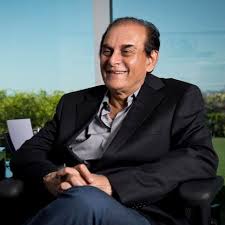
Good morning to all of you. Good morning. So happy to be here on a Sunday morning, early morning. And I said I'll deviate from the dress code, not wear a jacket. So I'm a very informal person. So in our office also, we have an informal kind of culture where people can come dressed in jeans, t-shirt every day. We are not into B2B selling or anything like that, so we don't need to create impressions to other clients because we ultimately sell our products to the households through our distribution channels. So everybody comes in informally. And also in the organization, it's very open, very informal. Everybody calls me by first name. There are no organizational boundaries, hierarchies. If anybody wants to talk to any other function, they can just contact them directly rather than going through an organizational route. And I think the whole objective is to create a high degree of openness.
So I was just asking, is there a functional bias in this group? And I was told that it comprises of all the functions. Is that right? Yeah. So maybe I'll talk a little bit about what is required to succeed in business based on my experiences. And after that, I'll go into culture building, how do you create a culture of innovation. And then I'll talk a little bit about CXOs and what role can they play and what should they be doing. So I think, is that okay? Yeah.
So I started my journey at a very young age, and I'm not an MBA. I'm just a commerce graduate. But because I had not studied, I had the desire to learn. And as the business grew from virtually scratch, and we needed to employ good talent, MBAs, chartered accounts, all the more reason for me to improve my basic competencies in managing a business. I was not that bright to get into a management school, but anyway, that's worked out well for me. Because of the fact that I was not able to get into that school, I made extra effort to learn, and that effort still continues. I think what I wanted to say is that learning is a lifelong journey, and there is no end to it. Whether you're doing a role or not doing a role, if you stop learning, then you become a fossil. So it's very important that you go on learning. And in the initial phases, I started learning from my own people who are working for me, and I still do that. I think a lot of learning comes from talent within the organization. But you have to be open to learn. If you say that I'm superior compared to others, then they will stop telling you. So I think it's very important to create that environment where one can learn. I have learned from workmen at the factory level also. If you show that you want to learn, you go on asking what is new, what is different, how can I improve, give me feedback, then you can go on learning all the time.
And many times, when it comes to giving feedback, people may say something to you. And I think there is a way of giving feedback and there is a way of accepting feedback. So when it comes to giving feedback, we believe in using 'I' language. So suppose if I have to say something to you, if I was you, I would do something like that. So you take the onus on you rather than saying you should do like that. It's just a one-word twist, but it has a big impact. So the word 'I' plays a very important role. And then you have to say something constructive. In feedback, you can't say you're useless or you're not good, that's criticizing. You want to critique, you want to say how can you improve. So there's again a difference between criticizing and critiquing. So I think that's how feedback should be given. And on the other side, if you're giving me feedback and if I ignore that feedback or just take it very lightly and I'm not interested, then you will stop giving me feedback. So even though I may not be agreeing with your feedback, if I tell you that thank you for giving me feedback, I don't agree for these reasons, but you continue to give me feedback, you'll come back to me again. If I ignore you, you will say forget it, he's not interested in my views, so I'm going to stop giving feedback. So it's very important how to give feedback, how to receive feedback, what should be the reaction.
So I'll go back to my own journey in terms of building this business. And if I had to identify what worked for Marico, I would say that innovation has been the biggest reason for discontinuous growth. So when we were stagnating in our market share for Parachute, when we launched, we had 0% market share. Then we went to 15% because of distribution. And then we innovated in the area of packaging, and then we became market leaders, about 50% market share in a very large category. It's a very large category. It's like everybody uses coconut oil in India, at every age. So we sell something like, within India and outside India also, the biggest market outside India is Bangladesh, we sell something like 7 crore bottles every month. So all that happened because of innovation. And then we went on improving the brand, reinforcing the brand.
So the other area is where you pioneer a certain sector. For example, edible oil segment, we have pioneered the health premium edible oil under brand Saffola, and we kept it at that. So brands like Revive, Medical, which we acquired, so wherever we've innovated or pioneered, we've seen a discontinuous impact on our business. And if I look at the market share of all our products in wherever we are present in that particular segment, we are market leaders. So even in a shampoo, we are only present in say anti-lice shampoo, which is a small segment, but we are clear market leaders. So when you are a market leader in any segment, the impact because of economy of scale, because of ad spends compared to what you are getting in terms of your sales, is much better compared to all your competitors. And you get economy of scale. And then when a new competitor comes in, which could be a threat to you, the biggest impact is felt by the weaker brands, and not the stronger brands get least impacted. That's what we have seen. Or when it comes to leveraging with the trade, because you are a market leader, all the new channels also, whether it's a chemist or whether it's e-commerce or whether it's a quick commerce, they have to have your brand because it's demanded by so many people. So huge leverage in terms of the marketplace, in terms of cost structure, in terms of pricing power. If there is inflation, you can take the first price increase. And I think that has a discontinuous impact on your financial returns. So I've always believed that we should do something where we are leading, and that's what our journey has shown over a period of time.
So many people ask me, what should I be doing? And again, depending on the segment you are in, you have to find a differentiator. In our case, it was market leadership, it was innovation, it was pioneering initiatives. In some cases, it could be technology. In some cases, if you're a service industry, you need some discontinuous impact on your service or some other. You need to identify what will differentiate you in the marketplace and work on it. If you have a me-too product, it'll be very difficult for you to succeed if you're a late entrant. Because what are you doing? I mean, you are giving something to the final customer or consumer without any differentiation, and why would that person shift? Okay, you can use pricing as a power, but it's a matter of time, other players will copy you on pricing. Pricing advantage is not sustainable unless it is backed up by a change in your cost structure where your cost structure is fundamentally different than your competitors. If that is the case, and if it is difficult to copy that cost structure, then you can use pricing as a way to gain market share or to improve your financials. So I think that's what I believe, that's how one creates a right to win. And then one has to go on doing innovation on a perpetual basis. You can't say I've innovated once for a certain brand and I'm done, because it's a matter of time, others copy it. So any good initiatives in the marketplace are bound to be copied. So you always have to be two steps ahead of others in the area of whatever you're doing. There has to be continuous thrust on innovation. And I think that's where the role of top management comes in.
So in my first 15 years or so, I was mainly in Bombay Oil Industries, which was a company which was a family-managed company with different businesses. And I was able to advocate within the family to take this consumer products business into a different entity because it requires a different culture. Consumer products business, and every business requires a different culture. And culture has to be tied into your strategy and your social competitive advantage. Culture is not a standalone. They say culture eats strategy for breakfast and like that, but I think culture and strategy go hand in hand. So you need to decide what is the culture you require to succeed in your strategy. And I think that's when Marico was formed, I got an opportunity of defining the culture. It was based on my own internal beliefs in terms of how the company should be managed, what should the culture, what should be the values. And this happened in 1991. And I wrote down my thoughts, 15-20 random pages on terms of what should be the leadership style in the organization. I for one believe in participative leadership style where you involve people. Sometimes there is a feeling that it can lead to some delay because of consensus building, but for key organizational initiatives, consensus building is very critical because you don't want a situation in the areas which are very critical to the organization where the top management or the middle management doesn't buy into that. They have to buy in fully because then only they will be able to take it forward. If I finalize the values where some of my CXOs or middle management is not feeling a part of it, they will say these are MD's values or the owner's values, and they will just not take effort. Because ultimately, values, culture has a strong top-down kind of impact. And if some leadership in the middle and top doesn't take it seriously, you will not be able to create a strong culture.
So after writing those values, about 20-30 pages at that time, I shared that with my team. I didn't have any clue in terms of culture building, how to build a culture. So it was just an exploration. And then it evolved. Actually, I got very good positive feedback from my team, and they felt that, and I'm talking 30 years back, more than 30 years back, that a promoter who was thinking like this, I think is good. So we spent something like eight or 10 full days on that values document. And I think what it did was it got better structured. I had also some blind spots in terms of what should be included, what got changed, rectified. And at the end of that six to eight months of deliberations, we had a value document which had values described under three different pillars: people, products, and profits. And then we said that what next? Because this is only me and my immediate team, seven, eight people. How do we take it further? So we went to a management consultant and we said, how do we change the values into culture? And that's a big, big journey for any organization. So we involved CXOs at a function like this and one level lower, about 30-40 of them. And we said that these are the values started by me, improved by me and my team, and now we want your involvement. So it's not a top-down initiative. We want you to discuss these values in small groups of six, seven each, and come back to us and make a presentation where you agree, where you don't agree. So at the end of that two days, we had two things. One is all of them were involved, so involvement leads to commitment, and they were fully committed because they were involved in this journey and it was not a top-down kind of a thing that you have to do it. And more importantly, we also asked them, if these were the values, what are you seeing in the organization today? Where are the gaps? Where do we need to improve upon? So we had lots and lots of suggestions in terms of we need to do this, these are the values, then you create a culture. We had a whole host of suggestions.
And after that, what did we do? We actually went to all our corporate locations. We had sales offices in four regions, international business, our factories. I went personally to each and every location and talked about these values and why values are very, very critical. And again, involved them in terms of small groups making a presentation. So one full day spent in something like 14 locations each, and talking about the values and again identifying where are the gaps. So at the end of those deliberations, we had some, I don't know, 200, 300 suggestions to improve on our values and culture. And for the next two to three years, I would personally monitor that with my team every month in terms of prioritizing those values, what do we need to do, and just working on it regularly. So I think values, when practiced on a regular basis by the top and middle management, it leads to certain behaviors within the organization, and that's how you build a strong culture.
So what is our culture? Our culture is very open. I mentioned in my beginning that it's very open. You were going to a new office, so people could see each other, people can approach directly at whatever level, cross-functionally. If somebody wants to meet me, they can meet me directly, contact me directly, no need to go through my secretary and things like that. And then we had what we call relationship reviews, where every boss and the team would meet once in two years, go out to an external location, because in a day-to-day pressure kind of environment, you may not have the right environment to give feedback. So this is again helped by an external facilitator, just to bring that openness. That's what I like about you, what I don't like about you. And it is not only to me, but at a peer level also. So basically bonding and bringing in openness. And I've got some feedback which sometimes hits you very hard, but it's okay. If you want to create an open environment, you have to be ready to take that feedback. We have an open house in the organization every year at what we call organization communication exercise. We share a lot of information with all our members, including our workmen, in terms of what we are doing, what did we do well last year, what are our plans for next year, what is the competitive environment. And then there are awards, values awards, innovation awards. We have an open house which is one to one and a half hours where you have an option of asking questions openly to the management, or if you don't want to reveal your identity, you have some tricky question, you can write down and put it in a box without giving your name, and we'll address it. So basically you're overcoming the resistance to ask some awkward questions, and the management team has to answer. In the first few years, we used to get questions more about this facility not there, this pay compensation. Now most questions are about the strategy, what are we doing in the organization to win in the marketplace, things like that. So I think then when you tackle openness from different angles, you create an open culture.
The other thing is we said openness has to be combined with trust. So how do you create trust within the organization? So from 1991 onwards, we've done away with the muster in the organization. We've done away with sick leave, casual leave. If you're sick, we trust you, you can take leave. We've done away with authorization of expenditure. If you incur any expense on behalf of the company, you don't need to go to your boss, you can self-authorize yourself. So these are strong signals you are giving to people that the organization is trusting you. And you want to create trust between individuals, because when you have openness and trust, the dialogue is much more. And for innovation to succeed, it doesn't happen in an R&D lab. Innovation happens across the organization, across functions. So we want individuals who have some idea but don't know how to execute their idea to discuss that with their colleague who can help them, and that can only happen if you have an open and a trusting culture.
So how do you drive innovation was a bigger challenge. So we said that we will go into a structure which is very flat, where the number of levels between the top and the bottom will be minimal. But for that to succeed, you need very good quality talent. If the number of levels are minimal, then automatically the top management will be forced to empower, delegate. So we believe a lot in empowerment, but you have to empower, delegate, and not abdicate. You should delegate, that means you're equally responsible for what's happening in what one of your colleagues is doing. So if you have very good talent which is ideally better than you, and I always believe that you should, whenever there is a vacancy, you should try and improve the quality of talent. It is a continuous process of improving competencies within the organization. I for one, because I had security of being the founder, the entrepreneur, I always believed in taking individuals who are better than me in that functional area. So whether it's a marketing head or technology, whatever, they had to be better than me and they have to challenge me. I think that's what the challenge is amongst all the CXOs. Can you recruit, go on recruiting talent, and be secure about yourself? And then go on improving the organizational competency levels. So flat structure, empowerment, and that reduces bureaucracy, that increases agility. And agility is very important in today's environment because things are moving fast. A vaccine would take about 10 years to develop, developed in two years in COVID times. I think that has given a lot of thrust to the agility part. And today's environment, agility is very, very critical. And sometimes perfection and agility don't go hand in hand. So I believe that if there are some areas, you don't need to be perfect in each and everything you do. Sometimes speed is more important. Perfection is the enemy of good. So I think you have to have the right balance depending on what is the issue. Of course, if you're in an airline industry, safety is the most important thing, you can't compromise on that, you have to be excellent. I think every business, in my opinion, has certain sources of competitive advantage. And in our case, which is FMCG, we had a two-day workshop to determine what are my sources of competitive advantage. There are certain things in the organization, if I do extraordinarily well, it has a discontinuous impact on my business. So out of the two-day deliberation with a professor from Michigan, we identified marketing, sales and distribution, new product development, and cost management as these four areas. And these four areas, the objective is to be the best in class. So based on their identification, we did multiple things. We had a big program on how do you leverage information technology in sales, how do you improve marketing processes. We did a study with Accenture in terms of improving your cost structure, how do you improve competencies in all these three, four areas. And in these three, four areas, I believe is that we should have the best in class talent and bench them at the 90th percentile of the industry. If the talent is good, in terms of compensation, because you want to have good talent, retain them. Of course, there is an internal opposition that how come you are giving some preferred treatments to these three, four functions. But one has to realize that these are the functions which are creating maximum value for the organization. Not to say that you have to neglect other functions. I'm saying others could be benched at 60-70%, but these two, three functions in our case, we have to be best in class.
So I'll go back again to the culture building. So we have, the biggest deterrent to innovation is the fear of failure. And I've seen that mainly amongst the young youth, especially MBAs who have passed out from management schools, good management schools. They don't want to take a risk because they don't want a failure in the CV. Time I did something and I failed. You have to give them assurance that okay, it's okay to fail. I had multiple failures. If I list down, maybe 20, 30, maybe 100, I don't know. But if I'm always scared of failing, I will stop taking risk. So you have to encourage risk-taking. It's okay to fail. If the stakes are very high, then you can always prototype that on a small scale. For example, in our case, the stakes in launching new products is very high because if you have to launch something nationally, you have to advertise on a national television, press, and that requires a budget of 25-30 crores just for launch. But if you prototype that in one town, you can do localized marketing and reduce the risk to one-tenth, one-twelfth of the risk. And then define action standards. If I achieve these action standards in the prototype markets, I will scale it up. And until I achieve those action standards, I go on trying. So I'm not a big believer in market research. Sometimes market research is done just to protect your backside, which is not good at all. But you do market research for confirming some of your hypotheses. But don't try and get answers from market research. Ultimately, that can only come out of consumer insight. You have to do consumer insighting on your own. And I'm saying it's the most important way to get information about what's happening to the consumer. The whole world is changing. There are trends, especially in consumer products, which are global trends. Whether it is vegan, or whether it's natural or organic, or immunity, these are trends which have got accelerated in COVID. But you have to go on tracking this trend. Now we've got a big discontinuity in our sector is D2C brands, which is a big discontinuity again. So I think the outside-in and consumer insight gathering are more important to me than market research. So that's what we encourage individuals to do: take risks, it's okay to fail, prototype, and then scale it up. And the role of top management is very crucial. If somebody is making a presentation to me, a brand manager, they will know definitely that I'll ask them what is the innovation you plan for this brand in the next coming year. Innovation doesn't mean a new product or an extension of it, it means anything different you're doing. It could be a different way of advertising, it could be a different way of marketing or sales. So I think the key thing is to have top-down expectations and go down the line that people, they would know that innovation is critical for the top management. They will go on evaluating, if I do something innovative, it'll put me in a better place in terms of the organization's rating of me. So I think it's very important to create the top-down expectation, to remove the fear of failure, to encourage people to experiment on a perpetual basis. And then we also have innovation awards. So innovation awards, which are internal awards, where we ask individuals to talk about what made that innovation happen. So we get about 15-20 entries every year, and out of that, five or six entries are chosen. And most of these are teams. So you actually call them at the organizational communication exercise I told earlier, where everybody is there, and they explain what is the innovation and more importantly, how did that innovation happen. So again, you're reinforcing innovation from a different angle. And I for one believe that any values journey or any culture journey, you have to go on reinforcing that value on a perpetual basis. Then only you create a strong culture. We have values get evaluated at each and every location. So these are again anonymous surveys where HR would do a culture study amongst all the employees, and they would get the results, and they would analyze the results. And we would get results across functions, across locations. And if you find that a certain value or few values are getting low scores, then again HR will step in, take some rectification steps, and improve in that particular area or function. So I think you have to take it very, very seriously, culture building. You just don't write values. And I find that many times when I go to an organization and see the values pasted, and when I talk to people down the line, there is a lot of cynicism about those values, that these are there for the going to others. But you don't want this cynicism to happen. You have to take it very, very seriously. It has to be led by the top, and the chief person plays the most important role. So I think these are some of my thoughts in the area of values and culture.
I think let me talk a little bit of governance. And I don't need to talk a lot, but I think governance is very, very critical. And I think all of you as CXOs have to look at governance very, very seriously. We've seen many new-age businesses getting hugely impacted because some shortcuts they do. I think your role is to stop taking the shortcuts and look at highest levels of governance. If that happens, your ability to attract talent, your ability to retain talent will be much higher, including a board of directors, including your external investors if you are a publicly listed company. So I for one believe that you see seeds of weak governance when you're small, and if you start taking shortcuts, it's very difficult to change that behavior of people in terms of not taking shortcuts.
Let me just see whether I have covered whatever I had to. Okay, I'll talk a little bit about escape buttons. I find that when it comes to new organizational initiatives, you need to remove escape buttons. And I'll give you two, three examples. We saw an opportunity earlier, we were present only in India, and we saw an opportunity to grow outside India. And I would ask my sales, marketing heads to look at some other markets outside India. Invariably, because India is such a large country and such a big opportunity in India, they would not be able to spend that much time in a different country, which requires a different approach completely, because international business is very, very different than Indian business. And it would get some attention, but there would be enough escape buttons to say that no, I had to handle this Indian business, it's too many issues there. So until one fine day, out of frustration, I said that I don't want you to handle Indian business. I'm appointing a vice president international with a very small international base, but that person's job is only international, nothing else. I think that really did the trick, because that person went to other countries, identified which markets there is potential, briefed bankers in terms of acquisition opportunities, made organic entries in certain markets like Bangladesh and a few others. And today, 27% of our business comes out of, which includes almost 3,000 crores, comes out of international business, and that's highly profitable. I'm saying that removing escape buttons plays a very, very important role. And the same thing happened when it came to a certain functional area, when we had to launch our ERP initiative. I'm talking not 20 years back. Normally the tendency is to give your functional team to handle a part of their job in ERP. We said no, we want a very good quality team at an external location who would not get disturbed at all. Their whole job, cross-functional team, will be to launch ERP. So we put them into a different location for a period of nine months. They came back and we had the best ERP implementation. We got some awards from SAP also. But I'm saying again, we removed escape buttons. So I think for key organizational initiatives, it's important to identify and remove the escape buttons.
I think one other thing I wanted to say was, I think all of us have, especially at middle level, three hats we are wearing. One is the role we are playing, which is if I'm a brand manager, I am handling that brand, which is my role hat. Other is my functional hat, which is I'm part of marketing function, so I have to play that hat. And number three is I'm wearing an organizational hat, which is I'm part of this organization. As the level goes up, I think one has to wear more and more of an organizational hat. And that's where all of you come in. If you're a CXO, you have to put yourself into organization shoes. And I've seen many companies that there are internal squabbles within CXOs, which they want to protect their own turf rather than looking at the organizational interest. To me, organizational interest comes first. And that's what CXOs and the top team has to realize. You can't say that this person is very good, he's attached to me, but I'm not willing to transfer that person to some other function. Organization determines what is good. Is it better to transfer that person to some other function or some location? That is the organizational priority, not your priority. And I think that's where CXOs have to realize that they have to look at the organization interest first and after that their own interest.
Let me now just sum up. I think on weak performance, I don't need to say, but clearly I have asked many people to go in the past. Those who are relevant at one stage stop becoming relevant again. The thumb rule is organization first. Do it in a human manner. I'm not asking them to sack and put them on the road, but do it, give them a chance. But ultimately, if you think that that person is not good, especially at senior levels, it's better to dispense, because the organization interest will get impacted if you have some employee who's very good at the past but not good now. And it will just demotivate the strong performers. The strong performers will leave, then weak performers will go.
Let me end by saying what is the role of senior management. I think I'm a big believer in focus. Do a few things, but do them well, because focus leads to depth, and depth leads to excellence. One has to have strong belief in people. I need not say that. Be open to new ideas. I've shared that. Trust, trust paradigm. Build constructive no-men rather than yes-men. You want constructive no-men in the organization. One has to be willing to experiment and learn from failures. And agility is very important. You don't want a situation where you want to go into analysis paralysis. And ultimately, be a role model. You have to walk the talk. Identify what is relevant for business success, prioritize, and then delegate. And get the right people on board and place them in roles which are based on their strengths. So these are some of my thoughts. I hope that was useful.