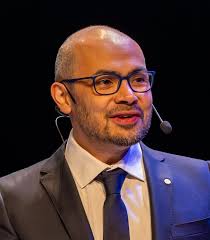
Good evening. Thanks everyone for coming. I'm David Joseph, CEO of the Royal Society of Arts. This evening is one of the highlights of our year. It's the night we choose one person, one idea, and say that it mattered. Before we do, a word about where you're sitting, which is the Great Room. So in this room in 1877, Alexander Graham Bell showed people the telephone. They stood about where you are and heard a voice come out of a box. And in this room, Sir William Cooke unveiled the electric telegraph. And until that afternoon, the fastest a message had ever traveled was the speed of a horse.
In this room, Thomas Edison's light bulb was first shown to the British public for the first time—light in your house that wasn't a flame. And this isn't a museum of things. These were actual nights. People walked in not knowing and walked out having seen history made. And by the way, every single time someone sensible explained why it wouldn't work. When Edison said he was building a light bulb, gas shares crashed and Parliament set up a committee. The committee concluded the whole idea wasn't worth the attention of practical men. And when the telephone turned up, the Post Office took it to court and won on the grounds that a telephone was illegally a telegraph and a phone call was illegally a telegram. I personally can't get the image out of a telephone in handcuffs at the back of a police car.
But every time something arrives, sensible people explain why it can't happen. And a few years later, it's in everybody's house. And that's what's special about the Royal Society of Arts. For more than 270 years, this has been the place where people bring ideas and test them before the rest of the world has decided what to make of them. It's also why this year we're resetting the Royal Society of Arts as the home of creativity for the common good. It sounds like a mission, but it's really a return to what this place has always tried to do: find people with ideas and bring different worlds together and put creativity to work making life better for everyone. Which brings me to the medal and why we're all here tonight.
Prince Albert ran the society for 18 years. When he died, the society made a medal in his name. In 1864, we gave the first one to a man called Rowland Hill. Hill's idea was that a letter should go anywhere in the country for a penny. That sounds small, but it wasn't. Before Hill, you paid whenever the letter arrived, and the further it had come, the more it cost you. People turned letters away at their door because they couldn't afford to find out what was inside. Hill's penny fixed it, and overnight anybody could write to anyone. After Hill, the medal went to Marie Curie for radium; to Alexander Graham Bell, back again, but this time for the telephone he showed us in this room 25 years before; to Winston Churchill in 1945; to Stephen Hawking for putting physics into ordinary people's heads; to Tim Berners-Lee for the World Wide Web; to Zarine Kharas for co-founding JustGiving; and to Sarah Gilbert for the Oxford vaccine. None of it looked obvious at the time.
I spent most of my life working in music, so please bear with me for one more minute. In 1982, a branch of the Musicians' Union voted to ban the synthesizer—not limit it, ban it. Their worry was simple: one keyboard could sound like a string section, and a string section was 40 jobs. What tipped them over was Barry Manilow, who was ahead of his—he is ahead of his time. It was said Barry Manilow was touring Britain with synths instead of the orchestra he'd bought the time before. So the idea of the ban was madness, but the fear underneath it wasn't. They were wrong about the machine. Synths were hopeless at sounding like violins and brilliant at sounding like something never heard before, and the whole sound of the '80s came out of that. They weren't wrong about the musicians. Some of these players never worked again; others were fine. Nobody could tell you at the time which would be which. And that's worth remembering. Things change. Sometimes we resist them, and sometimes we embrace them. And sometimes we only understand what they meant years later looking back. But there are a few people who seem to know what matters before the rest of us do and who help us see to it. Which brings me to this year's medal recipient, Sir Demis Hassabis.
Now, if you want to feel really bad about yourself, listen up. Chess master at 13; wrote a computer game at 17 that sold millions; Cambridge; then a doctorate in how memory works in the brain; then he started DeepMind, and DeepMind built the machine that beat the best Go player in the world. He's been a fellow of this society since 2009. He was later made a Royal Designer for Industry, the highest honor for a designer in this country. He stood in this room in 2016 and talked to us about artificial intelligence. No one sitting here could have told you which bits would come true. Since then, the Nobel Prize in Chemistry, the knighthood, the Lasker, the Breakthrough, the Gairdner—three of the biggest prizes in medicine, one after another.
And here's what he actually did. Your body is run by proteins—tiny machines, millions of them, doing every job going: digesting your dinner, fighting off a cold. And what each one depends on is its shape. So if you want to understand a disease or build a drug, you need the shape. That's the whole game. And getting the shape of one protein, just one, could take a scientist years, sometimes a whole career. AlphaFold has now done 262 million of them, and he gave every single one away free to every researcher on Earth.
Rowland Hill would have recognized that. People had gone at that problem the same way for 50 years, and what changed was somebody looking at it differently. That's a creative act for the common good. His dad is a singer-songwriter who's always admired Bob Dylan, and in retirement he's composed and staged a musical. So whatever that house was doing, it was really working. He carries all of this lightly, which I think is how you can tell he's a British scientist.
Now, this medal matters too much to hand it over carelessly. We think whoever presents it should know the recipient properly. So, I asked Demis' team whether someone might say a few words. It took them about a second to come back with Professor Hannah Fry. I should declare a personal interest. Hannah once dissolved a bank card in nail varnish remover on television to show the thin copper wire hidden inside it. We tried it at home, and now every time we pay the bill in a restaurant, someone at the table has to mention the wire. And I love that. That's one of the most remarkable things about Hannah. She takes something you've carried in your pocket for 20 years and shows you the idea inside it. And that's why we're here tonight: not the invention, the moment somebody thought of it. Please give a very warm welcome to Professor Hannah Fry.
Thank you very much, David. Well, David has already taken us through some of the biggest achievements that Demis has made, which is useful because I think reading out Demis' entire CV would take us through to next morning. But I'm here instead to give you a little bit more of a picture of the person who's sitting in front of us. When I very first got to interview Demis back in 2017, I was going through the frankly absurd list of things that he'd achieved before most of us have even worked out what we're good at: chess prodigy, games designer, Cambridge graduate, world-class neuroscientist. And I cheekily decided to ask him, "Demis, could you not have tried a bit harder?" And rather than just laugh it off, Demis told me this incredible story about when he was a kid and his dad had offered him the exact same piece of advice: it doesn't matter how well you do as long as you try your hardest. Now, rather than hearing that as reassurance, Demis, who by the way was aged about nine at this point, heard it instead as a philosophical problem because how do you actually know that you've tried your hardest? How do you manage to optimize for effort without dying? Because the thing is, there is a logic to it here: if you are alive at the end of it, then surely you had a bit more to give.
Now, the DeepMind—this is a picture of you as a child, I think, Demis—the DeepMind co-founder Shane Legg puts it really well. He says there is no 50% mode in Demis. There isn't even a 99% mode. There is only 100%. And as somebody who has played Bananagrams with Demis, can I just confirm how accurate that is. Right. By the way, word of advice: if you get that option, don't take it. It's not good for your ego. Now, I think there is something else in that story about when Demis was a child that is really worth noting because the thing that strikes me about Demis is that he appears to have spent his entire life asking, I mean on the surface, unreasonable questions, right? Not just "how do I get better at chess?", but "what is my brain actually doing when I am playing chess?" Not just "how do I build a computer game?", but "how much of reality could be captured by simulation?" Not just "can AI beat us at games?", but "can AI help us to solve some of the hardest problems in science and help humanity while we're at it?"
And that last bit, that's the bit I think that really matters here. Because with Demis, I've seen firsthand how the concern for humanity isn't just something that gets tacked on afterwards. It is right there at every single stage of his thought process. The ambition is enormous, of course, but so is Demis' extraordinary sense of responsibility that comes with it. And I think that's the combination: extraordinary ambition, relentless curiosity, and a genuine concern for where it all leads that really makes Demis quite so special. It's also why so many people, myself included, feel so much more optimistic about the future, knowing that Demis is such a key part of shaping it. And all of that, I think, feels particularly fitting for the Albert Medal, which is an award that celebrates extraordinary ingenuity, but also put to work in a way that makes a real difference to the world. Now, Demis, you have spent your life trying very, very hard, possibly harder than is entirely sensible. And it is an absolutely enormous pleasure for me to get to present you with the RSA's Albert Medal.
Well, thank you all of you for coming this evening, and thank you David and Hannah for those amazing introductions and opening remarks. So generous of you. It's always an enormous pleasure for me to come and visit the RSA and especially be in this room, as they reminded me I gave a talk here 10 years ago. It felt much more recent than that, but it's just such an inspiring space and all of the amazing things that have happened in this room, the amazing art that we see. And it's a huge honor to be awarded the Albert Medal, especially as I was looking back through all the previous recipients and all these amazing people. What I really love about it is the interdisciplinary nature of what it celebrates and recognizes.
And that's the way I've tried to live my whole life and run my career, is not really seeing any boundaries between creativity and science. In fact, much the opposite. I've always worked at the intersection of technology and creativity right from the very beginning. David mentioned my early games career, designing and programming video games mostly in the '90s, in the early stages of the games industry. And I was so fascinated by the games industry at that time because it was really using creativity—this idea of making something fun or interesting for millions of people to interact with—but that goal, the creative goal, was driving all of these amazing technology advancements. At the time, it was inventing 3D graphics. I was using it to try and push AI at the forefront of what was going on. And in fact, beyond what was happening in academia at that time, it was actually the game industry that was pushing forward a lot of AI ideas, and then even the hardware. The hardware we use today, the GPUs that we use for AI, were originally, of course, invented for 3D graphics. And it turns out that everything is a matrix multiplication, it turns out, maybe in the universe—we can maybe talk about that later at drinks. But it's kind of incredible that not only the direct things that you were trying to do, but these sort of ancillary benefits appear.
And that's been one of the lessons I've taken throughout my career: you pursue a goal for its own sake, and then if it's a big enough, ambitious enough goal within a multidisciplinary environment, other amazing things will happen and be facilitated by that that you couldn't have imagined at the time. I think there's just so many examples of that. And I guess I was brought up in a household—David mentioned my dad, my mom, and actually my brother and sister—they're all on the creative side of things: music, and my sister's a professional musician and composer, and games playing, and the arts is really where my whole family, I guess my genetics, my kind of upbringing is about that. But the interesting thing for me is I trained first through chess, then computers, and then the sciences. My whole formal training has all been on the scientific, logical side. But at my heart, I think of myself as being led creatively, intuitively, and emotionally, actually, which is maybe not what you'd expect to hear from a scientist.
But I think that's also what's helped me in my science. What separates the good scientists from the great scientists is creativity. All good professional scientists, professors, and so on, they're already by definition brilliant technically at what they do; otherwise, they wouldn't have reached that level. But then it's the creative side and intuitive leaps that I think are the things that have yielded the big breakthroughs. If you look again at some of the people that were mentioned—recipients of the Albert Medal and the other big prizes—it's basically their leaps of intuition often that lead them to their big breakthroughs, underpinned by their technical capabilities.
So I think again, as we look forward now to AI, you've all probably heard me give talks about it. I've spent my whole career working on AI in one form or another because I think it's going to be one of the most profound technologies humanity will ever invent. I think it will be a revolution in the way that electricity was, telephone, the internet, mobile. I think it'll be at least as big, but perhaps bigger than all of those—maybe something like 10 times the impact of the Industrial Revolution. And the additional challenge is that it's probably going to happen 10 times faster, so unfolding over a decade instead of a century. The Industrial Revolution brought many amazing things—modern medicine, child mortality went down, all of these incredible things in the end that it brought—but it also came with challenges that we all knew, and in fact new institutions, new approaches were needed to deal with the downsides of industrialization and the effect on the environment and so on.
And I think again with AI, there's just unbelievable opportunity. One of the main reasons and motivations for me to work on AI my whole life is to advance science and medicine. That's why I personally work on things like AlphaFold and now our spin-out, Isomorphic Labs, to accelerate drug discovery. I've always said that the number one thing I think we can apply AI to is improving human health. I still believe that now, and I think ultimately it could be the most amazing tool for advancing our understanding of the world around us. That's what I'm dreaming about, and that's what I'm trying to push really hard on. And I think that's what society needs from these new technologies.
But of course, it's not just about the technology; it's also about what do we as a society want to do with it. The technology just enables all these opportunities, all these possibilities, all these paths, and that's what I see as a technologist, an engineer, and a scientist. But it doesn't define what we should do with it, what is beneficial for society, how should it shape the next era of humanity. And I think that's for the arts, humanities, social sciences, and those aspects that are represented by the RSA and many of the people in this room: about shaping that and guiding humanity into that next era in a way that is going to be beneficial for everyone. I think that's almost a philosophical problem, actually. And I've often talked about the need, at this juncture when we're on the cusp, on the eve of the foothills of the singularity—I like to call it, a few years away from full AGI—we need to start thinking about that now. I don't think society's ready yet for what's coming.
What are we going to value? What is purpose? How are we going to use these tools to enhance human creativity, not replace it? What is the difference between craft and the soul of a creative piece going to be in the world of AI? Really fascinating questions that I think the technologists are not best placed to answer, actually. I think that's got to come from the arts and the humanities to define that next era. And what I really hope is that places like this can be a convening point for that discussion across the sciences and the arts. I think that's more important than ever in this new era of AI: what is it going to mean to be human and the things that we create and then value?
And I've no doubt—the optimistic part of me has no doubt we will be able to deal with this new era and adapt to it because I really believe in the power of human ingenuity, again represented by this room. And I think what Dame Judi Dench mentioned about, isn't it amazing what we've already created with our creative minds? I often stop and marvel when I go on a transatlantic flight of how did we do this with our brains that were evolved for hunter-gathering out in the tundra. How have we managed to create all of this art and this beauty and what we call modern civilization, including all of our technologies like flying on a 747 across the ocean? It's just miraculous if you think about it. So if we manage to do that and adapt to here, I've got no doubt we and the next generation will figure out what to do next. But we need to take it seriously. We need to start that debate yesterday because this is coming very fast towards us. But I'm sure we will work through it and we'll come out the other side in a bright new future and what I hope will be almost a new Renaissance—a new coming together of science and the arts, maybe that hasn't happened since the Renaissance. I think we're due that again, and perhaps it will unleash a new golden era of scientific discovery and wonder. Thank you very much.
I mean, you ended your comments there talking about the Renaissance. I always thought it was really notable that for a number of years, your office at DeepMind was named after Da Vinci. Why Da Vinci? What is it about Da Vinci that inspired you so much?
So I have sort of three or four favorite, I guess you can call them scientific heroes of all time, and Da Vinci is one of them and Aristotle is the other because of their all-roundedness. You look at Da Vinci, his incredible artistic talents, like the Mona Lisa and The Last Supper and so on, and then you look at his medical and engineering diagrams, and he painted these exquisitely beautiful drawings of the heart and the lungs and lots of biology. And he wouldn't have been able to do that to the scientific level of accuracy if he wasn't brilliant from the artistic side. So I just find him fascinating. And I'd love to see that type of era again, and I think AI could maybe help with that. So he's always been my big inspiration for me.
He's like the ultimate interdisciplinarity.
Yes, exactly. Where there's no—and I think if you read biographies of him, is that he just didn't see any boundaries between what he was able to do. I don't think he thought about it as, "I'm doing art now; I'm doing science now." He just drew. He just did amazing things, produced amazing things.
In terms of those boundaries, I mean, David was talking about your family background, the fact that all of your family are artists. Did you feel a boundary, as it were, when you were growing up? Did you feel like the odd one out, or did it just feel like you were doing—
No, when I was young, it didn't. Later I kind of realized that in maybe my late 20s or something. But I sort of described my parents as bohemian in the sense of like we had no money, but it was always just sort of being creative. And I think my dad encouraged not being conventional, let's put it that way. So my parents have never had sort of normal nine-to-five jobs, and they didn't really believe in that. So I guess that gave all of us kids the permission to be kind of unconventional, follow your passions. And then my mom was always more on the kind of spiritual and arts side. So I've always had that kind of input—the humanities, if you want to call it—coming through that.
And then I think it happened to be a great combination with me loving chess and computers and then having to get better at those things encouraged me to improve the logical, scientific part of my mind. What I really loved about computers and chess and all those things was the creative output: designing games or playing great games of chess. These are kind of artistic pursuits really and outputs, but you have to be very technical to produce outputs worthy of the name. So you sort of have to get good at all of the mathematics and the sciences. And then really for me, where all the drive, the North Star for me since I was a kid, is trying to answer the big questions and the big mysteries of the world around us. And for that, I think you need both the art side and the scientific side to really truly understand a lot of these questions: the nature of consciousness, creativity, dreaming, time. So there's so many fascinating things in my opinion to look into. That's what led me to AI in the end pretty quickly because I felt we needed a meta-tool to help us and help me with answering as many of those questions as one can in what is a relatively short lifetime.
Well, I guess your second career by 16 as a games designer is sort of a good illustration of that point. It's kind of a creative pursuit on the one level, but it was also your first foray into AI really, right? Tell us how what you were doing there ended up being the very beginnings of what happened with DeepMind.
Well, because there's not enough time in general. So I've always been in this rush because there's so many things, so many amazing things to discover and create and experience. And also, because there's so many interesting things to do, I like doing things for more than one reason generally—at least four reasons if possible. So games was a great one. I loved games. I loved designing and playing games. I could see the enjoyment people would get from them. But I also used it as a bit of a Trojan horse, especially with my own company, Elixir Studios, to get some AI research funded somehow, which you couldn't get funded any other way. We're talking about the early '90s here, right? It was impossible to get it funded any other way. But I would try and sneak in some AI research with people like Demis—like Dave Silver—ostensibly to do our games and to control the little people or the simulation under the game. And then that would become successful and then could fund the next ideas in AI.
So I was learning about all of that and also learning how to manage startups, but also creative engineering teams. Something I took with me from that to DeepMind was how do you combine cutting-edge engineering with something that's a creative objective. So in this case, it was when is it going to be fun? If you want to really scare a game designer, you could just ask them that question: "So, when is this game going to be fun? Is it going to be in three months or six months?" And it's like, "Well, I don't know." Obviously your publishers who are paying for it, they're just like, "Is it fun now?" "No, not yet, but it will be." And that reminded me of when I did my PhD, sort of like, "Well, when is this breakthrough going to happen?" If you knew the answer already, then it wouldn't be research. If you could guarantee it was going to be fun, then it wouldn't be creative, what you were building. So actually I realized it was very analogous in terms of the creative part of it: this unknown, it needed a lot of taste and intuition and kind of faith in what you're doing. And I realized doing science and game design, that was quite similar. The games designers and artists in the games, the best ones to me felt quite similar in what they were doing to the best scientists that I'd met.
And then underpinning that was this combination with great engineering and technical capability, and sort of like how do you mix that together? The difficulty we used to have in games is you've got all this engineering going on and it's trying to support and intercept what is effectively an open-ended creative question. And that's a little bit the same in science: we've got to build all these technologies, especially in AI supporting something like AlphaFold. You don't exactly know when it will be done, but you kind of know the types of things you've got to build, and it's an iterative thing. That's why I love building multidisciplinary teams. They've got to feed into each other. The engineering informs the research and the research informs the next part of the engineering, and that's why things like AlphaFold and AlphaGo were successful.
I mean, you mentioned your PhD there. We should probably talk about this as well, because this was quite a corner turn from the surface looking at it: from games designer to neuroscientist, especially looking at imagination in the brain. And that sort of feels like quite a big sharp change in direction, but for you it was another piece of the same puzzle.
Yeah. So for me, it was just different angles. I think if you didn't realize I was trying to build DeepMind and AGI, then it would look a bit strange, right? I was doing game design. I did computer science as my undergraduate at Cambridge. Why would you switch to neuroscience? Well, it's because I was trying to look at the question from every angle possible: what is intelligence, what are the capabilities that underlie intelligence? And again with my PhD, I felt during my games career, my early 20s, I'd pushed AI knowledge as far as it could go as it was known then. This was the mid-'90s before the neural network revolution and so on. So I was looking in the early 2000s for an orthogonal source of information about how intelligence works, and thinking, and planning, and all the things that we regard as being intelligent. So what better place to look than the brain?
And of course fMRI machines had just become kind of mainstream. So there were all these new incredible tools to use. We could look inside the brain. If you think about an fMRI machine, that's kind of amazing as well. We all use it for our medical exams routinely now, but back in the early 2000s, it was this incredible thing: you're going to look inside the brain with these massive magnets and see what bits light up when you think. It was kind of irresistible to me, to be honest, that you could make some progress there about some of the big questions about thinking and so on. And then I picked memory and imagination because, firstly, they're fascinating topics, but imagination specifically, like planning for the future. That was what I was doing a lot in my games and chess career: effectively in chess you're planning forward to checkmate someone or get to a winning position, and you imagine that, visualize that, and you plan back from there.
I don't know if you've all seen The Queen's Gambit, the series—amazing series. It's very accurate because Garry Kasparov was consulting on that. When she's dreaming about the positions when she's sleeping and they're in her mind, that is actually how it feels when you're a top chess player. So I'd experienced all of that. And then same in game design, I reused that as answering this question of when it's going to be fun: you imagine someone playing it, and what are the difficulties they're going to have, when are they going to get bored, and how does the interface work, and all of those things—you're viscerally imagining it. So I was very fascinated by how the brain does it. And almost no one had looked at this question of imagination; they looked at memory, but not imagination.
something we had no idea how to do with AI. So it was a capability that seemed fundamental to the way we create and plan and reason, but we had no idea how to do with AI at that time. So for multiple reasons, again, that seemed like a good thing to look at. And as a third reason, I wanted to understand at some of the top universities in the world, learning from some of the best professors, how does research work and how does discovering new things at the coalface of the frontier of knowledge feel? And it's exhilarating and amazing, but there's a whole process to it too that I think a lot of my technologist colleagues don't understand, because it's different from engineering, actually doing research.
I mean, when you put them together like that, it does sort of feel as though it has all been the same question all along. You've got the brain as sort of a simulation engine, games are a simulation engine. I mean, even in a way, chess and literature and music, you're sort of constructing this version of reality that you get to spend a little bit of time in. It is the same question really, isn't it?
It is. It is really. The twin fascinations I've had—I've been lucky in my life, I've been able to find a lot of things I'm very passionate about and then I've been able to connect those things together into a grander goal. If you think of the heart of it, the two things are AI and intelligence: what is it, how can we harness it to advance in other ways? And then the second thing is simulations and using building accurate simulators. Originally I was doing them by hand for games, but they were little microcosms of what I would go on to do. Even my first game, Theme Park, that David mentioned, was a little simulation of a Disney World. It was unheard of to try and do that in 1993, '94. I was amazed by how far you could get to the extent where 10 million people would enjoy interacting with that fairly basic simulation of a theme park.
And of course, that leads me to the bigger question of what's going on here? I'm not subscribing to some basic kind of simulation theory, but one does have to sort of think through computationally and from a physics point of view—and I talk to a lot of physicists about this—what is really underpinning the nature of reality, which in my opinion is the ultimate question. So yeah, for me, all the paths lead to that question.