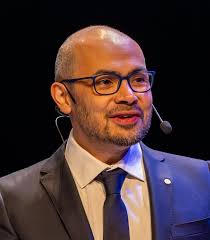
Welcome to the second Athens Innovation Summit at the Odeon of Herodes Atticus, here at the very place where democracy was born. We could create a global platform to discuss the future of entrepreneurship and how to ensure that innovation makes the world fairer, more resilient and more prosperous. By gathering here, we are standing at the very place where some of the boldest, brightest and biggest ideas were born, molded and put into action with incredible impact, changing the way we live to this day. Today's high-impact entrepreneurs follow paths that started in ancient Greece. And Athens stands as a timeless symbol of what is possible by humanity. We're hosting this night because if we believe that Herodes can guide us to a better future, then Athens has definitely a global role to play. Ladies and gentlemen, please welcome on stage the Greek Prime Minister, Kyriakos Mitsotakis, the co-founder of Google DeepMind, Sir Demis Hassabis, and the co-founder of Endeavor, Linda Rottenberg.
Good evening everyone. I can't think of a more perfect setting or a more perfect pairing for tonight's conversation. We are seated at the southwest slope of the Acropolis, the birthplace of democracy, philosophy and drama, to discuss one of the most dramatic moments in human history, the rise of artificial intelligence, and the challenge it poses to all of us. To get this moment right, I'm joined by Prime Minister Kyriakos Mitsotakis, who has been a strong advocate for innovation while also emphasizing the need for ethical frameworks. And Vice chair Demis Hassabis, who has been at the forefront of this revolution while also advocating for educating citizens on the limitations of AI. I'm honored to be with you both and look forward to our conversation. So I'd like to frame tonight's conversation around three larger themes. One, what can we learn from past moments of enormous human change, the golden age in Athens, the Industrial Revolution to shape our approach to today? Two, the current dialog around AI centers on Silicon Valley versus China. And yet, as we see in the 50 countries where Endeavor operates, innovation is everywhere. We're big proponents of what we call the power of elsewhere. So question number two, what can we learn from a country like Greece and a London based company like DeepMind that can help inspire founders everywhere? And three, with the prospect of general and artificial intelligence, or AGI, it poses a unique challenge to human civilization. So we'll spend most of our conversation in this area and ask you both to draw on your experiences to help us navigate the inherent tensions of the moment. So let's dive in. Prime Minister Mitsotakis, you and I met many years ago studying philosophy and social theory at Harvard and there was even a class called Thinking About Thinking that began with a focus on ancient Athens. So we're here at the Herodian as you think about the future of AI. What values from Greece's past should guide us?
Well, first of all, it's a real privilege to be sharing the stage with Demis. Thank you so much for being here and for supporting us in this fascinating journey to understand how we can use AI in a truly positive manner. It's amazing to be sitting here. Usually, we don't appreciate how this theater looks like from the stage, but I think it is sometimes worthwhile to think and draw lessons from classical Athens. Although we need to point out that this Odeon was built during the Roman era. And to understand what was it that caused this amazing innovation in terms of organizing our societies? And what forced Athenians to abandon old systems of political regimes in favor of democracy. And at a time when democracy is under challenge everywhere. Looking back to ancient Athens and trying to draw lessons from that unique experiment, acknowledging its limitations, I think is very much a worthwhile understanding the true power of debate, the necessity to be able to convince citizens who will then vote all together about the collective actions of the city, and also to recognize what Pericles said in his funeral oration, which I always try to remember, that if you don't do well in a city that is flourishing, the city will find ways to support you. But if you do well in a city that doesn't do well as a whole, you will probably also end up not thriving. So connecting the benefits of the city to individual flourishing is something which was very much at the heart of Athenian democracy. So I always like to look back and draw lessons from this period. And I think these days, this is a very healthy exercise.
Sir Demis, you have also spoken a lot about thinking about thinking and the need to draw lessons from the past. I know you're a student of the Athenian philosophers. And with regard to another great disruption, you've said that it will be ten times bigger and ten times faster than the Industrial Revolution. So take us behind the scenes in the labs with your engineers and designers. Are you talking about Aristotle and Plato? And are you worrying about a new Dickensian London?
Well, thank you. And first of all, I want to say thank you to the Prime Minister and the government and Endeavor as well for inviting me here. It's incredible to be talking here in this amazing historic place. And as you mentioned those greats, I'm really proud of my Greek heritage on my father's side. And one of the things that I studied a lot growing up was the classics and Greek history and also mythology, and it was actually very formative for me about the way I think about the world. And you talk about those greats, Plato, Aristotle, Socrates, Archimedes. And really, this is the birthplace of not just democracy, but also science and philosophy. And actually, my favorite piece of art is the School of Athens by Raphael in the Vatican, depicting that kind of golden era in an idealistic way. And I think we can learn a lot of lessons from that time. I think especially the way, as you mentioned in the beginning, sciences and arts can be blended together, and drama, and it's all one part of being human and advancing human knowledge and understanding of the human condition. And that's how I've tried to work in my career. Even though I've worked in technology, I've also worked in things like designing video games, which involves the artistic side of things too. So I'm very interested in how I can help both with the sciences, advanced science, but also how it can help enable more creativity.
Wonderful. So let's move on to the topic of innovation elsewhere. Demis, you were born in London. Your father was Greek Cypriot. Your mother Chinese, Singaporean. And yet when you raised capital from American investors, they told you you had to move to Silicon Valley. You resisted and stayed in London. Tell us how you made that decision and what have been the pros and the cons?
Well, when we started DeepMind back in 2010, it's hard to imagine today, just 15 years later, but almost nobody was working on AI, even in academia, let alone industry. So it was a very unusual thing to try and raise venture capital for. And we had to find unusual investors on the West Coast. But I was wanting to stay in London. I grew up in London and I love London, it's an international city. But the main things were, I felt there was incredible talent in Europe and the UK that was untapped at the time for deep technologies like AI, and I felt that if we could set up an ambitious organization that was really trying to reach for the sky, those types of people would be attracted to work in a place like that, and we'd sort of have the fields to ourselves in the UK at the time. And that's what transpired. And now, of course, hopefully DeepMind is being a good example for many other deep technology companies to start up in Europe and in London, and we're proud to have played a part in that. But the other really important thing was more from an ethical point of view. Even though in 2010 it seemed like a long way to go before we would make progress with AI, we planned for success. So at some point we imagined and we knew, even before setting up DeepMind, that if we were successful in this endeavor, AGI and AI would be one of the most important technologies ever invented. So if that's true, then of course that would also come along with a lot of important ethical questions and ethical challenges about how to make sure it benefits all of society, and also technical questions around how we keep that kind of technology under control and on the right guardrails. So we already had at the beginning of DeepMind, we were planning that if we were successful, then these ethical questions and tenets really would have to be built in from the beginning. So we've always had that in mind. And so with that comes the fact that Europe is important. It's clear to everyone now that AI is going to affect every corner of the world, all industries, all parts of society. So I think it's important for the world to have a say in how these technologies develop, not just a small part of California. And I think Europe's voice in that is really important, and the value systems that we have in Europe. So I think you can only have that kind of influence if you are also at the leading edge technologically. And that's what we've tried to wave the flag for with DeepMind and do our part in that.
I loved, by the way, meeting Yannis of Reflection AI, a Greek founder and AI who worked for you at Google DeepMind. And I've been saying that Endeavor is all about starting the tech mafias. And you have your, like the PayPal Mafia, and you have your DeepMind mafia already. It's amazing. Mr. Prime Minister, you are working hard to make Greece a place that really matters in terms of innovation. Elsewhere, you and Endeavor Greece have collaborated on an initiative called Innovation Nation, and Pharos AI is one of the first AI factories in all of Europe. We were talking earlier and you reminded me that you worked as a venture capitalist before you went into politics and have cared about this topic for a long time. So describe your local and regional efforts on innovation and globally, how do you plan to compete for talent like Demis?
Well, first of all, thank you for mentioning the important role that Europe can play in this new emerging world where it seems to me that most of the discussion involves the competition between the United States and China. And the truth is that when we talk about Europe, we usually think of it as a supranational entity that is very good at regulating, but not very good at innovating. And I think there is some truth to that. And one of the main missions that we as European leaders have agreed to is how do we make Europe as a whole more entrepreneurial? How do we break down barriers between countries? How do we create a true single market which really does not exist in digital services? I'm sure this is the experience also of a lot of Greek startups. And how can we actually also raise capital at the European level, to ensure that our startups or Greek startups don't necessarily have to be acquired by the big U.S. companies in order to chart their own future paths? So there is, I think, a big European dimension in terms of fostering innovation. And we have made good use of these European initiatives and the European funds by setting up one of the first seven AI factories in Greece, which is essentially a structure revolving around a very powerful supercomputer that is in the process of being built in the city of Larissa, but also trying to make sure that our startups have access to cutting edge computing power and can actually develop AI solutions out of Greece. And I must pay tribute to the tremendous work that Endeavor has done in fostering what is an incredibly dynamic startup ecosystem in Greece. I was a venture capitalist many, many years ago. I set up the first incubator in Greece back in 2001, and never would have imagined that this dynamism would emerge out of Greece. It's a complete change in the mindset of young people, thinking about entrepreneurship and actually taking the risks to set up their own company. So for us, I see AI as a transformative technology that can really allow the country to leapfrog other European countries in our effort to catch up with the rest of Europe. It's as simple as that. And this means not just supporting our ecosystem of entrepreneurs, which is something that we do through incentives for supporting more venture capital, but also trying to use artificial intelligence at the level of government. This was a topic of the discussion that we had today, in terms of becoming much more efficient, but also in terms of identifying specific verticals where AI can truly be transformative: healthcare, education, civil protection, just to mention a few of these vertical areas where we really want to be at the forefront of applying artificial intelligence for the benefit of all Greeks. So I'm very enthusiastic and very excited about the prospect of this endeavor that we have started to implement, and I'm extremely bullish about the future of the Greek entrepreneurial ecosystem as well. And I would never have imagined that we would be able to fill this auditorium 45 minutes before Greece is going to play a very important basketball game. So thank you for being here.
Well, we will get you out in time. And Yannis is actually a supporter of Endeavor, so we love him. And I should say that everyone met our incredible chairwoman Costanza, as well as our managing director, Panos. But it was your wife and entrepreneur Morava who first convinced us to bring Endeavor to Greece. Now, I should point out that I know Linda since we were classmates at Harvard College. I tried to convince her to bring Endeavor to Greece. I failed, but Morava succeeded. So well done. I'm sure she's very much the founder of Endeavor. Okay, so those were the warm up questions. Now let's dive into some of the tensions, starting with innovation versus regulation. So Demis, you're part of an industry that is famous for its move fast and break things philosophy, which translates to government, keep your hands off. And yet you've said that perhaps AI was released from the lab too early. So now that the genie is out of the bottle, are there opportunities for governments to regulate AI, or is your colleague at Microsoft, Mustafa Suleyman, right that containment is no longer possible?
So, I think we thought a lot about these topics over the years, and I feel like you've got to be at the cutting edge of the technology to understand what's coming down the road. So in terms of regulation, it's moving so fast and it's changing so fast, we have to be careful about how we regulate it. It's so important, it needs to be regulated. But we have to allow the innovation to flourish and be bold about that whilst mitigating against the risks. And actually, although the tech industry is famous for its move fast and break things, I actually don't subscribe to that view with this technology. Of course, it made a lot of progress and a lot of the modern technology we see today comes from that kind of relentless progress. And that part of it is good. But I think where the technology is transformative, like AI, we have to be more thoughtful about it than that. In terms of the break things part of move fast and break things, we need to be more careful and try and have as much foresight as possible. So I would advocate, instead of that philosophy, to use the scientific method and to try and get as much understanding about these systems before they're deployed really widely. And it doesn't mean we'll get everything right all the time, because things are changing so fast, but we should try and do the best things possible to safeguard against these risks whilst enabling all the amazing use cases like advancing science and medicine, and all the amazing things that I think AI will bring into the world. So we've got to get that balance right of being bold with the opportunities but being responsible about mitigating the risks. And that's going to be a continual creative tension, I think, all the way to AGI.
I love that answer. Mr. Prime Minister, what is your answer to the question of regulating AI, and what can national governments like yours do? Or should there be some sort of supranational structure akin to what we did in the monetary system following World War Two? Some are calling for a Bretton Woods of AI.
I've been thinking a lot about this question, and unfortunately there is no easy answer. I do believe that at some point, some sort of global arrangement will be necessary, especially an understanding between the US and China, that there are real risks involved in this technology. If this becomes a race to who develops first the most powerful model, then there is really no incentive to regulate because there are commercial incentives and geopolitical incentives just to be the first to get your hands on this extremely powerful technology. And this, of course, creates an environment where no one talks about regulation, and very few people are as thoughtful as Demis about the consequences and the ramifications of this incredible technology that we have created. In Europe, we have our own regulatory framework, which I think is reasonably well thought out, and I'm talking about the AI Act. But at some point, we don't want to be a regulatory black box in a world where no one is talking about regulation. So I think it is important to engage both with the United States and with China, and certainly to engage with the big technology companies. And in my mind, we need to pick our regulatory battles in a smart way. So we need to set some clear priorities. For me, for Greece, there are two areas that concern me profoundly. The first is the health and the mental health of kids and teenagers. And the second is the impact of AI on our democratic discourse. And we were discussing this with Demis as we have elections coming in two years. And I think the number of deepfakes that we will see by then is going to be a real challenge to the democratic discourse and to actually getting to the truth of anything if we don't know what is true and what is created by artificial intelligence. And especially when it comes to the question of mental health of kids and teenagers, I think we need to be stricter also with the big technology companies in terms of either pushing for a design that really takes into account the relative age of the users, or even considering more radical options such as banning the use of social media under a certain age, if we cannot succeed otherwise in mitigating the negative impact of our kids having access to smartphones, which really have been built simply with the purpose of maximizing engagement. And again, this is probably a question relevant to social media, less relevant to artificial intelligence. But of course, as these algorithms become smarter, they will also become smarter in terms of capturing our attention. And when we are talking about the brain of a child or a teenager, we're really running a massive experiment with the mental health of the next generation. And I don't think we are fully cognizant of the risks that we are assuming. So I would really like to engage with the big tech companies and make them understand that they need to be part of this discussion, and they need to be bolder in thinking about this challenge. And if regulation is necessary, then we should not hesitate to regulate that space smartly. One last point is that Greece has led probably Europe in terms of technologies around age verification. So we now have what we call a kids wallet, which is a platform that allows parents to set up the phones of their kids in a way that suits their own preferences and choices. It's a first step in the direction of at least making parents and kids aware that being addicted to the phone and being addicted to constant scrolling is probably not the best thing you can do as a kid or as a teenager.
Yeah, and I'd love to have the chance to respond. Let me just add that one of our classmates two weeks ago announced that one of their children, who's in their 20s, had taken their life, left no note, and the parents discovered that they had been conversing not with Google, but with one of your competitors, AI, and used that as their therapist and friend and decided to take their own life. And it's just, I'd love the chance for you to respond, because this is a real thing the parents are worried about.
Yeah, there's a lot of complexities here that have to be navigated very carefully. And I think the Prime Minister is absolutely right about that. And we at Google, of course, have been thinking very carefully about those things. And I think we should learn the lessons from social media, actually, where you know, this allowed you to maybe move fast and break things ahead of the understanding of what the consequence second and third order effects were going to be. And I think with AI, we have to get that right. And in fact, we also need to think about the way AI interacts with social media. And I think it can help with some of these attention issues in terms of summarizing things and helping with finding the things that are useful and helpful for people, without hijacking their attention. But it can also, if it was misused, make the problem worse. So I think we've got a lot of complicated things to navigate. And this is, again, one of the challenges with AI as well as one of the opportunities. And I also agree with the Prime Minister that ideally we would have some international cooperation or understanding or minimum standards around the deployment of AI, because I think that's where the rubber meets the road. There are interesting research challenges there about AGI and autonomous systems and how to keep control of those things, but actually how it affects the public is through the deployment in products and services. And I think that's where maybe regulation in the near term can focus on, because it's more tangible as to what the effects are that the governments and society want to see. But again, enabling all the good use cases of AI as well, to increase productivity in science and medicine and those things. So again, it's going to be about getting that balance right between innovation and mitigating the risks.
Another area where there is dissonance between the political leaders and tech leaders is whether the future will be shaped by scarcity or abundance. Mr. Prime Minister, I suspect, or I can imagine, that a lot of your energy is focused on managing the real world consequences of climate change. And yet we hear from the futurists that AI will solve all these problems, ushering in an era of radical abundance. And all we need to do is shift our zero sum mindset. So as a leader, how are you balancing the short term anxiety with the long term promises?
Well, Keynes said in the long term we're all dead. So it's a very valid question. And I think that if one were to try to imagine the world in 2050, I think a lot of the challenges that we are facing today, such as nuclear fusion and limited cheap energy, these problems will probably be solved by then. But the question is, how do we get from where we are today to where we will be in 25 years? And there is no doubt in my mind that AI can create tremendous productivity gains and hence create tremendous wealth. Then the question becomes, okay, if there is a lot of wealth to be created, how is this wealth going to be split, and how is everyone really going to benefit from this amazing technological revolution? And we were discussing what happened during the Industrial Revolution. And this transformation is going to be much more significant. And there was a lot of social upheaval. And we should have no doubt in our minds that a lot of jobs will be threatened, will be destroyed as a result of this revolution. And we're not just talking about blue collar jobs, we're talking about white collar jobs. And that is going to cause a lot of anxiety. It will put our pension systems under a lot of stress. So you will have productivity gains for industry, for capital, especially the big companies that are developing these technologies or the companies that are actually using it in order to enhance their productivity. So wealth will be created, but you will also have a significant displacement of jobs. And I think it's already happening in the United States. If you look at the labor market, I don't think we are ready as a society about this reality, which will hit us relatively soon. So there was always this discussion regarding the destruction of jobs and the creation of new jobs. And every time in every big technological revolution, people were very pessimistic only to realize that maybe more or different jobs or better jobs were created in the future. But there is going to be a period of transition. So unless people actually see personal benefits to this revolution, they will tend to become very skeptical. And if they see, sorry for being so blunt, obscene wealth being created within very few companies, this is a recipe for significant social unrest. So I would very much urge us to engage in a more substantive discussion with the technology companies to at least acknowledge the fact that these changes in the labor market may actually happen sooner than we think. Because at the end of the day, if AI is a productivity tool, it enhances clearly the productivity of workers, but it will also replace human labor. And every corporation will have an incentive to do that if the return on its investment is positive.
We will get back to the question of jobs. But Demis, I want to focus a little bit on this notion of radical abundance. And it does feel like we're being told daily that a cure for cancer, limitless clean energy, lifespans to 150 with interstellar travel is, like, weeks away. And you won a Nobel Prize, shared a Nobel Prize for AlphaFold, which correctly predicted the structure of 3D proteins. And that is amazing. But actually, skeptics are now comparing this era to the dot-com bubble. And The Atlantic went so far as to call AI a mass delusion event. So are you worried that your colleagues are over promising and under-delivering, and that people aren't feeling the benefits of all the wonderful things you're speaking of?
Yeah. So I have no doubt that the progress in AI has been incredible, and almost at lightspeed, but it's not a silver bullet in of itself. And I think what I often say is that it's being overhyped in the near term, the next couple of years. AGI, I think, is at least 5 to 10 years away. There are still some big breakthroughs I think are required. But I think it's also underestimated and underappreciated quite how transformative it will be when it does come. Even still now. And just the way of quantifying that, we talk about an industrial revolution, which I think we can learn a lot of lessons from. But I expect AGI, the advent of AGI, to be maybe something like ten times the impact of the Industrial Revolution, but maybe ten times faster as well. So a kind of hundred X. So in a decade, over a decade instead of a century. If you think about that, that's pretty monumental. I think that's what's coming down the line. And we have to use the time now. Governments and technology companies and society need to use the time now to prepare for that and what that means. And I think there will be these amazing things. There will be this kind of notion of radical abundance. And AlphaFold, I think, is just the first example of that, that we'll look back on in a decade. And hopefully there'll be many more examples of these big breakthroughs on cancer, on fusion, on material design, optimal batteries, all sorts of incredible new technologies in energy, in physics, and in medicine. And I think that could lead to a world where we have this notion of radical abundance, where we're not limited by the amount of resources. Maybe we also have unlimited renewable free energy. We can make space travel easier. These types of things sound quite fantastical perhaps today, but I think in 25 years or 5 years time, it will be perhaps normal. But then the question comes: how do we make sure all that extra productivity, all those extra resources are distributed fairly and everyone benefits from them in a fair way? And I think that's more a government and society and social science and economics question, rather than just a technological one. And how do we do that internationally? And what are the right governance bodies? And probably they don't exist today, the right types of institutions to deal with those types of questions. So maybe we need to do some institutional building first, over the next decade. And then we can sort of deal with that next era. So I think it's going to be very exciting, but there will be challenges. And I have a lot of confidence and faith in the adaptability of humans. We're incredible. The human brain is the only evidence we have in the known universe of general intelligence being possible. And look what we've created with our minds: modern civilization, modern science, modern philosophy. And I think we're infinitely adaptable. And I think we'll do that again for this next era.