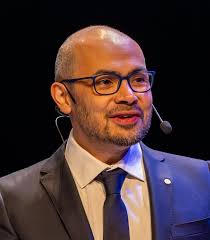
The thing about being in my head is that there's never an off switch. So it's quite tiring as well. I'm not very good if I don't have some problem to solve. So fortunately, there's a lot of problems.
Welcome to your job interview.
Your resume speaks for itself. Chess prodigy at 12 years old, designed and programmed the '90s video game Theme Park, and of course co-founded DeepMind, which would go on to create AlphaFold, win you a Nobel Prize, and lead you to found another company, Isomorphic Labs. What is the first thing you remember being good at?
Oh, wow. So I think it was probably when I was about four years old learning chess. So I saw my dad and my uncle play. Apparently I asked them if they could teach me. So they humored me, but then after a couple of weeks I was beating them both, and then they took me to the local club, and then I ended up, you know, captaining all the England junior teams after that.
What is one piece of advice early on that you are glad that you ignored?
I don't know if I ever ignored pieces of advice. I kind of try and solicit as much information as I can, and then kind of synthesize that, and then make my own decision. I do remember during my postdoc at MIT talking to some of the big names, big professors in classic AI, and asking them about this idea of, you know, building learning systems with deep learning and reinforcement learning, and they thought it was a very bad idea. But when I listened to why they thought it was a bad idea, I didn't really agree with their reasons. So I thought at least if it didn't work, as we were thinking about setting up DeepMind, it would not work in an interesting new way.
How do you go about making a decision? It sounds like that synthesis of information is really interesting.
Maybe it comes from my chess background, of like trying to get as much information as possible. Obviously in the real world you can't have perfect information, unfortunately, like a chess game, but you can try and get as much information as possible and sort of, you know, almost try and play out in your mind, strategize in your mind, plan back from the goal that you want to achieve, what are the intermediate steps. Every choice you make in the real world, it's very complex. There are always, you know, pros and cons to it, and I think you've just got to make the most of the plus sides of it.
But you love a simulation.
I do. Any type of simulation. I think those have been my two passions in the beginning really: AI, and then simulations, and often combining the two.
What do you view as the most consequential decision of your life thus far?
I think my whole life's been a series of kind of maybe a little bit unusual or slightly unconventional decisions. I'm not afraid of doing those. I guess if I was to think what's the most consequential, it's probably starting DeepMind in 2010, where pretty much nobody thought AI would work. Certainly not in a commercial setting. Even in an academic setting, it was regarded as a bit of a niche, maybe a dead end. It's hard to remember now, given that AI is the only thing anyone talks about now. But we were convinced it was going to be the most important thing in the world, so we, you know, decided to go ahead with it. I think it was important for us, but also in a way it kind of seeded the whole modern AI industry we see today.
You sold DeepMind to Google in 2014 for around $650 million. Tell me about the moment you decided to sell to Google.
Well, looking back on it now, of course, it seems very undervalued, which is actually even at the time we thought that. But again, back in 2014, it was still very difficult to get any proper funding, serious funding. You know, I'm talking hundreds of millions of dollars. It was actually Larry Page that reached out to me. I think he found out somehow, maybe through Elon Musk or having a conversation with one of our investors. Elon was an investor at the time. We'd already realized we were going to need enormous amounts of compute. Maybe we didn't imagine quite as much as what we're using today, but certainly, you know, orders of magnitude, or two orders of magnitude more than we were able to access at the time as a small startup. We got to the point where they wanted to do due diligence on the company, and at that point we were this sort of mysterious small research startup in London, and we just had pretty much a blank screen as our website. That was it, you know, with our logo, which was, you know, intentional because we thought we were on to something really big. But we didn't want, you know, the other big companies necessarily to catch on yet while we were still kind of doing the research. But then, you know, we decided to do the diligence with them, and it was a bit of a Rubicon moment, because once you had some of their top researchers and programmers — I remember Jeff Dean at the time looking through our code — they've now seen all the secrets that we, you know, we've sort of built up over the three, four years. So it would have been tough if it hadn't gone through at that point. But fortunately, I think they were pretty blown away with what we've done.
Do you ever regret selling, looking at the valuations today?
Not really, because I've never really done this to, you know, maximize financial wealth or something like that. For me, it's always been about advancing the mission of getting AGI safely into the world and for the benefit of humanity, and accelerating that as fast as possible for things like advancing science and medicine. You know, I think if we hadn't sold at that time, we wouldn't have been able to go on and do some of the great scientific work we ended up doing.
This year, there have been reports of AI agents hacking companies and even governments. Who do you think should bear the responsibility for these types of situations?
Well, I think that's a really complex question and something we've got to — it's got to be addressed. I think it will depend very much on the specific circumstance. But what I think is important at the moment is to treat these as kind of serious warning shots for the industry. I think it shows the potential of what could happen if we don't put the right guardrails and test these systems in a secure enough setting. This is a critical thing to get right, and it's why I've been sort of calling for things like potentially, you know, some kind of standards body to test and certify frontier AI systems. You know, I think today's systems are very impressive. They're pretty powerful, but they'll be nothing compared to the systems that are coming down the road in one, two years. And, you know, I think we've seen some cyber issues currently, but I'm also worried about future issues like in bio or even things like nuclear. I think we've got to get a grip on that now, while the systems are still, you know, impressive but still not as powerful as they're going to be in the next couple of years.
You have also previously said that the hardest thing to do in science is to ask the right questions. What do you think is the right question currently?
I think today, the most pressing question on my mind is how do we bring AGI, sort of steward it safely into the world, and then maybe the most important thing is how does society want the world to look like with something like AGI in it?