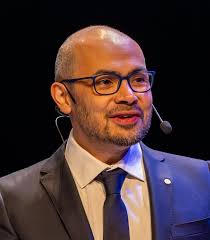
And it's such a pleasure to see everybody here for the conversation with Demis Hassabis. We're especially honored today to have President John Levin leading this fireside chat. One of the things that makes Stanford University so distinctive is that some of the most important ideas emerge not within a single school or discipline, but at the intersections of schools and units. That spirit of cross-university collaboration is particularly important right now as advances in AI begin to reshape nearly every domain of society. And nowhere is this more consequential than in medicine. I feel that personally through the GSB's close partnership with the Stanford School of Medicine, which is undertaking an extraordinary effort to reimagine cancer innovation and care by bringing together social scientists, scientists, clinicians, engineers, and innovators to transform the patient journey from prevention through survivorship. That vision is ambitious and it will require the full capabilities of a great university working together. Stanford's strength lies not just in excellence within fields, but in our ability to connect fields. We bring AI researchers together with physicians, organizational leaders together with scientists, and entrepreneurs together with people deeply committed to human well-being. And that is one reason that today's conversation feels so important.
Demis Hassabis is an artificial intelligence researcher, an entrepreneur, and a Nobel laureate whose work sits exactly at these intersections. He's the co-founder and CEO of Google DeepMind, one of the world's leading AI research companies. This was founded as DeepMind in 2010 and acquired by Google in 2014. And the company is now central to Google's AI efforts and has produced some of the defining breakthroughs in the field. Some of these breakthroughs include AlphaGo, the first program to defeat a world champion at the game of Go, and AlphaFold, which solved the 50-year grand challenge of protein structure prediction by accurately predicting the three-dimensional shapes of proteins. This was a breakthrough with enormous implications for disease understanding and drug discovery. For this work, Demis, alongside John Jumper and David Baker, was awarded the 2024 Nobel Prize in Chemistry. He's also a fellow of the Royal Society and the Royal Academy of Engineering. And in 2024, he was knighted for services to artificial intelligence. He has also been named the Time 100 list of the world's most influential people multiple times, including in 2017 and 2025.
But what makes this moment especially compelling at Stanford is that the conversation around AI here has never been only about capability. It has also been about human flourishing. Several years ago, Professors Fei-Fei Li and Jennifer Aaker began teaching a Stanford course on AI for human flourishing, built around a profound set of questions. What does it mean to be human? What does flourishing look like? And when does technology help advance those goals versus undermine them? One insight from this work has stayed really deeply with me. And that is that some forms of friction are actually load-bearing. The struggle to find the right word, the discomfort of difficult conversations, the challenge of learning something new are not inefficiencies to eliminate. They are instead the very experiences through which growth, agency, resilience, and meaning emerge. And that too is why our discussion today matters so much. At Stanford, advances in AI are not abstract. They are already reshaping how we think about discovery, diagnosis, leadership, learning, and human potential itself. Advances in AI are also forcing us to grapple with larger questions about judgment, ethics, institutions, and what kinds of lives we ultimately want technology to help us build. So, thank you all for being here, and please join me in welcoming President John Levin and Demis Hassabis to the stage.
Demis, it's great to have you here at Stanford.
Fantastic to be here. Thanks everyone for coming.
Really appreciate you doing this. So, we're going to I'm going to ask you some questions. We'll have some questions from students and looking forward to hearing your thoughts. So, maybe we would You've been chronicled a lot recently. A movie, a book. So, many people have heard about your trajectory. It is quite remarkable. Chess prodigy, video game developer, scientist, tech entrepreneur and leader, Nobel laureate. That's just the first half of your career. So, if you were going to try to draw a through line through all those different things that you've done, what would it be?
Well, I think there's several through lines actually with what seems maybe somewhat unconnected subjects. First of all, I've always really enjoyed working at the intersection of creativity and technology and very broadly construed. So, actually the games industry, the video games industry, which is the first my first very early part of my career in the '90s, was one of the most creative spaces in any industry that was using cutting-edge technology with art and design to sort of create an entirely new entertainment medium. So, that was really an amazing time. In fact, some of the most fun times I've had in my career was early in the '90s. The chess and neuroscience I did, all of those things I've tried to I had from this idea of working on AI and AGI being the most important thing one could and most interesting one thing one could spend your career working on also from a very early age. So, as a teenager probably I read too much science fiction, reading things like Gödel, Escher, Bach, these types of books and biographies of some of my scientific heroes, you know, Turing and Feynman and so on. So, all of these were serving to inspire me to try and understand the world around us in a really deep way and then building AI was my expression of that mission to try and build the ultimate tool for science. And I've tried to because life's short, I've tried to reuse and repurpose every experience I've had in service of that bigger North Star mission that I've had for more than 30 years. So, you know, my chess training is the way that I think about business and organizing things and planning and how I think I've been able to break down very ambitious plans into smaller, more manageable steps. That all comes from kind of chess thinking, I would say. And then using games, first of all, building games, learning about engineering projects at scale, running companies, startups, and then fusing this creativity with engineering. Actually, it's what we do today with AI and engineering science. So, you're fusing creative work, scientific work with very hardcore, cutting-edge engineering. So, that all serve together. And then finally, on games, as everyone knows, we used games in the early days of DeepMind as the perfect proving ground for testing out algorithmic ideas. Probably most famously with AlphaGo, which I think, you know, we've just had the 10-year anniversary of and was really, looking back now, maybe the start of the modern AI era.
When you went into AI professionally in 2010 or so, you started DeepMind, you had this very ambitious vision. You were going to solve intelligence and then solve everything else. How's it going? Well, let me expand a little bit. What has gone according to plan and sort of what has been off plan?
Well, the broad arcs of it have gone, I mean, unbelievably well. Perhaps, you know, when we started DeepMind in 2010, that's Can you imagine? We used to go to try to go to VCs in the UK, which there weren't very many, and with that as the business plan. It was literally step one, solve intelligence, step two, use it to solve everything else. And people were quite confused. But, we really meant it. And, actually, we may go back to exactly using that mission statement because so by solving intelligence we meant build AGI ideally also understand the nature of intelligence on the way to building AGI and perhaps using AGI to help us understand our own brains and minds better you know things like the nature of consciousness what is creativity dreaming all of these deep mysteries of the mind and one of the reasons I studied neuroscience was try to learn from what we understood about the brain as inspiration for algorithmic ideas. And sort of so that one was to try and build AGI and then we always had in mind what sort of happened which is that of course it's a general purpose technology maybe the general purpose technology and if it was built in the right way so it was a learning system that was very general what would be the limit of what it could be applied to it's not you know it could be applied to almost anything was the dream and I think that's what's born out I had specifically in mind for that step two advancing science and medicine so that's what I meant by using it to solve everything else I meant the big questions in science all of them I wanted to you know I was fascinated by all of them the nature of time the nature of reality maybe that's the most fundamental one and I love physics when I was at school that was my favorite subject and I think when you are using the big questions you end up doing physics probably but the reason I decided that there were too many interesting big questions. So how is one to you know try and tackle all of that in a lifetime and that meant in my view building new tools and to aid us at the best scientists best experts to make much faster progress in the fields that they were tackling in the big questions and important questions that they were tackling and then of course AI in itself is also a fascinating artifact in itself scientific sort of object one could call worthy of study itself. It's almost a new field. So, this is sort of to me it would felt like the most fascinating and most important thing to spend one's life on and I would have been doing it even if it hadn't worked out, I would have found some way to be doing this, you know, in academia or wherever I would this is what I was always planned to spend my life working on and all those things I did earlier were different expressions gathering the experience and I suppose the knowledge to be able to attempt something like DeepMind in 2010 when we were sort of I felt we felt we were ready to make fast progress. And of course, the second part of that use it solve everything else is now much broader than just science and medicine although that's where I've tried to personally do my work in as well as running the overall organization, but obviously it's going to be amazing for productivity and many other things in the world outside of just science and medicine.
As you've been building these different models at DeepMind you started with games and then you went into science. Have there been were there particular moments where that I mean you started with a lot of conviction, but I'm curious if there were sort of particular moments where you sort of saw this is actually going to work. AlphaGo and playing move through the
Yeah, there were many moments where I thought it wasn't going to work, put it that way. So, what some of the ones I remember really well are we started with games because they're self-contained. They're obviously were designed to be by other humans to be challenging or fun for other humans to play. They're often I love games. They're often microcosms of a lot of real world scenarios. You know, if you think of go or poker or chess. I often thought as you know, an MBA one of the thing courses I'd have in an MBA or business school course would be a games module to, you know, study those types of games, diplomacy. They all have really interesting aspects of the best games of real life and you can obviously practice many times in a kind of safe scenario. That's what I think games are really useful for and that applies to AI systems that are learning, too. They're you know, they're neat environments, they're challenging and they have clear objective functions. Which is also was very important for our early days of reinforcement learning. Almost no one had used reinforcement learning for any kind of scaled up problem. It was just being used, you know, it was very kind of it was obviously an academic discipline but it was used mostly for toy problems like little grid worlds. It wasn't clear it could scale up to anything major. And so we started with I would say the most famous set of but most basic games that had become, you know, well popular which were Atari games. And from the 70s. And we started with the simplest game of all which was Pong. You know, there's the two the bat and the ball, just two bats and a ball. And there's an inbuilt AI system, it's not really an AI system, an inbuilt system that controls your opponent and uses all the information that the game has about where the ball is and so on to move the bat around. And what we wanted to do was could you play Pong just from the pixels on the screen? So the raw data, the raw visual input. And no other information, no privileged information about, you know, access to the insides of the program about, you know, where the ball is or the speed of it and so on which obviously the program knows. But we didn't give the DQN system as it was called, our Atari system, any of that information. It just got the 20,000 pixels on the screen. And 20,000 pixels, I mean, it seems you know, sort of trivial now but back in 2010 that was enormous amount of input data. No one had ever dealt with something that complex and then multiplied by all the frames that you were doing. And for about it felt like 6 months, maybe it was only a 2 months, but we couldn't win a single point at pong, right? So, it was bad you know, it was jerking the bat around. It was like, 'Oh, is it ever going to even be able to like control the bat?' And of course he had no notions of any of these things. He was just losing 21-0 to the in-built AI. And I did think and we had the couple of different ways of trying to attack this and we had almost no money, you know, the runway, you know, the bare the couple of million dollars of funding that we had, which wouldn't even cover an intern these days, was our entire funding and you know, we're paying it we had we were taking like no salary and it was running out the money and I was like, 'Oh, well, maybe it turns out maybe we are still 10 years too early. Maybe we're 20 years too early.' And then magically it got a point and it was like, 'Oh, maybe it was just luck.' And then it started winning a lot of points and then it started winning the games and then it was like, 'Okay, we have lift off now.' So, and those of you working with you will know this. If you get a foothold, you can usually climb your way out of that. That's been the history of AI I would say, right? Once you have something working, there's usually a way of optimizing it more. And that's what turned out with Atari and then so that was our first big result and our first nature paper was the you know, really the first deep reinforcement learning model certainly at scale combining deep learning to learn the domain and deal with the perceptual inputs and the complexity of the inputs find the patterns in it and then reinforcement learning built on top of that to kind of make the decisions and do the planning. And then of course that culminated in AlphaGo, which was the always our aim Dave Silver and I who's head of that project. We were undergrad friends as undergrads at Cambridge and we would just had been discussing it since our undergrad about we you know, we were there in the mid-90s. The Deep Blue Kasparov match happened while we were at college. Of course, I was fascinated about both from the chess and the AI point of view. But, I was more impressed with Kasparov's brain than I was with Deep Blue because Kasparov, you know, with his incredible mind, still one of the biggest chess geniuses there's been of all time, he was able to basically compete on an equal footing with this supercomputer brute force machine next to him. But, of course, he could do all the other things with his mind. Speak five languages, do his politics, drive cars, all the rest of the things humans can do. To me, that was you know, incredible. That's much more impressive. So, there was something missing from the Deep Blue system. And obviously, those techniques, those expert system techniques, where you hand curate the heuristics and then you use brute force search on top, which is still how a lot of traditional chess programs work today, that works for chess, but it's never worked for Go. Because Go is too esoteric a game. It hasn't got material. Every piece is worth the same. It's all about patterns and intuition. Even the top Go players, that's how they play it. So, we realized we sort of thought, okay, if someone could actually get to world champion level of Go, it's not just about really that was that was an aside getting to that level. It was more about the approach he would have taken would probably be a really interesting algorithmic approach. And maybe and hopefully would generalize to other domains. And that's what happened turned out with AlphaGo. So, and then it went beyond our wildest dreams really because not only did it win the match against Lee Sedol in 2016, it also created new famously new strategies that had never been seen before, even though we've played Go. Go is the oldest game humanity has invented, 2,000 years old, 2,000 plus years old, and been played professionally for hundreds of years. And we hadn't discovered those strategies. So, I was sort of that was sort of double whammy for me. I was waiting for that moment that AI was able to come up with something novel. And we you know, it's not there's more levels of creativity than that but beyond that but at least it was a novel idea. And then that was for me was what I was waiting for to then start using AI for science. So, the moment we got back from Seoul, we started the AlphaFold project.
Now, when you So, let's talk about the science a bit because then you went into the protein folding problem. And again, you picked a problem where there was data and where there was a clear objective function and in terms of thinking about protein folding. And it worked. I mean, you actually managed to solve this long-standing problem of predicting protein structure. You did something very interesting when you came up with AlphaFold, which was it was obviously a huge science Nobel-worthy scientific breakthrough. Probably also of commercial value. And you just gave it away for free. I'm curious How did you come to that decision? Did you Was it something Did you think about other ways of going about it? Why give it away?
Yeah, so we picked the protein folding problem. I had my kind of eye on that since also, you know, my undergrad days in Cambridge. That's when I first came across it. I had a few biologist friends who were obsessed with the protein folding problem. And actually they ended up becoming structural biologists, of course, in their career. And one specifically I remember he was you know, every time we were in the pub playing table football or something, he would be talking about obsessively at how this was the most important problem in biology. And more importantly, I think it is a root note problem. Like if you could unlock that and find the structures of proteins, that would unlock whole, you know, new avenues of research. Things like drug discovery, obviously we're trying to push that, but also fundamental biology and disease understanding. So, this was a problem worth really spending a lot of tension and time on because of the downstream effects that it would have. It also felt to me it was a fascinating problem. It felt to me like the ultimate puzzle, you know, 3D puzzle of how does this sort of, you know, amino acid sequence, you can think of it as genetic sequence, fold up into this 3D structure. It's amazingly interesting intricate thing. And the more I looked into proteins, the more incredible my respect and wonder is for biology. Like these unbelievable little bio nano machines, you know, everything on life obviously depends on proteins. And as you start looking at their structure, you start understanding their function. So, this was fascinating to me as a science question. And then yes, there was the clear objective. It's sort of like minimizing the free energy in the system. Presumably, this is how physics is doing it. It's why the body, you know, these proteins fold in milliseconds in your body, you know, billions of times a second. So, somehow physics has solved this. So, it can't be there must be some topology, let's say, that you could learn, maybe with a deep learning system, that would guide the search. Just like we've done with AlphaGo to find a great move in Go, a great strategy out of the, you know, more possibilities than there are atoms in the universe in Go. And protein folds are even larger search space than that. But there's some way to narrow that down in a sensible way. You learn a kind of heuristic using the deep learning models to then guide your search for that to become tractable. And it felt like a really analogous problem in science to what we'd solved in Go. Sort of applying some of those same approaches, those same theories to this domain. And then the other thing was there was obviously 50 years worth of painstaking crystallography, structural biology work by many great labs and people and after all of that effort there was about 150,000 structures in the PDB, the main database, which isn't a lot actually. Obviously it's a huge amount of effort that's gone into that, but there's 200 million proteins and 150,000 also for machine learning systems is a very small amount of data. So most people thought it was at least 10-20 years away before we would have enough data and the right types of algorithm to tackle that. But we felt that using every technique we knew in the end that we could make progress with that and it turned out to be the case and then when we decided to or how would we make the maximum impact with this, it was obvious to me that we should fold all the proteins so that because it not only was AlphaFold accurate, it was extremely fast. It could fold a protein in a matter of seconds and then collaborate with in the end European Bioinformatics Institute in Cambridge to which host many of the biggest databases, biology databases scientists use and just host the entire 200 million protein structures on their database and just allow it to be as simple as a kind of Google search to just find your protein structure along with the confidence intervals the machine learning system had about which parts of the protein structure it was confident on, which is very important for biologists to know. So we put that all together and it was of course could have been very valuable I don't know how many billions of dollars or whatever. I mean it depends how you calculate it to do that experimentally would be incalculable cost, but it would have been hugely valuable to keep proprietary, but for us it felt like we would only be able to scratch the surface of the downstream impact that putting all those structures out in the world could have on our own because you know, there's 3 million researchers around the world that use AlphaFold pretty much every day. Almost every biologist, medical researcher in the world. There's no way one organization could have done that. So, it was obviously the right thing to do. We also had depended on public data to train the first version of AlphaFold, so it only felt right to give back to that community, the structural biology community, this amazing resource that was amplifying the resource they had basically built. And so it was just it wasn't even a question for me. And you know, it was great that also the executives at Google also, you know, love science and totally got that. I don't think all companies would have made that decision. So, I give them a lot of kudos on that, too. That was an easy discussion. And then we've tried to ourselves push that downstream with Isomorphic Labs, an Alphabet spinout that is building, you can think, several more type of AlphaFold level breakthroughs, putting them together in a way that will accelerate, hopefully, drug discovery, you know, take it down from years to months, maybe even one day weeks, just like we did with protein structures, which used to take, you know, years for a single one, and then we could do it in seconds.
I think that's one of the really exciting areas of the future with AI. I want to turn for a minute to something you said earlier this week. You were in the news this week because at a big Google event you said that we're in the foothills of the singularity. Yeah. It got a lot of it got a lot of pick up. I and I understand that maybe the Google press team might not have been so thrilled about it, but since you're out there saying that, what did you mean by that?
Yeah, so the full thing I said that sort of closed the conference was, when we look back at this time, I think that, you know, maybe I'm thinking sort of 10 years from now, I think we will realize that we were standing in the foothills of the singularity now. What I mean by that, and the way I reason I chose that word, is that so there's the technology, which is AGI. We've been calling AGI this next version of really general artificial intelligence. I believe that we're only a few years away from that, maybe like 2030, plus or minus a year, which is astounding to think, really. And then the era I think that will be such an enormous transformative technology, it's going to effectively be a new human era. And that's what I'm meaning by the singularity is that, and what many science fiction writers have written about that, is that it's sort of describing the era that we will be in in and around when AGI the advent of AGI happens. So, and I think we can feel, this year I would say, even though I've been working towards this for 30 years, I think this year, with the way the agents are working and tool use, it's starting to become really useful for, you know, still early days of it, but genuinely useful in people's workflows. And we can sort of see what extra things that need to be done, and all of us the leading labs are working on that. I think this is the beginnings of that, but the foothills. I still think there's a lot more work, and it's just the beginnings, but and it's not any one thing, it's several different technologies, several use cases that I see, several things that I thought were maybe a bit further out turned out to be now that are coming together that make me feel that in aggregate, and to the extent that I wanted to say that. Because I think society needs to hear that, because we don't have long to prepare for what that means. And it's going to be enormously profound, I think. And the future, in my view, still to be written, but these next few years are going to be very critical as to which way that will go, and how we collectively want that to look like.
If you look at surveys of how people perceive AI in this country in particular, it's very negative right now. It's
And maybe more negative here than even in other countries. And there's probably lots of things driving that, concerns about privacy or state control or the size of the tech companies or jobs. How do you, I mean, you're running one of the leading labs, and how do you think about that public concern about the technology?
I think the public's right to be concerned. I think that there are things that, and I'm concerned about several aspects of what the technology is. It's a dual-purpose technology. It's something this profound, you know, I sometimes describe it, quantify it as 10 times the impact the Industrial Revolution was, 10 times faster. And so, you know, instead of taking place over a decade instead of a century. So, that's like a 100x of the Industrial Revolution, and it's probably an underestimate, to be honest, but that's probably enough for us to try and comprehend, right, and deal with. And so, of course, I think there are super exciting. There's going to be amazing things that are going to happen. Like, we're trying to do that with solving all disease. I think, you know, a lot of the other challenges facing society today, from climate and energy to disease, will be helped by AI. I'm sure of it. And in fact, I'd be much more worried about those challenges if I didn't think something like AI was coming down the line.
But it's going to cause a lot of change and disruptions, and actually both on the technical side, economic, and philosophical. And I think we've got to think through very thoughtfully and bring together all parts of society to discuss this, not just the technologists. The technology and the safety of the technology is just one piece of this. It needs economists, social scientists, and humanity experts to kind of chart out what is going to happen next. And I think one of the reasons it's negative here is that, specifically, because it's different in other countries. For example, when I go to, we came back from the summit in India, it's hugely popular with the youth of India because they see the opportunities that it's going to democratize for them, having access to basically the same tools that you would have needed to go to Silicon Valley for. You know, the world, we're in an amazing moment in that everyone can access pretty much what's going on in the frontier labs, but only, you know, with a delay of just a few months, right? That's unheard of really, if you think about that. So, there's incredible things, but I think it's also partly the way some of my peers are articulating the, I think they're being very careful with their communication and understanding. They're being way too certain, I would say, with some of their pronouncements. Where I think actually there's just huge uncertainty, and that is worrying in itself, but it's also means that nothing is decided, in my opinion. I think it's kind of unknown, and I think anyone who says that, I think directionally I could tell you some things, but I think a lot of it really depends on the actions taken in the next few years.
And also what the youth of today, the many students in the room today, you're going to be forming, you're the first generation to kind of grow up AI native, should we say, like I did computer native. And just like every generation, you'll master these technologies, become super productive with them. And I actually think, over the next 10 years at least, hard to predict beyond that, you'll almost be superpowered with those if you use them in the right way. The amount of creativity and projects you can do, and the amount an individual will be able to do. But maybe that will change the nature of jobs, there'll be more entrepreneurial, small entrepreneurial things, rather than big companies. I don't know. It's going to change a lot. But, and I think part of that is for society to come together, really take this exponential seriously, not just the technologists, but economists and others need, we were discussing this last night, need to take this seriously right now, and start charting out what does that look like if we're in a post-scarcity world, for example, how does everyone benefit from that? You know, a lot of it's about how does, you know, it's obviously not correct for just a few people or a few companies or even a few nations to be benefiting from this technology. Needs to be broad, it's going to affect all of humanity. Has to broadly accrue the benefits to everyone. But, how's that going to be done? We really need, we've been, a lot of us have been talking about this for a while, but we really need answers now and concrete things and actions to be taken. And I plan to do my bit on that. I've been thinking a lot about this over the years and planning and building sort of influence on this, and I will do what I can. Obviously, we're an important actor, but we're only one actor in this space. But, I hope, I know that the good news is I know that all of the sort of leading labs and the leaders of those labs, although they disagree on a lot of things, they do worry about what, you know, these sorts of issues coming down the line. But, we need more forums to allow them to, you know, for us to come together to discuss these things more candidly. And I think that's what probably the public is detecting is this sort of slightly skewed discussions about what's going to happen, and maybe there's some ulterior motives behind some of that messaging, you know, raising money, other things. But, I think we need to get to, you know, use the scientific method, be really rigorous and thoughtful about this, you know, critical moment in history.
And then maybe the final thing I would say is I would love to see, I think it's incumbent on the industry and the field to show more unequivocally what the benefits are. And not just talk about them, but demonstrate them. So, in health, in medicine, in science, these things are all in my view are sort of unequivocal goods, right? Like AlphaFold, but there aren't enough examples. There should be 20 AlphaFolds, right? And there should be, you know, we got to like stop talking sort of in the hypothetical about curing cancer and actually cure cancer, right? And so, these are the things that I think are going to be needed to demonstrate to the public, you know, why are those of us who are excited about it, and many of us are in this room, why are we excited about this? Why have we spent our whole life building towards this? And also, how are we going to concretely mitigate the risks while enabling all of the amazing things that we would like to see, and I think society needs.
I think a lot of great points there that if there were some tangible benefits that were realized because of AI breakthroughs, say at a human health or drug discovery, that might change people's, you know, perception in some ways. And I love the suggestion of sort of trying to think further out about a world that might look very different in terms of productivity and so forth. It's hard actually to do that.