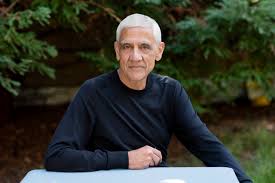
Welcome everyone to the Information TI. My name is Akash Pastrica. It is Monday, September 21st. Today on the show, we have some big developments on the US-China AI dialogue. Our tech and politics reporter Leo Schwarz spoke with US Treasury Secretary Scott Bessent directly about it. We'll have more on that in just a minute. We'll then get to a conversation that I had with Vinod Khosla. I spoke with him about some ideas that he has for tax reform in the AI era. I also asked him for his thoughts on the current AI safety regulation debate that is going on. And to close out the show, I'm bringing on the co-founder and CEO of Clay. The company was recently valued a few weeks ago at $7.1 billion. I'm going to talk to him about the AI safety debate going on as well and how it affects enterprise software. It's going to be a great show. So, let's get right on into it. President Trump is set to meet with China President Xi Jinping this week and talks between top government officials already started over the weekend in New York. The Information's tech and politics reporter Leo Schwarz spoke with US Treasury Secretary Scott Bessent last night. I want to bring on Leo to share more about that conversation. Leo, welcome back to the show. It's great to have you here.
You had a busy weekend, busy Sunday. You were talking with US Treasury Secretary Scott Bessent. What did you ask him and what did he tell you?
Yes. So yesterday Scott Bessent along with the US trade representative Jamieson Greer spoke with a Chinese delegation led by the vice premier on a number of subjects but AI was top of the agenda. Of course the biggest debate in Washington has been about a potential slowdown around AI given the pace of model development. Could there be some sort of accord with China that would be safety focused? I asked Bessent about this and he actually said that it had been discussed that China and the US have talked about creating what's called the China-US AI dialogue which will be essentially a notification mechanism where if there's some sort of incident that rises to the national security level both countries can tip each other off to it and they also said that they would be meeting again on the subject.
Did that surprise you? Has something like this been on the table for a while?
It's surprising to the degree that pretty much every senior Trump official including Trump himself has said we are not slowing down AI. We cannot halt development namely because of this race with China. So the fact that there was anything discussed I think is a bit surprising. At the same time if you actually take what Bessent said at its word this isn't really a slowdown in any sense. It's basically just saying if there are any sort of incidents, we'll let each other know about them. It's really unclear what would happen after that notification. So, is this a slowdown? Probably not, but it does seem like a step in the right direction.
Right. And of course, that would depend on the implementation of this type of... this is an initial discussion. You know, it would very much vary on whether or not the implementation goes and both parties actually have to pick up the phone and make the call in the first place. What about export controls and trade and chips? Did that come up at all?
So, this has been one of the central questions and sticking points between the US and China, namely the export of advanced US chips, Nvidia chips specifically. As our reporting has showed recently from our terrific reporters in China, there has been a push to emphasize domestic chip production and domestic chips. So I did ask whether export controls of US chips were discussed at all and Jamieson Greer, who's the trade representative, said that it was not on the agenda, which again is a bit surprising, although that doesn't mean it won't be discussed at the main summit happening this week.
Yeah, I mean I imagine just given the size of that industry that maybe that's something that it's like we can talk about the AI stuff here. Let's leave the chips and the trade for, you know, the presidents to talk about down the line, maybe.
Yeah, we'll see. I mean, I think that will be a major point of contention moving forward.
So, what about President Trump's social media posts over the weekend? This was another flurry of news. You know he talked about an AI force of some kind. Can you unpack what it is he said, what we know, what we don't know, what your thoughts are on how this would actually be implemented.
Yeah, as you mentioned, it was a busy weekend. I think every weekend is busy now. It already seems like a distant memory, but last Saturday is when Dario Amodei posted his big essay, Pacing the Frontier. So, it seems like Saturday is a day for news. Now, Trump announced this idea of an AI force. I was talking with some sources over the weekend. I do think this took everyone by surprise. So, as you may imagine, it's still a bit half-baked. But what it seems like is there will be some new AI czar. It will be modeled after the Space Force, which was a major initiative under Trump's first term. What remains unclear is how it overlaps with all of the offices already dealing with AI. Of course you have CAISI which is the small center under the commerce department and you have the national cyber director. You have all the intelligence agencies. There are lots of groups already dealing with AI. So what the new remit of this AI force will be remains to be seen but we'll work hard to try to find that out.
Yeah. But I mean let's just talk about this AI czar. I mean, so David Sacks previously occupied the role of crypto and AI czar. Do you have any thoughts on... I mean, look, you can make a prediction right here and right now if you want on who might be a candidate for that, but I mean short of that, what type of person do you think he might be looking for for that role?
Well, there was a good piece in Axios this morning that basically said one of the biggest challenges in appointing a position like this is and especially one that's overseeing a large private sector industry is that you have to make sure that they divest from their holdings or at least don't have conflicts of interest. So what the Axios piece speculated is that maybe it would be a government official who's already essentially gone through that process. So someone like Emil Michael who's currently at the Department of Defense. I don't know maybe Dario Gil at Energy. There's a number of people. Sriram Krishnan of course was David Sacks' number two and recently left the government or maybe David Sacks would come back although I think that seems unlikely.
Yeah. But I mean to your point like this is an imminent issue and so you know it strikes me that they wouldn't want to drag their feet on this is going to take me a month or two or three to divest my holdings and stuff like that. So I think that's a good point. Leo, before we let you go, so I mean we've talked about the US-China policy. We've talked about the US's own view on it. What about that regulatory framework, the voluntary release, the voluntary oversight? We've been waiting for a little more clarity on that. Is there any sign that we're getting clarity on that?
Well, I might actually have a light at the end of the tunnel to share, which is there was a FOIA or Freedom of Information Act lawsuit filed by a nonprofit and there was a court filing last week that showed that they'd reached some sort of agreement with the federal government to release some of the documents from the framework by October 30th. So, we might actually see those forced to be made public. Of course, they could be heavily redacted. It could be limited release of what the documents are, but it seems like we might finally get those to see the light of day.
Great. Well, Leo, I want to thank you for coming on. That is Leo Schwarz, our tech and politics reporter here at the Information. This past Friday, I had the chance to sit down with Vinod Khosla, the founder of Khosla Ventures. Vinod recently wrote an opinion piece for the Information arguing for tax reform in the AI era. We also talked about his view on AI safety regulation, the role of government, and given that he also just bought the Seattle Seahawks. I also asked him for his view on prediction markets. Here is that conversation.
Vinod, welcome back to TI TV. It's great to have you here.
So, Vinod, you wrote this piece, an opinion piece for the Information, and it had a number of interesting tax proposals for the AI era, and there was a lot in there. I mean, you talked about eliminating preferential capital gains. You talked about closing loopholes that benefit the wealthy, stuff like carry forward tax losses, stepped up basis for inheritances. And the idea here is that these collections should then go to the people whose jobs will inevitably be replaced by AI. And one of the forecasts you made is that more than 60% of human labor will be replaced by AI. And it's a thoughtful piece and I encourage everyone to read it. The question that I was left with, Vinod, is to what extent do you think in the current political environment these proposals can actually be implemented?
Well, the first thing I want to say is if we don't move fast forward on AI, we will lose that race to other nations, especially China. Now, one approach to that is protect jobs. And if we protect jobs, AI won't be deployed and we will lose people. The much more important premise I have is we have to protect people not the jobs they have because there's so much fear about AI. To get rid of that fear, we need to make sure that people understand they'll be protected, which is very different than protecting jobs that some of the socialists want to do. So what's the solution? We generate enough money to protect the people as they transition from those jobs to other jobs and we can talk about what those other jobs will be. I think for today's jobs, you know, farm workers, assembly line workers, cubicle workers if I can call them that, maybe two-thirds of them will be replaced by an AI capable of doing their job. I like to say for 80% of the jobs AI will be able to do 80% of each job.
That large a dislocation will have huge economic benefits as economists measure it and a lot of dislocation and fear as individuals and human beings measure it in the US. And so that's what we need to take care of. Then the question is how do we generate enough money to do that because we want to be deficit neutral. We do not want to create more deficits. So the simplest way to do that I think and we can talk about the mechanism by which it might happen is to raise capital gains tax and it's not to raise it unfairly just make capital gains the same as taxes on labor. If I earn an income, it doesn't matter whether it's $75,000 a year, $30,000 a year, or $750,000 a year. I should be taxed the same way as if I generated the same income from capital gains. 40% of capital gains is paid by people making more than 10 million a year.
Then you say what capital gains is doing is redistributing income except it's doing it upwards instead of downwards towards people who need it. So if we just levelize all taxes are the same. Doesn't matter whether your income comes from labor or from investment it's all the same tax rates.
Do you think that the current political environment... I mean you know in the current administration and the midterms will happen, you know whatever happens there do you think that they would be okay with that?
I think politics is stuck. What Trump showed us is with some strong stance running for president you can get enough people mobilized. So I started with the premise what approach would appeal to 75 to 100 million voters. It took 75 million people to elect Trump roughly and so it has to appeal to that many voters. If the pitch is everybody independent of their source of income should pay the same taxes and the rich shouldn't get a tax break by calling it capital gains. It's just a tax break. And there's other tax breaks we can talk about. We generate roughly $300 billion a year that we can distribute to people who are in transition from their job that's displaced by AI to other jobs and we don't have to slow down that transition.
But we can protect the people. Yes. I think a bold presidential candidate say I'm going to take this view that rich people with capital gains shouldn't get a better break on a better tax rate than ordinary people and there will be some exceptions. You can make exceptions for first home primary home sale or farm sales and others there. So there's a few things people that need protecting. So the majority of the people don't pay any capital gains, but the people who make capital gains pay the same rate as normal people do. I think that's very doable as a presidential candidate and I hope in 2028 some presidential candidate adopts that platform.
Can I ask you have you... all these ideas that you laid out? I mean, there are a number of politicians on both sides that have put forth ideas of what taxation in the AI era could look like, and in some cases, it's divided parties, too. Have you presented these ideas to lawmakers behind the scenes? What reactions have they given you about these ideas?
Well, I haven't yet, but I think it's time to do it now. As presidential candidates gear up for 2028.
Who do you want to talk with?
This is an interesting platform because it could appeal to either a moderate Republican or a Democrat, maybe even a socialist Democrat would say instead of saying I'm going to protect workers and stop AI, here's a much better platform because we'll protect the workers, not their jobs. I think this works either on the left or on the right and one geared towards fairness around tax rates. And stop the redistribution of income upwards that's going on. The thing to keep in mind is capitalism is by permission of democracy and democracy could revoke it and there's strong socialist tendencies among the younger folks in this country. We've seen that, seen lots of surveys and reports that say socialism isn't a bad thing. I think this reverses that trend and it gets people behind. Let's have the best AI use, the fastest GDP growth we could possibly imagine and yet protect people in the dislocation that might cause.
Right. Vinod, I want to ask you a slightly different question about another facet of government regulation. So, we have this dialogue about AI safety, which is currently top of mind for everyone. And I want to put aside for a minute the risks that people think AI could pose. You've made very clear through your writing. I mean, it has a lot of promise and I think we can all agree with that as well. My question that I'm more interested to hear from you on is how you think AI should be regulated. Who should do the regulating? What are your thoughts?
Well, before I go there, I want to finish the thought we were talking about, which is we levelize capital gains, get rid of breaks that rich people use like MLPs and stepped forward basis and a bunch of others, and we could generate about $400 billion. At peak unemployment during COVID we were spending about 250 billion a year on unemployment benefits for people. And so we can generate enough money to protect people during this transition. But the other thing I think before we get to your safety risks is we haven't shown people why AI is beneficial. It's trivially inexpensive to make free primary care available to every person in the country, probably for a billion dollars a year or a month or less. Think about it. Free primary care to everybody, which should reduce downstream health care costs, free AI tutors to every child in this country.
And that would reduce education cost. So we can save money by getting the benefits of AI to people in a tangible way where they can see the benefits of AI and we have to do that which has not been done very well. So benefits, safety through a fund and I also talk about how we get to a sovereign fund and token taxes and some other ways. We can have a pretty large corpus of money to help people over the longer term. Getting to the safety issue, I would say the following. Any important technology and AI is a potent technology has good uses and bad uses. That's been true. It was true of nuclear. You can have nuclear bombs and nuclear power plants. Biotechnology. You can have bioweapons or you can have medicines that cure people. What's different about AI is previous technologies like nuclear and biotechnology were verifiable when used. You could verify when a nation like China would use them.
That is not possible in AI. And hence international treaties which naive people propose are just out of the question. You can't trust Putin who's throwing people out of windows or a president who will use the Tiananmen Square people to run over his own people with tanks to abide by any treaty. We know COVID most likely escaped from a lab. I would assign it 90% probability. They were doing research surreptitiously. I think so trust is not possible. So treaties are not possible.
So it sounds like then you think government should be involved.
Well, government should make sure there's enough oversight to ensure safety. That's not saying we should slow down AI development in the West or in the US. China has already declared this AI safety scare is just not a real thing. They've been very derogatory towards the AI safety argument. So they're going to proceed full bore treaty or not. And so we have to do that. But that doesn't mean we can't... we have to ignore safety. I think oversight boards are very very possible. You buy a hair dryer at Amazon. How is safety insured? There's an independent private body called UL and you have the UL stamp on everybody. Now I'm not saying that directly translates into AI or the implications are the same. The implications from AI mishaps are much much larger. But we can have industry bodies and I do like the idea of shared independent organizations people like me have proposed. I think that's the right direction to explore and detail out further.
What do you think of the concerns that these independent bodies, the ones that have been doing some of the investigations and reviews right now. I mean the big concern is are they actually independent? Some of them share the same sources of capital in some cases. Do you think that they are independent enough as is?
Look, there's a lot of people in the AI research area who are passionate about AI safety. Yoshua Bengio comes to mind. He could be making hundreds of millions of dollars. He's working in a nonprofit in Canada to ensure safety. Can we get a dozen people like that monitoring the direction of this oversight board? Absolutely. Jeff Hinton's spoken about it. So there are enough people where they will be independent and they care about the safety element enough and they should be on this board. And monitoring and developing the process. By the way, it's not a one-time process. It's going to be continuous iteration on safety. I think of it as those old comic books, Mad Comics, if you remember spy versus spy.
That's how it's going to be between good AI and bad AI. And there's many strategies. There's oversight of the models before they're released.
And so I just want to make sure I understand your perspective. So with these oversight bodies, so should the government have a role explicit? I mean, you have the independent bodies, but you know, I'm thinking about the way the FDA has to approve prescription drugs, right? Right now it's a voluntary process with the model companies submitting their model for oversight with the government. Do you think there should be an official government review attached to this independent body?
I'm glad you brought up the FDA. There should be consultation, not gating the development of models. That's a very big difference. It's very very clear all companies trying to get drugs or clinical trials or other approved are moving from the US to China. Every startup we have in bio wants to do trials in China, not the US because it's so much faster. So governmental bodies slow things down and we can't let that happen. Not in this area. Look what's far more dangerous than bad AI or AI gone wrong. It's strong AI in the hands of China or North Korea or Putin. That's way more dangerous where it's directed to do harm than AI that might accidentally do harm.
So let me ask you one question though. You know, I was texting with someone about this exact issue and the point that they raised is that well, having the government involved, one argument is that it might slow things down, but the other argument you can make is that the DoD, I mean, you know, we could develop that the government could sort of do its own research the way it has with other technologies. And you know, if the Department of Defense wanted to use its own AI, develop its own AI that is at the cutting edge, it could also do that. You could argue...