Thanks to technology, biology has become the new frontier.
I scratched at the surface when it comes to biology, that I had to do a lot more to change the societal mindset. I knew I was going to be rejected, but I didn't give up because I said, "Okay, I'll keep doing things which will finally work." If your family is not such a great support system, your friends can be a support system. Your colleagues can be a support system. I'm not the kind of leader that believes in commanding and controlling everything. In fact, I'm the kind of leader who wants to put together a great team of people who are smarter than me. I have a working friend whose kids are so proud of their mom. Not one of them feels neglected. But having said that, I would say it's much easier for women today to lead than it was in the past.
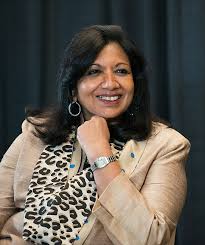
Good evening, everyone, and a very, very early morning for Lakshmi, who is joining us from the US. It's not every day that you get to introduce someone who didn't just build a company but opened an entirely new frontier. Kiran Mazumdar-Shaw's journey is proof that when women lead on their own terms, entire industries can transform. She redefined what was possible in biotechnology, not just for India but for women everywhere who were told that science, scale, and success weren't for them. At Herky, our mission is to get more and more women to step into leadership on their own terms, and this conversation today, in partnership with Inc., is a reflection of that shared belief. We're thrilled to be joined by Lakshmi Praturi, the founder and CEO of Ink Talks, a pioneering platform that brings together global thought leaders and changemakers. Lakshmi is a master storyteller and community builder with decades of experience shaping conversations around leadership, innovation, and impact, and now has also brought about Inkomen to take that transformation to women's doorsteps.
Together, we recently launched a special project spotlighting 49 women from across industries. Why 49? Because women make up 49% of the world's population, and it's time that their stories shape the world that we live in. Kiran, your story of resilience, reinvention, and relentless vision is one that has shaped more than an industry. It has shaped mindsets. It reminds us that success doesn't come from playing by the rules. It comes from knowing when to break them. For those of you who are joining us live, do make it an engaging session. Use the Q&A box throughout the conversation and drop in your questions as they come up, and we'll try to get to as many as we can at the end of the session. Thank you so much for being with us today. We are honored to listen and learn from a trailblazer who never waited for permission and who never stopped paving the way. Lakshmi, on to you.
Thank you. So Kiran, I've known you for a long time, and there are many—if you do the search—there are many, many titles for you, starting with, you know, you're India's first in so many things. You're India's first self-made woman billionaire. You're the first woman to chair the board of governors for IIM. And you are an interesting fact: you speak six languages, from what I understand, and probably, I'm sure, you've added a couple more since it's been written in the wiki about you. And you're an art collector, and you are a philanthropist, and you are the first Indian woman to receive the Othmer Gold Medal in 2014 for outstanding contribution to science and chemistry. Your Padma Shri, Padma Bhushan, etc. And all this started—I really want to start with how this whole career started with a drama. You know, your life is full of drama, and it started with the drama of you wanting to be a medical student. And when that didn't happen, you wanted to be a brewmaster. You went to Australia. You were the only woman in your entire class, graduated top of the class, came to India, and then nobody wants to give you a job as a brewmaster. And then you say, 'Oh, okay, maybe I think I'll do enzymes in another field.' And the thing that I wanted you to address in this whole thing is there is rejection after rejection after rejection for a 20-something, 24 or 25-year-old Indian woman starting something, but you never give up. You're 'if not this, then that; if not that, then something.' You know, but I have covered probably at least a couple of years of anguish and disappointment and upset and anger into like a few sentences. So I want you to start with what is it that gives you this strength to just—what was it like, first of all, to want to do something and not being able to do it, and say, 'Okay, but I'm just going to do this.' I just want to hear your state of mind of that rejection to pushing through.
Thanks, actually. Always nice to see you, though not virtually—I would have preferred this in person.
But let me answer your question in many ways. Okay. First and foremost, I don't think I was angry, if you know what I mean.
I somehow accepted the fact that there was a gender bias, and a serious gender bias, in society. I was trying to change societal mindset. So, you know, as someone who wanted to change societal mindset, I was prepared to accept this rejection, if you know what I mean.
One of the interesting things is that for everyone who has this resilience and courage to fight the system, you need someone to back you, especially from home. Okay.
And my parents, especially my father, was my biggest proponent. Okay. So I knew that, you know, at home I felt so welcome. So everyone was proud of me. So I had that strength and that courage of my conviction. Even when I was being rejected, my father would say, 'They don't know what they're doing. You know, they're missing out on someone like you.' So it kind of gave you that—that rejection was kind of compensated by someone who believed in you, right? So ultimately, I think women have to first believe in themselves. It is very important for their support system to give them that belief. So for me, I think every woman who succeeds—and I've spoken to many successful businesswomen and women leaders—and every one of them says how strong a support their families were. Okay. Every one of them, in fact, had a father figure who was very, very supportive, a family that was very supportive. I haven't heard any woman leader who has succeeded saying, you know, 'My family just rejected me, abandoned me, and threw me out, and I had to fend for myself.' So I think that is very important.
So basically, all of us emanate or come from a family that believes that women can do something, right? I'm sure you also came from that kind of background.
So I did not feel angry. I felt that I had to do a lot more to change the societal mindset. I knew I was going to be rejected, but I didn't give up because I said, 'Okay, I'll keep doing things which will finally work.' When it wasn't working that well in India, I thought maybe I should go out of India because maybe the societal mindset there may not be so bad. And before I could go abroad, of course, I had this opportunity to start my own company. I thought, 'Oh wow, what a wonderful opportunity that is. Maybe I can change the societal mindset by starting my own company.' So that's how I started. But even when I started my own company, I was rejected by bankers. I was rejected by people I wanted to hire. So I had a number of other rejections. Okay. But I didn't give up because I said, 'Look, this is my opportunity to change their mindset. I hope someone somewhere will believe me. I know some banker will believe me. Not all bankers will have this mindset, and I will find those people,' if you know what I mean. So that's the way I actually pursued and persevered and finally made it.
You know, it's so interesting you say this. You know, when I was 21, I finished my MBA and I went for an interview, and they asked me in the final, final interview, 'What is the guarantee you won't get married and leave the job?' And it upset me so much. I was the one who actually got angry, and I said, 'I'm leaving the country,' and I left. But it's interesting how—I mean, I left, but then 15 years ago I came back, and I'm doing whatever I want to do in India. I think whether you're angry or not angry, whether you're upset or not upset, whether you're here or somewhere else, I think the key, what you're saying, is just keep doing something, keep one step forward instead of giving up. You know, I think that's the key. And you know, as you said, even after you started, you've talked in the past about how difficult it was to get employees to join you. And I read somewhere—I don't know if it's true or not—that the first person who joined you was a retired garage mechanic or something like that. And even employing people, getting banks to give money, you know, all these things. It's like just when you think you've gotten over one problem, something else comes. It's sort of like whack-a-mole, you know, you put one thing down and something else comes up. So I was actually curious. You talked about your parents, but was there like a quote or a song, or is there like a quick thing you have in your head that you keep thinking of every time when things don't happen, or is it just, you know, just keep moving forward?
I don't think I have that kind of a little mantra or something. It's just that I keep moving on, you know.
Yeah. It's your attitude. It's that sense of purpose.
You know what I mean? That's what keeps me going. I have this purpose. I want to do things. I want to put India on the map of the world for biotech. I want to pursue, you know, I want to bring the focus and spotlight on STEM education. I want women to pursue, you know, biotech, biology, STEM. I want women to excel in this area. I want young people to excel in this area. I want young entrepreneurs to think about biotech and life sciences because I keep telling them today is the most exciting time. I said, you know, today, thanks to technology, biology has become the new frontier.
We've only scratched at the surface when it comes to biology, and I think today biology is the most powerful quantum computer you can ever think of because—
Our own bodies, right? Understanding our own brain, our own body, is just what's happening.
It's about instant nanocomputational capabilities that your body has, that every living cell has, you know.
Whether it's cell signaling, whether it's chemical signaling, enzymatic signaling, electron impulses—you know, look at the way our body signals and how it computes and how it responds and how it solves, you know, challenges. I mean, it's just mind-boggling to think that we don't even understand it all, and that we're slowly beginning to understand how living systems work, you know.
And I think that's so fascinating. So I think every young person ought to be fascinated with biology. Thanks to technology—without technology, you would not even understand it.
Correct. Thanks to technology, you're able to do so much, you know.
And I want to continue in that train of thought. I mean, first of all, you know, genetics itself is such an exploring field today in terms of just how much more we are able to understand ourselves at the cellular level. And then the whole, you know, whether it's our own skin or brain, we know so little about ourselves, you know. And I think one of the things is with the, you know, great availability of storage that's much cheaper today and computational power, we are getting to know so much more about it. Like, we are almost ready to clone ourselves, and I'm sure in some countries they have cloned people as well. I wanted to talk a little bit to you about what do you think are the—especially when you go into genetics and epigenetics and all these kinds of stuff—what do you think are the sociological, moralistic boundaries we need to draw around ourselves as to how far we need to go? It's the most exciting—you're absolutely right—in science and tech, it's the most exciting time today. So talk a little bit about where do you think we are going and what do we need to watch out for?
First and foremost, it's not just about genetics and genomics. It's about—
So it's about your genome, it's about your microbiome, it's your proteome, it's about your metabolome, it's so many things. Okay. So you can't really segregate genetics because you can't isolate genetics as that is what will allow you to clone something. Genetics changes in many, many ways depending on the environment, the microenvironment which you live in. So I think we should not look at genetics in the way you are prescribing. Right. Secondly, I also believe that today you have the power of correcting faulty genes. I think that is so important. But you know, many people are born with rare diseases, genetic diseases, and today, thanks to CRISPR technologies and gene therapies, you can correct those differences or those deficiencies, which I think is very powerful in terms of what you can do in terms of reversing very debilitating diseases. Many of these diseases actually cut short life. By basically changing the genetics of a person, you can extend life. So I think there are marvelous things about genetics.
But you know, I don't know why people keep on focusing on cloning because I think you must understand that every technology can be put to good use and bad use.
And let me tell you, cloning is very important when you want to, you know, breed or cultivate something of high productivity. Say, for instance, you want to clone a rice clone because it's a very high-yielding rice. Why don't you think there's something wrong with that? Right? Why does it always have to come to human beings? No. Humans will actually use their moral conscience to decide what should be done and what shouldn't be done. But like I said, if a human baby is born with genetic deficiencies, why wouldn't you use genetics to correct it, right? And if you want to ensure that a child is not born with genetic deficiencies, and if you can do it while the child is a fetus, you will do it in future. So I think the way I look at this whole area is about how do you use technology. Gene editing is a very powerful tool, a very good technology. How do you want to use it? So I think human beings have gone through big technological revolutions with both a plus and a minus. I mean, look at nuclear energy itself. You can either make a bomb or you can produce energy, right? It can light up a whole country, right? With the least impact on the environment. And at the same time, you can set off a nuclear bomb and it can just be devastating and kill everyone. So it depends on how you use technology.
I don't think we should have this discussion about how we should look at genetics in that way. I think you need to look at genetics in a very positive way. What is the good that can come out of genomics, genetics, and gene editing and gene cloning and what have you. And not focus on the bad aspects of what bad people would do or bad actors. No.
I think it's what you're saying in terms of everything starting with the knife to internet to genetics, you know, all these things, you can use it in a positive way and you can use it in a negative way. And what I meant to say, and I think it's important, is that it's not just science, you know, there is a sociological, there's a humanistic, there is a great social good that could come out. I mean, when you talk about the right type of solve the world hunger, you know, it's just there are so many implications.
Everything has these various aspects to one sector, whether it's biotech, whether it's any—I mean, today social media is supposed to have the worst impact on society.
It's allowing us to do this.
So I think you need to look at every technology which will have all these ramifications and pluses and minuses, and what is the, you know, greater good that it does society. That's what you should.
Correct. And you know, continuing on that, because this is one of the areas that's really great for future jobs and expanding. So as we're talking to a lot of professionals about what are some of the areas we should, you know, train ourselves in, etc., I'd love for you to talk a little bit about what are the different aspects of biotech. It's not—I mean, one is through an engineer or a doctor or whatever, but there are many areas that are coming up now where things are happening. So from your point of view, what are some of the new things you're looking at? You invest in new companies as well, and your own company's expanding into different areas. Tell us a little bit about where are we going and what are you excited about in that?
I think biotech is the most exciting field as I can see it because today when you combine AI technology and biotech, it is just amazing.
Now what I look at is what are the various emerging areas. So obviously one of them is, of course, synthetic biology. Now synthetic biology today is the most sustainable solution that you can provide to many aspects. You know, for example, we know that there are many products like, you know, starting with proteins that can be fermented. Okay. Or natural colors and natural flavors that can be fermented. So you don't really destroy biodiversity for that. Right.
Then you got—and there are many other uses of synthetic biology in many, many applications. But synthetic biology to me is a very powerful new area. We haven't done much with it in terms of what the potential is. Then you have what is called personalized medicine, precision diagnostics, you got robotic surgeries, you've got, you know, drug delivery devices. You got so much happening in all these fields, right? That's in healthcare. Then you got agri-biotech where again there's so much happening in agri-biotech. There is so much happening in enzyme technologies. You're actually replacing all chemical processes with biotransformation, and that itself is a big positive impact on the environment. You know, there is in every realm of biotech, from agri-tech to industrial biotech to now even if you look at biofuels, okay. And biofuels, what we should understand is that what we're looking at with biofuels right now is unsustainable because you're trying to create biofuels from biomass that's produced on land. Okay. There are companies today who are actually trying to produce the same biomass through ocean farming because 70% of the planet is oceans.
And that's a much more sustainable solution to biofuels than what we're doing today. So that's happening. So I think there's so much happening. Even I feel, you know, energy storage of renewable energy, especially solar energy, the answer is going to come from biotech and biology because photosynthesis is one great form of storing solar energy which has worked out. We need to elevate that. Can we decipher that? Can we create energy storage based on photosynthesis? So there's so much happening in biotech that I just feel it's the most exciting time for young entrepreneurs to just let their imagination run wild and to really look at what all biology has done to solve so many problems and how we borrow from that. I mean, we hear very often that, you know, spider silk has been used to make parachutes or fabric.