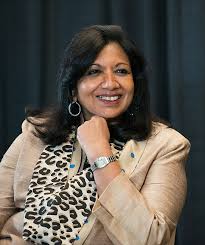
Despite the fact that I was competent, that I was qualified, I just couldn't get a job. So, banks didn't want to lend to me. People didn't want to work for me because I was a woman employer and I didn't have money or capital. There will be someone who believes your story. Don't give up. Keep talking about your story, about what you're trying to do, and someone will listen to you. Someone will believe that story and someone will invest in you. When you solve for problems, your science becomes very powerful. When you look for a problem to solve after you're trying to develop a product, it becomes very difficult. I am not one of those people who will give up or slow down because I'm driven by this sense of purpose and I know I have a finite amount of time and I want to make use of every minute I can to do whatever I can to bring about this mission that I'm on.
Kiran, I'm really so grateful that you said yes and you agreed to do this.
No, but you know, my quest is that when someone has achieved as much as you have, but also the impact it has created, we have to capture the sort of gems of that and see if that can create the next wave, you know. And that's really the question. So if I were to think of one word how I think of you, I think of you as a changemaker and a force of nature. You know, be that as an entrepreneur or a business leader, but more importantly as an enabler for many other women, community builder, philanthropist. So there is just so many facets to you, and some of us may succeed in one aspect, but might not necessarily, you know, build out so many other aspects of who we could be as a human being beyond one label, right? So for me, if I think of you, I think of you as a changemaker. But in the context of your own journey and the many things you have done, how do you describe yourself, Kiran?
I think of myself as someone who wants to certainly impact and bring about change, and so to that extent, I am a changemaker. I'm driven by change and I want to change the world. I want to change the world through my efforts in the way I conduct my business. You know, my whole mission has been about providing essential medicines and life-saving medicines through affordable access. So my whole focus on research has been how do I deliver affordability through all that I research.
The second thing I also want to do is I believe very intensely in science. How do I use science to the best ability I can to do better things, to develop new medicines, to develop new technologies? So I'm driven by that kind of sense of change that I can bring about.
I also like to describe myself as somebody who's deeply driven by purpose. And I think when you're deeply driven by purpose, you find the energy to go on. A lot of people ask me, "How come you're not, you know, slowing down? How come you're not giving up?" I said, you know, I'm not one of those people who will give up or slow down because I'm driven by this sense of purpose, and I know I have a finite amount of time, and I want to make use of every minute I can to do whatever I can to bring about this mission that I'm on, you know. And that's what actually I think gives me that energy. If you don't have purpose, if you don't have a mission to pursue, then you can sort of, you know, lay back and slow down and disengage. My late mother was like me. She was driven by a strong sense of purpose, and she died with her boots on, you know, that kind of thing.
Yeah. Yeah, I think one thing among talking to so many people over my lifetime, I think there is always a strong mother or a grandmother somewhere on whose legacy and on whose footsteps I think we take it to another level. So I feel the same way about my mother.
You started this in late '70s when no one had heard the word entrepreneur, startup. I mean, today all that is very common, but we have to go back to that time where honestly no one could have thought that starting to where we are sitting today was possible at all. So where did that conviction to do this in India come from? That it's not a conventional retail kind of a business, this is a high-tech biotech business when the industry globally only was nascent. So what was the making of that young Kiran who said, "I'm going to do this"?
First and foremost, it was a very rebellious time for me because, you know, I had been rejected by the brewing fraternity in India because I had come back as a qualified brewmaster, as India's first woman qualified brewmaster, and I was so ready to pursue this profession. And I just thought that, you know, I wouldn't have a problem getting a job. And I was so wrong because nobody would have me. They kept telling me that, you know, they respected my credentials, but unfortunately, industry was not ready to accept women in brewing. So despite the fact that I was competent, that I was qualified, I just couldn't get a job.
And so when I got this opportunity to start a business or a company, I did it with a sense of rebellion, and that's why I call myself an accidental entrepreneur, because I never planned to be an entrepreneur. And once I started on this journey, I realized that it was a very unconventional journey, because nobody had heard of biotechnology. Nobody thought that it was possible to create a business based on biotechnology. And I call myself the first tech startup in India because I literally was a garage startup and at a time when nobody could even understand what a tech startup was. And I had zero credibility and I had a very high risk profile, because, you know, I was a young woman, 25 years of age, a scientist—and in those days scientists never became entrepreneurs—
Or business leaders. Forget business leaders; I was just a small entrepreneur. Nobody understood what biotechnology was. I had no business experience and I had no money.
So those were the days when you needed collateral, you needed business experience, and you needed to be a gray-haired person to run a successful business because most businesses were started by people who had worked in industry and who basically became entrepreneurs in ancillary industries. You know, so if you worked in a big company, you could actually set up a small ancillary business which could support that big business. That's how entrepreneurship was in those days. And here was I trying to set up this company which was quite daunting in many, many ways to many, many people.
So banks didn't want to lend to me. People didn't want to work for me because I was a woman employer. And I didn't have money, no capital or serious capital, to really build this business. So when I look back on those days, yes, I think it was very brave of me to take on this big, challenging task. But nevertheless, I think because I was in that rebellious mood where I wanted to prove myself, I wanted to prove to those who felt I couldn't be employed that I could actually run a very, very successful business. So when you have that kind of foolish courage, no, I think a lot of things come out of you. And, yes, it was the height of the License Raj, and like I explained, when I actually built this facility that we are sitting in, it was at the height of the Asian Games project where cement was in scarce supply, steel was in scarce supply, and I had to really fight for my quota to get this built. So I know what I went through, but in reflection, I think that's what makes you strong. That's what makes you very resilient, and that's what makes you a very confident entrepreneur when you actually do it.
Gosh, if only we could bottle up that rebelliousness and somehow then, you know, we'll have an easy way. But it's not like that, right? So we have to do the next best, which is, you know, whenever someone has an unconventional journey and are going in uncharted waters, so to speak, I think there is something that is very core to their value system, to their principles, to their perspective that allows them to make that journey, which is why not everybody can do that. But perhaps if we can capture what that was for you, maybe some of us could follow.
Yeah, so you know, Vani, that's a very important question, especially for me to answer. I was very science-driven, so I realized that India had a lot of scientific talent, but there was a huge amount of brain drain, and I felt that we were not leveraging science enough, and I felt that biotech was an area where we could really put that science to action. And that's what was my first driving sense of purpose, saying, how do we put science to action? And you know, my late father had told me that brewing is the oldest biotechnology known to man, because it's about fermentation science. It's about harnessing microbes, you know, to make beer, yeast, things like that. So I realized that biotech is a fascinating science where you're harnessing living systems to produce important products.
In my case, it happened to be enzymes because I couldn't get a job as a brewer. And I was sort of consoling myself by saying at least I'm close to my vocation, which is biotech, which is fermentation science, which is microbial technologies. So with that, I started developing enzymes. And these enzymes, of course, were industrial enzymes, but they were produced from fungi, bacteria, and recombinant technologies, which was something which was new at that time. Recombinant technology was in its nascency, and I started Biocon in 1978 and Genentech had only started a few years earlier.
Yeah, in San Francisco. So I think it was a very opportune time for me to say, "Hey, at least I've started at a time when I'm not a laggard, and I should therefore use these technologies to put India right on par with what's happening in other parts of the world." So those were some of my thinking, saying, how do I create a biotech company out of India? How do I create a science-led company, a research-led company, and really put India right up there on the map of the world because we are not really far behind? That was my thinking.
And I started with enzymes, which was a very exciting area to operate in. In fact, enzymes are now becoming very exciting today. But those days it was about replacing chemical technologies with enzyme technologies, and to me that was quite exciting, to think that chemical technologies were so polluting, so energy inefficient, and you could actually replace them with eco-friendly, energy-efficient technologies that were enzyme-based.
And so when I started Biocon, I started putting together a small research group that was really looking at developing new enzymes and new enzyme technologies. And we were doing this in a very frugal way because we were so under-resourced. And, of course, the first thing was I had to convince banks to lend to me. And banks didn't want to lend to me because they said, "You have no collateral, you have no business experience, and you're trying to start a company based on biotechnology, which is a new area which we don't understand. It's very high risk." So I never gave up. I kept talking to bankers over and over again. And one message I want to give to young entrepreneurs is there will be someone who believes your story. Don't give up. Keep talking about your story, about what you're trying to do, and someone will listen to you. Someone will believe that story and someone will invest in you.
That was my experience of starting Biocon, because one brave banker believed in me and gave me a credit line. And then a few years later, another brave banker, Mr. Vaghul, took a bet on me and helped me to scale up. And that all was a result of being very true to your conviction, very passionate about what you were trying to do, and having the confidence to pursue that passion. That is entrepreneurship—that you believe in what you're doing, and you believe that this can be a very good business, and be persistent with it.
So Kiran, we really need to double click, because you know, you make everything sound easy. Okay? But very, very few leaders have that youngness to be thinking ahead. "I'll embrace AI," you know, "I saw opportunity for statins," or this or that, or whatever. You make all that sound so easy, but what is it? If we can think of two or three things, is it that you read a lot? Or is it that you are always pushed by a purpose? You're restless. There has to be things that define you, why you have this energy to keep doing this, to keep reinventing, to keep doing this. And we need a thousand more entrepreneurs for India to reach this 30 trillion economy in the next 20 years that we are all charting out for. So maybe 10,000, but we don't have 100. So what is it?
No, Vani, I think all of us are eternal learners. I'm sure you're an eternal learner. I want to learn new things. I don't want to stay static at any point in time because the world is evolving so fast. If you don't read, if you don't keep abreast with what's happening in terms of new technologies and new opportunities, you're not an entrepreneur. I think every entrepreneur has to constantly look for new opportunities, learn new things, understand what's happening in their sector, and try and see whether there's something in it for them.
So I've always tried to keep abreast with technology. I've always tried to look for new opportunities, because I'm restless in that sense, because I know that if we get too complacent about a set of things that are working right now, I know that that will not remain forever. So it's like a treadmill. You cannot keep running and keep static. It's like my late husband John used to say, don't confuse movement for progress. It's about really progressing in the right direction with the right perspective. So you've got to move ahead. You've got to try and be ahead of the curve, or at least along the curve.
But I think most entrepreneurs do try to reinvent themselves. But if it's an entrepreneur who just wants to build and exit, it's not going to happen. If you're an entrepreneur who wants to build an enduring company, like I was and I am, you have to think on your feet. You have to keep reinventing. You have to look for those new opportunities. If I just want to exit, it's very easy for me to do that. But that is not a true entrepreneur. You know, I really feel that building a company, building an enduring company is what we need to do in this country. Otherwise you'll never build scale. You will always build very innovative companies, but you will never build scale, and when you don't build scale, you cannot be powerful.
So if you look at the difference between a number of US companies and Indian companies, US companies have always focused on building scale. That's why you have these mega companies. Google could have exited at any time.
Apple could have exited at any time, but they built scale. Okay, I believe very much in building scale. A lot of startups, even in the US and other places, there are two models. One is where you build and exit, okay, and build the next company and exit. So that's one model. The other model is building scale, building enduring companies, and I belong to that latter category.
So I think in India, because of the size at which we operate, we must build scale, and India has that big opportunity to build economies of scale. So for me, that whole concept of affordable innovation because of the scale at which we operate is a very exciting thought. Similarly, everything is about population scale. You know that in digital technologies, our greatest strength is population scale digital technologies, population scale digital urban infrastructure. That's what has made us noticed by the world, right? So if we don't scale because of the population scale that we have, then we're missing a large opportunity. So anything we do, I don't care whether it's service-led or product-led, we must focus on that scale of operation.
The one comment that I keep hearing is, do we really have the talent in India for science? Where are the PhDs? Where are the AI architects or robotics experts, or whatever the segment that you take, right? Yet you built at a time and continue to build talent depth into the firm, whether the talent is coming ready-packaged out of the university or not, because India and talent gets a bad backseat in the context of frontier technologies, whether it's quantum, whether it's anything else, doesn't matter. How should we think about talent specifically, this kind of deep science talent, for India to build the future?
So, you know, this is a very interesting question you're asking me, and this is the same question I asked Sundar Pichai at the recent AI summit. I said, "Sundar, tell me honestly, what do you think of the talent available in India for AI?" And he said something very interesting. He said, "You know, the PhDs that we hire in our company in India are excellent. They are really, really good talent. They're rich talent. They are talent that we can really leverage in a very, very significant manner. The rest of the talent, I would say, is obviously very ordinary talent. But the good news is that they're all hungry to learn. So what we find is that this talent, once you skill them and once you basically put them into a certain training program, they learn very fast." That's the real opportunity India has, because you can train this talent very fast. So it takes companies who know how to train talent to get the benefit of these basic talent.
I think we found the same when you look at Biocon. You know, we are a large biotech company today by any means, and when you look at our research centers, we have really, really world-class expertise when it comes to senior leadership, and these are all PhDs from not just Indian universities, but overseas universities, who have also helped to build all these technologies and capabilities. And then we have the rest of the R&D ecosystem where we have scientists and people at that level who are basically people out of colleges, right? So that's your general talent, but we're able to train them to a very, very high level of skills.
So I think if companies are willing to invest in skill development, they learn very fast, and most of this talent can become world-class in no time. But you have to give that time to train these talent. And it happens all over the world. I mean, if you look at China, China just hasn't arrived; it has invested in developing that talent. India needs to invest in developing that talent. And that's why I think the new education policy, which is project-led, which is driven by other learning models which are really experimental models, questioning models, I think that's going to make a difference. So I think we really need to double down on the way we train our talent.
You know, that's what is going to be important. But having said that, the research talent that we have in this country is very good, but we need to give them opportunities, see? And that's happening a little more and more. And I think industry unfortunately is not investing enough in research.
Exactly. And companies like ours who are investing in research do find that talent, but a lot of big pharma Indian companies are not investing enough in research, and they have deep pockets. They should be investing in research, but it's a bit of a sort of a catch-22 for them, because if they start investing in research, it starts reflecting on their P&L, and then they feel, why do that when we are getting such a—we have such a nice profit engine that's serving well for us, why should we disrupt that? So there's a little bit of that catch-22 which needs to be broken. And I don't know when it'll happen, but I know that Indian companies are very capable of good research.
So right now I'm relying on the startups to do that, and there are a large number of startups who are investing in research, but unfortunately we don't have enough patient capital. So they are stunted, they are frustrated, they go out of the country. How do we really create the US-like ecosystem? How do we create Y Combinators? How do we get the VC funding in place for such companies?
You know, whether it's personalized medicine, genomics, biologics, I mean, today it feels like everything is radically changing as far as technology goes in every aspect. We talked a little bit in AI, and I was recently at one of our space companies in an observatory they had built, and I was blown away. So it feels like around us, the cyber-physical, somehow there seems to be a momentum and a big shift, right? Not an incremental innovation. So what are two or three things that you are very excited about looking into the future?
So I really think personalized medicine is very, very exciting. I think CRISPR technologies and gene technologies are very exciting. I think reprogramming cells and cell technologies are very interesting. I also believe that medical devices are very, very interesting, because I was talking to a friend of mine in the US who has developed an AI-based stent, which is a very interesting concept. It's about trying to zap any cancer cell in your body, because she says—
But the stent goes into your heart?
Not into your heart, onto one of your arteries in your arm.
Okay. And basically it's a very interesting device which basically can distinguish between a normal cell and a cancer cell because a cancer cell is a big cell, and it zaps it. So can you do that and just constantly be rid of cancer cells? Because your body is always producing cancer cells, but your T cells are making sure that they are killed. But if it escapes, then that's what leads to cancer. So she's trying to say, can we zap out every cancer cell so that it doesn't lead to cancer at all? I mean, these are exciting ideas.
So I get very excited because I invest a lot in startups, both in India and overseas. So in India, of course, I invested in Immuneel, which is a CAR-T therapy and cell therapy company, and I've been encouraging them to develop a very innovative pipeline, which they have. So I'm very excited with what they are doing. But equally, I invest a lot in various startups abroad which are exciting like what I just described, or which are doing some very innovative science. So I keep myself very excited and engaged with all that's happening in the world, and I think that's the way I like to see myself understanding new technologies.
In India, one of the questions that keeps coming back, and I'm sure this was very relevant to your industry also, is regulation. Today, going into the new economies and stepping into the new world, almost like a new industrial renaissance, if you will, what should be the role of regulation and policy? How should we think about this?
You know, that is fundamental to innovation. Now, if you're innovating at a rapid pace and regulations are not keeping pace, then you miss the boat. That's exactly what's happening in our industry. Regulations are still in a time warp. They're not keeping pace with what we're doing to advance science, to advance drug development, to advance new molecules. Now, if you don't have regulations that keep pace with innovation, you cannot succeed as a nation.
What China has done is getting the whole world to sit up and notice. China has completely revamped their regulatory process, and you can take an idea from the lab to the market in the shortest possible timeline. We need to emulate that. And it's not just China, it's Australia. Australia is doing the same. And now the US has woken up to the fact that they're lagging behind and they're trying to catch up. But why can't India catch up?
And when you talk to regulators in India saying, "Why can't we emulate China?" they say, "Oh no, we cannot put our patients to such risk. Oh, we have a large population, we cannot take—you know, we are a democratic country, we cannot be putting our patients and people to risk." I think that's a very hollow argument because today's science is strong enough not to put people at risk. So I think regulators have to understand that we are devaluing our own country by not really reforming our regulations to keep pace with innovation. And otherwise, you'll drive businesses out of India because nobody wants to do things in India. You know, it is still not easy to run businesses in India. So ease of doing business, the regulations, all this have to really change. So to me, it's a very, very important part of India's economic growth.
You know, it almost feels like déjà vu, because today again we are talking about deep tech, sovereign tech, and is India behind? Can we catch up as a third pole globally? But all of these science-led companies require capital, long-term patient capital. They require deep talent. They also require access to markets, right? So you were just advising entrepreneurs, and we have a next generation of entrepreneurs who need to put India on the map again on science and technology, right? Of these three or four things that are essential, what is most critical, and what is your advice to entrepreneurs on how to find a balance to solve for it?
So you know, Vani, first and foremost, I think when you talk about any entrepreneurial venture which is based on science and technology, your understanding of science and technology must be very, very deep or very strong. The idea that you're trying to take to the market must be clearly understood by the entrepreneur, and investing in that idea is extremely important. Because the problem with most businesses is they try to solve a problem which—or they basically develop a product and then try to solve a problem.
What you need to do is to look at a problem and solve for it using science and technology. So just to repeat myself, most entrepreneurs go for the technology and then try to find a problem to solve. But my rationale has always been look for a problem to solve and then find the science and technology to solve it. So that gives you a mission, a purpose to do that. This way, if you're going to build a technology and then find a problem to solve, it is always very difficult. Very few people are lucky.
So when you say today, yes, everybody is excited with AI, everybody's excited with digital technologies, but they're all diving into it without understanding what is this problem they're trying to solve. You know, yesterday I had a young entrepreneur who was trying to sell a healthcare AI startup concept to me, and I pushed back to this young entrepreneur and I said, "What are you trying to solve?" Even though the presentation had that this is the problem and this is what we're trying to solve, I said, "Is that really a problem you're trying to solve? Where did you create that problem? Did you create an AI model and now you're assuming that that's the problem you're solving? Whereas if you ask industry, is that a problem worth solving and are they willing to really give you lots of money to solve that problem, the answer will probably be no."
So don't look at it as a technology that is now trying to look for a problem to solve. Rather, like in our case, when we developed enzymes, we actually went for industries where they had problems and we solved those problems using enzyme technologies. Similarly, when I developed insulin, I solved a problem for India, because India was the diabetes capital of the world. We were importing all our insulins, and 90% of those insulins were animal insulins, and only 10% were recombinant human insulin because we couldn't afford it. Only the affluent patients could afford recombinant human insulin. So I solved for that problem saying, how do we make affordable insulin using our own technological capabilities? So that gave me a very, very good purpose, because I was going to solve for a very important problem for India, and that became a big success story for us, which has become an even bigger success story for us today, because insulin is a very important life-saving medicine. And today, because GLP-1s have become so important, insulin companies are vacating the insulin space and we are the only company that can fill that void. So you see, when you solve for problems, your science becomes very powerful. When you look for a problem to solve after you're trying to develop a product, it becomes very difficult.
We just want some questions that we can get to know you a little bit as a person. Yeah. So what's a recent movie that really captured your mind or heart?