Let's get started. I'm Susan Hockfield, the Whitehead professor of neuroscience. By training, I'm a neuroscientist. And I'm the former president of MIT. And as president, I was the first biologist to serve as president. And also the first woman to serve as MIT's president. And I'm particularly proud that MIT's current president, Sally Kornbluth, is the second biologist and the second woman to serve in that role. So I guess I didn't mess things up for my successors.
So I want to add my welcome to all of you to MIT's Future Fest, which we view as a celebration of the possibilities of the future. I'm going to introduce Kiran Mazumdar-Shaw in a minute. But I just want to say that this Future Fest is a new idea. And it's opened the doors of many of our campus buildings and laboratories to outsiders. And there's a great buzz on campus about it. And we're delighted to be part of the celebration.
So over the last several decades, the new understandings that scientists have revealed of biological pathways have transformed the pharmaceutical industry. And it's transformed the pharmaceutical industry in a very interesting way. It used to be a chemicals-based enterprise, but no longer. So it now has incorporated biological substances into entirely new modes of disease intervention. And I think as we think about what's rapidly changing at this moment in time, what we imagine to be a pharmaceutical is changing very, very rapidly in a very interesting way.
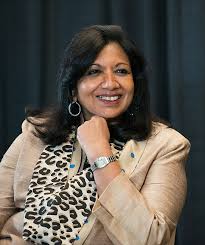
So today, for that reason, and a number of others, we have the enormous privilege of hosting one of the early and most successful bio-entrepreneurs, my friend and colleague Kiran Mazumdar-Shaw, who's the founder and chair of Biocon. Biocon is an innovation-led global biopharmaceutical company that is not just treating new diseases but driving down the cost of essential biologic therapies, ensuring affordable access for patients in 120 countries worldwide.
From Biocon's launch in 1978, Kiran has built Biocon from a garage startup, literally, into a $7 billion global pharmaceutical enterprise that's making a lasting impact on health care in 120 countries around the world. Under Kiran's leadership, Biocon has changed the lives of literally millions of people living with diabetes by providing access to affordable insulin. Since 2004, Biocon has provided 9.2 billion, billion doses of insulin.
Biocon has also provided access to affordable biosimilars for millions of people who are battling cancer and rheumatoid arthritis and other debilitating diseases. The company introduced the first biosimilar version of trastuzumab that treats an aggressive form of breast cancer. And Kiran has been a game changer in addressing health care needs affordably.
Now, Kiran and I are going to start this afternoon with a short conversation between the two of us. And then we'll open the microphones for your questions. So please be ready with your questions for Kiran. I hope that she stimulates your curiosity as much as she has stimulated mine over the many years that we've known one another. So Kiran, let's get started. So you have been at the forefront of the truly amazing bio revolution in pharmaceuticals. But you came to biopharma through an unusual path. What brought you into the world of gene engineering and organism modification for human use? Why don't you give us a peek into how, I like to think about this, Kiran the brewer became Kiran the gene engineer and lifesaver?
So thanks, Susan. It's great being here and I'm so glad to be part of the Future Fest, MIT Future Fest. Which, as you know, we were all so excited to develop as a concept. So you're right. I started my journey as a brewmaster. And you asked me why did I even think about it. It was a daft idea in retrospect. Because I remember graduating from university and wanted to do something in applied bioscience, biotech. I was very fascinated with biotech. And my late father, who was a brewmaster himself, said, why don't you do brewing? And I thought to myself, brewing? I said, is that the right career for a woman? And he said, why not? Why are you bringing gender into it? Do you know brewing is the oldest biotechnology known to man. And he said, it's about fermentation science. It's about the molecules bouncing off each other. I mean, it's fascinating. So I said, why not.
And if I think about my life, I've had a fairly unconventional life right from the very start. And so you use the word maverick. I guess that's what's maverick about me, that I keep challenging the status quo. I keep doing things in a very unconventional way. And so brewing was very unconventional for a young woman growing up in India that was so conservative about how women should be brought up. So I went to Australia. Graduated as a brewmaster. Came back to India thinking, I'm going to be lapped up because I'm so competent, I'm so confident, and I've learned so much. But then I was in for a rude shock because, just as I feared, every brewery told me this is not a job for a woman. And I think that's what actually then got me to think about, OK, what can I do with this knowledge.
Fortunately, I sort of accidentally ran into a biotech entrepreneur from Ireland who asked me to partner with him to set up Biocon in India. And interestingly, I started with enzyme technologies. And enzymes were something I was very familiar with because the whole brewing process is enzymatic if you think about it. And so I thought, OK, it's still connected with what I've learned. And therefore it made a lot of sense. And I think, again, I was looking at a very different way of processing products. And I said, chemical pollution was not being discussed at all. So all these polluting chemical technologies, everyone was using that technology. And I thought to myself, well, you know, using biocatalysis, using enzymes is a much greener approach. Makes sense. Let me try it out. And that's how I started my journey of setting up a biotech company.
So the early years were really spent on developing these enzymes from fungi, bacteria, and yeast. And in the process, I got very fascinated with, of course, genetic engineering. And I chanced upon a yeast technology that was based on genetic recombinant DNA. Pichia pastoris was the organism, the yeast. And I said, let's make enzymes from this. So we started making enzymes from Pichia pastoris using recombinant DNA technology. And then there came a point in time when I said, why am I only making enzymes? I mean, by which time I think the world had started moving towards biologics because the early 2000s—I mean, the 1990s was when we started seeing a move towards biologics and antibodies. And I said, why not look at that as a way of moving forward.
And I decided to leverage this yeast technology into making insulin. And why insulin? Because India was at the epicenter of diabetes. We were importing all our insulin. And only 10% of the patients could afford recombinant human insulin. The rest had to use animal insulin. And I thought that was so unethical. I said, why is this so? So my whole mission started in terms of how do I make sure that life-saving medicines and essential medicines should be accessible to every patient who needs it around the world. And that's how I started my journey of developing innovative technologies that could deliver affordable medicines. That was the way I started. And insulin was my starting point.
So I, of course, started developing recombinant human insulin. And in 2004 I was able to get it launched—or approved in India. And of course, I really disrupted the price point because I brought it crashing down to a tenth of what it was being priced at. And I also forced the innovators down because they also were forced to drop their pricing. So I think that has been my strategy, saying, why is it so expensive? Why can't we make it cheaper? I mean, today I'm even involved with a CAR-T therapy company where I'm trying to disrupt that space. And we've managed to offer CAR-T therapies in India for around $50,000.
So that's the way I've looked at innovation. How do we deliver affordability through very innovative technologies? And of course, recombinant DNA technologies are very powerful. And now add AI to that and I think it will be even more powerful.
Fantastic. So from your perspective, Kiran, as among the earliest and the most successful bio-entrepreneurs, what were your biggest challenges as you launched your company? What were the impediments?
A lot. I mean, when I started my company, no one understood what biotech was all about. It wasn't in the vocabulary of Indian industry. And of course, I was 25 years old. I had no business background. I had no money to offer as collateral security. There was no question of venture funding in India in those days. And I was high risk in every way. Banks were very, very reluctant to even lend me money, let alone invest in me, because there was no such concept. So I just found it very difficult initially to start my company because people just felt that they didn't understand what I was doing.
And I was a woman, of course.
So there was a huge gender bias for sure.
But I think—I always tell young people, don't give up because someone, somewhere will listen to you, believe you, and help you. And that's what happened to me. One brave banker believed in me and decided to extend credit. A few brave people decided they should work with me. Some of the young engineers and scientists thought this was quite cool and decided to join me. So slowly but surely, I kind of developed the company and built the company.
And I think it was—I mean, when I look back on those days, it was very exciting discovering new things. Building things with your bare hands. Doing things which had never been attempted before and succeeding. I think that was what made it very exciting. Today, of course, we are at a very different scale than when I started in my garage. And today we have almost 15,000 plus people in the organization worldwide. And of course, we are the third largest producer of insulins in the world. And of course, we have very large manufacturing and R&D capabilities. So I think when I look back at my almost five-decade journey, I think it's been very exciting, very challenging, but very rewarding.
Great story. It's exciting. It gives me chills. So maybe in the audience we may have some prospective company founders. And what I would ask you now is if you were advising those founders today, what do you consider the key elements to getting a successful company off the ground?
So the first thing is, obviously, you have to be very passionate about your concept, your idea. It has to be rooted—I mean, in biotech, it has to be rooted in good science. And I think you have to make sure that your first few steps that you're taking in that proof of concept are really telling you something very important. Don't try and fabricate the truth because you want to hear it a certain way. So I think that's very important. I think science leads that decision.
Secondly, it's not an easy path. So you've just got to keep building on that idea that you have. And I think endurance is very important. Stick to it. If you really believe that this is going to work, then there will be a lot of setbacks. And I know in my case, I remember developing a very proprietary technology, and we had developed a very successful pilot-scale technology for making a certain type of enzyme. And we just thought it would scale up very easily and it didn't. And we were so challenged when it didn't scale up because we had made mistakes. We had sort of miscalculated some of the anthropic factors of the fermentation. We had not realized that there were aspects of fermentation that we had not looked into in terms of the scale-up aspects. And that set us back by almost six months.
But then we put our engineering caps on. We put our biotech caps on and said, no, it's got to work. And it did work. So I think young entrepreneurs must realize that as long as the science is strong and you can solve and crack that problem, don't get disheartened or feel that your technology is not working. Because I think the essence of that is that if you believe that you're doing the right thing, you will. It's about problem solving at the end of it.
And all biotech engineers are problem solvers.
Amazing story. So there is, I would say, a parallelism that Biocon's evolution mirrors the rise of India as an economy focused on science, technology, and healthcare innovation. An innovation-based economy. What does it take for emerging ecosystems to compete on a world stage? And what lessons from your journey might be relevant for the next generation of entrepreneurs and scientists? I mean, you turned the nation around, not just the industry. So I want to put it in context with my own experience.
Please. So when I pivoted from enzymes to biopharma, the reason I did that is because I realized that the Indian pharma industry was all about chemically synthesized small molecules. And they got very good at it. So you had a large number of pharma companies in India all developing generic medicines because they had got so good at understanding how to re-engineer chemically synthesized small molecules. And I realized that nobody was actually looking at biologics because protein therapeutics were completely different. How do you use recombinant DNA technologies to produce proteins? That was way beyond the understanding of most people in the pharma world in India. So I decided, hey, that's a good opportunity for me because it differentiates me. And it also allows me to do something important for India and put India on the biotech map of the world.
So what I did then was to, as I said, leverage some of these enzyme technology platforms to move from enzymes to biopharma. And insulin was the first. Then, of course, I decided I had to develop antibodies. And that became another big mission for us. But I think what really drove me was, Susan, the fact that most of these biologics were way beyond the reach of the average patient in India.
By cost. And that became a big, big challenge for me. I said, I've got to disrupt this space. And that was my driving purpose and my mission. And it still is because I feel that these are life-saving, essential medicines. If patients who need them can't access it, then what good is that innovation? And that's what kind of keeps me going. And that's what I did. And whether it was antibodies, whether it was insulin, I keep making sure that the innovation that drives what I'm trying to do is to deliver affordability and access.
That's wonderful. That gives me chills.
And contrary to what people think. They often ask me, they say, oh, so if you're doing that, is it a not-for-profit organization? And I say, certainly not. I said you can choose one model which is high value, low volume, which only is able to be accessed by a handful of people. Or you do it the other way around. Economies of scale, high volume, low value. And that's what I have chosen, saying if I build economies of scale, I build affordability.
Great insight. So through your wonderfully generous philanthropic support of institutions such as the University of Glasgow, Memorial Sloan Kettering, and our own MIT Koch Institute for Integrative Cancer Research, you've invested not just in healthcare but in the advancement of science itself. And what motivates your commitment to supporting scientific research? And how do you see that research accelerating breakthroughs that can benefit humanity?
So first and foremost, I've always believed that India as a country has a huge talent pool of scientists and engineers. And I believe that advanced scientific research is where we need to go. So there's no point just having a large population of good—just base-level scientists and engineers. You've got to focus them on cutting-edge research. And not enough of that was being done in India. Now I think things are improving. But for a long time, most students who were curious about science would go out of India. And the first thing I wanted to do was I wanted my own company, Biocon, to be a very exciting ecosystem for pursuing high-end research.
But then I said, I've got to also create a very strong network of academic research where I can help these students to pursue areas which they otherwise find it difficult to do so. So I instituted a large number of these fellowship programs. And I'm very happy that many of these students who I supported from India have done very well either in the US or even come back to India and set up their own labs in some of the important academic research institutes in India. And of course, Glasgow University was because of my late husband, John, whom you knew very well. And the Advanced Research Center in Glasgow is now thriving with over almost close to 1,000 scientists and engineers in a very multidisciplinary way. And it's very exciting that every time I go there, I see a lot happening. And I see a lot of, again, Indian students being able to go there and take advantage of all that's happening.
How wonderful to catalyze that kind of activity.
And of course, Koch Institute was my first philanthropic initiative in advanced research, which has always made me very happy.
So I'm going to ask one more question. And then we're going to turn it to all of you who will drive the conversation through the remainder of our time. So think about your questions for Kiran. I only have another 45 or 405. I think you'll appreciate through this conversation that Kiran and I have been talking together for many years. And she has been a real inspiration to me. So through your—you just touched on this. I want to double down on that so it doesn't pass unhighlighted. So through your generous philanthropic support of institutions like the University of Glasgow because of John, Memorial Sloan Kettering, and the Koch Institute for Integrative Cancer Research here at MIT, you've invested not just in health but also in the advancement of science itself. It's one of these marvelous relationships where in developing new drugs, we invent new science. And how do you see that research, the research that goes into the biopharmaceutical work, accelerating the breakthroughs that can benefit humanity in medicines but also beyond?
Right now, Susan, I'm very interested in the convergence of technologies. I think we all talk about AI and digital technologies and quantum biology and computational biology and bioinformatics and all the rest of it. I think this is a very exciting time where we are seeing the convergence of technology. And I myself am an avid learner. I love to learn new things. And I want to see how we can basically look at the future of medicine in a very different way. Because today we know that a large part of the cost of developing new drugs or new medicines or new diagnostics is really about the regulatory process that takes forever. I mean, you—even to take a concept of a molecule from the lab to the clinic is a long path. Can we compress all of that? Can we basically understand these molecules better? Can we understand through AI what the target effect of a molecule could be? And can you design those molecules better to prevent those side effects or off-target effects? So I think there's a lot now going for these technologies.
So I think every company today is looking at how do we use new technologies to make things smarter, to make things more predictable, to make things more precise. And ultimately to shorten the whole journey of taking a molecule to the market. Once you do that, I also believe it will also give you a much more affordable drug. And it gets to the patient much faster because otherwise today patients have to wait forever to get access to that drug. So I just—I'm very excited with these new technologies. And I think we all need to work together to see how we basically take advantage of this convergence of technologies that's happening. So I know that at least at our company, I'm trying to really set up this strong focus on using—we, of course, have two types of use—I mean, focus on AI. One is the enterprise, which is all that happens with the operational efficiency stuff. But the other is also about AI for science, which I think is very exciting.
I agree. And I think it's just in its—shall we say, the pre-walking stiffness. So listen, let's open to questions. I hope there are mics. And so if you want to ask a question, just come up to—we have two mics. One on either side. And Kiran would love to answer your questions. If you don't come to the mic, we can't hear you and it won't be recorded. So please do use the mics. Go ahead. And tell us who you are.
Hi, [INAUDIBLE]. Yeah. Kiran, it was fun to hear the origin story of Biocon. I know that one of your innovations has been how you structured your businesses. And I thought it would be fun to hear—for the crowd to hear about the back of the napkin and the birth of Syngene because that's one of my favorites.
Thanks for asking me that question. She's asking me about how I started a research services company called Syngene in 1993. It was very interesting because it started as a dinner-table conversation in a restaurant in Bangalore in India where we were talking about the success of the software services companies in India. And I said, isn't it cool that they're offering these services as a 24-by-7 service offering? And they're basically the back office of all these companies like the financial—the banking sector and many, many other companies, enterprise software, and things. And I just suddenly during the discussion, I just said to a bunch of people, I said, what do you think about a research services company that does the same for pharmaceutical companies? What if we give you a 24-by-7 lab offering, which allows you to do a lot more for a lot less? And maybe it can advance your research a lot faster. And they loved it. They said, yeah, why not? So I said, OK, now put your money where your mouth is. So I took out a napkin and I said, why don't each one of you say I owe you $5,000? And so there were about five of them. And each one said, we'll give you $5,000. And that's how I started the company.
Hi. So my question is, more focused on my research. I would actually like to know your thoughts on with this growing interest in precision medicine and how as a company, are you focusing on that? Or is it something that interests you? More like patient stratification or more sex-driven intervention in medicine.
So let me answer your question in two ways. One is, of course, we are a company that essentially focuses on biosimilars. So biosimilars really is just—it's not a cut and paste, but it is really focusing on affordable biologics. But let me share with you what we did with one of the bispecific antibodies that we developed. Which we then, to your point of precision and personalized medicine, we said, OK, let's stratify it. And we did it as an HPV-negative drug for head and neck cancer. And we set up a company in Boston called Baykara Therapeutics. And that antibody is today now in phase III trials. My niece runs the company. And it's, of course, now a listed company in the US on NASDAQ. It's done very well. But the whole effort of conceptualizing the molecule and developing the molecule. And then, of course, the molecule was taken to large scale and then entered the clinic in the US. But that was actually a molecule where we wanted to stratify it and not just make it available to all comers. But we said, some patients are going to be really the big beneficiaries. And we discovered that it was HPV-negative, e.g., head and neck cancer patients. So I am very keen on stratification of patients.
The other thing is that, as I mentioned, we've started a CAR-T company. And there, of course, there's a lot of the personalized medicine aspect. But we are also looking at allogeneic CAR-Ts. So that's going to be quite interesting for us to get it into the clinic.