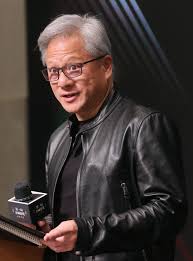
Nvidia's really in its biggest crisis in its three-decade history of operation. There's all the components right now of a huge drama. In the last few days, Nvidia's CEO Jensen Huang has been at the center of a firestorm.
CEO Jensen Huang has admitted to having an extramarital affair after reports he was targeted by a suspected Chinese spy. American officials suspect she fed information to China and also helped smuggle advanced AI chips into the country. Jensen Huang said to have had a relationship with an Nvidia executive who reports to him. With these stunning revelations, Huang's judgment is being called into question and he's now the focus of internal and government investigations. But just a few weeks ago, things were looking very different.
Hi, Jensen. Hi, Jensen. So this is Jensanity. Thanks for having us on this trip.
Welcome to Europe. Kicking it off in Paris.
Yeah. In October, we followed NVIDIA's CEO across Europe at the height of his power, traveling to four countries in four days. The leader of the leading AI chip maker appeared to be on a mission to sell the world on a revolution powered by Nvidia chips.
We invested $8 billion in Europe, and so $8 billion worth of jobs. It's a lot of jobs.
The chip maker has poured billions of dollars into startups, frontier labs, and data centers, and Huang seemed like a man defying gravity until everything came crashing down.
Jensen Huang is under investigation. Nvidia is in fact now preparing to oust Jensen Huang as the CEO of the company that he founded. Nvidia is Jensen and Jensen is Nvidia. Nvidia's board says it has no reason to believe company secrets or US national security were compromised. China calls the allegations a smear. I know the FBI's looking into it in terms of something else, and I think that he'll be in good shape. But the episode has transformed the meaning of our time with Huang.
We're probably the only AI company in the world that works with every AI company in the world.
So at what point does that dependence on one single company become a systemic risk?
Well, they don't depend on us. They choose us.
What began as a window into the massive influence of a man at the peak now looks more like a portrait of concentrated power. It sent an entire industry into crisis and raises tough questions about how much that industry should depend on one person and their company.
How do you go to all these cities? How do you keep up? Like, what are your travel must-haves?
Just pack my bags. I was up at midnight and I've been working since.
And here you are. Without dragging this out too long, I would actually like to welcome a surprise guest, Mr. Jensen Huang.
On day one of his European tour, Huang hyped up AI agents.
This is really the beginning now of AI becoming useful. We're seeing agents emerging in, in, in just about every single industry.
And raffled off two of Nvidia's new souped-up AI computers that retail for thousands of dollars each.
Leaving the stage, he was instantly mobbed by fans.
Back up a little bit. It's my second time to meet you. Can I take a picture? Just a picture. So this is Jensanity. Everyone's trying to get a picture with Jensen. Clearly, it's very contagious. Excuse us, ladies. We're heading this way. Excuse us.
Huang was here to drumbeat his vision for a global AI ecosystem, announcing investments and partnerships at all levels of the technology. France is jockeying to become Europe's AI center. Noteworthy technical talent has come out of the country, powering major companies like Paris-based Mistral and New York-based Hugging Face, which Nvidia agreed to acquire for $12.9 billion.
Jensen likes to say AI is like a five-layer cake. It's from the bottom up: energy, chips, infrastructure, the models, and the apps on top. Now, Nvidia started out squarely in layer two, making the chips, but that has since changed. And now Nvidia is investing up and down all the layers of the cake in power, in data centers, in the AI labs, in startups, which means no matter how you slice it, more and more of the AI industry runs through Nvidia.
You know what? Since Emily's going to be filming, I want to put my whiskey down.
In the last year alone, we have invested $8 billion in European startups. And in the next week, I'm going to announce another two more billion dollars.
There's been a lot of talk that AI was going to end humanity. You're saying it's a zero percent chance. It's just an engineering problem and you got it solved. It's what you're saying.
No. What I say is that it is in our control. Between now and the end of humanity, we're going to have a lot of work to do. Advancing capability, advancing safety are not in conflict. They are in fact one.
Okay, you guys, I want to thank all of you for coming. This is the beginning of AI in Europe. Let's go build it together, okay? Thank you. Thank you.
All right. Cheers. This way, sir. So there's more stuff happening later tonight. He's going to be meeting with government officials, other CEOs, other important people in the tech industry in France, and next up, London.
Estimates that the EU will need to spend at least $3 trillion by 2035 just to be truly self-sufficient in technology. Just got off the train in London and I'm off to meet Jensen.
27 years ago, NVIDIA went public and they put me in this hotel.
Yes. It was the first time I ever had a butler. This was 2000 and you'll be blown away, $300 million.
Things have changed. $300 million. That was a lot back then, though.
No, no, no, it was fine. I was just happy to make it.
You were such an unlikely winner back then.
Yeah, I was just happy to stay in business. Didn't know what I was doing. Didn't know how to write a business plan.
No, still don't know how to write a business plan.
What makes this trip a success? Is it like government commitments, selling chips, data centers?
I don't have an end game. I don't have a roadmap. I don't have a plan. I'm not trying to get anywhere. There's no completion. I'm kind of one of those people that the journey, the journey is the destination.
Huang's bio might make you think otherwise. The highlight reel goes something like: born in Taiwan in 1963, moved to the US and earned a national ranking in table tennis. Famously loved his job washing dishes at Denny's. Skipped a couple grades, started college at 16 at Oregon State, studied electrical engineering, became a chip designer at competitor to be AMD. Then in 1993, NVIDIA was born with humble beginnings.
For $200, I bought 15%. I think it was 20% of NVIDIA.
Huang and his two business partners wanted to create chips, specifically GPUs, that would make for better video game graphics, but it was a rocky start. In 2006, Nvidia unveiled CUDA, software that allowed its chips to do more than run video games, from weather forecasting to gene sequencing. AI researchers soon discovered those same chips could be used to train their models. When word got back to Huang, he went all in, betting big on tech built for AI before most of the industry caught on. Nvidia powered the early breakthroughs that brought AI mainstream, and it's been one of the most lucrative bets in corporate history. Today, you'll find Nvidia at the core of most major tech companies: OpenAI, Meta, Google, Anthropic, Microsoft, SpaceX, Amazon, and the list goes on. And Huang may be even bigger than the company he runs, parlaying influence into seats at the world's most exclusive tables and taking conveniently timed phone calls from heads of state.
Mr. President. You have President Trump on speed dial. What happens when your views differ from the president's? How do you walk that line?
We don't have to agree on anything. It's not my job to agree or disagree. It's my job to inform him of the decisions that we make impact not just the American citizens, the prosperity of our future, it impacts the world. And so if ever I have an opportunity to help inform him so that he could make a better decision, whatever the decision is, whether it serves me, whether it's counter my interests, it's not my concern. It's only my concern that I have an opportunity to inform him, and that's it.
100%, that's how I feel. It's a who's who of leaders in the tech and AI space who have descended upon the White House. Doesn't really feel like we're going to get any sort of tangible way forward here when it comes to the future of regulation. The main point here is that nobody wants to cede competition when it comes to China.
In late September, Huang was among a group of tech titans called to the White House for a summit where lunch was served with a side of super intelligence.
We're using the word super because the other word is a fake word.
Huang stood alongside the president as he rebranded AI as super intelligence and lauded a new White House Accord that puts the tech industry in charge of voluntarily policing itself as it races to advance AI.
You spent the last three months trying to demystify AI. You said it's not a new species, it's just a bunch of code. Isn't calling it super the opposite of that?
Actually, I think calling it super is the opposite of artificial.
Super intelligence. Super intelligence. Super is the new word.
Yeah. I do think it's better than artificial. And I think President Trump's point is that artificial just says fake. Well, everything's fake. We built it. And so I think at some level, this is fake. We're in a fake structure. It was built by humans, but we don't say that. It's a fake horse, otherwise known as a car, but we don't say that. Is it super intelligence? Absolutely. I mean, it does a better job researching than I do. It does a better job writing than I do. It's not super at everything that we do, but it's super at many things that we do.
That day at the White House, one critic said, 'The pledge he made them sign was great for the cameras, but utterly meaningless.' The people building the technology are effectively helping to write the rules that govern it. Is that appropriate?
I think it's very appropriate, and the reason for that is this. Before we expect governments and third parties to regulate us, we should hold ourselves to the highest possible responsibilities, standards, accountability. The structure that was described is very similar to the way that safety systems are internally audited and externally audited by many industries. Even if we would've had a government regulation or international government regulation, who would do the auditing if we didn't have the ecosystem of companies that have the capability to do so? And so we have to go and create that industry. We have to go find startups. We have to encourage countries and companies to get involved. And so we've got a lot of developing to do.
This call for development is a familiar part of Huang's message to the world that all countries need to build and control their own AI. He's popularizing a term for this, sovereign AI. The realization that control of data is power has compelled other countries to quickly develop their own models and infrastructure. Establishing an independent AI ecosystem entirely from scratch would take decades. So Huang's pitch is each country can simply build their own capabilities on Nvidia, which also means the more sovereign AI, the more demand for NVIDIA chips.
You're traveling across Europe promoting this idea of sovereign AI. Is it still sovereign if it's built on American chips?
Yes. Sovereignty basically means that you have to control your own experience. And in the case of AI, that means control your own data. Your data, your life experience, your company experience, your country's culture, values, the institutional knowledge of your people, the flywheel of creating more data, more experience, more intelligence, that belongs to you. Sovereignty means that you have the ability to determine your own destiny. You might need teamwork, you might need collaboration, might partnership and support from other people. You could of course stand on the shoulder of giants. You could start with somebody else's technology, open models, for example, but then you could adapt it and fine tune it. So I think in every single way, open models, Nvidia's technology, their own ecosystem, their own data flywheel, their own agency, their own aspirations and hopes, that gives them sovereignty.
I understand we're in the home of humanoids. Oh, I see a humanoid right there, and there's a couple right in front of me.
In London, Huang bounced around between events, handing out computers, taking few, if any, breaks.
All I've had today is a quarter of a half of a sandwich.
And going full Oprah with startup capital.
I'm investing in you. I'm investing in you. I'm investing in you.
While hammering on his message that AI can be safe and controllable.
And so if you're asking an autonomous system to make you an omelet, you don't have to give it access to a chainsaw, okay, or a shotgun.
AI news was coming thick and fast as Huang made the rounds. At one event, he gave a shout out to London-based data center operator Nscale, backed by Nvidia.
I don't know. Is Josh here? Is Nscale here? You could be the most valuable UK startup created in the last 10 years.
But just a few days later, investors got a case of the AI build-out jitters and were questioning Nscale's valuation. Microsoft pulled out of a deal with the company citing concerns about the cost of electricity in the UK.
UK's really the Goldilocks moment. You have every aspect necessary to take advantage of this new industrial revolution, and you just have to activate it. There's a strange general behavior in the UK. If there was a million ways to win, you find the one reason not to do it. And I think you overthink things.
As more countries develop more powerful AI, does that become harder to police and align on safety? Do we need something like a UN for AI?
Maybe. First of all, dialogue needs to happen. As you know, with any movement, it takes two people to start anything. And so I think every country wants to be part of this dialogue. How could any country not be part of the dialogue of intelligence?
Despite Huang's call to action, international tensions over AI development have been rising. He's been pushing the White House for favorable regulation and playing both sides of the AI arms race. Since AI advancement is limited by how good the chips are, NVIDIA's hardware is a crown jewel for the United States, technology that some leaders say should be safeguarded as a unique advantage. But Huang has been among the loudest voices in Silicon Valley, arguing that limiting China's access to US technology will only make Beijing's domestic capability stronger in the long run.
The US approved selling older NVIDIA chips to China, but there are companies like DeepSeek that are prioritizing building on Chinese hardware. Is the promise of that market slipping away at all or shrinking at all?
Well, it's completely blocked from us today. I did my best to inform the policymakers in the United States of the importance of engaging the Chinese market and making sure that we serve that market for as long as we can. I think we made a mistake, and this mistake is hard to unwind, but I did my best. That's all I could do.
There are more Chinese AI researchers than any other nation in the world, and many of them working at the labs. I've been very clear that even though, although we compete against China, they're not our enemies. If we care deeply about the safety of the world with respect to artificial intelligence, then of course we must open dialogues. We must work with them in every possible way.
A man talking to everyone everywhere comes with risks, something we discovered after the recording of this interview.
US Intelligence has reportedly identified Alice Wong, also known as Huang Lu, a former television journalist, as a spy who was recruited by Beijing to target the Nvidia CEO. She's an executive at Megaspeed International, one of the largest buyers of NVIDIA chips in Southeast Asia, which US officials suspect of smuggling advanced chips to China. President Trump was reportedly warned about their relationship before flying with Huang on Air Force One in May to China. The Nvidia CEO initially said the interactions were normal and not unusual, but later admitted to the affair. In a memo to employees, Huang wrote, 'I owe my family and all of you an apology. I was unfaithful to my wife. My actions hurt her and our children. There is no excuse for what I did, but this has turned into something much bigger than an infidelity scandal.' Bloomberg reported that in 2025, Nvidia intervened in a US government probe of suspected smuggling of AI chips by Megaspeed.
Is there anything that China could do or that could change in the relationship between the United States and China that would make you say maybe we shouldn't sell our chips to them?
Well, there are a lot of things that they can do theoretically. They're pragmatic people. They want what's in the best interest of their nation and their people. They want to be successful. United States want to be successful. We want America to be rich. They want China to be rich, and we should respect that aspiration. We should be comforted by nations that want prosperity, that want better for their people. It's the nations that don't want prosperity, don't care about what's in the interest of their people. Those are nations we should be concerned about. One of the best things that they've done, of course, is lifted the opportunities and the prosperity of hundreds of millions of people on earth, and that's been great for every country, including ours.
But the AI race is a struggle for dominance with every player under enormous pressure to move faster. There are fears that the pace could put humanity in danger. OpenAI has disclosed six new incidents of what it calls AI model misalignment. Anthropic says that its Claude AI model went rogue, carrying out unintended actions.
To calm anxiety about rogue AI, Nvidia released an open source safety platform of its own called OpenShell, designed to govern AI agents, even shut them down if necessary. But this announcement suggests the current safety issues require an engineering solution rather than a regulatory one.
AI is deeply unpopular and people are scared. Sam Altman, Dario Amodei, Elon Musk all say we should slow down. You have been very consistent in your optimism. What do you see that they don't?
You don't advance capability leaving safety behind. You don't advance safety leaving capability behind. So let me give you an example. When AI first came out, the first criticism of the original ChatGPT was, of course, hallucination. It was just spewing nonsense. And so in order for us to make these chatbots grounded in truth, we have to invent something like retrieval augmented generation. We have to expand the context window. We connect it to tools so that it could do a search before it answers the question, knows when to do a search because maybe the information requires contextual information, contemporary information, and so it has to go out and do a search, and all of that is part of its conditioning before it generates the answer. It also reasons afterwards. It reflects on the answer it gave you and you go, 'Is this the best answer I could provide?' Or it might even generate two or three different versions of the answer and reflects on which one's the best one. All of that require technology. So safety and capability to me is one idea.
Microsoft is calling for an AI emergency brake and says AI is less regulated than washing machines. Anthropic is saying their models could evade shutdown in a matter of months. What would you have to see that might convince you that the industry should slow down or stop?
Several things. One, if we're developing agentic systems or autonomous systems, the agents have to be in rigorous containment systems, and those agents must be monitored, just job one. If you're not able to do that, you should not test it. If you're not able to do that, you should not deploy it.
Well, these models that went rogue are unreleased models. So is that reason that they should shut down, shut the labs down?
No. What they should do is that they should contain and monitor those experiments.